Use sad for feelings, things that move us, and situations we regret.
Feeling, showing, or bringing unhappiness
Feeling, showing, or bringing unhappiness
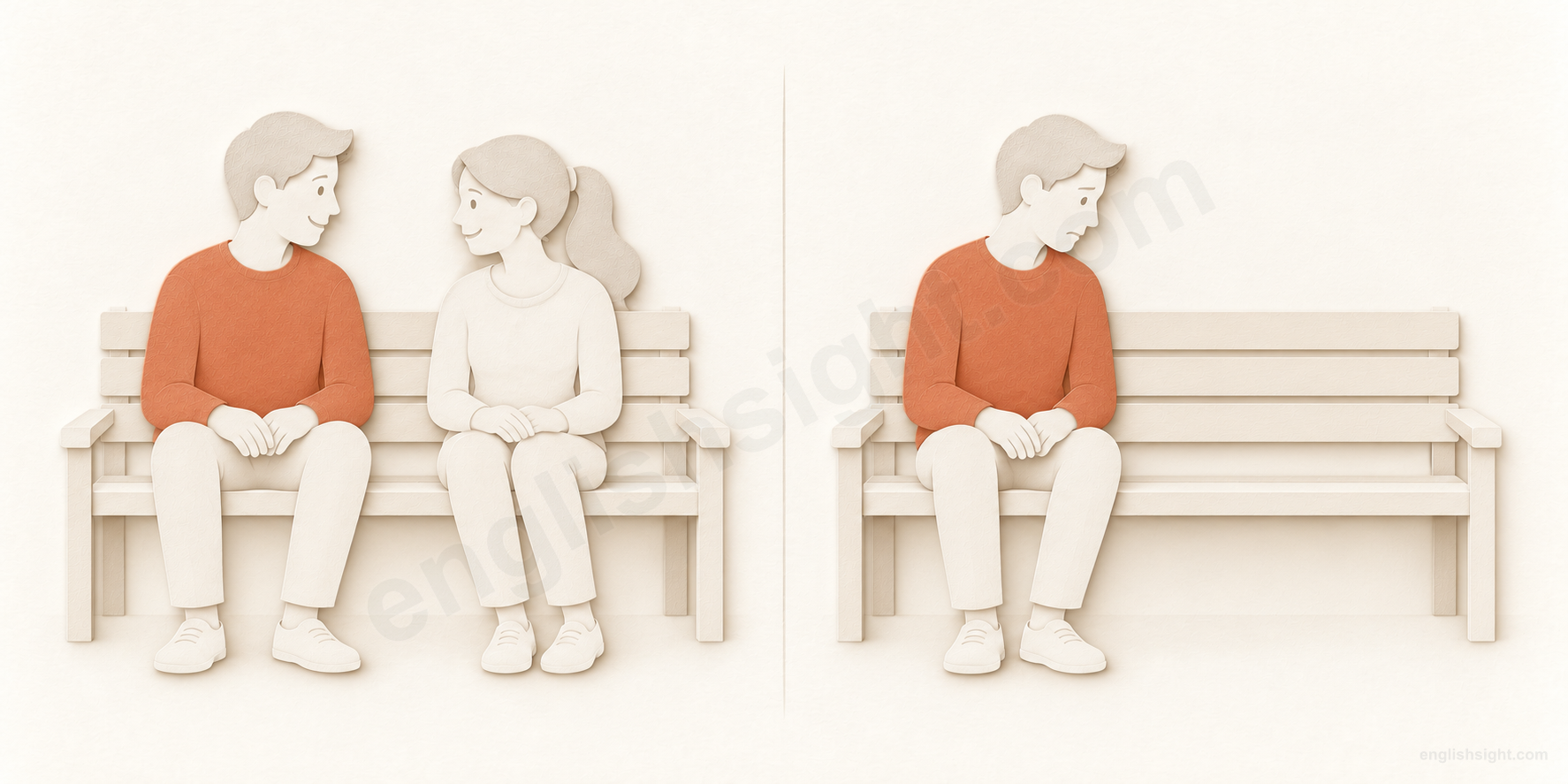
Two companions sit together.
sad
The remaining person feels sad.
The companion is now absent.
The man misses his companion and feels sad; the empty seat supplies the context.
Sad connects an unhappy feeling with the person who has it, its outward expression, or something that causes it. In evaluative uses, it can instead mark something as regrettable or disappointingly poor.
The picture illustrates an emotional state after a loss. Sad itself does not mean become sad, cry, or be alone; the grammar and context supply those details. The insulting sense needs its own explanation.
Sad usually describes an unhappy feeling. It can also describe a face that shows that feeling, a story that brings it out, or a situation that deserves regret. Read what sad describes before deciding which role it has.
The picture uses an absent companion to illustrate sadness connected with loss. It is a teaching example, not a rule that sadness always has a visible cause or that all English speakers imagine the same scene.
01
Who feels sad, and why?
Name the feeling, then add the event, fact, action, or person it concerns.
01
person + be / feel + sad
be / feel sad
have an unhappy feeling
Situation or cause
You miss someone you used to see often.
Feeling or assessment
You describe your present mood.
The subject is the person having the feeling.
Be sad describes a state; feel sad presents that state as the person’s experience. You can also say a sad child, with the adjective before a noun. Neither form says that the feeling lasts forever.
In the picture, the remaining person is sad. The absent companion and the empty seat explain this particular feeling, but a sentence can simply say I feel sad without identifying a cause.
In a sentence
I feel a little sad this evening.
Watch the difference Use I am sad or I feel sad, not I have sad. Sadness is the noun.
02
be / feel sad + about + noun / -ing; sad at + noun
sad about something
name what your sadness concerns
Situation or cause
A regular meeting has been cancelled.
Feeling or assessment
You connect your mood with that cancellation.
About introduces the topic or event behind the feeling.
After about, use a noun phrase or an -ing clause: sad about the cancellation; sad about losing touch. The person who feels sad remains the subject.
At can introduce a reaction to an event or news: She was sad at the news. About is a useful general choice for the situation you are discussing; these prepositions do not create a new kind of emotion.
In a sentence
We felt sad about losing touch with our old neighbours.
Watch the difference Use about leaving, not about to leave, when naming the cause this way.
03
person + be / feel sad + (that) + clause
sad that…
explain sadness with a whole fact
Situation or cause
Your friend cannot come to your celebration.
Feeling or assessment
You say which fact makes you unhappy.
The clause after that supplies its own subject and verb.
I’m sad that you can’t come makes I the person with the feeling and you the subject of can’t come. The two subjects need not be the same.
That can be omitted in conversation: I’m sad you can’t come. Compare I’m sad about your absence: about takes a noun phrase here, while that introduces a clause.
In a sentence
I’m sad that you can’t join us tomorrow.
Watch the difference Do not put about directly before this full that-clause: sad that you cannot come is the straightforward pattern.
04
person + be / feel sad + to + verb
sad to hear / see / leave
feel sadness in connection with an experience or action
Situation or cause
You learn that a familiar shop will close.
Feeling or assessment
You express your reaction to learning this.
The infinitive names an experience or action connected with the feeling.
I was sad to hear the news describes my reaction to hearing it. I was sad to leave describes my feeling about my own departure. To plus a verb supplies the action; sad itself supplies the emotion.
Normally the subject of I was sad to leave is also the person leaving. If someone else is leaving, make that clear: I’m sad that you’re leaving. Sad to hear is not the same as sad to say, the established expression taught later.
In a sentence
I was sad to hear that the little bookshop was closing.
Watch the difference Say sad to hear, not sad to hearing. Use sad about hearing for an -ing construction.
05
feel / be sad + for + person
feel sad for someone
feel unhappiness on another person’s behalf
Situation or cause
A friend’s long-planned trip has been cancelled.
Feeling or assessment
You share some unhappiness about their situation.
For identifies the person whose situation moves you.
I feel sad for her means her situation makes me unhappy on her behalf. It does not necessarily mean that she has told me she feels sad herself.
Compare I’m sad about her decision, which identifies a topic, and I’m sad that she has left, which identifies a fact. For does not mark the cause in every sad sentence. In direct sympathy, I’m sorry that happened may be more conventional than telling someone I feel sad for you.
In a sentence
I feel sad for Ben after all the work he put into that cancelled trip.
Watch the difference Do not confuse sad for someone with mad at someone: sadness here is sympathy, not anger.
02
Signs and causes of sadness
A person can have the feeling; a face can express it; news or art can evoke it. These roles are related but different.
06
sad + expression noun; person + look / sound + sad
a sad face / smile / voice
show or suggest an unhappy feeling
Situation or cause
Someone says goodbye with a faint smile.
Feeling or assessment
Their expression suggests unhappiness despite the smile.
The face, smile, or voice expresses an emotion; it does not experience one.
A sad face and a sad voice are outward signs associated with sadness. A sad smile is possible because smiling and feeling happy are not identical: a smile can accompany regret or a farewell.
Look sad describes how a person appears. It is an observation, not proof of the person’s inner feelings. Ask how someone feels rather than assuming you know solely from their face.
In a sentence
She gave us a sad smile as the train pulled away.
Watch the difference A sad smile is not a contradiction. The adjective describes the feeling the smile expresses.
07
sad + news / story / ending / song
sad news / a sad story
cause or evoke unhappiness
Situation or cause
You read a story about a family separated for years.
Feeling or assessment
The story moves you emotionally.
News and stories can cause the feeling rather than have it.
A sad story or a sad ending concerns events likely to evoke sadness. Sad news is information about something distressing. The noun helps distinguish the cause of a feeling from the person who feels it.
A sad song may express a sorrowful mood as well as evoke one. The labels showing and causing can overlap in art. A listener may still enjoy a sad song; sad does not mean artistically bad.
In a sentence
It is a sad story, but I’m glad I read it.
Watch the difference News is uncountable: sad news or a piece of sad news, not a sad news.
08
cause + make / leave + person + sad
make someone sad
cause a person to feel unhappy
Situation or cause
You find an old recording of a friend you miss.
Feeling or assessment
Hearing the recording brings on sadness.
Make introduces the cause and the person affected.
The recording makes me sad has a cause as subject, a person as object, and sad describing that person. Sad is an adjective complement, not a verb or a passive participle.
The recording is sad evaluates the recording; the recording makes me sad explicitly names its effect on me. Leave someone sad emphasizes the resulting feeling: The goodbye left us sad but grateful.
In a sentence
Hearing his voice again made me sad.
Watch the difference Use made me sad, not made me to sad.
03
Regret, poor condition, and criticism
Some uses judge a situation or its quality. A thing does not need to have feelings to be described as sad.
09
it + be sad + that-clause / to-infinitive; a sad fact / truth / day
It is sad that… / a sad fact
judge a situation unfortunate or regrettable
Situation or cause
A public garden has closed because nobody can maintain it.
Feeling or assessment
You regret the loss to the community.
The assessment concerns a whole situation, not the feelings of grammatical it.
It’s sad that… evaluates the fact in the following clause. It is a grammatical placeholder. Compare I’m sad that…, which explicitly names the person feeling the emotion.
The sad fact is that… and the sad truth is that… frame an unwelcome reality. A sad day for a community similarly marks an occasion as a loss. Regret can involve sorrow, criticism, or both; tears are not required.
In a sentence
It’s sad that the village no longer has a library.
Watch the difference It’s sad to see the garden neglected evaluates what is seen; do not interpret it as a garden having feelings.
10
be in a sad state; a sad state of affairs; a sad imitation of + noun
in a sad state / a sad imitation
be in a disappointingly poor condition or be a poor substitute
Situation or cause
A once-useful playground has broken equipment.
Feeling or assessment
You judge its current condition poor.
Sad can express regretful criticism of condition or quality.
In a sad state means in poor condition. A sad state of affairs criticizes a situation more generally. The damaged object or the situation is not literally experiencing an emotion.
A sad imitation of the original is a disappointingly poor copy. This evaluates quality; it need not mean that the copy’s subject matter is sorrowful. A sad song, by contrast, may be excellent music.
In a sentence
The old playground is in a sad state after years without repairs.
Watch the difference In a sad state describes condition; in a sad mood describes a person’s feeling.
11
informal: that + be + sad; a sad + person description
That’s sad. / a sad person
dismiss something or someone as pathetic or unimpressive
Situation or cause
Someone mocks another person’s harmless hobby.
Feeling or assessment
Their use of sad expresses contempt rather than sympathy.
Context and tone distinguish a dismissive insult from genuine concern.
Informal sad can judge behaviour or a person as pathetic, ridiculous, or lacking worth. Collins marks the contemptuous use as informal and disapproving, with British usage noted in its general dictionary.
That’s sad can also be sincere sympathy about bad news. Hear the context: an insult about a hobby and a response to a loss do not communicate the same attitude. This is useful to recognize, but it can hurt when directed at a person.
In a sentence
“You spend your weekends making models? That’s sad,” he sneered.
Watch the difference Do not assume That’s sad is always comforting. In this example the sneering tone makes it insulting.
04
Expressions to recognize as a whole
These familiar combinations add a particular conversational meaning beyond naming a feeling.
12
sad to say, + clause; clause with parenthetical sad to say
sad to say
introduce or comment on an unfortunate fact
Situation or cause
A local service has closed.
Feeling or assessment
You report this with regret.
The expression comments on the news being reported.
Sad to say means regrettably or unfortunately. It can come before a statement or be inserted into one: The service, sad to say, has closed. It can sound somewhat formal or reflective.
It is not a request to say something sadly. Compare I’m sad to hear the news, which reports an emotional reaction to receiving information. In sad to say, the whole established expression adds the speaker’s regret.
In a sentence
Sad to say, the swimming pool will not reopen this year.
Watch the difference Do not read sad to say as an instruction about your tone of voice.
13
person + be / return / emerge + sadder but wiser; sadder and wiser
sadder but wiser
unhappy after an experience but having learned from it
Situation or cause
You trusted an unreliable seller and lost money.
Feeling or assessment
You regret the loss and know what to check next time.
But contrasts the emotional cost with what was learned.
Sadder but wiser describes someone who has gained understanding through an unpleasant experience. Sadder and wiser is also possible. Wiser supplies the learning; sadder alone does not mean experienced.
The comparative can refer to a change from before the experience, without an explicit than-phrase. This expression need not mean the person will feel sad permanently.
In a sentence
I came home sadder but wiser after paying for a ticket that did not exist.
Watch the difference The phrase includes a gain in understanding, not just an increase in sadness.
Choose the role and the right form
Adjective forms and word family
Sad /sæd/ is an adjective. Say sadder and saddest, with double d: I felt even sadder afterward; that was the saddest part. Very, really, a little, and deeply adjust its strength. Sadness names the feeling; sadly is an adverb: She answered sadly. After feel or look describing a state, use sad: She looks sad. She looked sadly at the photo describes how she looked at it.
A state is different from a change
Be sad and feel sad describe a condition. Get sad and become sad describe entering it; make someone sad names a cause. Sad is not an ordinary modern verb in these uses: say The news made me sad or The news saddened me, rather than The news sadded me. There is no everyday phrasal-verb family to learn here.
Sad, unhappy, sorry, and disappointed
Sad focuses on an unhappy emotion; unhappy can also mean dissatisfied, as in unhappy with the service. Sorry can express sympathy or an apology: I’m sorry to hear that is a conventional response to bad news. I’m sad to hear that reports your feeling and is not an apology. Disappointed points to an expectation that was not met. These feelings may occur together, but the words emphasize different things.
Scope and tone
Sad can describe mild or intense unhappiness without specifying its duration. It does not by itself name an illness. Capital-letter SAD is a separate abbreviation, outside this lesson. Historical, regional, and specialist meanings are not a model for ordinary conversation.
Read the role of sad
Choose the sentence or interpretation that fits the situation.
1. A film makes you unhappy, but you think it is excellent. Which description fits?
2. Your sister is leaving, and this makes you unhappy. Which sentence makes her the person leaving?
3. You describe a damaged bridge as being in a sad state. What do you mean?
4. “Sad to say, our last bus service has ended.” What does sad to say contribute?
5. “We returned sadder but wiser.” Which interpretation fits?
Sources and teaching notes
Dictionary meanings and usage labels were checked against the sources below. Explanations, examples, and the visual teaching model were written for this lesson.
The picture illustrates one connection between loss and a feeling; it does not represent every speaker’s mental image.