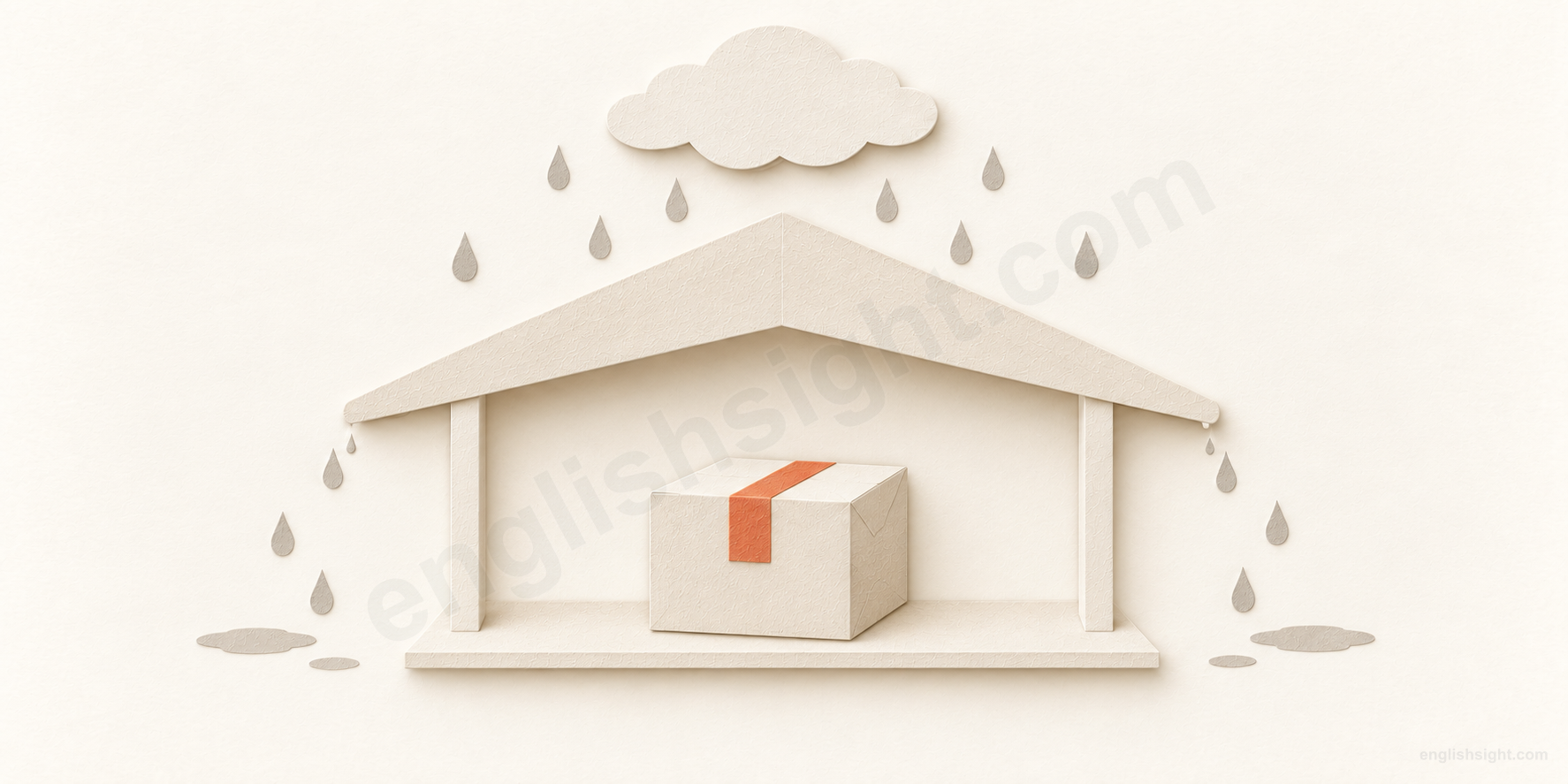
Safe: protected from harm, or involving little risk.
See who is protected, what might go wrong, and how the surrounding words define the risk.
Protection in relation to a threat
Protection in relation to a threat
Rain could damage the parcel.
safe
The parcel stays dry under cover.
The roof keeps the rain outside.
Safe describes the parcel’s protected condition, here in relation to rain.
Safe describes protection from harm or loss, or a situation with little danger of causing it.
The adjective describes a condition or an assessment; it does not itself describe becoming protected. A shelter is one illustration, not the meaning of every expression containing safe.
Safe can describe a person who is protected, a product that presents little danger, or a choice unlikely to fail. Start by asking: safe for whom, from what, and in doing what?
The shelter picture illustrates protection against a threat. Other uses concern loss, mistakes, trust, or caution; fixed expressions need their own wording. This is a teaching connection, not a claim about a picture shared by every English speaker.
01
People, objects, and physical danger
Ask whether the subject is protected, whether it causes danger, and which person or activity the judgment concerns.
01
be / feel / seem / remain / stay + safe
be / feel / stay safe
be protected, feel protected, or remain out of danger
Situation / concern
A storm is passing over the area.
Condition / outcome
You are indoors, away from its immediate danger.
Safe describes a condition; the linking verb gives the viewpoint or continuation.
We are safe reports our condition. We feel safe reports our sense of security, which can differ from the actual situation. Stay safe asks someone to remain out of danger; it is also a friendly farewell.
Safe can describe someone who has escaped trouble as well as someone who was never exposed. Compare We are safe now with We were lucky: safe identifies the condition, while lucky evaluates how events turned out.
In a sentence
We feel safe inside the shelter.
Watch the difference Safe is an adjective here. We are safely needs more information, such as We are safely inside.
02
safe from + person / thing / threat
safe from harm
be protected against a specified threat
Situation / concern
Water could reach the stored papers.
Condition / outcome
A waterproof case separates the papers from the water.
From names what might harm, damage, or threaten the subject.
In safe from water, the papers are the protected things and water is the threat. The same pattern extends beyond physical injury: safe from criticism means not exposed to criticism in that context.
Compare safe for children: children are the intended users, not the danger. Changing from to for changes the relationship, even when the main adjective stays the same.
In a sentence
The papers are safe from water inside this case.
Watch the difference Use from for the threat: safe from thieves, not safe for thieves when you mean protected against theft.
03
safe for + person / thing / use
safe for children
present little danger to a particular user or recipient
Situation / concern
You are choosing a toy for a small child.
Condition / outcome
You ask whether that toy presents a danger to that child.
For names the person or thing whose welfare matters in this use.
A toy that is safe for older children is not automatically safe for babies. The for-phrase limits the group to which the judgment applies; it does not say who provides protection.
Safe for indoor use and safe for use on wood specify a use or surface instead of a person. The assessment concerns those conditions, not every possible way of using the product.
In a sentence
Is this toy safe for a three-year-old?
Watch the difference Safe for is a language pattern, not proof of a product’s safety. For and from are not interchangeable.
04
it is safe (for someone) to + verb; thing + be safe to + verb
safe to drink / safe for someone to do
judge the danger involved in an action
Situation / concern
You need to cross a road.
Condition / outcome
You assess whether a child can cross at this point.
The infinitive names the action, and a for-phrase can name its performer.
Is it safe for children to cross here? uses it as a placeholder; children do the crossing. In Is this bridge safe to cross?, the bridge is what people cross. In The water is safe to drink, people drink the water.
It is not safe to enter warns about entering. It is safer to wait compares the risk of alternatives. Neither construction expresses permission by itself: allowed and safe answer different questions.
In a sentence
Is it safe for children to cross here?
Watch the difference Say safe to cross, not safe to crossing. For + person is needed in safe for children to cross, not safe children to cross.
05
a safe + place / distance; at / from a safe distance; a safe haven
a safe place / a safe distance
a location or distance that helps avoid harm
Situation / concern
Waves are breaking over part of the shore.
Condition / outcome
You watch from a position beyond their reach.
A place or distance is assessed by what it protects people or things from.
A safe place is suitable for avoiding the relevant danger or loss. A safe distance is far enough away in the situation; safe itself supplies no measurement. The rain shelter illustrates this protective relationship.
A safe haven is a place of refuge from danger or attack: The village became a safe haven for families fleeing the fighting. Haven is the noun for refuge; safe emphasizes its protective role.
In a sentence
We watched the waves from a safe distance.
Watch the difference Safe does not mean the same distance in every situation. The surrounding noun and context determine what counts as safe.
06
keep / make + object + safe; make + object + safe for someone to do
keep it safe / make it safe
maintain protection or establish a safer condition
Situation / concern
A loose part makes a machine dangerous.
Condition / outcome
A repair removes that danger.
Keep maintains a condition; make brings it about. Safe names the resulting condition.
Keep your documents safe asks for continued protection. Make the machine safe asks for a change. The object is followed by an adjective describing it: keep them safe, make it safe.
Make it safe for people to enter adds the intended users and action. The causative meaning comes from make, not from safe. A machine made safe is not a passive form of a verb safe.
In a sentence
The technician made the machine safe before the inspection.
Watch the difference Safe is not the ordinary verb for saving: say save the file or keep the file safe, not safe the file.
07
have a safe + trip / journey; a safe return; arrive / get home + safe and sound
a safe journey / safe and sound
travel without harm, or arrive unharmed
Situation / concern
Someone is about to travel, or has just completed a difficult journey.
Condition / outcome
You wish them well or report that they arrived unharmed.
A safe journey describes the event; safe and sound describes an unharmed condition.
Have a safe trip! is a wish, not a prediction. We were relieved by her safe return reports a return without harm. In They arrived safe and sound, the expression describes the travelers when they arrived.
Sound here means unharmed or in good condition, not noise. They arrived safely focuses on how the journey ended; They arrived safe and sound highlights their condition. Both are natural.
In a sentence
After the long drive, we got home safe and sound.
Watch the difference In the familiar expression, use safe and sound, not safely and sound. In ordinary narration, traveled safely uses the adverb.
02
Careful behavior, secure outcomes, and judgments
The threatened harm may be a mistake, a lost opportunity, an unwelcome reaction, or failure rather than an injury.
08
a safe + driver / person in a role; drive safely; informal Drive safe!
a safe driver
someone who acts carefully to avoid danger
Situation / concern
Two drivers have different habits behind the wheel.
Condition / outcome
You describe the one whose driving avoids unnecessary danger.
With a person’s role, safe can describe their careful conduct.
A safe driver is careful in driving. The driver is safe instead normally reports the person’s condition: perhaps they escaped an accident. The noun helps select the behavior-related meaning.
Drive safely is a neutral choice for describing the action. Drive safe! is also established, especially as an informal farewell; safe can be a flat adverb in that expression. Do not turn this into a rule that adjectives freely replace adverbs.
In a sentence
My sister is a safe driver, even on unfamiliar roads.
Watch the difference A safe driver and a driver who is safe need not mean the same thing. Safer and safest are the normal comparative forms.
09
job / position / lead + be safe; a safe seat
your job is safe
not be threatened with loss
Situation / concern
A company is reducing its workforce.
Condition / outcome
A manager says your position will be retained.
The threatened harm is losing something, not being physically injured.
Your job is safe means it is not in danger of being taken away. Compare Your job is safe with Your job is dangerous: the first concerns keeping the job, while the second concerns hazards in doing it.
A safe seat in British political reporting is a constituency where a party is very likely to win. Seat refers to political representation, not a chair with no broken legs. A safe lead in sport similarly suggests a lead unlikely to be lost.
In a sentence
The manager assured us that our jobs were safe.
Watch the difference Ask what might be lost. Safe in this sense does not promise that every aspect of the work or situation is free of danger.
10
a safe + choice / option / subject / investment
a safe choice / a safe subject
an option with little risk of failure or an unwelcome reaction
Situation / concern
You are choosing a topic for a first conversation.
Condition / outcome
You choose one unlikely to upset the other person.
The risk may be social or practical rather than physical.
A safe choice is an option expected to work without much trouble. A safe topic or subject is unlikely to cause offense or controversy in that setting. Context supplies what kind of bad outcome you want to avoid.
A safe investment is presented as involving little risk of loss. This is a description or assessment, not a guarantee. Safer than another option is a relative comparison and does not mean risk-free.
In a sentence
Travel was a safe subject for our first conversation.
Watch the difference Safe can be approving here. Do not automatically translate every safe choice as boring; that criticism needs context.
11
something + be a safe bet; it is a safe bet that + clause
a safe bet
a choice or prediction that seems likely to work out
Situation / concern
You need a small present for someone whose interests you know.
Condition / outcome
You choose something likely to suit them.
Bet turns the idea of low risk into an expectation of success or truth.
As a choice, a safe bet is something likely to be suitable: A notebook is a safe bet for someone who loves writing. The expression need not involve money or gambling.
As a prediction, It is a safe bet that the café will be busy means that this is very likely. Compare a safe bet with a wild guess: the speaker presents different levels of confidence, not different physical hazards.
In a sentence
For a friend who loves writing, a notebook is a safe bet.
Watch the difference Likely does not mean certain. Learn bet as part of the expression rather than reading every instance as a real wager.
12
it is safe to say / assume (that) + clause; can safely say / assume
it is safe to say / assume that…
present a statement or assumption as unlikely to be wrong
Situation / concern
Every ticket has been sold.
Condition / outcome
You confidently describe demand as strong.
Here the risk is making an incorrect statement.
It is safe to say that… introduces a conclusion the speaker thinks is well supported. It is safe to assume that… presents something as a reasonable basis for further thought. Neither formula proves the conclusion.
Compare It is safe to open the door, which normally concerns the danger of the action. You can safely assume… uses the adverb with the verb assume; the meaning remains confidence about an inference.
In a sentence
With every ticket sold, it is safe to say that demand is strong.
Watch the difference Safe to say usually concerns correctness, not permission to speak or a literal threat to the speaker.
13
a safe + design / performance / option; too / rather + safe
a safe design
conventional and lacking adventurous ideas
Situation / concern
A designer avoids every unusual feature.
Condition / outcome
The result works but feels unoriginal.
Avoiding risk can become a criticism when imagination is wanted.
In a review, a safe design or performance can mean one that takes no creative chances. The speaker may be disappointed by its predictability. This is a conventional evaluative use, not a claim that every safe thing is dull.
Compare a safe bridge design in an engineering discussion: there safe may simply concern protection against failure. The noun alone is not enough; purpose and tone select the interpretation.
In a sentence
The poster is clear, but the design feels rather safe.
Watch the difference Read for evaluation. Safe may praise sensible caution or criticize a lack of originality.
03
Trusting someone or feeling assured
These patterns identify a trusted person or a fact that gives confidence. Learn the complete expression.
14
secret / information + be safe with + person
your secret is safe with me
promise not to reveal private information
Situation / concern
Someone has shared personal news in confidence.
Condition / outcome
You promise to keep it private.
With identifies the person entrusted with the secret.
Your secret is safe with me reassures the listener that you will not pass it on. The secret is the thing being protected, and disclosure is the unwanted outcome.
With a concrete object, Your passport is safe with me can instead mean that I am looking after it. The with-phrase identifies the trusted holder; it is different from from, which names a threat.
In a sentence
Your secret is safe with me; I will not tell anyone.
Watch the difference The phrase is a promise about confidentiality, not a claim that the information is correct.
15
be in safe hands; be in the safe hands of + person; be safe in someone’s hands
in safe hands
being looked after by someone reliable
Situation / concern
You leave a difficult repair to an experienced professional.
Condition / outcome
You trust that they will handle it competently.
Hands represents the person’s care or responsibility.
Your bicycle is in safe hands says that its caretaker is trustworthy. It does not mean that the bicycle is literally being held. The same expression works for people, projects, and problems.
In the safe hands of Maya and safe in Maya’s hands identify the person responsible. Compare a safe pair of hands, which describes that person rather than the thing being cared for.
In a sentence
Leave the repair to Maya; your bicycle is in safe hands.
Watch the difference Use plural hands in this fixed expression. In safe hand is not the ordinary form.
16
person + be a safe pair of hands
a safe pair of hands
a dependable person for a responsible job
Situation / concern
A team needs someone to manage a delicate handover.
Condition / outcome
They choose a colleague known for sound work.
The expression evaluates the person, not the physical condition of their hands.
Calling someone a safe pair of hands emphasizes dependable performance and the avoidance of serious mistakes. It is especially associated with British usage and is common in reporting about responsible roles.
It may praise reliability without suggesting originality. Compare The project is in safe hands with Maya is a safe pair of hands: the first describes the project’s care, while the second identifies a reliable person.
In a sentence
We chose Elena to oversee the handover because she is a safe pair of hands.
Watch the difference Pair takes a singular article: a safe pair of hands. This is figurative, not an assessment of hand injuries.
17
do something, safe in the knowledge that + clause
safe in the knowledge that…
confident because you believe a reassuring fact
Situation / concern
You confirm that the office is locked.
Condition / outcome
You leave without worrying about that task.
The that-clause supplies the reassuring information.
She left, safe in the knowledge that the office was locked means this fact gave her confidence. Safe describes her assured state; it does not mean that knowledge is a physical shelter.
The pattern often appears in writing. It identifies the reason for assurance, not the quality of a guess: compare It is safe to assume the door is locked, which presents an inference rather than confirmed information.
In a sentence
Nora left, safe in the knowledge that someone would feed the cat.
Watch the difference Keep the knowledge that plus a clause. Safe knowledge alone does not express the same relationship.
04
Choosing caution and offering reassurance
Familiar expressions help us avoid trouble, explain an extra precaution, or emphasize security.
18
play it safe; play safe
play (it) safe
choose a cautious course rather than take a risk
Situation / concern
You are unsure how formal an interview will be.
Condition / outcome
You choose formal clothes to avoid a poor impression.
The whole expression means choosing caution, whether or not any game is involved.
I played it safe and wore a suit explains a cautious decision. Play safe is an established variant. Both can concern money, work, social expectations, or physical danger.
Compare play safely, which can describe actual play conducted without danger. The idiom play it safe can concern decisions that have nothing to do with playing. It is not a phrasal verb with a separable particle.
In a sentence
I played it safe and wore a suit to the interview.
Watch the difference It belongs to the fixed expression. Do not replace it with a plural object, such as play them safe, to express this idiom.
19
(just) to be on the safe side; on the safe side
to be on the safe side
take an extra precaution in case it is needed
Situation / concern
Your train ticket is stored on your phone.
Condition / outcome
You also print a copy in case your phone fails.
The extra step may prove unnecessary, but it protects against a possible problem.
To be on the safe side often explains why you did more than the apparent minimum. Just can make the precaution sound modest: I printed a copy, just to be on the safe side.
Unlike a safe side of a road, this expression does not normally identify a physical position. Compared with play it safe, it often highlights a specific extra safeguard rather than the overall cautious choice.
In a sentence
I printed a copy of the ticket, just to be on the safe side.
Watch the difference Keep on the safe side for the idiom. At the safe side is not its standard form.
20
Better safe than sorry.; It is better to be safe than sorry.
better safe than sorry
say that a precaution is preferable to later regret
Situation / concern
Someone wonders whether checking the address again is excessive.
Condition / outcome
You explain why the extra check is worthwhile.
The saying compares taking care now with regretting trouble later.
Better safe than sorry is a compact saying used to recommend or justify caution. The longer form is It is better to be safe than sorry. Sorry here concerns regret after an unwanted outcome.
It can stand alone as a response. Compare to be on the safe side, which normally attaches to a particular precaution. The proverb evaluates that precaution; it does not prove it is necessary.
In a sentence
I will check the address once more—better safe than sorry.
Watch the difference Keep the comparison than. Better safe then sorry changes the spelling and does not give the proverb.
21
(as) safe as houses
(as) safe as houses
emphasize that something is very secure or safe
Situation / concern
Someone asks whether valuables will be secure in a locked cabinet.
Condition / outcome
The speaker offers emphatic reassurance.
The familiar British simile intensifies safe; it need not refer to a house.
Your papers are as safe as houses here is strong reassurance. The first as can be omitted in informal wording. This is a British expression worth recognizing, rather than a necessary way to express safety everywhere.
The comparison is conventional. It does not establish that all houses are safe, nor does it verify the speaker’s claim about the papers. Very safe is a straightforward alternative.
In a sentence
With that lock, your papers are as safe as houses.
Watch the difference Use the plural houses in the idiom. Do not treat its emphatic wording as objective evidence of zero risk.
05
A safe: the lockable container
The countable noun names an object. An article or a plural ending distinguishes it from the adjective.
22
a / the safe; plural safes; keep / put something in a safe
a safe / two safes
a strong lockable container for valuables
Situation / concern
You need somewhere secure to store important documents.
Condition / outcome
You put them in a lockable metal container.
A safe names a container; safe without an article can describe a condition.
The hotel has a safe names an object. The plural is safes, not saves. In The passports are safe in the safe, the first safe is an adjective and the second is a noun after the.
A safe can be a small box or a larger cupboard-like container. The protection link helps you remember the noun, but grammar still matters: I feel safe does not mean that I feel like a metal box.
In a sentence
We kept our passports in the hotel safe.
Watch the difference Distinguish safe, save, and safety: a safe is a container; save is an ordinary verb; safety names the condition or idea of being safe.
Read the condition, construction, and context
Protected and not dangerous are different relationships
The child is safe describes the child’s condition. The toy is safe for the child evaluates what the toy might do to the child. From names a threat; for often names the intended user; to introduces an action.
Safe does not always mean zero risk
Everyday judgments depend on conditions and comparison. Safer means less risky than an alternative, and a safe bet is still an expectation. Feel safe reports a feeling. A confident phrase cannot establish the facts.
Adjective, adverb, noun, and verb
The adjective has safer and safest. Safely is the usual adverb; Drive safe! is also established, especially informally. A safe is a countable container, plural safes. Safety is a noun for the condition; save is the ordinary verb. Keep it safe and make it safe are verb-plus-object-plus-adjective constructions, not phrasal verbs formed from safe.
Specialist terms and boundaries
Safe sex names sexual activity with precautions against sexually transmitted infections; it is a conventional expression, not a promise of zero risk. In computing, safe mode names a special startup mode used for diagnosing problems. Baseball safe means that a runner reached a base without being put out. These are recognition notes rather than separate practical lessons. Legal safe verdict, regional approval or acceptance uses of safe, old food-storage containers, and slang noun senses are outside this course.
Choose the relationship and expression
Look at who is protected, what threatens them, and what the full construction contributes.
1. The box protects papers against water. Which phrase names the threat?
2. You want to ask whether children would face danger while crossing. Which sentence has the right construction?
3. All the seats have been booked. What does It is safe to say demand is strong mean?
4. You already have a ticket on your phone but print an extra copy in case the phone fails. Which expression explains this?
5. In The passports are safe in the safe, what is the second safe?
6. Maya is an experienced mechanic. Your bicycle is in safe hands means what?
Sources and teaching notes
Dictionary uses and constructions were checked against the sources below. The explanations, examples, and protection picture were created for this lesson; the picture is a teaching illustration.
The picture illustrates a meaning connection; it does not represent a shared mental image of all English speakers.