From a boat’s sail to travel, smooth progress, and familiar expressions.
Wind, sail, and onward movement
Wind, sail, and onward movement
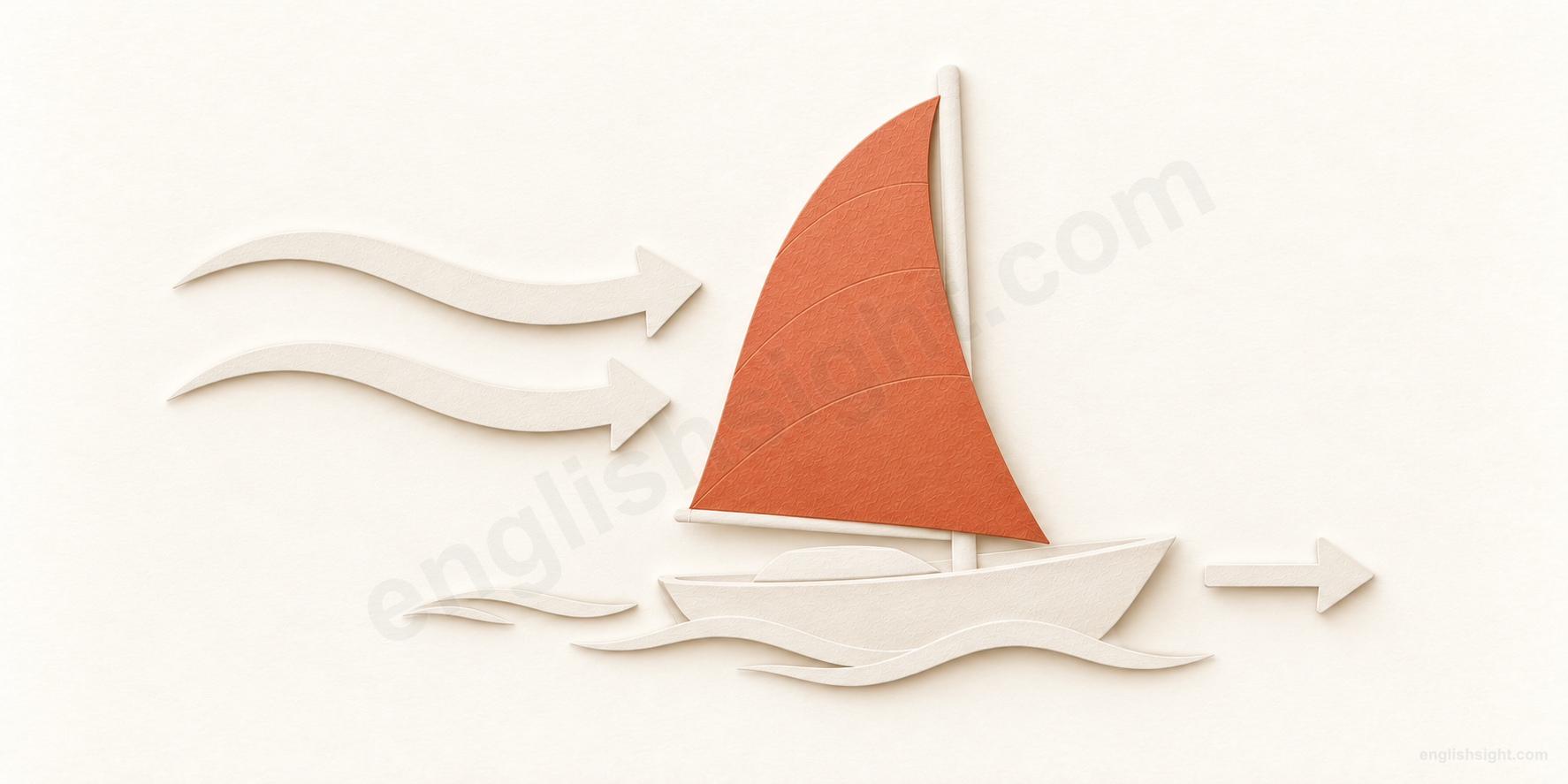
Wind approaches the boat's sail.
sail
The boat moves onward across the water.
The sail catches the wind's force.
Wind acts on the sail to help drive the boat onward.
A sail receives the wind’s force and helps drive a boat onward.
This physical relationship links the equipment with sailing. Modern travel uses include engine-powered ships, and fixed expressions add meanings that the picture cannot predict.
A sail catches wind to help drive a boat. The verb names travel on water as well as operating a sailing boat; it can also suggest smooth movement beyond the water.
Use this connection as a memory aid, then read the subject, object, and complete expression. A ferry can sail with an engine, and an exam has no real wind behind it.
01
The sail, its power, and a trip
Begin with the wind-catching surface. Notice when sail names equipment, a way of moving, or an outing.
01
a sail; sails; raise / hoist / lower + a sail
a sail / the sails
the surface that catches wind to help move a boat
Situation before
A boat carries a mast and a loose sail.
Situation after
The raised sail fills with wind.
The sail receives force from the wind; the hull carries it across water.
A sail is the broad surface attached to a boat’s rigging, not the whole boat. One boat can have several sails. A sailing boat or sailboat names the vessel; a sailor names a person.
You can raise or hoist a sail and lower it later. Compare The sail is torn with The sale ends today: sail and sale sound alike, but sale concerns selling.
In a sentence
We raised the sail when the breeze returned.
Watch the difference Count individual pieces: one sail, two sails. Do not use sail as the ordinary name for the mast.
02
be / travel + under sail; in / under full sail
under sail / in full sail
using sails as the means of propulsion
Situation before
A boat can use an engine or sails.
Situation after
It travels with its sails working.
Under sail describes how the vessel is powered.
Under sail means using sails. In full sail emphasizes that the sails are all spread. Here sail can refer collectively to the equipment or to sail power, so it does not need an article.
Compare The ship is sailing, which can describe an engine-powered ship, with The ship is under sail, which specifically points to sails. Under is part of the established expression; it does not locate the ship physically beneath a loose piece of cloth.
In a sentence
The yacht crossed the bay under sail.
Watch the difference Use under sail in this expression, not under a sail when you mean the method of propulsion.
03
go for / have + a sail; a short / two-hour sail
go for a sail
take a trip in a boat
Situation before
You have a free afternoon beside the lake.
Situation after
You spend some time out in a boat.
A sail can name an outing rather than a piece of equipment.
Go for a sail treats the experience as a trip. We had a short sail describes its length. Go sailing instead names the activity, without the article a.
The context supplies the boat and route: a sail around the island or a two-hour sail. This noun use does not mean buying or fetching a sail.
In a sentence
We went for a sail after lunch.
Watch the difference Compare go sailing with go for a sail; do not combine them as go for a sailing.
04
a windmill’s sails; the sails of a windmill
the sails of a windmill
wind-catching parts that turn a windmill
Situation before
Wind reaches the windmill’s broad arms.
Situation after
The arms turn and drive its mechanism.
The connection is catching wind, rather than traveling over water.
A traditional windmill can have sails: the broad wind-catching structures on its turning arms. This is a separate object use worth recognizing in descriptions and stories.
The boat in the diagram moves through water; the windmill stays in place. Do not carry the travel meaning into this noun use.
In a sentence
The windmill’s sails turned slowly above the field.
Watch the difference Modern wind turbines are normally described as having blades; do not assume sail is the usual label for every rotating part.
02
Travel, control, and departure
The subject may be a vessel or its passengers. A direct object may name the vessel being controlled or the water being crossed.
05
sail from A to B; sail across + water; sail + a sea / ocean
sail from / to / across
travel on water in a boat or ship
Situation before
Passengers board a ferry in one port.
Situation after
They travel across the water to another port.
Sail may describe the vessel or the people traveling on it.
The ferry sails and We sail can describe the same journey. The vessel may have an engine: sail does not always promise visible sails.
From gives the starting point, to the destination, and across the stretch crossed. Sail the Atlantic uses the body of water as a direct object; sail to the island uses a destination phrase. These patterns do not say that the traveler swims.
In a sentence
We sailed from the island to the mainland on the morning ferry.
Watch the difference Sail to France means travel there by water. Say fly to France when the journey is by plane.
06
sail + boat; learn / know how + to sail; go sailing
sail a boat / go sailing
operate or travel in a sailing boat, often for pleasure
Situation before
A learner is learning to handle a boat.
Situation after
The learner controls its movement on the water.
With a boat as object, sail can describe handling that vessel.
She sails a small boat names the vessel she handles. She knows how to sail can leave the boat understood. Go sailing is the familiar activity expression for recreation or sport.
Compare We sailed on a ferry: those travelers may simply be passengers. The object in She sailed the yacht identifies the vessel under her control. A passive is possible when the crew matters: The yacht was sailed by two friends.
In a sentence
My aunt taught me to sail a small boat.
Watch the difference Use go sailing for the activity, not go to sailing. Being a passenger does not by itself mean knowing how to sail a boat.
07
sail at + time; sail for + destination; set sail (from / for…)
sail for / set sail
leave to begin a journey by water
Situation before
The ship is still in port.
Situation after
It leaves and begins its voyage.
A departure time tells you when the voyage starts.
The ferry sails at six normally gives its departure time. For names the intended destination: sail for Lisbon. From names the departure port.
Set sail also means begin a sea journey; it is more formal or narrative than leave. Set sail for the island uses sail without an article. Set has the same form in the past: They set sail yesterday. Neither expression guarantees a wind-powered ship.
In a sentence
The ship set sail from the harbor for Lisbon at dawn.
Watch the difference Sail for Lisbon marks departure toward Lisbon, not arrival there.
03
Movement and progress beyond boats
Smooth movement provides a useful connection, but the words following sail determine whether the sentence describes a path, an easy achievement, or a sharp attack.
08
sail + over / across / past / into + place
sail over / past / into
move along smoothly, often quickly or confidently
Situation before
A ball leaves a player’s foot.
Situation after
It travels in a clear arc beyond the wall.
The movement resembles a vessel gliding along; no water is required.
A ball can sail over a wall, and clouds can sail across the sky. A person who sails into a room enters with a confident, sweeping manner. The path word tells you where the movement goes.
Sail over is not automatically an idiom: in a ball sailed over the wall, over supplies the spatial path. Sail does not mean every movement is effortless for the person who caused it.
In a sentence
The ball sailed over the garden wall.
Watch the difference A person who sails into a room may be walking confidently: sail is an extended movement use here. Sail into someone can instead mean attack or criticize them; the context decides.
09
sail through + exam / interview / process; sail through (it)
sail through an exam / a process
succeed or progress without difficulty
Situation before
An exam or approval process could cause difficulty.
Situation after
The person or proposal passes with little trouble.
Through frames a challenge as something passed from beginning to end.
Sail through an exam means pass it easily. Sail through the interview or sail through customs likewise emphasizes little difficulty. A proposal can sail through a committee when approval comes easily.
The challenge can be left understood: I expected trouble, but she sailed through. With a pronoun, say sailed through it. Contrast a boat sailing through a narrow channel: that can describe a real route, without saying the trip was easy.
In a sentence
Nina sailed through her driving test on the first attempt.
Watch the difference Do not separate the sequence as sailed it through when you mean passed it easily. Easy success is contributed by the whole figurative expression.
10
sail into + person + (for + noun / -ing)
sail into someone
attack or criticize someone forcefully
Situation before
A manager hears that the team ignored an instruction.
Situation after
The manager angrily criticizes them.
A person as target makes this an idiomatic attack, not an entrance.
In this informal expression, sail into someone means launch a forceful attack, often with words. For can introduce the reason for criticism.
Compare sailed into the office, an entrance, with sailed into the staff, a sharp attack in the relevant context. The person is the target, not a destination inside which the speaker moves.
In a sentence
The manager sailed into the team for ignoring the warning.
Watch the difference This is forceful and informal; use criticized for a neutral report. Say sailed into them, not sailed them into.
04
Learn the complete expression
These expressions borrow sailing imagery. Their established meanings need to be learned with the whole phrase.
11
sail close to the wind
sail close to the wind
take a risk by approaching a dangerous or unacceptable limit
Situation before
A business wants an advantage.
Situation after
It operates very near what rules allow.
The idiom describes risk near a boundary; it does not guarantee a violation.
Sail close to the wind can describe behavior that is risky or nearly illegal. It can also refer more broadly to approaching the limits of what others will accept.
The sailing imagery helps remember the risk, but the figurative phrase must be learned together. In a discussion of actual boat handling, similar wording may instead have a literal nautical meaning.
In a sentence
By hiding those charges, the company is sailing close to the wind.
Watch the difference Close to means near the limit; the idiom alone does not establish that a specific law has been broken.
12
take the wind out of + possessive + sails
take the wind out of someone’s sails
suddenly reduce someone’s confidence, enthusiasm, or anger
Situation before
Someone expects to win an argument.
Situation after
An unexpected response leaves them less confident.
Losing driving force becomes a teaching metaphor for losing confidence.
The subject is the person, news, or action that causes the change. The person whose confidence drops appears in someone’s: my sails, her sails, or the team’s sails.
An unexpected agreement can weaken an angry person’s attack; bad news can deflate enthusiasm. This does not necessarily mean making someone tired or physically unable to breathe.
In a sentence
The quiet reply took the wind out of his sails.
Watch the difference Keep the plural sails and match the possessive to the affected person: her sails, not she sails.
13
be + plain / smooth sailing; not all plain sailing
plain sailing / smooth sailing
easy progress with few difficulties
Situation before
A project has had a difficult start.
Situation after
After a problem is solved, work becomes easier.
Sailing imagery describes the progress of the whole undertaking.
Plain sailing, especially in British English, and smooth sailing describe an easy course of events. It wasn’t all plain sailing says there were difficulties, even if the undertaking eventually succeeded.
After the repair, it was smooth sailing evaluates the experience. Compare We sailed through the test, which uses a verb and names a particular challenge. These expressions are related in imagery but have different grammar.
In a sentence
Once we fixed the connection, the presentation was smooth sailing.
Watch the difference Sailing is part of this fixed noun expression; do not replace it with a sail.
14
that ship has sailed
That ship has sailed.
the opportunity is no longer available
Situation before
There was a chance to apply.
Situation after
The deadline has passed and the place is taken.
A departed ship provides an image for a chance that has passed.
That ship has sailed is a conversational way to say it is too late for the opportunity under discussion. That points back to the earlier chance; the speaker need not be talking about travel.
For example, someone proposes applying for a job after it has been filled. The phrase closes off that particular possibility; it need not mean every other opportunity is gone.
In a sentence
I wanted to join the course, but that ship has sailed—the last place went yesterday.
Watch the difference Has sailed is the present perfect here: an earlier departure matters now. Do not interpret the reply as a travel report when the context is an expired chance.
15
trim + possessive + sails
trim your sails
adjust plans or actions to suit circumstances
Situation before
A team’s funding becomes smaller.
Situation after
It adapts the scale of its plans.
Adjusting sails for conditions becomes an image for adjusting behavior.
Literally, trimming sails means adjusting them to suit the wind. Figuratively, trim your sails can mean adapt your actions to circumstances. Oxford also records the more specific sense of reducing costs.
This is useful to recognize in commentary and business writing. In everyday conversation, adjust our plans or cut our costs may be clearer. Trim does not always mean physically cut material from a sail.
In a sentence
With less funding available, the organization had to trim its sails.
Watch the difference Read the context: the expression can concern general adaptation, reduced spending, or actual sail adjustment.
Keep the equipment, journey, and idiom distinct
Forms and pronunciation
Sail /seɪl/ sounds like sale. Verb forms are sail, sails, sailed, sailed, sailing. Sailed ends in /d/. The activity is sailing; a boat trip can be a sail.
Objects change the interpretation
Sail a yacht can mean handle the vessel; sail the Atlantic means travel across that body of water. Sail on a ferry may describe an ordinary passenger. An intransitive journey has no object to turn into a passive; a vessel-control sentence can have a passive.
Progress does not always mean ease
A boat can sail in dangerous conditions. Smoothness is prominent in the extended movement sense and easy success in sail through an exam, but ease is not a promise attached to every use of sail.
Coverage boundary
This lesson covers modern everyday noun and verb uses and selected figurative expressions, with windmill and trim your sails for recognition. It does not teach sail types, sailing technique, submarine structures, historical counting of ships as sail, or every literary expression.
Choose the intended meaning
Use the context and the words around sail.
1. The timetable says the diesel ferry sails at seven. What does that tell you?
2. You want to name a recreational activity. Which expression fits?
3. Maya sailed through her interview. What is the speaker emphasizing?
4. The editor sailed into me for missing the deadline. What happened?
5. The only vacancy was filled yesterday. Someone says, “That ship has sailed.” What do they mean?
Sources and teaching notes
Dictionary meanings and constructions were checked on the publisher pages below; VOA supports the missed-opportunity expression. The explanations and examples are original. The wind-to-motion connection is a teaching model.
The diagram is a memory aid, not a picture shared by every English speaker.