Learn salt at the table, in descriptions, and inside familiar idioms.
A substance becomes an ingredient
A substance becomes an ingredient
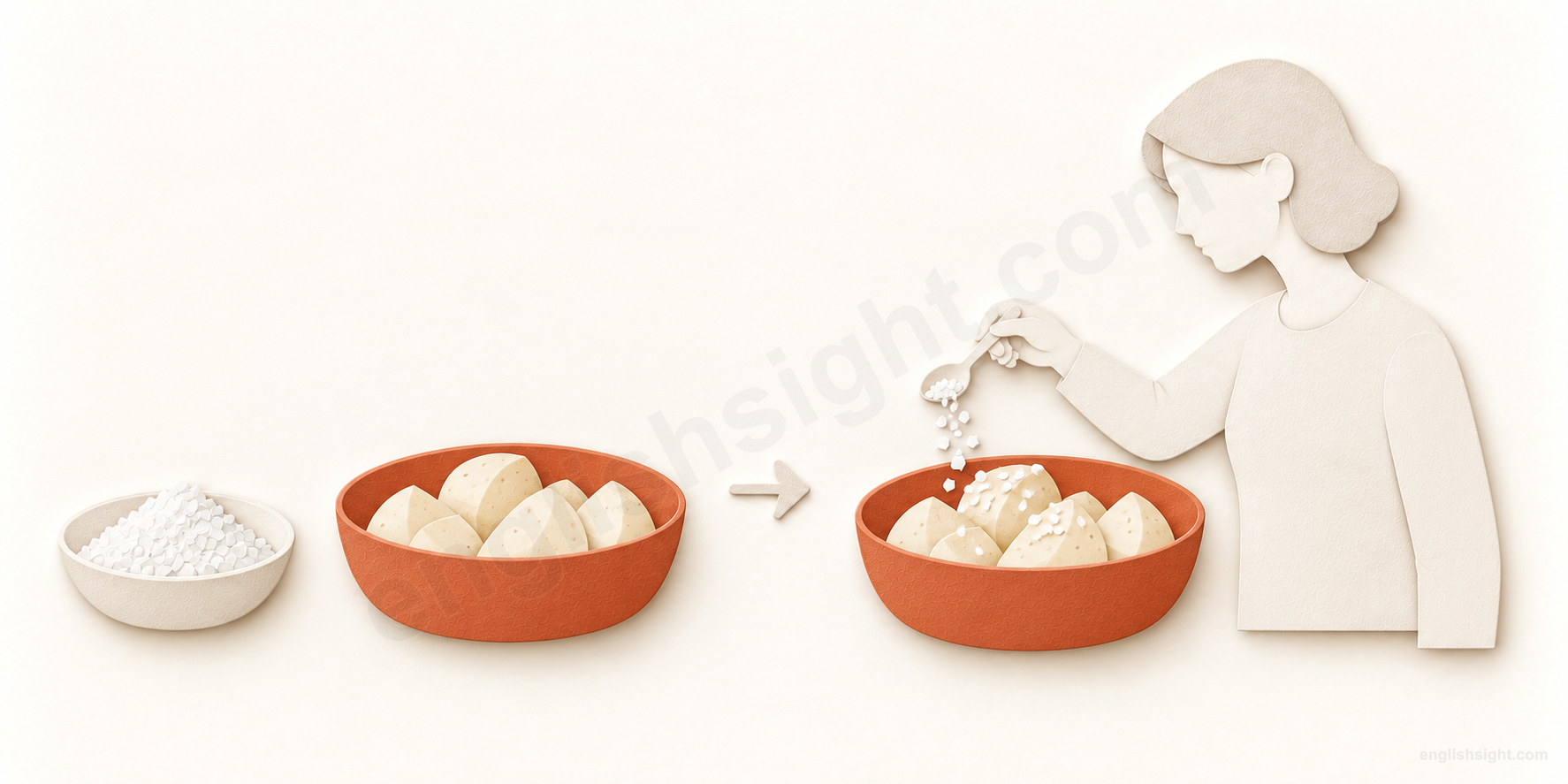
The salt is in a separate dish beside a bowl of potatoes.
salt
Salt has been added to the potatoes.
A cook tips a spoon so salt falls onto the potatoes.
The noun names the substance; the verb names adding it to food.
Salt is a crystalline substance used to season or preserve food. To salt something is to treat it with salt; the purpose depends on what receives it.
This model connects the everyday noun and the physical verb. Chemical salts form a wider category, and fixed expressions need their own explanations. The diagram shows addition, not a guarantee that food tastes better.
Salt first names a familiar substance. As a verb, it describes putting that substance on or into something. The object tells you whether the purpose is seasoning food, preserving it, or treating an icy road.
Some expressions keep a visible connection to salt; others have established meanings you must learn as a whole. A picture of seasoning cannot predict what a person means by worth their salt.
01
Name and measure the material
Begin with the ordinary substance, then notice when salt describes water or names a kind of chemical.
01
some / the + salt; table / sea / rock / garlic salt
some salt; pass the salt
name the familiar seasoning
Situation / starting point
The salt is at the other end of the table.
Meaning / result
You ask someone to move it within reach.
The noun names a material, not an individual crystal.
At a meal, salt normally means the familiar seasoning. Ask for some salt, or ask someone to pass the salt. The latter request ordinarily means passing its container; you do not need to name the container separately.
Table salt, sea salt, and rock salt name forms or sources of the material. They do not turn every grain into a countable salt. Garlic salt names a seasoning mixture, so a word before salt can identify an added flavor rather than a source.
In a sentence
Could you pass the salt to Maya?
Watch the difference For ordinary seasoning, say some salt, not a salt. Use a salt shaker or a salt cellar when the container itself matters.
02
a pinch / grain / teaspoon of salt; high / low in salt; low-salt + noun
a pinch / grain of salt; low in salt
measure salt or describe its amount
Situation / starting point
You are following a recipe or comparing labels.
Meaning / result
You identify an amount rather than count salts.
The countable noun is pinch, grain, or another unit.
A pinch is a small amount picked up between fingers; a grain is one small particle. One pinch may contain many grains. A teaspoon of salt is another measure. The plural belongs to the unit: two pinches of salt.
For amount, use much, little, more, or less with salt. This sauce is high in salt describes its content; a low-salt sauce uses a compound adjective before the noun. Salt intake means the amount someone consumes, without itself giving a recommended amount.
In a sentence
The recipe needs two pinches of salt.
Watch the difference A literal pinch of salt measures an ingredient. With a pinch of salt can also form a separate idiom about belief.
03
salt + noun; salt water versus fresh water
salt water; a salt lake
describe something containing salt
Situation / starting point
You compare a lake with a freshwater stream.
Meaning / result
You describe the water as containing salt.
Salt before a noun can describe its content or setting.
Salt water contains salt; fresh water contrasts with it. A salt lake contains salty water, while a salt marsh is land in a salty coastal environment. In these combinations, salt modifies the following noun rather than naming an act of adding salt.
Compare a pot of salted water: this normally describes water to which someone has added salt, for example while cooking. Salt water does not by itself say that a cook or anyone else added it. To comment on taste, The water tastes salty is a natural choice.
In a sentence
This lake contains salt water.
Watch the difference Salt is established before nouns here. For an ordinary taste judgment, use salty rather than The water tastes salt.
04
a + salt; plural salts; mineral / bath / smelling salts
a salt; mineral salts; bath salts
recognize a wider chemical or product category
Situation / starting point
A science text mentions more than ordinary table salt.
Meaning / result
You recognize salt as a category with countable members.
Chemical salt is a wider term than the seasoning.
In chemistry, a salt is a member of a class of ionic compounds; ordinary table salt is one example. This allows a salt and several salts. Mineral salts in a science text need not mean several packets of seasoning.
Bath salts names crystals added to bath water, often to give it a pleasant smell. Smelling salts names a strong-smelling substance associated especially with past attempts to revive someone who had fainted. These are conventional plural names; learn each complete expression. Neither name identifies table seasoning. This lesson explains the vocabulary, not how to use the products.
In a sentence
The report lists three mineral salts.
Watch the difference Do not carry the uncountable food rule over to every scientific use, or assume all salts are table salt.
02
Say what receives salt
The same verb can describe several purposes. Read its object and the surrounding situation.
05
salt + object; be salted; salted / unsalted + noun; taste + salty; salt to taste
salt the food; salted / salty
add salt, or describe treatment and taste
Situation / starting point
The cook is seasoning a dish.
Meaning / result
Salt has been added, and the dish may taste salty.
Salted describes addition; salty describes a property.
In Salt the vegetables, the subject does the action and the vegetables receive salt. You can also say add salt to the vegetables or season them with salt. Season is broader: it can involve other flavorings as well. In a recipe, Salt to taste means add as much salt as suits the desired taste; it does not specify a fixed quantity.
Salted nuts have had salt added; unsalted butter has not had salt added. Salty describes salt content or taste: The sauce is too salty. Something can be salted only lightly and need not taste very salty. Salted water is useful for describing preparation, whereas salty water emphasizes its character.
In a sentence
I salted the potatoes, but they are not too salty.
Watch the difference Say The potatoes taste salty for taste. The potatoes are salted describes treatment, and The potatoes are salting does not express that finished state.
06
salt + food; salt + food + down; salt it down; salt cod / beef
salt fish; salt something down
preserve food using salt
Situation / starting point
Food is being prepared for storage.
Meaning / result
It is treated with salt for preservation.
The purpose comes from the food and storage context.
To salt fish can mean using salt to preserve it, not just adding a little at the table. The plain verb also means season, so context decides whether preservation is intended. Salt cod and salt beef are established food descriptions.
Salt the fish down is an established form for preservation; down is not a direction in which the fish must move. A pronoun goes before down: salt it down. A passive sentence such as The fish was salted describes the treatment without naming the person. These are language examples, not instructions for preserving food.
In a sentence
Before refrigerators, the family salted fish for storage.
Watch the difference Salted does not always mean preserved: lightly salted snacks may simply have added seasoning. Read the purpose in context.
07
salt + road / path / driveway; be salted
salt the roads
spread salt on an icy surface
Situation / starting point
A road is icy in winter.
Meaning / result
Workers treat it with salt to help melt the ice.
The road is the treated object; no food is involved.
With roads, paths, or driveways as its object, salt means applying salt to deal with ice or snow. The underlying material-to-surface relation is like seasoning, but the intended result is different.
The council is salting the roads describes work in progress. The roads were salted is a passive description of the treatment. Neither sentence guarantees that every icy patch has disappeared: salting names what was done, not a promise of a safe surface.
In a sentence
The crew salted the bridge before dawn.
Watch the difference The object changes the purpose. Do not interpret salting a road as making it taste better.
08
salt + text / talk + with + added elements; be salted with
salt something with jokes
add small elements throughout something
Situation / starting point
A speaker has a mainly serious talk.
Meaning / result
Short jokes appear at intervals in it.
The material being scattered is figurative.
A writer can salt a story with jokes or a speaker can salt a talk with quotations. The main work is the object of salt; the with-phrase names the elements introduced into it. The image of scattered seasoning helps explain the distribution.
The passive is useful: The talk was salted with jokes. This is a descriptive, figurative use, less basic than add a few jokes. It does not mean the jokes are about salt, and the construction does not guarantee that the audience enjoys them.
In a sentence
Nora salted her talk with brief jokes.
Watch the difference Salt with is a verb followed by a with-phrase, not a separable particle verb like salt away.
03
Learn the whole expression
These expressions concern belief, distress, character, competence, or savings. Their meanings do not come from adding up separate dictionary translations.
09
take + claim / report / what someone says + with a pinch / grain of salt
take something with a pinch / grain of salt
be cautious about believing a claim
Situation / starting point
Someone makes a claim that may be exaggerated.
Meaning / result
You leave room for doubt instead of accepting it fully.
The full expression comments on reliability.
Take that claim with a pinch of salt means do not assume it is completely accurate. It does not necessarily mean reject every part of it. A claim, report, promise, or what someone says can fill the object position.
With a grain of salt is especially associated with North American English; Oxford also lists pinch of salt as the general form. This is a fixed expression about belief. In Add a pinch of salt to the soup, the same words name a literal quantity and have no skeptical meaning.
In a sentence
I would take that sales promise with a grain of salt.
Watch the difference Keep with in the idiom. It is not a request to eat salt or an instruction to declare the claim false.
10
rub salt in / into the wound; rub salt into someone’s wounds
rub salt into the wound
make an already painful situation worse
Situation / starting point
Someone is disappointed by a failure.
Meaning / result
A reminder or further setback adds to the hurt.
There must already be a painful experience to worsen.
Rubbing salt into the wound describes adding distress to an existing hurt. A person can do it by making an insensitive comment, but an event can also have this effect without anyone deliberately intending it.
The wording varies: rub salt in the wound, into the wound, or into someone’s wounds. To rub salt into the wound can introduce a further bad development. The wound can be emotional or situational; no physical injury or actual salt is required.
In a sentence
Mentioning the winner’s prize just rubbed salt into the wound.
Watch the difference This means adding pain to existing pain. It is not the same as taking a claim with a pinch of salt.
11
person / people + be + the salt of the earth
the salt of the earth
praise someone as thoroughly good and dependable
Situation / starting point
A neighbor helps others reliably without seeking attention.
Meaning / result
You praise the neighbor’s character.
The expression evaluates people, not the land.
The salt of the earth is warm praise for a good, honest, dependable person or group. It often fits someone who helps quietly and deals with difficult situations without a fuss.
Use the as part of the established noun phrase: She is the salt of the earth. A plural subject is also possible: They are the salt of the earth. Do not try to recover this character judgment from the literal chemical meaning of salt.
In a sentence
Our neighbors are the salt of the earth; they always help when trouble comes.
Watch the difference This praises character. It does not specifically say that someone is skilled at their job; worth their salt does that.
12
be worth + possessive + salt; any + role + worth their salt
worth your / their salt
be competent and deserve respect for your work
Situation / starting point
You consider what a capable worker should do.
Meaning / result
You judge the worker against that standard.
Worth belongs to the whole expression about competence.
Any guide worth their salt would check the route means any competent guide would do so. The expression often follows a job noun, but a sentence such as She is worth her salt also works. One’s in dictionary headings stands for the appropriate possessive: my, your, their, and so on.
This is not a statement about buying salt or how much a worker eats. It can praise competence or imply criticism by setting a basic standard. Unlike the salt of the earth, it primarily evaluates ability or value in a role, not general goodness.
In a sentence
Any editor worth their salt would notice the missing page.
Watch the difference Use the possessive: worth their salt, not worth the salt. One’s is a replaceable dictionary form, not a word to repeat literally.
13
salt away + money; salt + money + away; salt it away
salt money away
save money, often secretly
Situation / starting point
Someone receives money and does not spend it openly.
Meaning / result
They store it for future use, possibly dishonestly.
Away contributes putting aside; the saving sense is established.
Salt money away means build up savings or a reserve. Dictionary accounts differ in emphasis: Oxford highlights secrecy and usually dishonesty; Collins also records a broader informal saving sense. Context matters, so do not automatically accuse someone of a crime solely from this phrase.
This is a separable phrasal verb: salt away the money or salt the money away. A pronoun must go in the middle: salt it away. For neutral everyday personal saving, save or put money aside is more straightforward. The connection to preserving something for later is a memory aid, not a rule that predicts the expression.
In a sentence
The treasurer was accused of salting away the stolen funds.
Watch the difference Say salt it away, not salt away it. A literal preservation sense of salt away also exists, so read the object.
04
Recognize two further descriptions
These uses occur in stories and descriptions. Learn to recognize them without treating them as the basic food meaning.
14
an old salt; plural old salts
an old salt
recognize an informal name for an experienced sailor
Situation / starting point
A sea story introduces a veteran sailor.
Meaning / result
The narrator calls that person an old salt.
This countable person sense is separate from the food material.
An old salt is an informal expression for a seasoned sailor. Here salt names a person, so a salt and plural salts are possible, unlike ordinary uncountable salt at the dinner table.
The expression has a nautical, storytelling flavor. It is useful to recognize, but experienced sailor is clearer in neutral everyday description. Do not extend old salt to every experienced worker; the established noun sense refers to a sailor.
In a sentence
An old salt showed the visitors how to tie the rope.
Watch the difference Old salt does not mean stale seasoning, and it is not a general synonym for any older person.
describe a mixture of dark and gray or white hairs
Situation / starting point
Someone has both dark and pale hairs.
Meaning / result
You describe the mixed coloring.
The comparison is about appearance rather than seasoning.
Salt-and-pepper hair has dark hairs mixed with gray or white ones. The familiar contrast of pale salt and dark pepper provides a visual comparison; nobody is sprinkling seasoning onto the person.
The compound adjective is normally hyphenated before the noun: a salt-and-pepper beard. Pepper-and-salt is a recorded variant. Compare salt and pepper on the table, where the two words simply name two seasonings.
In a sentence
The driver had a short salt-and-pepper beard.
Watch the difference Keep the descriptive compound distinct from a request for salt and pepper at a meal.
Keep the substance and the expression distinct
Count the measure, not the seasoning
For ordinary food use, salt is uncountable: some salt, less salt, too much salt. Two grains or two teaspoons of salt count units. A salt can instead mean a type of chemical compound.
Salt, salted, and salty
Salt names the material or the action. Salted describes treatment with salt; salty describes salt content or taste. Salt also appears before nouns in established combinations such as salt water and salt beef. These patterns overlap, but they are not freely interchangeable.
Forms and grammar
The verb forms are salt, salts, salted, and salting; salted has an extra spoken syllable at the end. Physical uses take an object, and passive forms are natural: The roads were salted. Salt away is a separable phrasal verb; salt with is a verb plus a with-phrase. There is no need to invent a full particle-verb family.
Limits of this lesson
This is a selection of modern uses and useful recognition vocabulary, not a frequency ranking. Specialist processing, security terminology, historical social distinctions, and obsolete senses are outside the teaching scope.
Choose by the situation
Decide whether salt is a material, a treatment, or part of a fixed expression.
1. A recipe needs a small amount of ordinary table salt. Which sentence fits?
2. Someone added far more salt than you wanted. How would you describe the taste?
3. An advertisement makes an unlikely promise. What does taking it with a grain of salt mean?
4. You lost a final, and a friend keeps showing you photos of the winner. Which expression describes making the hurt worse?
5. In a story, a manager secretly saves stolen money. Replace the money with it in salt away the money.
6. Any mechanic worth their salt would check the brakes. What is being judged?
Sources and teaching notes
The linked dictionaries support the meanings and grammatical patterns. Explanations and examples are original; the diagram connects the material to its physical use as a teaching aid.
The diagram illustrates a useful connection, not an image shared by every English speaker.