Use same to compare identities, features, actions, and situations—and learn the fixed expressions separately.
Check what is being held the same
Check what is being held the same
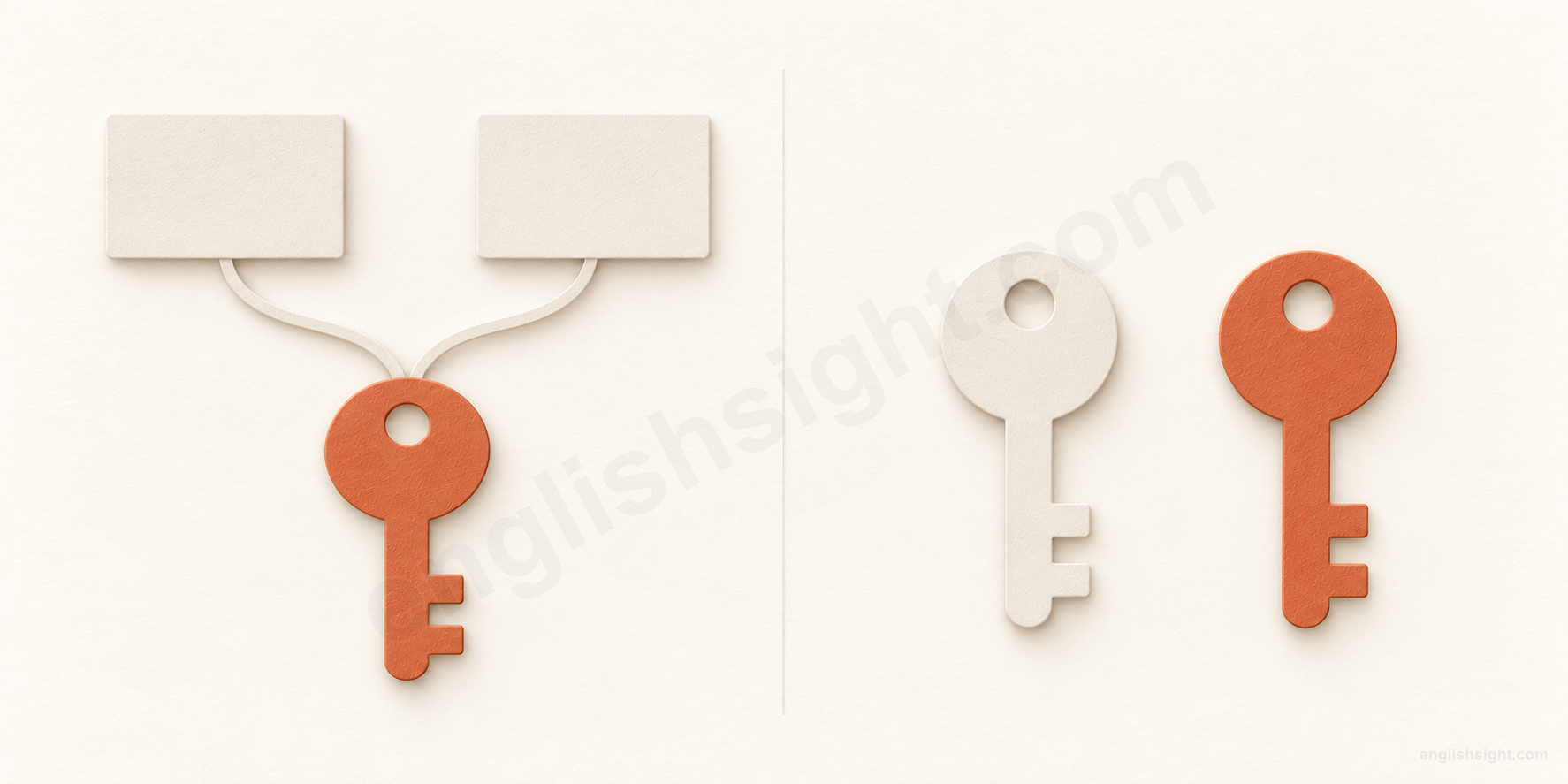
Two references, or two separate objects
same
One shared object, or a matching design
Compare identity or the relevant feature.
Two references, one key; two keys, the same design.
Same identifies one shared referent, or no relevant difference between the things, actions, or states being compared.
The diagram contrasts a shared identity with a matching design. It shows a comparison, not a movement or a required change of state. Fixed expressions need their own explanations.
Same asks what is being kept identical: the particular thing, a relevant feature, or a situation across time. Context tells you which comparison is intended.
A useful teaching model is to check two references or two cases for identity or a relevant match. It does not claim that every English speaker imagines one picture, and it does not predict every idiom.
01
One identity, matching features, or no change
First decide what you are comparing: a particular object, a type, a measurement, a way of doing something, or a state across time.
01
the same + noun; the same + noun + that / relative clause
the same key
one particular thing referred to more than once
Context / comparison
You used a particular key yesterday.
What is shared
You use that key again today.
Two references can identify one object, not two matching objects.
The noun names what remains identical: a key, a person, a place, or an event. I used the same key means the particular key has not been replaced by another.
A following relative clause can identify it: This is the same key that opened the side door. Here that introduces a clause about the key; it is not the comparison word as.
With We read the same book, context decides whether you shared one physical copy or read separate copies of one title. Ask which sense matters when the distinction is important.
In a sentence
I used the same key that I used yesterday.
Watch the difference Two people can have the same name without being the same person.
02
the same + noun; the same kind / type / model of + noun
the same kind of thing
separate things match in the relevant way
Context / comparison
You compare two separately owned jackets.
What is shared
You notice their matching design.
Matching does not require one shared physical object.
In We bought the same jacket, there may be two jackets of one design. The comparison concerns the type, not joint ownership. Adding kind of or model makes that reading clearer.
Similar allows differences; the same normally presents no relevant difference. The relevant respect comes from context: two phones can be the same model but different colors.
In a sentence
We bought the same model of phone in different colors.
Watch the difference Do not assume the same means identical in every possible detail; identify the feature under discussion.
03
the same + size / age / price + as; cost / pay the same
the same size / age / price
match on a specified scale
Context / comparison
The two boxes are different colors.
What is shared
Their measurements match.
The noun after same selects the dimension being compared.
The same size compares size; the same age compares age. Other features may differ. Equal is useful for a measured quantity, but is not a replacement for same in every identity expression.
Use the same size as with a comparison: This box is the same size as that one. For a price, These tickets cost the same says their prices match; cost supplies the money context.
In a sentence
These two boxes are the same size, but different colors.
Watch the difference Say the same age as me, not the same age than me. In full form: the same age as I am.
04
the same as + noun / pronoun / -ing; the same + noun + as + clause
the same as
name the comparison explicitly
Context / comparison
You know the answer on an earlier form.
What is shared
You compare it with the answer on this form.
As introduces what you compare with.
The same as can compare nouns, pronouns, activities, or situations. My answer is the same as yours compares answers; Reading a summary is not the same as reading the whole book contrasts activities.
As can also introduce a clause: I chose the same route as you did. The verb in that clause makes the comparison explicit. Compare the same route that we took yesterday, where that identifies the route.
The comparison may be understood: Are these the same? Keep the in a normal full sentence even when no noun follows same.
In a sentence
My answer is the same as yours, but not the same as Leo’s.
Watch the difference Use the same as, similar to, and different from as dependable patterns; do not mix them into the same to.
05
in the same way (as / that…); verb + the same
in the same way
perform actions in a matching manner
Context / comparison
Two people solve the problem.
What is shared
Their method matches.
The comparison concerns how an action is done.
In the same way describes a method or manner. Two students can reach the same answer in different ways; result and method are separate comparisons.
We both fold it the same is possible, especially in conversation: the same functions adverbially. In the same way is a clear, broadly useful alternative. In the same way as I do names a comparison; in the same way that I showed you supplies a clause describing the method.
In a sentence
We reached the same answer, but we did not solve the problem in the same way.
Watch the difference For an ordinary comparison of manner, use the same or in the same way; do not add -ly to same to form this expression.
06
be / stay / remain the same; still / much / roughly / exactly the same
stay / remain the same
continue without a relevant change
Context / comparison
The price was ten dollars last week.
What is shared
It is still ten dollars today.
Compare one situation at different times.
Be the same can describe a current match; stay or remain the same explicitly expresses continuation. Remain is somewhat more formal. The price is still the same adds the idea that no change has occurred yet.
Not the same can mean changed in quality, feeling, or behavior: The town isn’t the same without its market. It need not mean that a different town has replaced it.
Exactly the same stresses a match. Much the same, roughly the same, and more or less the same allow small differences: The route is much the same as before. These modifiers show how precise your comparison is.
In a sentence
The shop has a new owner, but the prices have stayed the same.
Watch the difference Not quite the same means there is some difference; it does not necessarily mean completely different.
02
Refer back, emphasize, and connect events
The same can stand for an earlier action or idea. Other patterns emphasize identity or place events and claims together.
07
do / have / choose the same; the same + verb
do / have the same
refer back without repeating a noun or action
Context / comparison
Mina saves a copy of her work.
What is shared
You save a copy too.
The same retrieves an action or choice from context.
In I did the same, do carries the action and the same points back to what was done. In I’ll have the same, the choice is understood from an earlier order. This need not mean taking the other person’s actual food.
The same can also be the subject: The same happened to me. Make the reference clear; if several different actions were mentioned, repeat the intended action instead.
In a sentence
Mina saved a copy before closing the file, so I did the same.
Watch the difference Keep the in a normal sentence: I did the same, not I did same.
08
the same goes for + person / thing; the same applies to + person / thing
the same goes for
extend a statement to another case
Context / comparison
A rule has been stated for full-time staff.
What is shared
You include temporary staff under that rule.
The same refers to the earlier statement, not the people themselves.
The same goes for adds another person or case to the scope of a previous statement. The same applies to is a useful, more neutral alternative. Goes here does not describe travel.
The same is the grammatical subject, so use goes or applies even when the following noun is plural. The preposition belongs to the expression: goes for, applies to.
In a sentence
Full-time staff must wear a badge, and the same goes for temporary staff.
Watch the difference Say the same goes for them, not the same go for them or the same applies for them.
09
one and the same (+ noun); the very same (+ noun)
one and the same / the very same
emphasize that apparently separate references have one identity
Context / comparison
You hear of an author and a local teacher.
What is shared
You discover that both descriptions identify one person.
The emphasis rules out two separate individuals.
One and the same stresses a single identity behind two descriptions. You can say They are one and the same or add a noun: one and the same person.
The very same key emphasizes that particular key. Very here does not grade an adjective as in very large. The standalone reply The very same confirms an identification: “The teacher who wrote the guide?” “The very same.” It can sound formal or playfully emphatic.
In a sentence
The author of the guide and our new teacher are one and the same person.
Watch the difference The fixed phrase is one and the same, not one in the same.
10
at the same time; at the same time as + noun / clause
at the same time
events happen together
Context / comparison
Two phones begin ringing.
What is shared
Their ringing overlaps.
The shared feature is time, not the identity of the actions.
At the same time places events together in time: The phones rang at the same time. The actions can be different: She was cooking and listening to the news at the same time.
The same time every day instead compares repeated clock times on different days. Same time tomorrow? is a shortened arrangement question; its missing words are supplied by the conversation.
In a sentence
The doorbell rang at the same time as my phone.
Watch the difference Use at for when something occurs: at the same time. To compare durations, say for the same amount of time.
11
(but) at the same time, + clause
at the same time, …
add a balancing or contrasting consideration
Context / comparison
You acknowledge an advantage.
What is shared
You also mention a drawback.
Both claims belong in the judgment; this need not describe simultaneous events.
At the same time can connect arguments. The second claim qualifies the first, rather than simply reporting when something happens. It often follows but.
In The course is useful; at the same time, it is expensive, usefulness and cost both matter. There is no event whose starting time must match another event’s. Context distinguishes this discourse use from the literal time use.
In a sentence
The apartment is small, but at the same time it is close to work.
Watch the difference Do not translate every at the same time as a statement about two simultaneous actions.
03
Short replies in everyday conversation
These conventional replies leave words understood from context. Their missing article is not a rule for every sentence containing same.
12
statement → Same here.
Same here.
say that the previous feeling or situation applies to you too
Context / comparison
A friend says she dislikes crowded trains.
What is shared
You share that feeling.
Here points to your own case in this informal reply.
Same here is an informal response meaning that you share the thought, feeling, desire, or situation just mentioned. It can also echo a choice: “I’ll have tea.” “Same here, please.”
The reply depends on a suitable preceding statement. It is not a general translation of yes and does not answer every question. Unlike The same to you, it usually describes your own position rather than returning a wish.
In a sentence
“I prefer walking to taking the bus.” “Same here.”
Watch the difference Same here is a conventional short reply; it does not license My answer is same in a full sentence.
13
greeting / wish → (And) (the) same to you.
(The) same to you.
return a wish or greeting
Context / comparison
Someone wishes you a pleasant weekend.
What is shared
You return that wish.
To you directs the earlier message back to the speaker.
The same to you and Same to you return a greeting or good wish. And the same to you is another natural response. This is different from reporting that you feel the same.
The expression can also throw an insult back at someone. The preceding message and tone decide whether it is friendly or hostile; same itself does not supply politeness.
In a sentence
“Have a lovely weekend!” “Thanks, and the same to you!”
Watch the difference After a compliment such as You look great, You too may fit better; choose a reply that makes sense when directed back.
14
(I’ll have) the same again, please.
the same again
order another of what you just had
Context / comparison
You have finished a drink.
What is shared
You order another drink of that kind.
The kind is repeated; the consumed drink does not return.
The same again is a conventional way to request another drink like the previous one. The short request Same again, please relies on the server knowing the order; a full form is I’ll have the same again, please.
Again adds repetition. Compare I’ll have the same, said after a friend orders: that can match the friend’s choice without repeating your own earlier order.
In a sentence
I’ll have the same again, please—another sparkling water.
Watch the difference If the earlier order is unclear, name the drink. This expression does not mean to return the empty glass.
04
Established expressions with same
Learn these as complete expressions. A shared identity or unchanged position can help you remember them, but the whole phrase supplies the conversational meaning.
15
All the same, + clause; clause + all / just the same
all the same / just the same
say nevertheless or despite that
Context / comparison
You recognize that someone could not solve your problem.
What is shared
You still appreciate their effort.
The full expression keeps a judgment or response despite an obstacle.
All the same and just the same can mean nevertheless. They can introduce a clause or appear at the end: It was raining. All the same, we went out; I thanked her just the same.
Distinguish this use from These keys are all the same, where all refers to all the keys and same describes a match. In Just the same size, just can emphasize an exact match. The words alone do not settle the interpretation.
In a sentence
You couldn’t repair the lamp, but thank you all the same.
Watch the difference All the same does not mean that every detail of the two situations is identical.
16
it is all the same to + person; if it is all the same to you, …
It’s all the same to me.
say that the alternatives make no difference to you
Context / comparison
You can meet on Tuesday or Wednesday.
What is shared
Either day is acceptable to you.
The choices can differ while your preference does not.
It’s all the same to me means you do not mind which option is chosen. To me identifies the person whose preference or interests are being discussed.
If it’s all the same to you can introduce a preference or request: If it’s all the same to you, I’d rather leave now. It asks whether the other person minds. Tone matters: It’s all the same to me may sound relaxed, indifferent, or impatient.
In a sentence
“Tuesday or Wednesday?” “It’s all the same to me.”
Watch the difference Compare All the same, I prefer Tuesday, which means nevertheless and expresses a preference.
17
the same old + noun; the same old story; more of the same
the same old story
a familiar situation repeats, often disappointingly
Context / comparison
The bus has been late several times.
What is shared
It is late again today.
The repeated pattern matters more than the individual occasion.
The same old story can refer to a recurring situation rather than a story being read aloud. Speakers often use it when another familiar problem occurs.
The same old excuse similarly suggests that an excuse is tiresomely familiar. Old contributes familiarity and often annoyance; same contributes repetition. More of the same can describe further things of the previous kind without necessarily criticizing them.
In a sentence
The bus is late again—it’s the same old story every Monday.
Watch the difference The same old story does not have to be a literal narrative or a historically old event.
18
amount to the same thing; correction → Same difference.
amount to the same thing / Same difference.
treat a distinction as unimportant in practice
Context / comparison
Two payment schedules are described differently.
What is shared
You judge that they produce an equivalent total.
The practical consequence can match even when descriptions differ.
Amount to the same thing treats two situations as equivalent for the point being discussed. It need not claim that every detail is identical. The reason for treating them as equivalent should be clear.
Same difference is a chiefly American informal reply that dismisses a distinction as unimportant. It can sound careless or dismissive: “It costs forty-one dollars, not forty.” “Same difference—I can’t afford either.” Use it cautiously when accuracy matters.
In a sentence
Paying twenty dollars now and ten later amounts to the same thing as paying thirty dollars now, if there are no fees.
Watch the difference Equivalent total cost does not make the payment dates identical. State the respect in which the choices match.
19
be / get on the same page (about + topic)
on the same page
share an understanding or agreement
Context / comparison
Two colleagues discuss a plan.
What is shared
They agree about what should happen next.
The shared page is an idiomatic shared position, not necessarily a document.
Be on the same page means agree about something or share an understanding of how to proceed. Get everyone on the same page describes bringing people into that agreement. Merriam-Webster labels the idiom chiefly US and informal.
You can specify the topic with about: Are we on the same page about the deadline? Agreement about one point does not imply agreement about everything. Actual readers can also be on the same printed page; context decides whether the phrase is literal.
In a sentence
Before we begin, let’s make sure we’re on the same page about the deadline.
Watch the difference The idiom uses on the same page; in the same page is not the usual expression.
20
be in the same boat (as + person)
in the same boat
share a situation, especially a difficulty
Context / comparison
Your flight has been cancelled.
What is shared
You learn that another traveler’s flight is cancelled too.
People share a predicament without needing to be together physically.
Be in the same boat means be in the same situation or predicament. It is especially useful for showing solidarity when several people face a difficulty.
We’re in the same boat does not promise a solution or imply that we agree about how to respond. Compare on the same page, which concerns agreement or understanding. Someone far away can be in the same boat as you.
In a sentence
I haven’t found a room yet either, so we’re in the same boat.
Watch the difference The idiom uses in the same boat. It does not mean that you necessarily share transport or responsibility.
Make the comparison precise
Usually the same, not a same
Use the same in ordinary full sentences, including after be: They are the same. Demonstratives can replace the: that same day, these same problems. Fixed short replies such as Same here and Same again can omit the. Do not turn these exceptions into a general rule.
Read the part of speech through the construction
Dictionaries describe adjective, pronoun, and adverb uses: the same key, do the same, and work the same. Same has no ordinary verb tense, passive, causative, or phrasal-verb family. Do not add a plural ending to same: the same books, not the sames books.
Identity, likeness, and equality are different questions
The same person identifies an individual; similar people can still be distinct individuals. Equal prices compare a quantity. Identical can emphasize an exact match. No one substitute fits every use of same; name the relevant feature when context could mislead.
Avoid official shorthand in ordinary conversation
Business or legal writing sometimes uses same to mean something already mentioned, as in receipt of same. In everyday English, use it, them, or repeat the noun. Specialized compounds, historical forms, and an exhaustive catalogue of longer idioms are outside this lesson.
Choose the comparison or reply
Identify what is shared, then read the whole expression.
1. Two people buy separate phones of one model in different colors. Which statement is accurate?
2. Your answer matches Ana’s. Choose the standard comparison.
3. A friend tried but could not repair your lamp. You still appreciate the effort. Which reply fits?
4. Someone says Have a lovely holiday! You want to wish them a lovely holiday too. Choose a natural reply.
5. The room is expensive, but at the same time it is close to work. What does at the same time do here?
6. You and another applicant are both waiting for delayed results, but you disagree about what to do. Which expression describes the shared difficulty?
Sources and teaching notes
The linked dictionary entries support the usage distinctions. The explanations, examples, and comparison diagram are original teaching material; the visual is a learning aid.
The diagram illustrates a comparison; it does not claim that everyone pictures same in one way.