Talk about sand as a material, work on a surface, and understand its familiar metaphors.
Tiny grains, different arrangements
Separate grains can form a movable mass
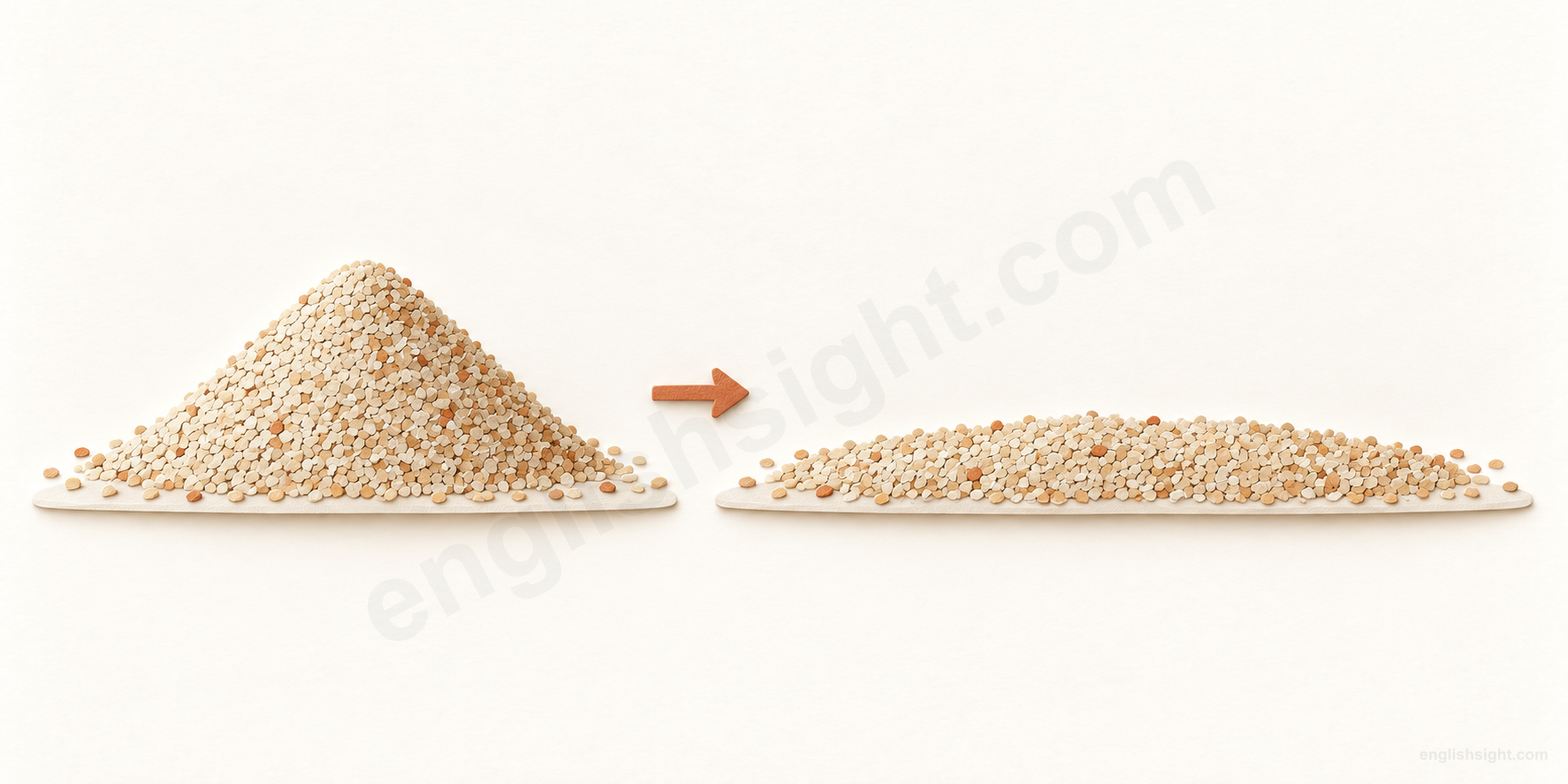
Dry sand gathered in a heap.
sand
Sand spread into a wider, shallower layer.
Loose grains can shift and spread.
Tiny grains form a mass whose arrangement can change; the grains are enlarged here for clarity.
Sand consists of tiny, loose grains that can collect into a heap or spread into a layer.
The sketch focuses on dry, loose sand. Wet or compacted sand can hold a shape; the model is a learning aid, not a rule that predicts every verb or idiom.
At the beach you may feel sand as one mass, yet it consists of many separate grains. This distinction explains why we usually say some sand but a grain of sand.
The loose-grain model connects several uses, but it does not generate every expression. Sand a table and draw a line in the sand need their own construction and context.
01
Grains, quantities, and sandy places
Start with the material. Grammar distinguishes an amount, an individual grain, an area, and a name for something made of sand.
01
sand; some / much / a little sand; the sand + identifying phrase
sand / some sand
the loose material made of tiny grains
Situation / starting point
You find loose grains inside a beach bag.
Meaning / outcome
You name the material, without counting its grains.
Sand names the material as a mass.
Sand is made of tiny grains of rock or mineral material. It may be dry or wet, fine or coarse; the word does not require a yellow colour or a beach.
Use sand without an article for the material in general: Sand gets everywhere. Use the sand for a particular amount or area already identified: The sand in this bag is wet.
Brush the sand off your feet describes removing it from a surface; shake the sand out of your shoes describes removing it from inside. Off and out of belong to those removal patterns, not to a phrasal verb headed by sand.
In a sentence
There is still some sand in my bag.
Watch the difference For an ordinary amount, say some sand, not a sand or a few sands.
02
a / two + grain(s), handful(s), bag(s) + of sand
a grain / a handful of sand
count particles or measure an amount
Situation / starting point
You want to mention one particle or one small portion.
Meaning / outcome
You put a countable unit before of sand.
Count the unit; keep the material noun unchanged.
A grain of sand is one particle; three grains of sand are three particles. A handful of sand measures an amount that fits in a hand. A bag of sand names the amount held in a bag.
The plural ending belongs to grains, handfuls, or bags: two bags of sand. A grain is not a miniature beach, and sands is not the ordinary plural for individual particles.
In a sentence
A few grains of sand fell onto the table.
Watch the difference Distinguish a little sand, an amount, from a few grains of sand, a number of particles.
03
on / in the sand; adjective + sands; the sands of + place
on the sand / golden sands
a sandy surface or a large sandy area
Situation / starting point
You describe where you sit or what a coast looks like.
Meaning / outcome
Sand refers to the surface or extent of a place.
Sands can name broad sandy areas, not a count of grains.
Sit on the sand treats it as a supporting surface. Dig in the sand treats it as material you work within. The choice of preposition follows the relation: footprints in the sand are impressions in its surface.
Golden sands and desert sands describe stretches of sandy land. This plural is especially useful in descriptive writing and holiday descriptions; ordinary conversation can simply use the beach or the sand.
A beach is a place beside the water and may have stones rather than sand. Sand is the material and also occurs far from the sea. The two words are not interchangeable in every sentence.
In a sentence
Beyond the village, golden sands stretch along the coast.
Watch the difference The sands here means sandy land; it does not mean several separate grains.
04
a / two sand dune(s); a / two sandcastle(s)
a sand dune / a sandcastle
name a sandy landform or a shape made from sand
Situation / starting point
You see a wind-shaped hill or a child’s model.
Meaning / outcome
The full noun identifies what the sand forms.
The following noun supplies the kind of thing.
A sand dune is a hill formed as wind gathers sand. A sandcastle is a model castle made of sand. Sand identifies the material, while dune and castle identify the form.
These are nouns you can count: two sand dunes, three sandcastles. Their conventional spellings differ: sand dune is two words; sandcastle is one. This does not make sand itself countable in the ordinary material sense.
In a sentence
The children built a sandcastle near the water.
Watch the difference A dune is not every pile of sand; use the name for the wind-formed landform.
05
in sand; sand-coloured + noun
sand / sand-coloured
a light colour associated with sand
Situation / starting point
You compare colour choices for a room.
Meaning / outcome
Sand names a shade rather than a loose material.
A colour name does not say what an object is made of.
In colour descriptions, sand names a pale yellowish, greyish, or tan shade. A shop may list curtains in sand; the exact shade depends on the product.
Sand-coloured curtains states the colour clearly. Sandy can describe something containing sand, covered with it, or resembling its colour, so use context rather than assuming that every sandy object is merely beige.
In a sentence
We chose sand-coloured curtains for the bedroom.
Watch the difference Real sand has different colours; sand is not a universal precise colour specification.
02
Working on a surface
The verb can mean rubbing a surface smooth or putting sand onto it. The object and setting help you choose the right interpretation.
06
sand + object; sand + object + smooth; be sanded
sand a surface
rub a surface with an abrasive to make it smooth
Situation / starting point
A wooden shelf feels rough.
Meaning / outcome
You rub away roughness before painting.
The object is the surface being worked on.
Sand the shelf means work its surface with sandpaper or a sander. Abrasive grains remove small amounts of material; it does not normally mean pouring loose sand over the shelf.
This is a regular action verb: sand, sands, sanded, sanding. You can say I’m sanding the shelf, or use a passive: The shelf was sanded before painting. Sand it smooth makes the intended resulting surface explicit.
In a sentence
Mina sanded the rough edge before painting the shelf.
Watch the difference Sanding changes a surface by abrasion; washing it removes dirt with water and is a different action.
07
sand down + noun; sand + noun / pronoun + down
sand down
smooth a surface or reduce roughness by sanding
Situation / starting point
A table top needs preparation for a new finish.
Meaning / outcome
You smooth its surface by abrasion.
Down belongs to the sanding expression; it need not describe downward movement.
Sand down is often interchangeable with sand in this surface-working sense. Down can suggest removing rough or raised material, but does not require moving the tool downwards.
The expression is separable: sand down the table or sand the table down. Put an object pronoun between the verb and particle: sand it down, not sand down it. Sandpaper is the tool or material used, not the object being made smooth.
In a sentence
The top feels rough, so I’ll sand it down first.
Watch the difference Sand down does not mean lower a table physically or cover it with sand.
08
sand + road / path / surface
sand an icy road
spread sand onto a surface
Situation / starting point
An icy path is slippery.
Meaning / outcome
Workers put a layer of sand on it.
Here the verb adds sand instead of rubbing material away.
Sand can also mean scatter or cover with sand. On an icy road or path, the context points to applying sand for grip, rather than using sandpaper.
Compare sand a wooden floor before varnishing, normally an abrasive action, with sand an icy road, a spreading action. Both take the surface as object, so grammar alone does not settle the meaning. This use is particularly relevant where winter road treatment uses sand.
In a sentence
The crew sanded the icy path before the visitors arrived.
Watch the difference Sanding a road does not by itself mean melting the ice; the word describes adding sand.
03
Established images and expressions
These expressions use different features of sand: hiding something, marking a boundary, shifting, weak support, and time passing. Learn each whole expression.
09
bury / hide + possessive + head in the sand
bury / hide your head in the sand
avoid admitting or dealing with a problem
Situation / starting point
There are warnings that a plan is failing.
Meaning / outcome
Someone deliberately avoids facing the warnings.
The whole expression criticizes avoidance, not lack of information alone.
Bury your head in the sand describes refusing to face something unpleasant. The imagined hiding action helps explain the metaphor, but no literal sand or physical hiding is required.
Change the possessive to match the person: I buried my head in the sand; they hid their heads in the sand. It often sounds critical, so it is stronger than saying someone has not heard about a problem.
In a sentence
We can’t bury our heads in the sand when the complaints keep growing.
Watch the difference Not knowing about a problem is different from refusing to acknowledge it.
10
draw a line in the sand; a line in the sand
draw a line in the sand
set a firm limit on what you will accept
Situation / starting point
Others keep asking for work outside an agreement.
Meaning / outcome
You state the point beyond which you will not agree.
A marked boundary stands for a limit on acceptable action.
Draw a line in the sand establishes a limit: this much is acceptable, but no further. The line can concern behaviour, spending, or demands; it need not be a physical mark.
The expression can sound firm or confrontational. State the actual limit so the listener knows what you mean. It does not mean that you have solved the disagreement or that the other person will respect the limit.
In a sentence
We drew a line in the sand: no more unpaid weekend work.
Watch the difference The boundary meaning belongs to the full expression; sand alone does not mean a rule.
11
(the) shifting sands of + noun
the shifting sands of…
circumstances that change and are hard to deal with
Situation / starting point
Rules change repeatedly while a team tries to plan.
Meaning / outcome
The team has to adapt without a stable basis.
The moving ground is a metaphor for an unstable situation.
The shifting sands of something describes a situation that keeps changing, making understanding or planning difficult. It is especially useful in commentary about policies, business, or relationships.
Shifting describes repeated movement or change; sands supplies the image of ground that does not stay fixed. This is a figurative expression, not a phrasal verb, and not just a neutral synonym for any small change.
In a sentence
Small businesses struggle with the shifting sands of local regulations.
Watch the difference Keep the usual plural sands in this expression.
12
be built on sand; a plan / argument + built on sand
be built on sand
depend on a weak or unreliable basis
Situation / starting point
A forecast assumes orders that no customer has promised.
Meaning / outcome
Its impressive results rest on an unreliable assumption.
The foundation image evaluates support, not appearance.
A plan, argument, or success built on sand lacks a reliable foundation and may fail. What is weak may be its evidence, assumptions, or financial basis.
The passive-looking phrase belongs to the construction with build; sand is a noun after on. Unlike shifting sands, it need not imply repeated changes. A single false assumption can make a plan built on sand.
In a sentence
Without reliable sales figures, the forecast is built on sand.
Watch the difference A weak basis makes failure possible or likely; the phrase does not state that failure has already happened.
13
the sands of time; the sands of time are running out
the sands of time
the passing of time, imagined as grains in an hourglass
Situation / starting point
A writer reflects on years going by.
Meaning / outcome
Falling grains become a picture of passing time.
This image comes from sand in an hourglass, not from a beach.
The sands of time is a literary or rhetorical way of referring to time passing. An hourglass lets grains fall from an upper chamber into a lower one, giving the image a connection with a limited span of time.
In The sands of time are running out, the speaker suggests that little time remains. For an everyday practical warning, We’re running out of time is more direct. Learn the plural sands as part of this expression rather than counting literal moments as sands.
In a sentence
The old clock reminds her that the sands of time keep running.
Watch the difference This is a stylized expression; it is not the usual way to ask how long a task will take.
Read the noun, verb, and whole expression
Material is usually uncountable
Use sand is and some sand for the ordinary material. Count grains or containers when needed. The descriptive plural sands names areas, and fixed expressions such as shifting sands keep their established form.
Two different surface actions
Sand a shelf normally means abrade it; sand an icy path can mean spread sand on it. Sandpaper and a sander are used for the first action. The setting matters as well as the object.
Forms and pronunciation
Sand is /sænd/. The verb forms are sand, sands, sanded, sanded, sanding. Sanded has an extra syllable, /ˈsændɪd/. Progressive and passive verb forms are natural in suitable contexts.
The image has limits
A sandy area, a colour, and sand used as an abrasive connect with the material in different ways. The idioms select separate images. None requires every English speaker to imagine the same picture.
Coverage boundary
This lesson covers everyday material and place uses, colour descriptions, two surface actions, sand down, and familiar figurative expressions. Geological size classifications, oil-bearing formations, specialist sand-filled channels, regional sand meaning courage, and names such as George Sand are not expanded.
Choose the meaning that fits
Check whether you need a material, a countable unit, an action, or a complete expression.
1. You mean three tiny individual particles. Which phrase fits?
2. You will smooth a rough table top with sandpaper. Which instruction uses the pronoun correctly?
3. A crew sands an icy path. What does sand most naturally mean here?
4. An argument depends on invented evidence. Which expression describes its weak basis?
5. A travel description promises miles of golden sands. What is being described?
Sources and teaching notes
The sources below support the meanings and constructions. Explanations and examples are original; the heap-to-layer sketch is a teaching model, not a dictionary claim about a universal mental picture.
The diagram is a teaching aid; speakers do not all share one mental picture.