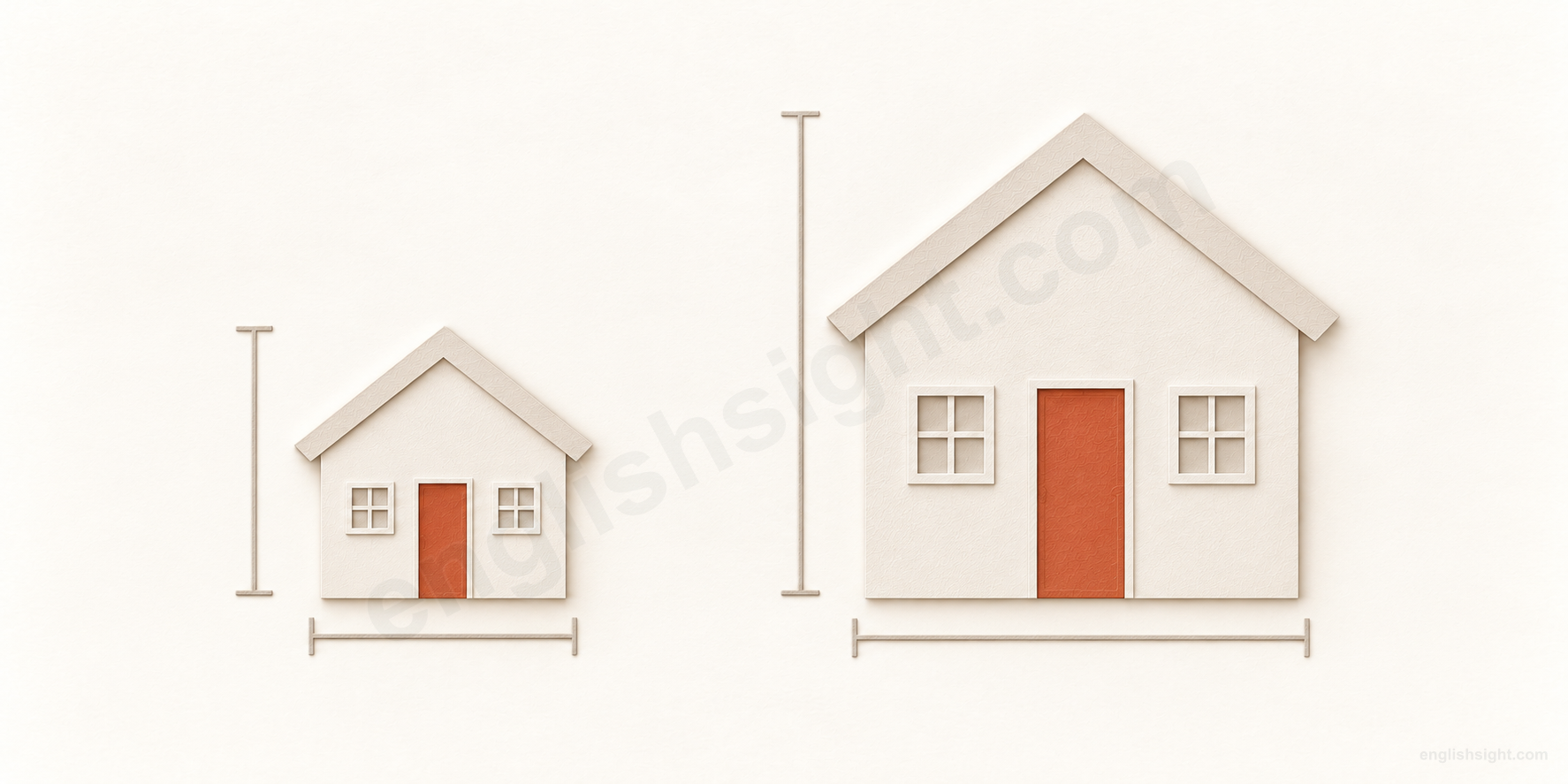
Measure, compare, resize—and recognize the separate branches.
Size in relation to a reference
Size in relation to a reference
Smaller representation
scale
Larger reference
Corresponding lengths change by a consistent factor.
The same house design appears at two sizes with matching proportions. This illustrates scale as a size relationship.
A scale can express how large or high something is relative to a measuring system or a consistent proportion.
The sketch selects the proportion branch: two representations keep the same shape while corresponding lengths differ by a constant factor. It does not explain every use of scale.
Scale often gives size or degree a reference: a row of marks, a range of ratings, or the proportion between a model and the real thing. The words around it tell you which reference matters.
The same spelling also names weighing equipment and protective plates, and it can mean climb. Learn these branches in context instead of forcing them all into one picture. The visual model is a teaching aid, not a claim about every speaker’s mental image.
01
Measure and compare
A scale can supply marks, ratings, or ordered levels. Ask what is being measured and what the endpoints mean.
01
read + the scale; read + a measurement + off the scale
read the scale
use the marks on a measuring instrument
Situation / reference
A measuring jug has lines along its side.
Meaning in this context
You identify the liquid level.
The scale is the marked reference, not the liquid.
The lines on a jug or thermometer let you read an amount. Check the units before interpreting a mark.
Compare reading the scale with weighing something on the scales: the first means interpreting measurement marks; the second means using weighing equipment.
Example in context
Read the scale on the jug before adding more water.
Watch the difference Scale is not automatically a ruler: the marks may appear on many kinds of instrument.
02
on a scale of / from X to Y; on the + named + scale
on a scale of 1 to 10
give a rating using defined levels
Situation / reference
A form asks how easy a task was.
Meaning in this context
You choose a score from the stated range.
A number only makes sense with its rating system.
Say on a scale, then give its range: of 1 to 10 or from 1 to 10. State whether a higher number means better, worse, or more intense.
A temperature scale also defines a measurement system: 30 degrees on the Celsius scale and 30 degrees on the Fahrenheit scale are different temperatures.
Example in context
On a scale of 1 to 10, with 10 meaning very easy, I would give it an 8.
Watch the difference Use on a scale for a rating; at scale has a different meaning.
03
a pay / salary scale; a scale of fees / charges
a pay scale / a scale of fees
organize payments in a schedule
Situation / reference
Jobs have different grades and responsibilities.
Meaning in this context
Each grade has an associated salary range.
This scale links a category to an amount of money.
A pay scale tells you how pay relates to a job grade or other conditions. A scale of fees lists charges for services; scale of charges is another established form.
At the top of the pay scale refers to the highest listed level. It need not mean being the most senior person in the organization.
Example in context
The job starts near the bottom of the pay scale.
Watch the difference A pay scale is a payment structure, not one person’s payslip.
04
fees / payments + on a sliding scale; a sliding scale based on + condition
on a sliding scale
vary a rate according to a stated condition
Situation / reference
People have different incomes.
Meaning in this context
The same service costs different amounts under a rule.
Sliding describes an adjustable payment rule.
A sliding scale changes the charge or payment as a relevant condition changes. For example, a community class may set lower fees for lower incomes.
Sliding does not mean that the price changes unpredictably: ask which condition the schedule uses.
Example in context
The centre charges class fees on a sliding scale based on household income.
Watch the difference Do not assume every sliding scale is income-based; the context must supply the rule.
05
at the top / bottom / other end of the scale; high / low on the scale
at the other end of the scale
contrast opposite parts of an ordered range
Situation / reference
Some hotel rooms are very expensive.
Meaning in this context
You turn to the cheapest rooms.
The two ends belong to the same comparison.
The top, bottom, and other end of the scale describe positions in a range. No physical ruler or printed chart is required.
The social scale orders people by perceived social position. That wording describes a ranking; it does not establish anyone’s personal worth.
Example in context
Suites cost hundreds a night; at the other end of the scale, a shared room costs twenty.
Watch the difference At the other end contrasts positions, not a physical location at the far end of a room.
06
subject + be / go + off the scale
off the scale
emphasize an extreme amount or degree
Situation / reference
Demand is much higher than anyone expected.
Meaning in this context
You describe it as exceptionally high.
An imagined measuring range supplies the comparison.
Off the scale is an established idiom for an exceptionally large amount or degree. It need not refer to a real measuring instrument.
It can express positive or negative extremes: excitement can be off the scale, and so can anger. Compare out of scale with, which describes a mismatch in relative size.
Example in context
Demand for tickets was off the scale after the band announced its return.
Watch the difference Off the scale does not automatically mean good; the thing being described determines the evaluation.
02
Keep or change proportions
A scale connects a representation with its reference. Resizing and expansion use related language, but a business need not grow in exact mathematical proportions.
07
a scale of 1:N; a scale model / drawing
a scale of 1:100
relate a drawing’s dimensions to real dimensions
Situation / reference
A real wall is ten metres long.
Meaning in this context
The plan shows it as ten centimetres long.
One drawing unit represents one hundred real units.
At 1:100, one centimetre on the plan represents one hundred centimetres in reality. Use matching units when reading the ratio.
A scale model preserves proportions. Smallness alone does not make a toy a scale model: corresponding parts must follow the ratio.
Example in context
We built a scale model of the house at a scale of 1:100.
Watch the difference A length ratio of 1:100 does not mean the area is one hundredth; area changes in two dimensions.
08
draw / build + something + to scale; be drawn to scale
drawn to scale
use consistent proportions in a representation
Situation / reference
You want to check whether furniture will fit.
Meaning in this context
A plan preserves the relevant relative sizes.
All corresponding lengths follow the same ratio.
A sketch drawn to scale can support size comparisons. A sketch marked not to scale may explain an arrangement without reliable relative dimensions.
To scale is a fixed prepositional expression. There is no article before scale here.
Example in context
Draw the room and the furniture to scale before choosing a desk.
Watch the difference Say drawn to scale, not drawn to a scale, when using this fixed expression alone.
09
be / look + out of scale with + reference
out of scale with
be disproportionately large or small beside something
Situation / reference
A small room has modest furniture.
Meaning in this context
One enormous lamp looks mismatched.
The judgment is relative to the surroundings.
Out of scale with compares an object with nearby things. It can describe something that is too small as well as too large.
Unlike not to scale, this need not concern a drawing. A real building can look out of scale with the houses beside it.
Example in context
The new sign looks out of scale with the narrow shopfront.
Watch the difference Do not confuse out of scale with out of stock, which concerns availability.
10
scale + object + to + size / percentage; be scaled to fit
scale an image
change dimensions by a chosen factor
Situation / reference
A picture is too large for a page.
Meaning in this context
You reduce it while retaining its proportions.
The object is resized rather than physically climbed.
In design and computing, scale an image means change its size. For example, scale it to 50 percent makes each dimension half the original if the same factor is applied throughout.
The passive is natural: The image was scaled to fit the page. Scaling differs from cropping, which cuts away part of the picture.
Example in context
Scale the image to half its original width, keeping its proportions.
Watch the difference Changing width alone can stretch or squeeze an image instead of preserving its shape.
11
scale up + noun; scale + noun / pronoun + up
scale up
increase size, output, or capacity
Situation / reference
A workshop makes twenty units a day.
Meaning in this context
It prepares to make two hundred.
Up marks expansion; it does not mean moving upstairs.
Scale up production describes expansion. Physical designs may enlarge proportionally, but expanding an operation need not multiply every detail by the same factor.
Use scale up the operation or scale the operation up. With a pronoun, use scale it up. The passive production was scaled up focuses on the increase rather than the organizer.
Example in context
The team plans to scale up production before winter.
Watch the difference Scale it up is the normal pronoun order; avoid scale up it.
12
scale down + noun; scale + noun / pronoun + down; a scaled-down + noun
scale down
reduce size, amount, or scope
Situation / reference
A festival plan exceeds the budget.
Meaning in this context
The organizers arrange a smaller event.
Down reduces the undertaking rather than canceling it automatically.
Scale down can reduce a model or a project. A scaled-down version keeps something of the original while making it smaller or less extensive.
Say scale down the event or scale the event down; with a pronoun, scale it down. It has been scaled down is a normal passive form.
Example in context
We scaled the festival down to fit the smaller budget.
Watch the difference Scale down does not necessarily mean shut down: reduction and closure differ.
13
scale back + noun; scale + noun / pronoun + back
scale back
reduce a level of activity or commitment
Situation / reference
A company has an expensive travel programme.
Meaning in this context
It allows fewer trips.
Back suggests a reduction in what is being done or planned.
Scale back overlaps with scale down, especially for spending, plans, and activity. It can reduce a proposed commitment; the full plan need not already be operating.
Use scale back spending or scale spending back, and scale it back with a pronoun. Collins marks the expression mainly US; it is useful to recognize in international business reporting.
Example in context
We need to scale back our travel plans this year.
Watch the difference Back does not guarantee a return to an exact earlier amount.
03
Describe the size of an undertaking
Here scale concerns how much activity, work, or impact is involved, rather than a numbered instrument.
14
the scale of + noun; the sheer / full scale of + noun
the scale of the problem
describe how extensive something is
Situation / reference
Several reports describe separate failures.
Meaning in this context
You realize how widespread the problem is.
Scale concerns overall extent, rather than one individual measurement.
Ask about the scale of damage, work, or a problem when you need to understand its overall size or reach. The sheer scale emphasizes how impressive or overwhelming that extent is.
Compare size and scale: size is an easy choice for a shirt; scale is especially useful for projects, events, and effects considered as a whole.
Example in context
The survey helped us understand the full scale of the damage.
Watch the difference Scale of the problem is not normally a numbered rating unless the context introduces such a system.
15
on a large / small / global scale; large-scale / small-scale + noun
on a large / small scale
describe the extent of activity
Situation / reference
A grower begins with a few plants.
Meaning in this context
The method is tried in limited production.
The expression describes how much activity takes place.
On a small scale and on a large scale describe limited and extensive activity. On a global scale extends the comparison to the world.
Before a noun, use the compound adjective: a small-scale trial or large-scale production. Compare We tested it on a small scale with We ran a small-scale test.
Example in context
We tested the method on a small scale before expanding.
Watch the difference Do not substitute at large scale mechanically for the established phrase on a large scale.
16
work / operate / deliver + at scale
at scale
operate for large numbers or an extensive deployment
Situation / reference
An idea works in one classroom.
Meaning in this context
You ask whether it can serve hundreds of schools.
At scale concerns the demands of extensive operation.
This phrase is common in business and technology discussions about delivering a service widely. A successful small trial does not automatically establish that the service works at scale.
It does not state a fixed numerical threshold. Explain the expected number of users or sites when precision matters.
Example in context
The pilot worked, but can we deliver the service at scale?
Watch the difference At scale is not the phrase for a score of seven out of ten; use on a scale.
17
full-scale + investigation / operation / model
a full-scale investigation / model
describe full scope or actual size
Situation / reference
A brief check leaves serious questions.
Meaning in this context
A complete investigation follows.
Full-scale can concern completeness or physical dimensions.
A full-scale investigation uses a thorough effort rather than a limited preliminary check. A full-scale model instead has the dimensions of the thing represented.
The noun tells you which interpretation is relevant. A scale model can be reduced; a full-scale model is at the reference object’s actual size.
Example in context
After the initial checks, the company began a full-scale investigation.
Watch the difference Do not assume full-scale always means physically big: the model’s reference object may be small.
18
achieve / benefit from + economies of scale
economies of scale
reduce unit costs through greater production
Situation / reference
A fixed setup cost covers a short print run.
Meaning in this context
More copies share that setup cost.
The saving concerns cost per item, not necessarily total spending.
This established business expression describes cost advantages from producing more. For example, sharing a setup cost across more copies can reduce the cost of each copy.
The usual plural is economies of scale. Growth alone does not prove such savings: additional costs may offset them.
Example in context
A longer print run can bring economies of scale by spreading the setup cost across more copies.
Watch the difference Economies of scale does not mean that the total bill must become smaller.
04
Weigh things and influence outcomes
A weighing device has its own noun use. Balance imagery also appears in expressions about decisions.
19
British: scales + plural verb; American also: a scale + singular verb
kitchen scales / a kitchen scale
name equipment for weighing
Situation / reference
You need a measured amount of flour.
Meaning in this context
A weighing device shows its weight.
Scales names the equipment, not its individual markings.
British English commonly uses plural scales even for one device: These scales are accurate; a pair of scales is another way to name one device. American English also uses a scale: This scale is accurate.
Kitchen scales measure ingredients; bathroom scales measure body weight. To weigh is the ordinary verb: weigh the flour on the scales.
Example in context
These kitchen scales are accurate enough for baking.
Watch the difference Do not call one British-style device a scales; use scales or a pair of scales.
20
subject + tips / tipped the scales at + weight
tip the scales at
state a weight, often an impressive one
Situation / reference
A pumpkin is placed on weighing equipment.
Meaning in this context
Its weight is announced.
At introduces an amount of weight.
This established expression means weigh a particular amount. It often appears in lively descriptions of a person, animal, or unusually heavy object.
It does not require a visible two-pan balance. Weigh is the simpler neutral alternative.
Example in context
The winning pumpkin tipped the scales at forty kilos.
Watch the difference Keep at before the weight; in someone’s favour belongs to a different use.
21
something + tips the scales / balance + in favour of / against + someone
tip the scales in someone’s favour
give one outcome a decisive advantage
Situation / reference
Two applicants seem equally suitable.
Meaning in this context
One relevant qualification influences the choice.
An added factor affects which side wins.
The balance image helps explain a decision going one way. Tip the balance is a close alternative; in favour of names the side helped, and against names the side disadvantaged.
Unlike tip the scales at forty kilos, this expression does not report weight. The subject is often the factor that changes the outcome.
Example in context
Her experience with children tipped the scales in her favour.
Watch the difference Read the following words: at plus a weight is literal measurement; in favour of introduces an advantage.
05
Notes, surfaces, and climbing
These established branches need their own context. A rating scale does not explain a fish’s scales, and scaling a wall is not resizing it.
22
play / practise / practice + scales; the + key + major / minor scale
practise scales
play an ordered series of pitches
Situation / reference
A learner is working on finger control.
Meaning in this context
They play notes in the order of a chosen scale.
A musical scale orders pitches, not loudness.
A major or minor scale gives a particular pattern of pitch intervals. You can play a scale upwards or downwards; it is not simply any tune.
Practise scales is British spelling; practice scales is American spelling. The C major scale and the scale of C major are both useful forms.
Example in context
I practise the C major scale slowly before playing the piece.
Watch the difference Going up a scale means rising in pitch, not necessarily playing louder.
23
a scale; fish / reptile scales; be covered in / with scales
fish scales
name the small plates covering an animal
Situation / reference
A fish’s skin has many overlapping plates.
Meaning in this context
You describe that protective covering.
One scale is a plate; scales are many plates.
This countable noun commonly appears in the plural for a fish or reptile’s covering. A single loose plate is a scale.
It is a separate branch from measurement. A fish on the scales is being weighed; scales on a fish are part of its covering.
Example in context
The fish had bright scales along its sides.
Watch the difference Fish scales are not the same as kitchen scales, even though both nouns can be plural.
24
scale + in / inside / on + surface; a build-up of scale
scale in a kettle
name a hard deposit on a surface
Situation / reference
Water is repeatedly heated in a kettle.
Meaning in this context
A hard pale deposit remains inside.
Here scale is material, so it is normally uncountable.
In household contexts, scale or limescale names the deposit left by hard water. Some scale inside the kettle refers to material, not several measuring devices.
Scale is also used for hard deposits on teeth. The context distinguishes this from a fish’s countable plates.
Example in context
There is a build-up of scale inside the old kettle.
Watch the difference Do not pluralize ordinary kettle deposits as scales merely because several patches are visible.
25
scale + fish / teeth; be scaled; scale and polish
scale a fish / scale teeth
remove scales or hard deposits
Situation / reference
A fish still has its scales.
Meaning in this context
Someone removes them during preparation.
The verb names removal, not the addition of a covering.
In scale a fish, the fish is the object being cleaned, and its scales are removed. The ordinary active and passive are both possible: The fishmonger scaled it; The fish was scaled.
At the dentist, scale and polish describes professional cleaning that includes removing hard deposits from teeth. These uses depend on the surface-material branch, not the diagram’s size ratio.
Example in context
The fishmonger scaled the fish before wrapping it.
Watch the difference The object matters: scale the picture resizes it; scale the fish removes its scales.
26
scale + wall / peak / mountain; scale the heights of + field
scale a wall / mountain
climb a high or steep obstacle
Situation / reference
A climber is below a steep wall.
Meaning in this context
They climb up it and reach the top.
The wall is the direct object of the climbing verb.
This is a more formal or written alternative to climb for a high, steep object. Scaled the wall can describe getting to its top or over it, depending on what follows.
Scale the heights of a profession extends the climbing image to reaching great success. It is figurative and more elevated in style than do very well at work.
Example in context
The climbers scaled the rock face before sunset.
Watch the difference Use the object directly: scale the wall, rather than scale to the wall for this climbing sense.
Check the branch and the grammar
Countable, plural, or material?
A rating scale and a fish scale are countable. Overall scale and mineral scale are often uncountable. British weighing scales normally take a plural verb; American English also has a singular scale.
Verb forms and objects
The forms are scale, scales, scaled, scaling: drop the final e before -ing. Scaling can describe an ongoing action. Objects and particles select the sense; scale up/down/back are separable particle verbs. Scale a wall and scale a fish are ordinary transitive constructions, not particle verbs.
A useful connection has limits
Marks, ordered levels, ratios, and extent can help organize the main measurement family. The picture does not predict the meanings of animal plates, mineral deposits, or every idiom. This lesson gives common uses plus selected practical terms, not a frequency ranking or every technical meaning.
Read the whole expression
Choose the sentence that matches the situation.
1. You want a plan that preserves the room’s relative dimensions. Which instruction fits?
2. You must reduce an event and refer to it with it. Which order is natural?
3. A pumpkin tipped the scales at forty kilos. What does that say?
4. The fishmonger scaled the fish. What happened?
5. Which sentence uses the ordinary British plural name for a weighing device?
6. A larger print run brings economies of scale. Which conclusion fits?
Sources and teaching notes
The dictionary pages below support the usage coverage. Explanations, examples, and the proportion sketch were created for this lesson; the visual connection is a teaching interpretation.
The proportion sketch illustrates one branch; it is not an image shared by every native speaker.