Name the tool, count it with pair, and recognize its familiar extensions.
Two blades, one cutting tool
Two blades, one cutting tool
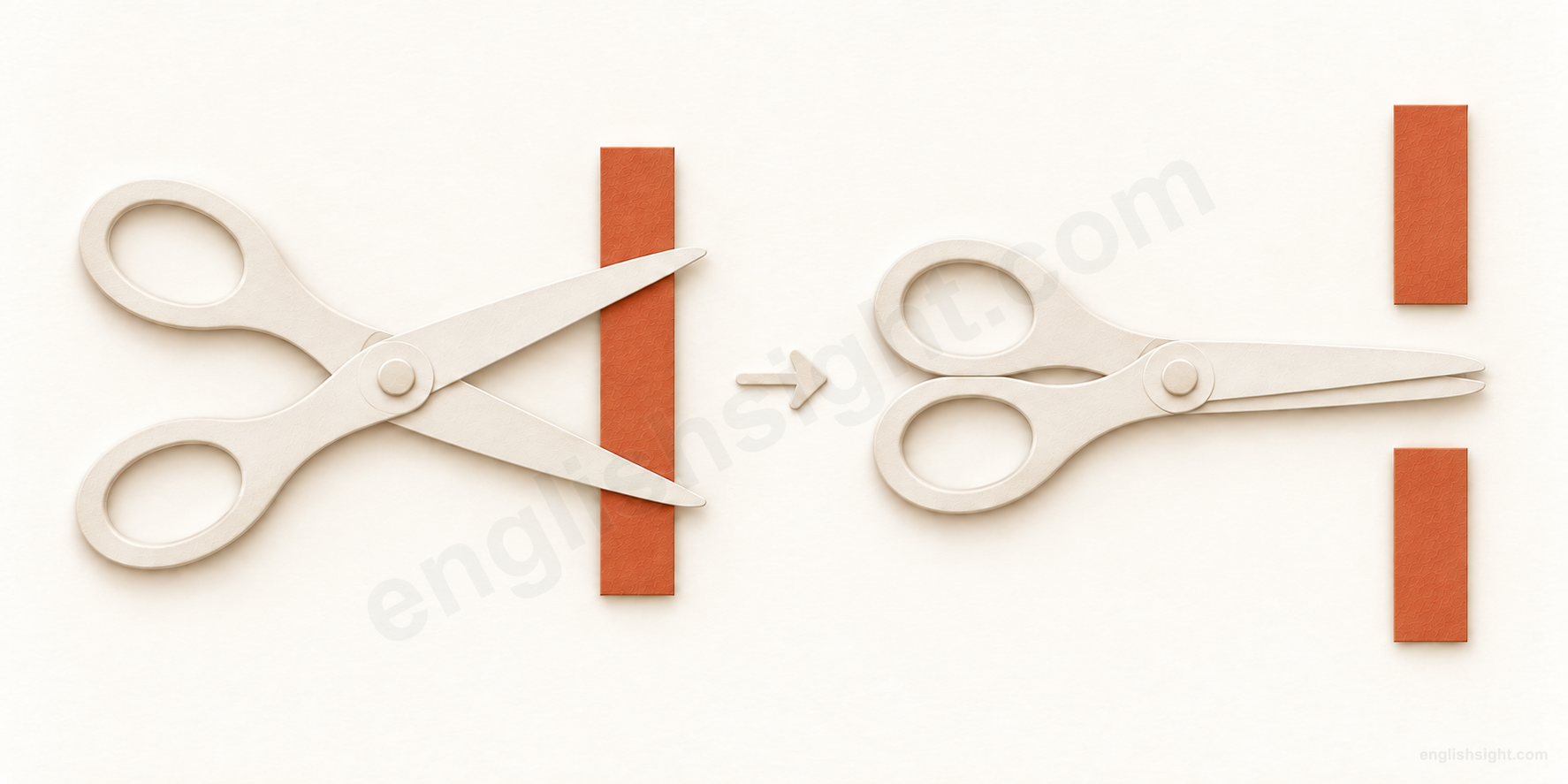
The open blades surround an intact paper strip.
scissors
The cut strip is shown as two pieces moved apart.
The handles close, turning the joined blades past each other.
Two joined blades form one cutting tool. Scissors can also name it at rest.
Scissors are a tool with two pivoted blades whose cutting edges slide past each other as the handles close.
This model explains the tool’s operation and the resemblance in some sporting terms. It does not make every use a cutting action, and the noun does not promise that a cut has been completed.
Scissors usually names a cutting tool. Its two blades are connected, and their edges pass each other as the tool closes. That working relationship also helps explain some names for leg movements.
The most useful grammar point is easy to miss: one tool is normally called scissors or a pair of scissors. Learn the name and its sentence patterns together.
01
Name and count the tool
Learn the object, its pronunciation, and the difference between a plural name and a count of complete tools.
01
scissors; some scissors; the scissors
scissors
a tool whose two joined blades work together to cut
Situation before
You need to separate a piece of ribbon.
What the expression conveys
You look for the appropriate cutting tool.
The noun names the whole tool, including both blades and handles.
Scissors have two blades connected at a pivot. As the handles come together, the cutting edges pass alongside one another. The diagram isolates this working relationship; the noun can name the tool even when nobody is using it.
The first syllable sounds like siz, not skis: British /ˈsɪzəz/, American /ˈsɪzərz/. The written c has no separate sound. Keep the final sound of scissors; it is part of the normal tool name.
In a sentence
Could you bring me some scissors for this ribbon?
Watch the difference A blade is one part. Do not call one blade a scissor when you mean part of the tool.
02
these / those scissors + plural verb; they / them
these scissors are…
use plural agreement for the ordinary tool name
Situation before
One cutting tool lies beside your notebook.
What the expression conveys
You ask whether it belongs to your friend.
One physical object can still have a grammatically plural name.
For ordinary learner English, use these or those scissors, scissors are, and they or them. “These scissors are yours, aren’t they?” can refer to just one tool. The ending does not tell you how many tools are present.
Merriam-Webster and the American sections of Collins also record singular construction. You may therefore encounter scissors is. Plural agreement is the straightforward model taught here; the existence of variation does not make a scissor the normal singular tool name.
In a sentence
Are these scissors yours? I found them beside my notebook.
Watch the difference Use these scissors in the ordinary tool sense, rather than this scissors. Changing to a pair changes the grammatical head.
03
a / one / another pair of scissors; number + pairs of scissors
a pair of scissors / two pairs of scissors
count complete tools with pair
Situation before
Three people each need one tool for a craft activity.
What the expression conveys
You request three complete tools.
A pair of scissors is one complete tool, not two separate tools.
Pair gives you a countable head noun: a pair, another pair, two pairs. “A pair of scissors is missing” has singular agreement with pair. “Two pairs of scissors are missing” has plural agreement with pairs.
Keep scissors unchanged after of. You can ask for some scissors when the exact number is unimportant, or for one pair when it matters. In “This pair is mine,” this modifies pair; in “These scissors are mine,” these modifies scissors.
In a sentence
We need three pairs of scissors, one for each person.
Watch the difference For clear everyday counting, say two pairs of scissors, not two scissors. A pair of scissor is also incorrect for the tool.
02
Describe the job and choose the tool
Use cutting patterns to say what happens, with scissors to name the instrument, and modifiers to specify its purpose or condition.
04
cut + object + with scissors; use scissors to + verb
cut something with scissors
identify the instrument used for cutting
Situation before
A label is attached to a parcel.
What the expression conveys
You describe how you removed it.
Cut names the action; with scissors names the instrument.
Put the material or item after cut: cut the thread with scissors. Alternatively, make the tool the object of use: use scissors to cut the thread. The to-infinitive explains the purpose.
“The thread was cut with scissors” is the passive form: the thread receives the action, and with still introduces the tool. “These scissors don’t cut well” makes the tool the grammatical subject and describes its performance. Neither construction turns scissors into a verb.
In a sentence
I cut the label off the parcel with scissors.
Watch the difference Say cut with scissors. Cut by scissors is not the usual instrument phrase in this context.
05
cut out + shape; cut off + part; cut + material + into + pieces; with scissors
cut out / cut off / cut into… with scissors
combine the tool with different cutting results
Situation before
You have a sheet of paper and a shape marked on it.
What the expression conveys
The shape is separated from the surrounding sheet.
The result comes from the whole cutting expression, not from scissors alone.
Cut out a circle means cut around its outline and remove it. Cut off a corner means detach the corner. Cut the paper into strips describes the resulting pieces. With scissors can specify the tool in all three.
With a pronoun object, say cut it out or cut it off. In cut it into strips, into introduces the result; it is not interchangeable with out or off. These are patterns built around cut, not phrasal verbs formed from scissors.
In a sentence
She cut a star out of the paper with scissors.
Watch the difference Cut out a star makes a shape; cut a star into pieces divides an existing star. The small words change the result.
06
kitchen / nail / sharp / blunt / dull + scissors; sharpen / open / close + scissors
kitchen scissors / nail scissors / sharp scissors
choose the tool and describe its condition
Situation before
You have different tools for food and personal care.
What the expression conveys
You choose a suitable pair for the task.
A word before scissors can name a purpose or describe how well the blades cut.
Kitchen scissors identifies a tool for kitchen tasks. Nail scissors are small scissors for trimming fingernails or toenails, often with curved blades. These are types of the same basic tool, not unrelated senses.
Sharp scissors cut effectively; blunt scissors, or dull scissors especially in American English, have lost their cutting edge. You can sharpen scissors. Opening and closing scissors describes the handles and blades moving, not a change in the number of tools.
Shears is a related tool name, used for garden tools and various heavier cutting tools. Garden shears is a better name for the large tool used to trim a hedge. Names overlap in some trades, so do not assume every tool called shears has exactly the same size or design.
In a sentence
These nail scissors are too blunt to cut neatly.
Watch the difference Use nail scissors to name the type, and a pair of nail scissors to count one tool. Do not remove the final s.
03
Recognize the game and blade-like movements
Some established names refer to a hand sign, a sporting action, or a related verb. Similarity helps explain the connection, while context determines the meaning.
07
play rock-paper-scissors; choose scissors
play rock-paper-scissors
use the hand game to decide something
Situation before
Two friends both want the first turn.
What the expression conveys
They use simultaneous hand signs to choose who starts.
Here scissors is represented by a hand sign, not a real cutting tool.
Rock-paper-scissors is a game in which players show a sign at the same time. Scissors beats paper, paper beats rock, and rock beats scissors. In this setting, “I chose scissors” names a game choice.
“Let’s play rock-paper-scissors to decide” offers a quick way to settle who goes first. The name draws on familiar objects, but the rules are a convention you learn with the game; they are not additional meanings of cut.
In a sentence
Let’s play rock-paper-scissors to see who goes first.
Watch the difference No actual scissors are needed to play. Read the entire game name before interpreting the tool word literally.
08
a scissor / scissors kick; perform + a scissor kick
a scissor kick / a scissors kick
recognize a sporting movement with opposing leg actions
Situation before
You are reading a swimming lesson or a football report.
What the expression conveys
The expression describes a movement of the legs.
The name compares leg action with the moving blades of scissors.
In swimming, a scissor kick involves a strong movement with the legs going in opposite directions. In football, the same name describes an airborne kick, with one leg raised and the other striking the ball. Context selects the sporting action.
Oxford also gives scissors kick as a variant. The countable noun is kick: one scissor kick, two scissor kicks. Collins and Merriam-Webster also record scissors for related gymnastic leg movements. These are recognition uses; they do not mean that an athlete cuts material.
In a sentence
The swimmer practised her scissor kick at the pool.
Watch the difference Do not assume a scissor kick is the same movement in every sport. The shared idea is the comparison with blade movement.
09
a scissor / scissors hold; in a scissor hold
a scissor hold / a scissors hold
recognize a wrestling hold made with the legs
Situation before
A wrestling report describes how one competitor holds another.
What the expression conveys
The hold uses the legs around the opponent’s head or body.
The comparison concerns enclosing pressure rather than cutting.
A scissor hold, also called a scissors hold, is a named wrestling move. A report may shorten this to scissors. The tool image helps explain two limbs working together, but the sports term must be learned in its own context.
“A scissors hold” is possible because the singular article belongs to hold. It does not justify “a scissors” as the ordinary classroom model for the cutting tool.
In a sentence
The commentator described the wrestler’s scissors hold.
Watch the difference A hold is a way of restraining an opponent; a kick is a striking or swimming movement. Do not treat these sports names as synonyms.
10
scissor + object; legs + scissor; scissor + noun
scissor something / scissoring legs
recognize the related verb and modifier
Situation before
A writer wants to emphasize a cutting action or a blade-like movement.
What the expression conveys
The related form scissor supplies a verb or modifies a noun.
Scissor can be a related word without being the normal singular name of the tool.
The verb scissor can mean cut with scissors: “She scissored the fabric into narrow bands.” Cut with scissors is a clear everyday alternative. Scissor can also describe legs moving like blades: “His legs scissored through the water.”
The verb forms are scissor, scissors, scissored, scissoring. In “She scissors the fabric,” scissors is a present-tense verb; in “She uses scissors,” it is a noun. Scissor also appears before a noun, as in scissor blade. That modifier does not name an independent whole tool.
American dictionary entries additionally record scissor for removing material from a text. This is a secondary descriptive use; ordinary editing can be expressed with cut or remove. Do not invent a general family of scissor particle verbs from the familiar combinations of cut.
In a sentence
She scissored the fabric into narrow bands.
Watch the difference For one ordinary tool, use a pair of scissors. A scissor blade is a blade belonging to that tool, not a complete tool.
Keep the word and the construction distinct
Plural form, one object
For ordinary tool references, use scissors are and they, or a pair of scissors is and it. Pair is a counting expression, not a claim that you have two complete tools. Some dictionaries also record singular agreement; this lesson uses the common learner pattern.
The tool is not the action
Scissors is usually a noun. Cut names an action; snip suggests a small quick cut; trim means remove a little to improve shape or length. With scissors supplies the instrument. The related verb scissor is real, but it is not needed every time you talk about cutting.
Scope of the visual model
A resemblance between blades and legs explains an image, not a complete sports rule. Rock-paper-scissors has conventional rules. This lesson includes those familiar connections without treating all of them as one literal sense or claiming a shared mental picture for every English speaker.
Choose the natural expression
Check whether you are naming a tool, counting tools, describing a result, or reading an extension.
1. One cutting tool is on the desk. Which is the ordinary plural-name pattern?
2. Three people each need a complete tool. What do you ask for?
3. Choose the sentence in which agreement follows pair.
4. You want to remove a paper circle intact from the surrounding sheet. Which request fits?
5. A swimmer practises a scissor kick. What does scissors contribute to this name?
Sources and teaching notes
The sources below support the word’s meanings and patterns. Explanations, examples, and the diagram are original teaching material; the visual model is a teaching interpretation.
The diagram explains a useful connection; it is not a mental picture shared by every native speaker.