From threaded fasteners to twisting, mistakes, pressure, and familiar idioms.
Turning along a thread
Turning along a thread to fasten
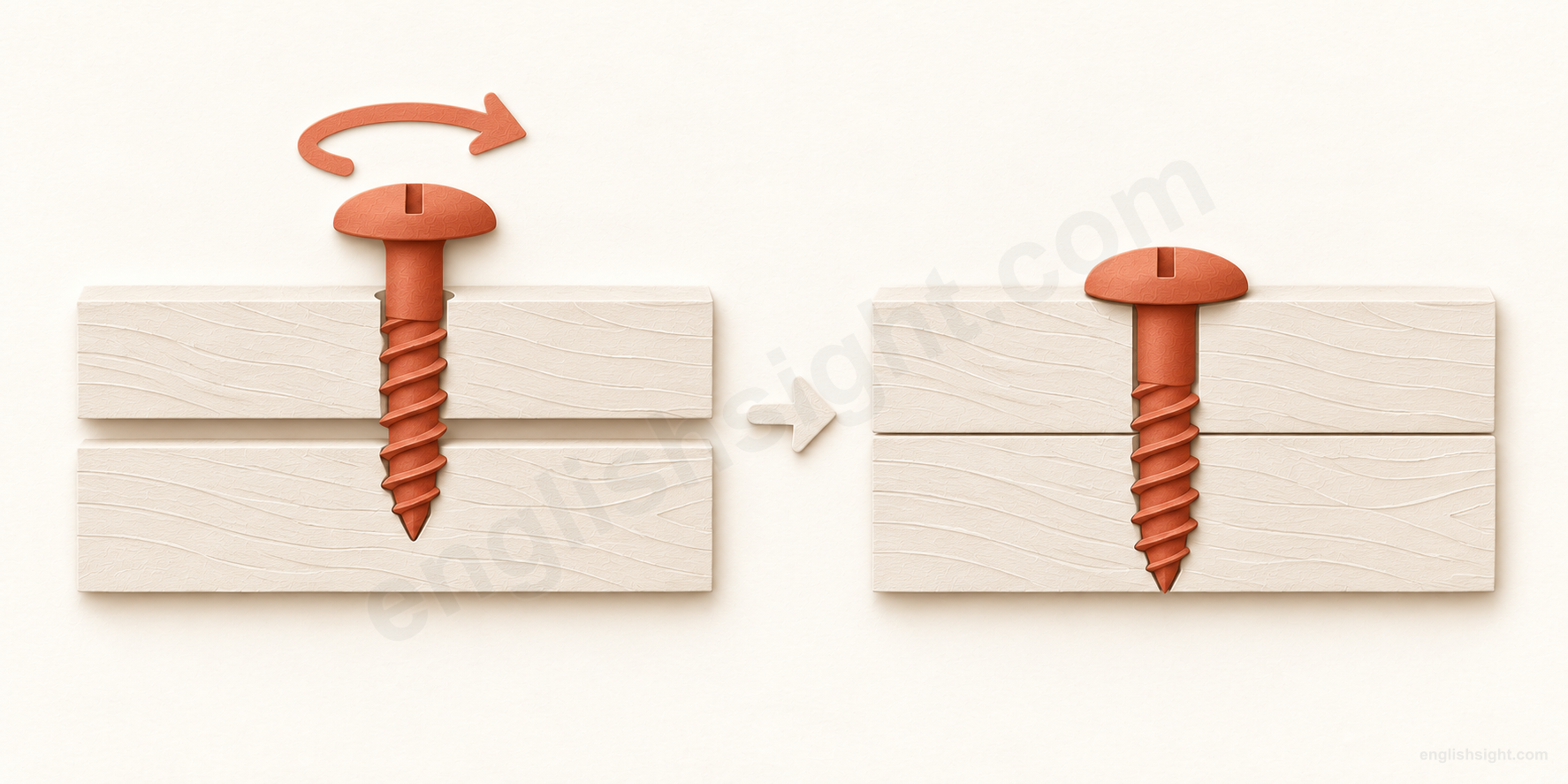
The screw is partly inserted, with its head raised and a small gap between the boards.
screw
The head rests against the upper board, holding the boards together.
Turning drives the threaded shaft deeper into the wood.
Turning advances the screw so its seated head can hold the boards together.
Turn a threaded part so that it advances into material or a matching thread and holds things in place.
This model explains the hardware family. Crumpling, pressure idioms, mistakes, and sexual slang have different limits; the lesson explains those separately. It is a teaching model, not a universal mental picture.
Start with a threaded fastener: turning moves it into a material or matching thread so it can hold parts together. The noun names the fastener; the verb can name attachment or the turning action.
Tightening and twisting provide useful links to some other uses. Expressions such as screw up a booking are learned combinations, and some slang meanings form separate branches. No single picture predicts them all.
01
Fasteners and threaded connections
Name the metal part, attach something with screws, or turn matching threads together. The object and the following words show which action you mean.
01
a screw; tighten / loosen / remove + a screw
a screw / screws
a threaded fastener
Situation before
A chair joint is loose.
What changes or is meant
A small metal fastener holds the pieces together.
The spiral ridge is the thread; turning helps the fastener enter and grip.
A screw is countable: one screw, two screws. A screwdriver is the tool used to turn it. Tighten a screw makes the connection firmer; loosen or remove a screw reverses that work.
Unlike a typical nail, a screw has a thread and is normally driven by turning. A bolt commonly fits a matching nut or threaded hole; the names overlap in some technical contexts. The sketch shows a familiar wood screw, not every screw design.
In a sentence
One screw is missing from the chair.
Watch the difference Do not call the screwdriver a screw. Screw is the fastener, not the tool.
02
screw + object + to / onto + support; screw + object + down / together
screw a bracket to the wall
attach something using screws
Situation before
The bracket is separate from its support.
What changes or is meant
Screws hold it in position.
The object names what you attach, which need not itself rotate.
In screw the bracket to the wall, you turn the screws, not the entire bracket. To the wall names its support. Screw the parts together describes joining them; screw a board down emphasizes securing it against a surface.
The passive is natural: The bracket is screwed to the wall. Have the bracket screwed to the wall can mean arrange for someone to attach it. The attachment meaning stays the same; have supplies the arrangement.
Screw up can also mean fasten or close something with screws. For example, We screwed the crate up for shipping describes securing the crate, not ruining it. The physical object and shipping context make this reading clear.
In a sentence
We screwed the bracket to a wooden post.
Watch the difference With a pronoun use screw it down or screw them together, not screw down it.
03
screw + object + in / into + opening; object + screws + in / into + opening
screw a bulb into a socket
fit something by turning its threaded part
Situation before
The threaded end is outside its matching opening.
What changes or is meant
Turning seats it in the opening.
The component itself rotates; no separate fastener is necessary.
A bulb or threaded pole can screw into another part. Compare screw the bulb in, screw it in, and screw it into the socket. In is a particle when no destination follows; into introduces the destination.
The bulb screws in easily describes its fitting mechanism or how readily it fits. It does not mean the bulb turns by itself. Screw two poles together likewise joins matching threaded ends.
In a sentence
This bulb screws into the socket.
Watch the difference Do not use screw for every way of fitting a bulb: some bulbs use a different attachment mechanism.
04
screw + cap + on / off; screw + cap + onto + jar; screw + object + tight
screw the cap on / off
attach or remove a threaded cover by turning
Situation before
A jar has a removable threaded cap.
What changes or is meant
Turning closes or opens the connection.
On attaches; off detaches. The turning mechanism is supplied by screw.
Screw the cap on and screw on the cap both work; with a pronoun use screw it on. Screw the cap onto the jar makes the support explicit. The cap screws off describes removal; unscrew the cap is another ordinary choice.
A screw cap, screw top, or screw-on lid uses matching threads. Screw the cap tight describes the resulting tightness; screw it on tightly describes how you turn it. British screw up a jar can also mean close it by turning, a different use from ruining something.
In a sentence
Screw the cap back on after pouring the juice.
Watch the difference Do not read screw up as always “make a mistake.” The object and context matter.
02
Twisting and tightening a shape
Paper and facial muscles can be squeezed into a tighter shape. These uses share a useful twisting or tightening connection, without involving an actual metal screw.
05
screw + paper + up; screw + paper + (up) into + a ball
screw up a piece of paper
crumple something into a tight shape
Situation before
A paper sheet is flat.
What changes or is meant
It is compressed into a crumpled ball.
The paper changes shape rather than being fastened.
Especially in British English, screw up a sheet or screw a sheet up means crush it in your hand. Into a ball specifies the resulting shape; screw the paper into a ball also works without up.
With a pronoun say screw it up. Crumple is a clear alternative across varieties of English. A screwed-up sheet here is physically creased, not a sheet that has made an error.
In a sentence
Maya screwed the rejected sketch up into a ball.
Watch the difference Paper as an object can also refer to a written assignment: context decides whether screw up means crumple it or spoil the work.
06
screw + your eyes + up; screw up + your eyes
screw up your eyes
narrow or close the eyes tightly
Situation before
The light feels uncomfortably bright.
What changes or is meant
The muscles around the eyes tighten.
This is a muscular action, not a threaded connection.
Screw up your eyes and screw your eyes up both describe tightening the eye area, for example in strong light. Screw them up places the pronoun before up.
This resembles the physical tightness in the core model, but there is no literal rotation of the eyeballs. Squint can describe narrowing the eyes; simply close your eyes does not necessarily suggest the same tension.
In a sentence
He screwed up his eyes against the glare from the snow.
Watch the difference Your eyes is a body-part object. Do not confuse it with screw someone up, which concerns emotional harm.
07
screw + your face + up / into + an expression; face + screws up
screw up your face
tighten the face into an expression
Situation before
A child tastes something very sour.
What changes or is meant
Their face forms a tight grimace.
The whole face contracts to show a reaction.
Screw up your face can describe a reaction to pain, an unpleasant taste, or similar discomfort. Screw your face into a grimace names the resulting expression; up can be omitted before into.
The face can also be the subject: Her face screwed up in pain. This describes a visible change of expression. It does not claim that the person has become emotionally unable to cope.
In a sentence
Nina screwed up her face at the sour plum.
Watch the difference Do not translate the expression as physically turning the head. The relevant change is in the facial muscles.
03
Mistakes, distress, and careless activity
Learn these established informal expressions as complete patterns. Up does not always mean a good result, and the physical diagram cannot predict these meanings.
With no object the focus is the failure; with an object it is what gets spoiled.
I screwed up admits a mistake. I screwed up the booking identifies the affected task. Screw the booking up is also possible, and a pronoun must go in the middle: screw it up.
This is informal and can sound coarse. I made a mistake or I got the booking wrong is more neutral. Up belongs to the established expression; it does not turn every screw action into a failure.
The American slang idiom screw the pooch also means make a serious mistake or botch a task: We screwed the pooch by sending the wrong contract. Learn it as a whole expression, with the verb changing tense normally. It can sound coarse; made a serious mistake is a neutral alternative.
In a sentence
I entered the wrong date and screwed up the booking.
Watch the difference Screw it up is correct; screw up it is not. The object is not necessarily physically twisted.
09
a screw-up; a screw-up with + task / arrangement
a screw-up
an occasion when something is done badly
Situation before
A team sends the same invoice twice.
What changes or is meant
They acknowledge the error.
The noun labels a failure or mistake rather than a metal object.
Use a screw-up for a mistake or failed piece of work: There was a screw-up with the order. The plural is screw-ups. This is slang, so an error or a mistake fits more formal communication.
The verb is written as two words: We screwed up. The noun can follow a: a screw-up. The spelling screwup is also used, especially in American English. Calling a person a screw-up says that they repeatedly make mistakes or fail; it is a harsh personal judgment, so describing the specific mistake is usually clearer.
In a sentence
There was a screw-up with the invoices.
Watch the difference Keep the noun and verb distinct: a screw-up, but we screw up.
10
screw + someone + up; be / feel + screwed up
screw someone up
cause serious emotional confusion or distress
Situation before
Someone experiences a deeply upsetting event.
What changes or is meant
They struggle to cope afterward.
A person is affected emotionally rather than attached or crumpled.
This slang expression can describe an experience that leaves someone distressed or confused. It is stronger than simply annoy someone. The person goes before up when expressed by a pronoun: It screwed him up.
Be screwed up or feel screwed up can describe the resulting troubled state. These are informal descriptions, not clinical diagnoses. Upset or deeply affected is often a more considerate choice.
In a sentence
The constant threats really screwed him up.
Watch the difference Do not confuse screwed up, emotionally troubled, with screwed to the wall, physically attached.
11
screw + body part / system + up; screw up + body part / system
screw up your back / a working system
injure or damage something
Situation before
A body part or system is functioning normally.
What changes or is meant
An action leaves it damaged or unable to work properly.
The object suffers damage, which may be physical or functional.
Screw up can describe injury or damage as well as an unsuccessful task. I screwed up my back lifting a box informally reports harm to the back. A change that screws up a system damages how it works.
The same separable pattern applies: screw it up. Compare a screw-up with the delivery, a mistake, and a screwed-up back, an injured or troubled body part. Context identifies the kind of harm; injure or damage is more neutral.
In a sentence
I screwed up my back carrying that heavy case.
Watch the difference This does not describe attaching anything to your back. The expression names damage, not the exact injury.
12
be + screwed; if + problem, person + be + screwed
be screwed
be in serious trouble
Situation before
The only copy of an important file is lost.
What changes or is meant
The team faces a very difficult situation.
This informal state does not require a person who cheated you.
We’re screwed can mean we are in serious trouble or likely to fail. It often expresses alarm or frustration. It differs from We’ve been screwed by the seller, where a passive construction identifies unfair treatment.
The meaning depends on the situation: If the backup is gone, we’re screwed describes the consequences of losing data. We’re in serious trouble expresses that meaning in neutral English.
In a sentence
If the backup is gone too, we’re screwed.
Watch the difference This is slang and may sound coarse. It is not a neutral description for formal reports.
13
screw around; stop + screwing around
screw around
waste time instead of doing the task
Situation before
Work needs to be finished.
What changes or is meant
Someone spends time on pointless activity.
Around forms an established activity expression, not a path around an object.
In informal American usage, screw around can mean fool about or waste time. Stop screwing around can therefore be a sharp request to get on with the work.
This use takes no direct object. It is separate from the vulgar sexual sense of screw around. The surrounding activity usually makes the intended sense clear; waste time is the neutral alternative.
In a sentence
We spent the afternoon screwing around instead of packing.
Watch the difference Do not assume every occurrence is sexual, or that every occurrence only means wasting time.
14
screw around with + thing
screw around with something
handle or change something carelessly
Situation before
A system already has working settings.
What changes or is meant
Someone experiments without due care.
With introduces what is being interfered with.
Screw around with the settings suggests careless fiddling, often with a risk of causing a problem. It does not mean install screws in the equipment.
The object stays after with: screw around with it. This is not the same word order as screw it up. The first describes interference; the second says the result is spoiled.
In a sentence
Please don’t screw around with the printer settings.
Watch the difference Say screw around with it, not screw it around with. For a neutral request, use Please leave the settings alone.
04
Unfair treatment and pressure
These expressions describe exploitation, threats, or increasing demands. Notice who suffers and whether something is taken from them.
15
screw + someone + (over); be / get + screwed; screw + someone + for + amount
screw someone (over) / get screwed
cheat or treat someone unfairly
Situation before
A customer expects an honest price.
What changes or is meant
They discover that they were exploited.
The affected person is the object, or the subject of a passive.
This slang use can express dishonest charging or other unfair treatment. We got screwed and We were screwed focus on the victim; by the seller can identify who did it.
Screw someone over also means treat them unfairly: The company screwed me over. With a pronoun, say screw me over, not screw over me. This is an established slang expression, not physical movement over a person.
Screw someone for an amount means make them pay an unfair amount. In money or business contexts the exploitation meaning is often clear, but the bare verb with a person can also have a vulgar sexual meaning. Cheat or overcharge is clearer in polite speech.
In a sentence
We got screwed on the repair bill.
Watch the difference Do not use screw someone as a neutral synonym for help, persuade, or charge them.
16
screw + money / thing + out of / from + someone
screw money out of someone
obtain something through pressure or threats
Situation before
Someone does not want to hand over money.
What changes or is meant
Pressure makes them surrender it.
The thing obtained is the direct object; out of names its source.
Screw money out of someone presents the obtaining as coercive, not a normal voluntary payment. From can also introduce the person. The expression is informal; Collins marks this use as mainly British.
This shares a teaching association with pressure, but the full construction supplies the participants: screw the money out of him. It is different from screw the cap off, where a physical part is removed by turning.
In a sentence
They tried to screw more money out of the tenant.
Watch the difference Keep the thing and the source distinct. Here money is obtained, while the tenant is pressured.
17
screw + someone + out of + money / benefit; be screwed out of + something
screw someone out of something
cheat someone so that they lose something
Situation before
A person has money or expects a benefit.
What changes or is meant
Unfair dealing deprives them of it.
The person is the direct object; out of introduces what they lose.
Compare They screwed money out of him with They screwed him out of his money. The first foregrounds what was obtained; the second foregrounds the victim and loss. The person-object form can describe losing a rightful opportunity or benefit too.
This is slang and suggests cheating or unfair treatment. A passive is natural: She was screwed out of her bonus. Cheated out of is a clearer alternative in a neutral account.
In a sentence
The dishonest agent screwed us out of our deposit.
Watch the difference In screw us out of our deposit, us names the victims and our deposit names the loss. Do not swap them without changing the construction.
18
put the screws on + someone; turn / tighten the screw (on + someone); a turn of the screw
put the screws on / turn the screw
apply pressure or make it more severe
Situation before
Someone resists a demand.
What changes or is meant
Threats or tougher demands increase the pressure.
The screw is a metaphor for tightening pressure, not a literal fastener.
Put the screws on someone means pressure them through intimidation or threats. Turn or tighten the screw on someone emphasizes increasing the pressure already being applied.
A turn of the screw is an additional worsening of an already difficult situation. These noun-based idioms are not simply the verb screw followed by a particle. Their tone suggests coercion or hardship, rather than ordinary encouragement.
You may also hear put the screws to someone. It likewise means apply coercive pressure; it is a variant of put the screws on someone.
In a sentence
The lenders turned the screw on the company by demanding earlier repayment.
Watch the difference Use plural screws in put the screws on; the familiar turn the screw expression uses singular screw.
05
Courage, judgment, and loose screws
A few familiar idioms use the idea of tightness or secure assembly. Their conventional meanings need to be learned with the whole expression.
19
screw up + your courage + to-infinitive
screw up your courage
make yourself brave enough to act
Situation before
You feel afraid to ask a difficult question.
What changes or is meant
You gather enough courage to speak.
This expression builds courage; it does not spoil it.
Screw up your courage means make the effort to become brave enough. A following to-infinitive can name the difficult action: screw up your courage to ask.
The exact noun matters. Screw up the booking usually means ruin it, whereas screw up your courage means gather it. Treat these as separate established uses. Gather your courage is a straightforward alternative.
In a sentence
I screwed up my courage to ask for a second chance.
Watch the difference Do not interpret this as destroying courage just because screw up can mean spoil.
20
have + possessive + head + screwed on (the right way)
have your head screwed on
have good practical judgment
Situation before
Someone must choose between two offers.
What changes or is meant
They consider the facts and make a sensible decision.
The image of secure assembly supports a conventional judgment about sense.
To have your head screwed on, or have your head screwed on the right way, means be sensible. It is an informal compliment about judgment, not a description of the body.
The possession pattern is fixed around head: She has her head screwed on. It does not mean that someone else literally attached it, and it is not an ordinary causative have construction here.
American English also uses have your head screwed on straight or right. Here straight describes sound judgment rather than the physical direction of the head.
In a sentence
Ask Leila about the offer; she’s got her head screwed on.
Watch the difference Do not replace head with mind and assume the same idiom remains natural.
21
have + a screw + loose
have a screw loose
behave in a way others regard as strange or unreasonable
Situation before
Someone proposes an obviously reckless plan.
What changes or is meant
A speaker dismisses the behavior as odd.
A loose component is a metaphor, not evidence of illness.
Have a screw loose is an informal and potentially insulting way to suggest that someone’s behavior is strange or unreasonable. It is not a medical description.
Compare The chair has a loose screw, which can be literal, with He must have a screw loose, which normally comments on behavior. If you want to disagree respectfully, describe the risky idea instead.
In a sentence
“He wants to camp there during a storm? He must have a screw loose.”
Watch the difference Do not use the idiom as a diagnosis or a respectful label for someone’s mental health.
06
Recognize rude and sexual uses
The hardware word is neutral. Some other uses are offensive or vulgar; recognize their meaning and choose a neutral alternative when speaking politely.
22
screw + that / it / you; screw off!
Screw that! / Screw you! / Screw off!
reject something angrily or insult someone
Situation before
A speaker is angry or dismissive.
What changes or is meant
They use a rude expression rather than a polite refusal.
The whole expression communicates attitude, not physical twisting.
Screw that! rejects an idea or situation; Screw you! directs an offensive insult at a person. Screw it! can express giving up on something in frustration. These are coarse expressions, not neutral ways to disagree.
Screw off! is a rude command to go away. Compare The cap screws off, which simply describes a threaded lid. In American slang, screw off can also mean do nothing useful; loaf or waste time is clearer.
In a sentence
“Screw that! I’m not waiting another hour,” he muttered.
Watch the difference For polite speech use I don’t want to do that, Never mind, or Please leave, according to your intention.
23
screw + (someone); screw around; a screw (vulgar noun)
screw (someone) / screw around
vulgar references to sexual activity
Situation before
A conversation uses slang about sexual relationships.
What changes or is meant
The words refer to sex rather than hardware.
This is a separate established branch; the diagram does not explain it.
Screw can be a vulgar verb meaning have sex, with or without a person as object. Screw around can refer to sexual activity with different partners; it may suggest disapproval. The same surface phrase can also mean waste time.
The noun a screw can refer crudely to a sexual act or a sexual partner. Describing a person this way is objectifying. For neutral language use have sex or sexual partner; these entries are here to support recognition, not to suggest polite wording.
In a sentence
In that scene, “They were screwing” refers to sex.
Watch the difference Do not confuse this with They were screwing the boards together, which is an ordinary repair activity.
Read the object, pattern, and tone
Forms and pronunciation
Screw /skruː/ has the regular forms screws, screwed, screwing; screwed is pronounced /skruːd/. The hardware noun has plural screws. Screwdriver names a tool; unscrew names reversing a threaded connection.
Up is not one meaning
Screw up paper crumples it; screw up a booking spoils it; screw up your courage gathers it. British screw up a jar can close it. Read the whole combination rather than assigning one meaning to up.
Grammar changes the focus
We are screwing the parts together describes work in progress; The parts are screwed together describes an attachment or its result. The cap screws on describes its mechanism. Ordinary hardware passives are natural. Causative arrangements use wider patterns such as have something screwed in place, not screw someone to do something.
Neutral hardware, variable register elsewhere
A screw and screw the cap on are neutral. Mistake expressions are informal or slang; insults and sexual uses can be offensive. This lesson labels these branches for recognition and provides neutral alternatives.
Specialist and regional nouns
Screw can also mean a ship’s propeller, and in British prison slang a prison officer. Those recognition meanings do not replace the ordinary fastener meaning. Specialist engineering, billiards, older salary and horse senses, and extended compound vocabulary are outside the main lesson.
Choose the meaning in context
Use the object and construction to decide what screw means.
1. A jar has a threaded cap. Which instruction tells someone to close it?
2. You want to say “Do not spoil it” using the informal expression. Which word order works?
3. In a British story, Maya screws a sheet of paper up into a ball. What happens?
4. I screwed up my courage to ask. What did I do?
5. Which expression describes careless interference with settings?
6. “If both backups are gone, we’re screwed.” Which neutral paraphrase fits?
Sources and teaching notes
The publisher pages below were consulted for meanings, patterns, and register. Explanations and examples are original; visual connections are teaching aids.
The diagram illustrates threaded fastening. Other uses need their own context and construction.