Use sea for salt water, named regions, wave conditions, and familiar expressions.
Land meets a broad expanse of water
Land meets a broad expanse of water
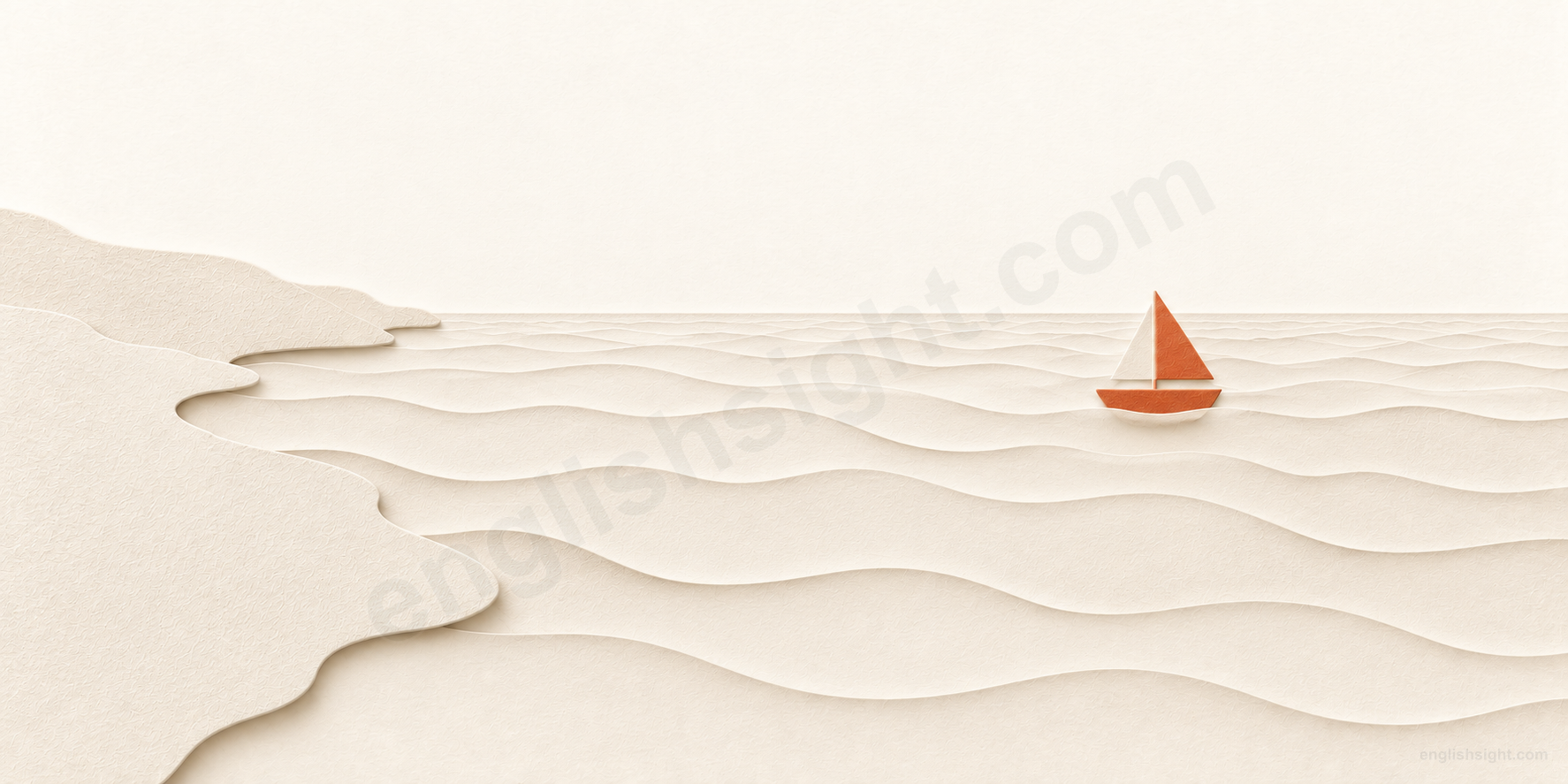
The curved land edge lies on the left.
sea
The sea extends to the right and toward the horizon.
The shoreline meets the broad water.
The shore gives a reference; the small boat shows the scale of the sea beyond it. This is one spatial view, not a sequence of events.
The sea is a broad expanse of salt water extending around and between areas of land.
This is a teaching anchor for the ordinary noun. Named inland seas have established names, and conventional idioms keep meanings that need separate explanation. The diagram shows a stable spatial relationship, not a required before-and-after event.
Stand at the coast and look across the water: sea can name that broad expanse. The same noun can identify one region, describe wave conditions, or provide a comparison for a huge mass of things.
Prepositions change the relationship: stay by the sea, travel by sea, and spend time at sea do different jobs. Some longer expressions are idioms, so the physical picture supports memory without predicting every meaning.
01
Water, regions, and waves
Sea can name salt water generally, one geographical area, or the condition of the waves. Read articles and number alongside the context.
01
the sea + singular verb
the sea
the broad body of salt water around land
Situation / starting point
You reach the coast after a journey inland.
What the expression describes
You can see water extending to the horizon.
Sea names the water and its expanse, not just the strip of beach.
In We can hear the sea, sea is a noun naming the water as a whole. It need not identify one separately named sea. The verb can describe what this water does: The sea is rising or The sea has washed sand away.
The sea is the usual general expression in British English; North American speakers often say the ocean in the same situation. Both words occur in both varieties. A beach is the shore where you might stand, rather than all the water beyond it.
In a sentence
The sea looks silver from our window.
Watch the difference Do not use a sea just to mean some seawater in a bottle. A sea normally identifies a body or condition of water.
02
a sea; two seas; the + name + Sea
the Mediterranean Sea
one particular geographical body of water
Situation / starting point
You point to a region on a map.
What the expression describes
You identify it by its established name.
A sea can be one named region rather than all the world’s salt water.
Countable sea distinguishes regions: This route crosses two seas. In a geographical name such as the Mediterranean Sea, capitalize Sea and normally keep the before the name.
Names are established labels, not a rule you can calculate from size alone. The Caspian Sea is inland; the name Sea of Galilee applies to a freshwater lake. Keep the name actually used rather than renaming a body of water because it does not fit a simple salt-water rule.
In a sentence
Our ship crossed the North Sea overnight.
Watch the difference Do not replace Ocean with Sea in an established name: the Pacific Ocean remains the Pacific Ocean.
03
a calm / rough sea; calm / choppy / heavy seas
a rough sea / heavy seas
the state or movement of the water
Situation / starting point
A wind picks up before a boat trip.
What the expression describes
The waves make the crossing uncomfortable.
Seas can describe waves and sea conditions, not several geographical seas.
The sea is calm describes its condition; a calm sea and rough seas also focus on the water’s movement. In heavy seas, heavy suggests powerful waves rather than water that weighs more than usual.
The plural in The ferry struggled in heavy seas does not mean the ferry crossed several named seas. The weather and vessel supply the relevant context. Choppy describes a surface with many short, uneven waves.
In a sentence
The ferry returned to port because of heavy seas.
Watch the difference Keep the distinction between a high wave and the fixed expression the high seas; the latter does not simply mean rough water.
04
the open sea; on the high seas
the open sea / the high seas
water away from the shore
Situation / starting point
A ship leaves the sheltered coastal area.
What the expression describes
It reaches a broad stretch of exposed water.
Open sea contrasts with the shore or a sheltered harbour.
The open sea highlights water away from land. A boat can reach the open sea even when the waves are calm. Openness and roughness describe different features.
The high seas is a formal or literary expression for the open ocean, especially waters outside any single country’s legal control. This is a vocabulary distinction, not a guide to maritime boundaries. The literary phrase the seven seas evokes the world’s seas collectively; it need not mean an exact list of seven.
In a sentence
The documentary follows a research ship on the high seas.
Watch the difference The high seas is plural and normally includes the. It does not mean a high tide.
02
Near it, in it, or travelling across it
Small prepositions distinguish a coastal location, contact with water, a means of transport, and time spent offshore.
05
live / stay + by the sea; go to the sea
by the sea
near the coast
Situation / starting point
You choose where to spend the weekend.
What the expression describes
Your accommodation is close to the water.
By the sea locates something beside the water; it does not describe transport.
A house by the sea stands near the coast. By means beside or near here, and the remains part of the noun phrase. You can also go to the sea, meaning travel to the coast rather than board a ship.
Compare We stayed by the sea with We travelled by sea. The first answers Where? The second answers How? A room with a sea view lets you see the water; that phrase alone does not promise direct access to a beach.
In a sentence
We rented a small flat by the sea.
Watch the difference Retain the in by the sea for a coastal location. Bare by sea has a different job.
06
swim in the sea; sail on / across the sea; under the sea
in the sea / on the sea
inside the water or supported on its surface
Situation / starting point
One person is swimming while a boat floats nearby.
What the expression describes
The person is in the water; the boat is on its surface.
In and on identify different relationships with the same body of water.
A swimmer is in the sea because the body is immersed in water. A boat sails on the sea because the surface supports it. Sea itself does not supply that contrast: the preposition does.
A boat can also be described as in the sea when the speaker locates it in a body of water, so these are useful viewpoints rather than a rule that boats always require on. Across the sea describes a route from one side to another; under the sea points below the surface.
In a sentence
The children swam in the sea while we watched from the shore.
Watch the difference In these ordinary phrases, use the sea, not bare sea: swim in the sea.
07
travel / go / send something + by sea
by sea
using a ship or boat as transport
Situation / starting point
You compare ways to send a large order.
What the expression describes
The goods will travel on a vessel.
By sea identifies the transport method.
Send something by sea contrasts with sending it by air or by road. The cargo is the thing transported; sea is not the vehicle’s name. No article appears in this established method phrase.
We went by sea likewise tells how we travelled, without naming a particular vessel or route. Related combinations include sea travel and a sea voyage. By the sea instead places someone or something near the coast.
In a sentence
We sent the furniture by sea to reduce the cost.
Watch the difference By sea and by ship can describe a transport method; by the sea usually describes a location.
08
be / spend time / be lost + at sea
at sea
away from land on a sea journey
Situation / starting point
The fishing boat has left port.
What the expression describes
The crew spends several nights offshore.
At sea describes being out on the water, especially aboard a vessel.
The crew spent a week at sea focuses on time away from land. It does not mean they were swimming for a week. The phrase has no the in this ordinary voyage use.
Lost at sea can describe someone missing during a voyage; it is more serious than simply taking a wrong road. In another context, I am at sea can mean I am confused. Boats, voyages, and dates favour the literal reading; difficult instructions may favour the idiom.
In a sentence
The crew had no visitors during their month at sea.
Watch the difference At the sea is not the normal replacement for at sea in this voyage expression.
09
go / head / look + out to sea; be swept out to sea
out to sea
towards or across the water away from land
Situation / starting point
You stand on a cliff looking away from the coast.
What the expression describes
Your gaze points across open water.
The expression can describe direction of movement or direction of looking.
A boat heading out to sea moves away from land. Someone looking out to sea may remain completely still: the direction belongs to the gaze, not a journey.
Washed or swept out to sea describes water carrying someone or something away from shore. The surrounding verb tells whether a person chose the movement; out to sea does not itself imply choice.
In a sentence
She stood at the end of the pier and looked out to sea.
Watch the difference Do not insert the into the fixed phrase out to sea. Out of the sea instead means emerging from the water.
03
Leaving shore and living aboard
These expressions describe sailing and getting used to a vessel. Learn the complete expression rather than treating sea as an action word.
10
go to sea; run away to sea
go to sea
become a sailor or leave on a voyage
Situation / starting point
Someone chooses work aboard ships.
What the expression describes
Sea travel becomes part of their working life.
Context distinguishes a sailing career from one departure.
In a life story, She went to sea at eighteen can mean she became a sailor. The expression refers to a way of life rather than just visiting a beach. With a specific voyage in view, go to sea can also describe setting off on the water.
Run away to sea traditionally means leave home without permission to become a sailor. Away adds the idea of leaving home or one’s usual situation; sea alone does not mean running away.
In a sentence
My grandfather went to sea when he was eighteen and later became a captain.
Watch the difference Go to the sea normally means visit the coast; go to sea can describe sailing or becoming a sailor.
11
a vessel + put / puts / put (out) to sea
put (out) to sea
leave land or a port by vessel
Situation / starting point
The fishing boats are ready in the harbour.
What the expression describes
They leave the harbour and begin their trip.
The vessel departs; nobody is putting an object into the water.
The boats put to sea is a conventional sailing expression meaning that they set off from land. Put out to sea is another form. In this use, put has no direct object after it.
The expression is especially useful in accounts of ships, voyages, or rescues. In everyday conversation, The boat left the harbour is a plainer way to describe the same departure. It differs from put the boat in the sea, where the boat is an object being placed in water.
In a sentence
The fishing boats put to sea before sunrise.
Watch the difference The past form here is put, not putted. Learn the complete sailing expression.
12
find / get + possessive + sea legs
find your sea legs
get used to a ship’s movement
Situation / starting point
A new passenger feels unsteady when the deck moves.
What the expression describes
After a while, walking aboard feels easier.
Sea legs names an ability to cope with movement, not a different pair of legs.
Finding your sea legs means becoming able to move comfortably on a ship and cope with its motion without feeling sick. Find describes acquiring that ability here, rather than locating a missing object.
Use a possessive such as my, your, or her with the plural legs: She soon found her sea legs. The phrase concerns adaptation aboard a vessel; it is not a general expression for learning to swim.
In a sentence
By the second morning, I had found my sea legs.
Watch the difference Keep legs plural in this expression. A literal injured leg is a different topic.
04
Measurements and everyday combinations
Sea also helps identify a reference height, a source, or an environment. The following noun tells you what kind of thing is being discussed.
13
at / above / below sea level; rising sea levels
above / below sea level
height measured relative to the average sea surface
Situation / starting point
A map gives the height of a village.
What the expression describes
You compare the village’s height with a shared reference.
Sea level is a reference height, not the height of a passing wave.
A place above sea level is higher than the sea’s average surface used for measurement. Below sea level places it lower than that reference. This is a noun phrase, and above or below supplies the comparison.
At sea level means at approximately that reference height. Compare at sea, which describes being offshore or, figuratively, confused. Rising sea levels concerns changes in that water height; level is the main noun.
In a sentence
The village lies about two hundred metres above sea level.
Watch the difference Use above sea level without the in this standard measurement phrase.
14
seawater; sea + noun: sea breeze / sea salt / sea air / sea view
seawater / sea breeze / sea salt
water, wind, or material connected with the sea
Situation / starting point
You describe things encountered near the coast.
What the expression describes
The following noun identifies the thing and its connection to the sea.
Sea can identify a source or environment within a larger noun expression.
Seawater names the salty water itself, including a sample in a container. Sea salt is salt obtained from that water. A sea breeze blows from the water towards land, while sea air simply names air near the coast.
The relation varies: salt has a source, breeze has a direction, and air has a location. Do not assume that sea adds exactly the same meaning to every noun. In a sea view, the sea is what you can see. These are combinations to learn with their spelling, not new actions performed by sea.
In a sentence
A sea breeze came through the open window.
Watch the difference Seawater is commonly one word; sea salt and sea breeze are two. Keep the established spelling of each combination.
05
Crowds, confusion, and established idioms
A broad expanse provides one useful comparison. Other expressions have conventional meanings that the coastline diagram cannot predict.
15
a sea of + plural count noun / mass noun
a sea of…
a large amount or number spread before you
Situation / starting point
You look over a crowded station hall.
What the expression describes
People appear as one vast mass.
The comparison borrows the sea’s extent, not its salt or wetness.
A sea of faces presents many faces as a broad mass in view. A sea of boxes can describe objects filling a space. The of-phrase identifies what makes up this figurative sea.
This is an expressive comparison, rather than a precise quantity. Faces are countable and luggage is uncountable, so the construction is not limited to one noun type: a sea of luggage suggests a vast mass of bags.
In a sentence
From the balcony, I saw a sea of umbrellas below.
Watch the difference Usually keep a in a sea of umbrellas. Do not interpret the phrase as saying the objects are floating in seawater.
16
be / feel + (all) at sea; be at sea with something
be (all) at sea
feel confused and unsure what to do
Situation / starting point
You read unfamiliar instructions.
What the expression describes
You cannot work out the next step.
This established idiom describes understanding, not a person’s physical location.
I am all at sea with these instructions means I cannot make sense of them or decide how to proceed. All intensifies the confusion; it does not mean every person is sailing.
The image of lacking familiar landmarks can help you remember the idiom, but that is a teaching comparison, not a rule for creating new expressions. All at sea is especially associated with British usage. Plain I’m confused is a straightforward alternative.
In a sentence
I felt all at sea with the new booking system.
Watch the difference Context matters: The crew are at sea may be completely literal. Do not add the for the confusion idiom.
17
a sea change in something; bring about / undergo a sea change
a sea change
a major transformation
Situation / starting point
A team changes how it makes decisions.
What the expression describes
Its whole approach becomes noticeably different.
The complete noun expression means a substantial change.
A sea change in attitudes is a marked transformation in how people think. In identifies what changes. You can describe something as bringing about a sea change or say that a situation has undergone one.
This expression is useful in discussion of organisations, policy, or society. Its established meaning cannot be worked out as any change happening near water. Ordinary change is enough for a small adjustment; sea change deliberately presents the change as substantial.
In a sentence
The new leadership brought about a sea change in the team’s approach.
Watch the difference Use a sea change as a noun phrase. Sea is not a verb meaning change greatly.
18
there are plenty more fish in the sea
There are plenty more fish in the sea.
other potential partners remain after a relationship ends
Situation / starting point
A friend is upset after a breakup.
What the expression describes
Someone tries to reassure them about future relationships.
Fish represents other possible partners in this conventional saying.
The saying offers reassurance that losing one relationship does not remove every future possibility. It is about potential partners, not a report on fish populations.
The wording is informal and can sound too casual when someone is deeply hurt. Whether it helps depends on the person and situation. Explain the intended reassurance rather than assuming that every unhappy friend wants this remark.
In a sentence
After the breakup, her brother tried to cheer her up: “There are plenty more fish in the sea.”
Watch the difference Learn the complete saying. Fish here is the ordinary plural form; fishes is not needed.
19
be / be caught + between the devil and the deep blue sea
between the devil and the deep blue sea
faced with two very unwelcome choices
Situation / starting point
You must accept an unfair deal or lose an important opportunity.
What the expression describes
Neither available option is acceptable to you.
The whole idiom expresses a dilemma with two bad alternatives.
Being between the devil and the deep blue sea means being caught between two unpleasant choices. The two images represent the alternatives; there need not be a real devil, sea, or physical danger.
This is a vivid established idiom, useful to recognise rather than necessary for every conversation. The plainer I have two bad options often communicates the same problem. Do not use it simply because a decision is difficult when one option is clearly attractive.
In a sentence
Paying the fee would empty our savings, but cancelling would cost us our deposit; we were between the devil and the deep blue sea.
Watch the difference Keep the fixed wording; between the sea and a devil is not the ordinary idiom.
Choose the whole expression
Articles change with the construction
The sea is the ordinary general noun phrase. A sea can identify one region or a particular sea condition. Learn by sea, at sea, out to sea, and above sea level without the; by the sea keeps the for a coastal location.
Sea, ocean, coast, and beach
Sea and ocean overlap for the general salt-water expanse, with different usual choices in British and North American English. Coast names the land along it; beach names a shore area, often sand or stones. Keep established geographical names unchanged.
Word class and pronunciation
Sea is pronounced /siː/, the same as see; seas /siːz/ sounds like sees. This lesson concerns the noun and combinations used before other nouns. Dictionaries may label the modifying use differently; it does not create a productive verb sea with passive, causative, or particle-verb patterns.
What the picture can explain
Extent helps explain a sea of umbrellas. Confusion, major change, and the longer sayings require their conventional meanings. The physical sketch anchors the ordinary noun; it does not show a required action or explain every idiom.
Choose the expression that fits
Use the situation, preposition, and complete phrase to decide.
1. Your boxes will travel on a cargo ship. Which phrase describes the transport method?
2. Your holiday cottage stands near the coast. Which phrase gives its location?
3. A forecast warns of heavy seas. What should a passenger understand?
4. At your desk, you say you feel all at sea with unfamiliar software. What do you mean?
5. Someone stands on a cliff and looks out to sea. What does this sentence establish?
6. A hall contains a sea of bags. What does the writer suggest?
Sources and teaching notes
The linked dictionary entries were consulted for meanings, constructions, and usage distinctions. Explanations, situations, examples, and the sketch are original teaching material.
The sketch illustrates the core noun meaning. Idioms need their own explanations; speakers need not imagine the same picture.