Follow seat from a supporting place to capacity, membership, control, and familiar idioms.
A supporting place for a person
A place that supports someone sitting
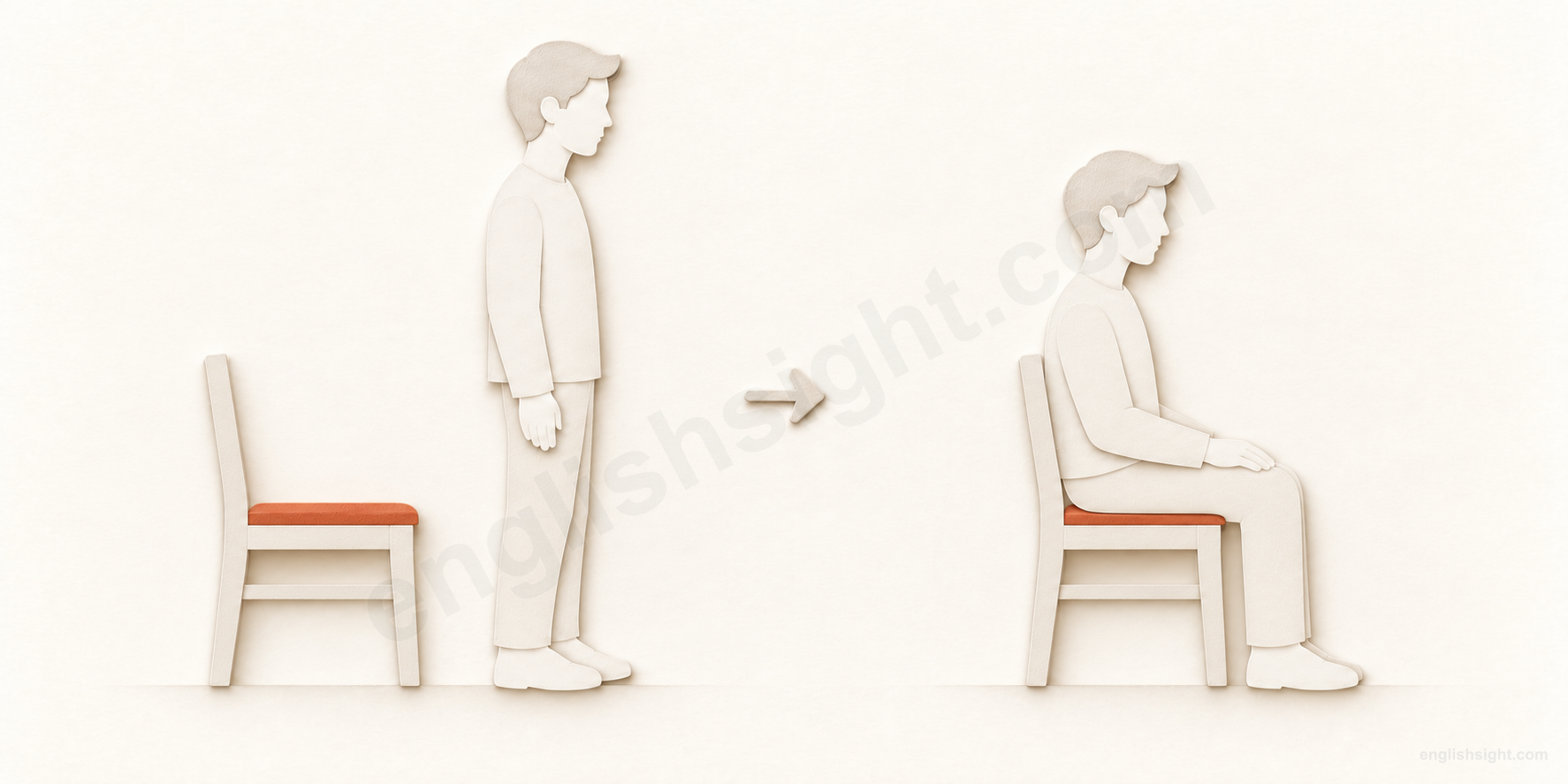
The person stands in front of an empty seat.
seat
The same seat now supports the seated person.
The person sits down on the chair.
A seat supports a person sitting; the orange surface shows that supporting place.
A seat is a place that supports a person in a sitting position; to seat someone is to give or arrange such a place for them.
The picture shows the literal relation between a person and a supporting place. Capacity counts such places; membership extends the idea of a place in a group. It does not derive the meanings of every fixed idiom.
Start with a person and a place that supports the person while sitting. A seat can be a chair, part of a bench, or a place in a vehicle. As a verb, seat can arrange a person in such a place or describe how many people a space can accommodate.
English also uses seat for membership, an institutional base, and several fixed expressions. Some links are easy to picture; others must be learned as complete phrases. The visual model is a teaching aid, not a claim about an identical mental image shared by all English speakers.
01
Places, surfaces, and everyday seating
Start with a place for a person to sit. The context can focus on its location, its availability, the right to use it, or the surface touching the body.
01
a seat; a window / aisle / front / back / passenger seat
a seat; a window / aisle / passenger seat
a place for one person to sit
Situation / intention
You enter a train and look for somewhere to sit.
Meaning in context
You find a place beside the window.
Seat names the sitting place; another word can specify where it is.
A seat may be a chair, part of a bench, or a place in a vehicle. It need not be a separate piece of furniture: three people can have seats on one bench. Chair names a type of furniture; seat is useful when the place for a person matters.
A window seat is beside a window; an aisle seat is beside the passage between rows. A passenger seat is for a passenger, often the one beside the driver in a car. Front, back, and rear identify the position. These modifiers add information to the ordinary noun.
You can sit on a seat or in your seat. In is especially natural for your place in a car, aircraft, or audience; on focuses on the supporting surface. This is a tendency, not a rule that one preposition is always wrong.
In a sentence
I found a window seat near the back of the train.
Watch the difference Use a seat or seats when counting places. A bench can provide several seats without being several chairs.
02
take / have + a seat; take + your seat(s)
take a seat / have a seat
sit down, often in response to a polite invitation
Situation / intention
A visitor is standing in the waiting room.
Meaning in context
You invite the visitor to sit.
Take a seat is an action expressed with the noun seat.
Please take a seat and Have a seat are ordinary invitations to sit down. Here take and have do not mean carrying a chair away or owning it. The whole combination serves a social purpose.
Take your seat often means go to the particular place assigned to you. Please take your seats can ask an audience to settle before an event. Sit down is more direct; adding please and a friendly tone can make it polite too.
The verb in take a seat is take, so its past form is took a seat. Seat remains a noun. In Parliament, take your seat can instead mean begin your duties as a member; the institutional context changes the interpretation.
In a sentence
Please take a seat while I check your appointment.
Watch the difference In take a seat, the subject sits down. In seat someone, the subject arranges a sitting place for another person.
03
Is this seat taken?; save someone a seat; give up your seat to someone
Is this seat taken?; save / give up a seat
ask about, keep, or surrender the use of a sitting place
Situation / intention
An empty-looking seat may already belong to someone for the journey.
Meaning in context
You ask whether you may use it.
A physically empty seat is not necessarily available.
Is this seat taken? asks whether someone is using or claiming the place. A person may have stepped away, so taken does not require someone to be sitting there at that instant.
Save me a seat or save a seat for me asks someone to keep a place available for you. Give up your seat means stop using it so that another person can sit there: I gave up my seat to a passenger with a walking stick.
Empty describes the current lack of an occupant; available or free describes whether you can use it. Free may mean available in this context rather than costing no money. These are ordinary combinations with the noun, not different senses of seat each time.
In a sentence
“Is this seat taken?” “No, you can sit here.”
Watch the difference Keep the object when giving up a particular place: give up my seat. Give up by itself can mean stop trying.
04
book / reserve a seat on + service; a seat for + event
book / reserve a seat
secure a place on a journey or at a performance
Situation / intention
You plan to travel or attend a show.
Meaning in context
A place is reserved for you.
Seat can refer to the right to occupy a place, not the furniture being sold.
Book or reserve a seat means arrange the right to sit in a place on a particular service or at an event. We bought two seats for the concert normally means buying admission with sitting places, not buying chairs.
Use a seat on a flight or train and a seat for a show or performance. A seat reservation may assign a numbered place. A travel ticket does not always include a reserved seat; that depends on the service.
Good seats and the best seats in the house evaluate the view or position in a theatre or other venue. House here refers to the venue or its audience area, not somebody’s home.
In a sentence
We reserved two seats for the afternoon performance.
Watch the difference A seat can be unavailable because it has been booked even when the vehicle or theatre is still empty.
05
the seat of + chair; a toilet / bicycle seat; seat + cover / cushion
the seat of a chair; a toilet / bicycle seat
the part that directly supports the person sitting
Situation / intention
A chair has a back, legs, and a flat supporting part.
Meaning in context
You identify the supporting part as the seat.
Seat can name one component rather than the whole object.
In the seat of a chair, seat means the surface under the person’s bottom. The chair’s back is a different part. A wooden chair can have a padded seat; the material of the seat need not match the rest.
A toilet seat is the supporting ring above the bowl. A bicycle seat is the part the rider sits on, also called a saddle. Seat cover and seat cushion name things that cover or soften a seat.
This is a part-versus-whole distinction, not a new action. Compare The seat is cracked, meaning the supporting part is damaged, with There is a spare seat, meaning another sitting place is available.
In a sentence
The legs are metal, but the seat is made of wood.
Watch the difference Seat is not the backrest. If the damaged part supports your back, name that part instead.
06
the seat of + trousers / pants / jeans
the seat of your trousers / pants
the part of clothing covering the bottom
Situation / intention
Someone sits on a damp wall.
Meaning in context
The back lower part of the trousers becomes wet.
The name transfers from the body’s sitting area to the clothing covering it.
The seat of a pair of trousers is the fabric covering the bottom. British English commonly uses trousers here; American English commonly uses pants. In clothing measurements or descriptions, a roomy seat means extra room around that area.
Seat can also mean the person’s bottom itself, especially in formal wording. For ordinary conversation about the body, bottom is generally a more straightforward choice. The clothing sense remains useful in repair and fit descriptions.
In a sentence
There is a small tear in the seat of my jeans.
Watch the difference A tear in the seat of your jeans is damage to the clothing, not to a chair. Context identifies the object.
02
Putting people in seats and counting places
As a verb, seat usually has an object: a host seats guests, a guest seats herself, or a room seats a number of people. Be seated can describe the resulting posture.
07
seat + person + place phrase; person + be seated
seat the guests; wait to be seated
give people particular places to sit
Situation / intention
Guests arrive at a restaurant.
Meaning in context
A host shows them to places at a table.
The subject arranges the sitting place; the object is the person being seated.
The host seated us by the window means the host gave or showed us places to sit there. The host need not lift us into chairs. Seat is transitive in this use: seat the guests, seat them, seat us.
At the table, next to Maya, and by the window specify the location or arrangement. Please wait to be seated asks customers to wait until a member of staff assigns them a place.
The passive changes the viewpoint: The host seated us becomes We were seated by the host. With a place after by, however, by gives location: We were seated by the window.
In a sentence
The host seated us at a quiet table near the door.
Watch the difference Say The host seated us, not The host seated to us. For your own ordinary action, say I sat down.
08
be / remain seated; seat + reflexive pronoun + place phrase
be / remain seated; seat yourself
be sitting, stay sitting, or put yourself into a sitting position
Situation / intention
A ceremony is about to start.
Meaning in context
An announcement asks everyone to sit or stay sitting.
Seated can describe the posture; the reflexive form names the person’s own action.
She was seated beside me can simply describe where she was sitting; it need not focus on an earlier action by a host. Remain seated means continue sitting. Please be seated is a formal invitation or instruction to sit down.
He seated himself at the desk means he sat down there. The object himself refers back to he. Seat yourself is grammatical but is generally more formal than sit down or take a seat; reflexive pronouns change with the subject: I seated myself; they seated themselves.
Compare Sit here with Seat yourself here. Ordinary sit does not need an object, while this use of seat does. The past of sit is sat; the past of seat is seated.
In a sentence
Please remain seated until the presentation ends.
Watch the difference Do not say I seated by the window for ordinary sitting. Use I sat by the window, I was seated there, or I seated myself there.
09
thing + seats / can seat + number (of people); a six-seater; seating for + number
seat six; a six-seater; seating for six
have enough sitting places for a stated number
Situation / intention
You need a table large enough for six diners.
Meaning in context
You check how many people can sit around it.
The subject is the table, room, or vehicle; the number describes capacity.
This table seats six means six people can sit at it. It does not mean six people are sitting there now. A car seats five and a hall can seat 200 use the same capacity construction.
A six-seater is something with six seats; a six-seater car uses the same form before a noun. The hyphen joins the number and seater. The number describes how many people can sit, not how many people currently own it.
Seating is a related uncountable noun for the seats available or their arrangement: seating for six, extra seating, a seating plan. When you count individual places, say six seats.
In a sentence
The new table seats six comfortably.
Watch the difference Do not use seats six to assert that six diners are currently present. It states what the table can accommodate.
03
Membership, a voice, and a centre of activity
A place in a group can stand for membership or influence. In formal language, a place where an institution is based can also be its seat. These are established extensions, not instructions to look for a chair.
10
a seat on + board / committee / council; a seat in + Parliament / Congress
a seat on the board / in Parliament
a position as a member of a decision-making body
Situation / intention
A committee has a limited number of members.
Meaning in context
A new representative joins it.
Seat stands for membership and the rights attached to it.
A seat on a board, committee, or council means a place as a member, often with a vote. A seat in Parliament or Congress similarly means a representative’s position. The important thing is membership, not whether a chair has been provided.
Win a seat means gain the position, often through an election. Hold or retain a seat means keep it; lose a seat means cease to hold it. A party can hold several seats because several of its representatives are members.
Take your seat in Parliament can mean begin exercising your duties as a member, especially in British usage. Compare take a seat in a waiting room, which is an invitation to sit down. Use context to choose the meaning.
In a sentence
A student representative now has a seat on the committee.
Watch the difference Use on the committee but in Parliament in these conventional expressions. A physical seat at a meeting does not automatically confer membership.
11
a safe / marginal seat; contest / win / lose a seat
a safe / marginal seat
an electoral district viewed through the position it elects someone to
Situation / intention
Two parties are competing in an election.
Meaning in context
A report describes how likely a district is to change hands.
Especially in British politics, seat can refer to the constituency itself.
A constituency is an area represented by an elected member. Calling it a seat focuses on the representative position associated with that area. To contest a seat is to compete in its election.
A safe seat is expected to be won by a particular party with little difficulty. A marginal seat is closely contested and may change hands. Safe here describes the electoral advantage, not personal or physical safety.
This is especially useful for understanding British election coverage. It is related to the membership sense, but the district and its electorate are now in focus.
In a sentence
Both parties are campaigning hard in this marginal seat.
Watch the difference A safe seat is not a seat with a safety feature. Political context supplies the electoral meaning.
12
the seat of + government / power; a seat of learning; county seat; family seat
the seat of government; a county seat
the place where an institution or activity is based
Situation / intention
A region has government offices in one town.
Meaning in context
That town is identified as the administrative centre.
Seat can name an established base rather than a sitting place.
The seat of government or the seat of power is the place where governing authority is based. A seat of learning is a formal expression for a place associated with education. Of introduces the institution, activity, or authority based there.
A county seat, in North American usage, is the town where a county’s government is based. County town is the British term. It names a town, not the chair of a county official.
In British historical or social writing, a family seat or country seat is a family’s principal country house, particularly one associated with an upper-class family. Recognize this established base/residence sense; it is not an everyday way to say any family’s home.
In a sentence
The courthouse stands in the county seat.
Watch the difference Do not use seat as a general replacement for location or home. These formal and regional combinations have conventional meanings.
13
have / get / give someone + a seat at the table
a seat at the table
inclusion in discussions with a chance to influence decisions
Situation / intention
A group makes decisions that affect local residents.
Meaning in context
Residents ask to join those discussions.
The table represents the decision-making discussion; the seat represents participation.
Have or get a seat at the table means be included where decisions are discussed and have a chance to influence them. The expression is common in discussions of representation, business, and public policy.
Give someone a seat at the table means include them in that process. It need not be a formal committee appointment and does not guarantee that their preferred decision will win.
A literal seat at a dining table is also possible. The surrounding discussion about decisions or representation signals the figurative meaning. Learn the complete phrase rather than assigning all of its meaning to seat alone.
In a sentence
Residents want a seat at the table when the new park is planned.
Watch the difference The expression concerns a voice in the discussion, not merely permission to sit and watch silently.
04
Control, pressure, attention, and improvisation
Learn these complete expressions with their prepositions and articles. Their familiar meanings come from the whole phrase, even when an image of sitting makes them easier to remember.
14
take a back seat; take a back seat to + person / thing
take a back seat (to someone / something)
play a smaller role or receive less priority
Situation / intention
You have been directing a project.
Meaning in context
You let someone else lead.
The rear passenger’s position provides a useful comparison for reduced control.
If you take a back seat, you become less active or let someone else have the leading role. It does not mean you necessarily leave the project altogether.
With a thing as subject, take a back seat to something means receive less attention or priority: During the move, hobbies took a back seat to packing. To introduces what takes priority, not a physical destination.
A literal back seat is a place at the rear of a vehicle. The idiom does not require a vehicle, and changing it to take a back chair loses the conventional expression.
In a sentence
I’ll take a back seat and let Nina lead the discussion.
Watch the difference A back seat can be a physical place; take a back seat in a work discussion usually describes your role.
15
be in the driving seat (British); be in the driver’s seat (North American)
be in the driving seat / driver’s seat
be in control of a situation
Situation / intention
Several people are negotiating a plan.
Meaning in context
One person has the main power to decide.
The driver’s control of a vehicle is the comparison; no actual driving is required.
Be in the driving seat is the usual British form of this idiom. Be in the driver’s seat is the usual North American form. Both present someone as controlling the direction of events.
In puts the person in that role, just as someone is in the literal driver’s position. The meaning of control belongs to the whole expression, not to every noun phrase containing seat.
Compare take a back seat, which gives someone a less active role. Being in the driver’s seat is not the same as simply being present or having a seat at the table.
In a sentence
With control of the budget, Sara is in the driver’s seat.
Watch the difference Keep in and the: in the driver’s seat. On a driver’s seat normally describes physical contact, not this conventional idiom.
16
be in the hot seat; put someone in the hot seat
be in the hot seat
be under pressure or responsible for difficult decisions
Situation / intention
A serious delay needs an explanation.
Meaning in context
The manager must answer questions and decide what to do.
The uncomfortable position is social or professional, not necessarily physically hot.
Someone in the hot seat may have to make difficult decisions, answer criticism, or accept responsibility under pressure. The expression is informal.
Hot suggests discomfort or pressure in the whole idiom. A new leader can be in the hot seat even before anything has gone wrong, because the role involves difficult decisions.
Compare the driver’s seat, which emphasizes control. The hot seat emphasizes the demands or scrutiny attached to a position; one person can occupy both roles at once.
In a sentence
The project manager was in the hot seat after another delay.
Watch the difference Use the hot seat, with the. The everyday idiom does not say that a chair is warm.
17
be on the edge of your seat; keep someone on the edge of their seat
be / keep someone on the edge of their seat
be intensely absorbed and eager to know what happens next
Situation / intention
A thriller approaches its ending.
Meaning in context
The audience waits in excited suspense.
The forward-leaning sitting image helps recall a state of intense attention.
Be on the edge of your seat means be very absorbed or excited, often because you are waiting to discover the outcome. You can use it when watching a film or game, or when following an unfolding situation.
A story can keep you on the edge of your seat. Keep names the cause that maintains your attention; the possessive changes with the person: my seat, your seat, their seats.
The phrase can be figurative even if the person is standing or lying down. It does not merely mean being worried about an ordinary problem; the sense of suspense and close attention matters.
In a sentence
The final scene kept us on the edge of our seats.
Watch the difference Keep on the edge of, not in the edge of. Use context to distinguish the literal edge of a chair from the idiom.
18
(fly / work / run something) by the seat of your pants
(fly) by the seat of your pants
act through instinct and immediate judgment without a prepared plan
Situation / intention
You must handle an unfamiliar situation without a script.
Meaning in context
You improvise as events unfold.
This fixed idiom concerns how you act, not where you sit.
Fly by the seat of your pants means manage using instinct or immediate judgment rather than a carefully prepared plan. The verb fly can be figurative: no aircraft or literal flight is necessary.
Other verbs can occur with by the seat of your pants: We ran the first session by the seat of our pants. By describes the manner of acting. Pants is part of the fixed expression, including in British English, where trousers is otherwise the ordinary word for that garment.
The tone is informal. Depending on context, it may suggest resourceful improvisation or inadequate preparation. It does not guarantee either success or failure.
In a sentence
With no rehearsal, we ran the workshop by the seat of our pants.
Watch the difference Learn the complete expression. Replacing pants with trousers is not the ordinary fixed idiom.
19
bums on seats; get / put bums on seats
bums on seats
people attending a show, especially as a measure of audience size
Situation / intention
A theatre needs a larger audience.
Meaning in context
An organizer focuses on getting more people to attend.
The seated body stands for an audience member in this informal expression.
Bums on seats is a British informal expression for the people attending an event, especially when the organizer is concerned about how many attend. Put or get bums on seats means attract an audience.
Bum is an informal British word for bottom. This expression can sound blunt or commercially focused because it counts attendance rather than discussing individual audience members.
Compare fill the seats, which is a less slangy way to talk about attracting enough audience members. The expression is about attendance, not about how comfortable the seats are.
In a sentence
The theatre hopes the comedy will put bums on seats.
Watch the difference This is informal British wording. Avoid it when a neutral or formal reference to audience numbers is more suitable.
Distinguish the place, the action, and the whole phrase
Seat, sit, and chair
Seat is a countable noun: a seat, two seats. As a verb its forms are seat, seats, seated, seating. Sit has sit, sits, sat, sitting and normally describes the person’s posture or action. Chair names a particular furniture type; a seat can also be a place on a bench or a representative’s position.
Objects and passive forms
For arranging people, use seat someone or seat yourself. The host is seating the guests is a normal action in progress. Guests were seated can describe the arrangement or the resulting posture. Please be seated is a formal request; remain seated asks people to stay sitting. Capacity, as in The hall seats 80, is normally expressed in the simple tense.
Read the complete construction
Take a seat, give up your seat, and be in the hot seat do not form one family of seat phrasal verbs. The first two use seat as a noun with another verb; the third is an idiom. At a table describes location, on a committee membership, and in Parliament institutional membership. Prepositions belong with their particular constructions.
What the picture can and cannot explain
The literal support relation helps connect seats, seating capacity, and the idea of a place in a group. It does not predict every idiom or establish a historical origin for each sense. Technical fitting senses, specialist riding terms, and rarer regional expressions are outside this introductory course.
Choose the useful meaning
Look at the subject, the surrounding words, and what the speaker wants to express.
1. You want a visitor to sit down while you check the booking. Which invitation fits?
2. A restaurant employee gave your group places at a table. Which sentence describes that action?
3. An empty room has places for 40 people to sit. What does The room seats 40 tell you?
4. Leah has a seat on the school committee. What does seat mean here?
5. During the move, hobbies took a back seat to packing. What happened?
6. A film kept you waiting excitedly to find out the ending. Which expression fits?
Sources and teaching notes
The main noun and verb uses were checked in Oxford and Collins publisher pages. The supplementary Cambridge idiom was checked from its publisher’s indexed definition text because its live page returned an access error. Explanations, examples, and the compatibility diagram are original teaching material.
The diagram offers a teaching connection; English speakers do not all share an identical mental image.