Find the next position, allow another chance, or measure a brief time.
The next member after a first
The next member after a first
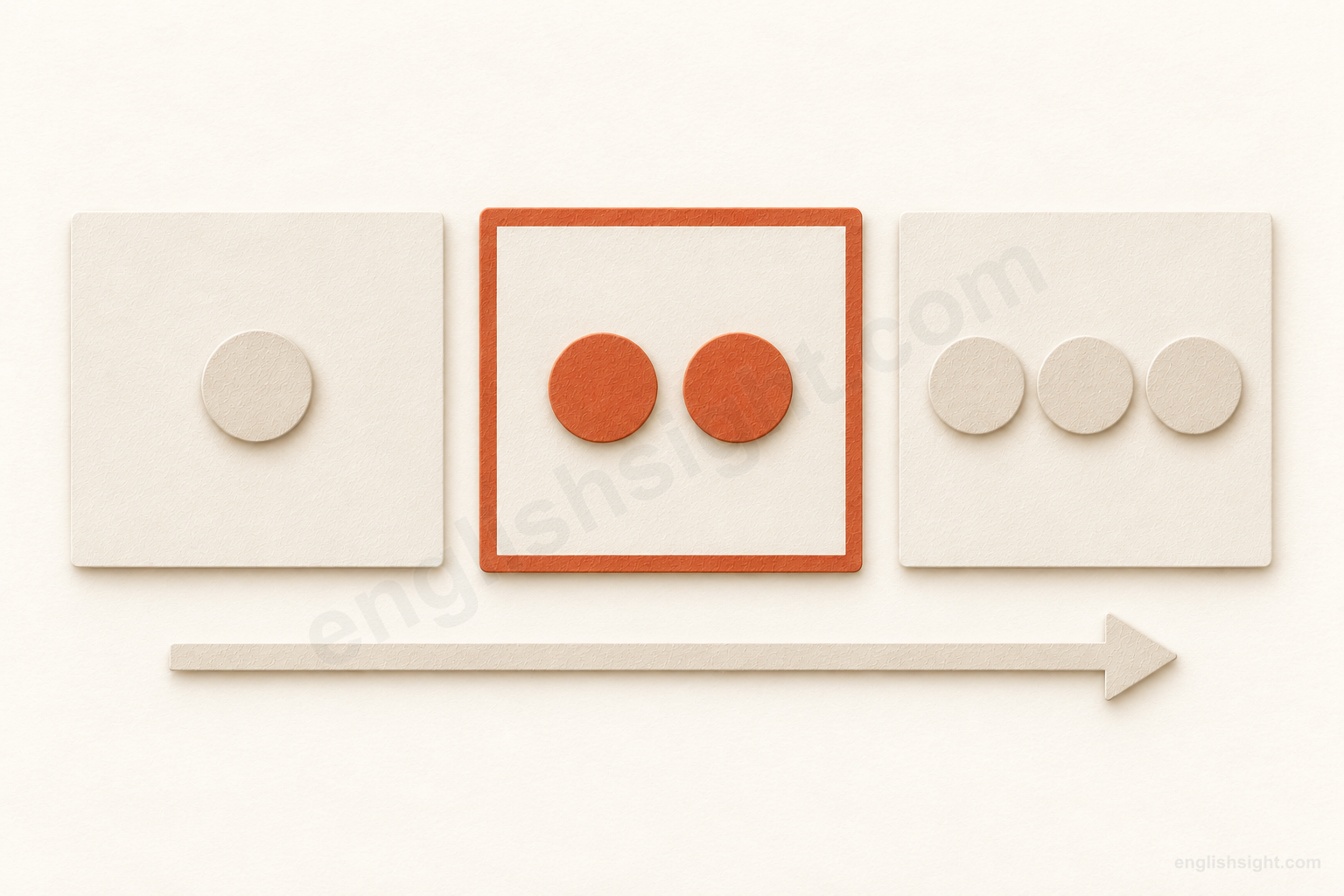
Start with the card on the left.
second
The orange-bordered card comes immediately after the first: it is second.
Follow the arrow to count from left to right; the cards do not move.
Second selects the next position after the first.
Second identifies the next member after a first in an ordered set.
Count from an agreed starting point. The arrow shows the reading order, not an object moving. Time measurement and established compounds are explained separately.
Second often locates something just after a first item, event, or rank. The important question is what you are ordering: doors, attempts, reasons, or quality.
The time noun second is a distinct everyday branch. Fixed expressions such as second nature and second thoughts also need their own explanations. A useful picture connects some uses; it cannot calculate every meaning.
01
Order, repetition, and rank
Ask what is being counted or compared. A position, another opportunity, and a rank need different surrounding words.
01
the / possessive + second + noun; the second (of…); the second to + verb; the second time + clause
the second / my second / the second to…
identify item number two in an ordered set
Starting situation
You count matching items from an agreed starting point.
What the expression adds
One item comes before the selected item.
Second gives a position; two gives a quantity.
The second door is a particular door in a sequence. Two doors counts doors without selecting one. The second of June uses the same ordinal in a date, and 2nd is its written abbreviation.
The second person to arrive identifies the person who arrives after one other person. We can omit an understood noun: I liked the second of the three designs. A possessive already identifies the set: my second visit, not my the second visit.
This is the second time I have lost my key counts occurrences up to now. For the second time tells which occurrence an event represents: She called for the second time. Neither expression measures two seconds.
In a sentence
Take the second turning on the left.
Watch the difference Choose a starting point and an order; an object is not inherently second.
02
a second + singular count noun; give somebody a second chance
a second chance / a second home
add another of the same kind
Starting situation
There is already one opportunity, attempt, or home.
What the expression adds
Another is available in addition to the first.
A second can introduce an additional item rather than identify a previously known one.
After an unsuccessful attempt, give someone a second chance means let them try again. A second cup of tea similarly adds a cup after the first; it need not be a cup already identified in a row.
Compare Give me the second chance with Give me a second chance. The first requires a context with a particular numbered chance; the second is the ordinary request to try again. A second home is an additional home, not necessarily an inferior one.
English as a second language refers to learning or using English in addition to an earlier language. Second in this established label should not be used to calculate how many languages a particular learner knows.
In a sentence
Could you give me a second chance to explain?
Watch the difference Second does not automatically mean worse or less valued.
03
every second + singular count noun; every other + singular count noun
every second day
select alternate members of a sequence
Starting situation
You choose a repeating schedule.
What the expression adds
One day is selected, the next is skipped.
Every second means every other, with one intervening item.
If you water a plant every second day starting on Monday, the next watering is Wednesday, then Friday. Every two days gives the same interval in that schedule.
Every second is different: with no following noun, second can be the time unit, as in The display changes every second. The head noun in every second day makes second an ordinal modifier.
In a sentence
We check the tank every second day.
Watch the difference Every second day does not mean twice a day.
04
come / finish / speak second; in second place; a close second; second to last
come / finish second
occupy the position after first in an order or ranking
Starting situation
Participants, turns, or priorities are put in order.
What the expression adds
The subject is placed immediately after the first.
Second can follow the verb without a noun or article.
Nora finished second gives her finishing position. Nora finished in second place expresses that position with a prepositional phrase. Speak second can instead name a turn in an agenda, with no judgment of speaking quality.
The runner came a close second says the result was nearly a win; close measures how small the gap was. Second to last counts from the end and means one place before last. A second-place finish still counts from the front.
Second can also rank priorities: In our household, family comes first and work comes second gives family greater importance. No race or sequence of completed actions is required. The context supplies what is being ranked.
In a sentence
Nora finished second in her first race.
Watch the difference Use finished second or finished in second place, not finished the second for the ordinary placing.
05
the + second + superlative + noun
the second-largest / second most useful
place a property one position below its highest value
Starting situation
You compare several things by the same property.
What the expression adds
Only one ranks higher on that property.
Second modifies a superlative, not a comparative.
The second-largest box is smaller than the largest but larger than the remaining boxes in the comparison. The second most useful feature ranks usefulness rather than size.
Use largest or most useful after second. Bigger compares one thing with another; second bigger does not express this rank. A hyphen is common in second-largest before a noun; second most useful stays an open phrase.
In a sentence
This is the second-largest room in the building.
Watch the difference Specify the comparison set when it matters; second-largest in a building is not second-largest in a city.
06
be second only to + noun; be second to none
second only to / second to none
identify one superior, or say that nobody is superior
Starting situation
You compare importance or quality.
What the expression adds
The wording says whether anyone ranks higher.
Only one and none give opposite limits on who can be ahead.
For me, sleep is second only to food says food alone is more important in this comparison. To introduces the higher-ranked thing. Only does not mean that sleep is unimportant.
Their service is second to none is strong praise: no competitor has better service. It does not mean their service is in last place, nor does it prove that no competitor can be equally good. These are established comparison expressions.
In a sentence
For reliability, this little printer is second to none.
Watch the difference Second to none praises quality; second only to X acknowledges one higher-ranked X.
07
first, + clause; second / secondly, + clause; in the second place
First, … Second, …
introduce the next point in an explanation
Starting situation
You have given one reason or instruction.
What the expression adds
You add a distinct next point.
This second organizes the message rather than measuring time.
First, check the address. Second, confirm the date. The words make the order of instructions explicit. Secondly is also possible for introducing another point.
Second can add a reason rather than a later action: First, it costs less; second, it lasts longer. The reasons need not occur one after the other in time. In the second place can also introduce a second reason, especially after in the first place.
In a sentence
First, the room is quiet. Second, it has good natural light.
Watch the difference Do not use in a second to introduce reason number two; that phrase normally means very soon.
02
Seconds and short pauses
The time noun is a separate branch. Numbers, prepositions, and conversational tone tell you whether the duration is measured or approximate.
08
number + seconds; for / in + number + seconds; per second; a number-second + noun
ten seconds / per second
measure time in units of one sixtieth of a minute
Starting situation
A clock or timer measures an interval.
What the expression adds
The result is expressed in seconds.
This countable noun names a unit, not position number two.
Sixty seconds make a minute. Ten seconds is a measured duration. Per second gives a rate: five frames per second means five frames for each second of time.
Compare It lasted for ten seconds, which states duration, with She completed it in ten seconds, which states the time needed to finish. Every ten seconds marks a repeating interval.
Before a noun, the unit stays singular in a compound: a ten-second pause. The second hand of an analogue clock displays seconds; this two-word noun differs from second-hand meaning previously owned.
In a sentence
The camera records thirty frames per second.
Watch the difference Use ten seconds after a verb but a ten-second delay before a noun.
09
in a second; for a second; in / within seconds; not for a second
in a second / for a second
speak about a very short time without precise measurement
Starting situation
A short delay or brief experience is relevant.
What the expression adds
The event is near, brief, or rapidly completed.
The preposition distinguishes when from how long.
I’ll call you back in a second promises a very short delay. I paused for a second describes a short duration. Both can be approximate: ordinary conversation does not necessarily promise one exactly measured second.
The screen went dark within seconds means it happened after very little time; the exact number is left open. Not for a second did I believe it emphatically denies even a moment of belief. Here the tiny unit strengthens the negative rather than reporting a stopwatch reading.
In a sentence
For a second, I thought I had left my bag on the train.
Watch the difference In a second normally looks forward; for a second tells how long the thought or action lasted.
10
just / wait / hold on + a second
Just a second! / Wait a second!
request a pause or interrupt after noticing something
Starting situation
Someone is about to proceed.
What the expression adds
You ask them to pause or reconsider.
Tone and context decide whether this is simple waiting or an objection.
Just a second, please can politely ask for time to finish an action. Hold on a second and wait a second serve a similar waiting function; second remains a time noun in these phrases.
Wait a second—these numbers don’t match interrupts the conversation because the speaker has noticed a problem. It need not ask for a literal one-second silence. Adding please and using a calm tone can make a waiting request less abrupt.
In a sentence
Wait a second—this ticket is for tomorrow!
Watch the difference Do not assume Wait a second is always a polite request; it can signal disagreement or surprise.
11
in / for a split second; a split-second + noun
a split second / a split-second decision
emphasize an extremely short interval or very fast decision
Starting situation
An event gives almost no time to react.
What the expression adds
The reaction happens in a tiny interval.
Split second intensifies shortness; it is not a fixed fraction.
For a split second I saw the bird describes a momentary sight. A split-second decision is made almost immediately, with little time for extended consideration.
Use the hyphenated compound before a noun, as in split-second timing. The phrase often emphasizes speed or precision rather than a measured scientific value. It does not mean two seconds.
In a sentence
She made a split-second decision and caught the falling glass.
Watch the difference Keep the article in a split second; split does not make second plural.
03
Extra portions, categories, and previous owners
Some nouns name an established category. Learn their number and article patterns rather than treating every second as an ordinal adjective.
12
have / want seconds; go back for seconds; a second helping
have seconds
take an additional helping of food
Starting situation
You have eaten a serving and there is food left.
What the expression adds
You take another serving.
The plural names more food, not more time.
Would you like seconds? offers another helping. Have seconds and go back for seconds are informal meal expressions. A second helping spells out the countable serving more explicitly.
Context separates We waited ten seconds from We had seconds. The first counts time units; the second describes eating again. Seconds is plural here, so do not replace it with a second when you mean another helping.
In a sentence
The soup was so good that we all went back for seconds.
Watch the difference Seconds is additional food; a second course is a later course and may be a different dish.
13
factory seconds; an item sold as a second
factory seconds
recognize goods sold as imperfect
Starting situation
A shop has items that do not meet its usual quality standard.
What the expression adds
They are sold as a lower-grade category.
Seconds here is a category of goods, usually plural.
Factory seconds may have small flaws such as uneven colouring or a minor surface mark. The phrase describes their grade, not how long they were made or how many owners they have had.
A second-hand plate has had a previous owner; a plate sold as a second is imperfect. A product could be both, but neither description entails the other. Check the stated fault rather than guessing from the label.
In a sentence
The shop sells factory seconds with small glaze marks.
Watch the difference Do not equate seconds with used goods; second-hand describes previous ownership.
14
in second; change / shift into second; second gear
in second / second gear
name a particular gear setting
Starting situation
A vehicle has numbered forward gears.
What the expression adds
The driver selects the second gear.
The noun can stand for second gear when the context is clear.
Change into second and drive in second refer to a gear setting. The numbering supplies the connection with order; second does not measure the duration of driving.
Gear is normally omitted only when the driving context makes it recoverable. I stayed in second on the hill means I kept that gear selected, not I remained there for one second.
In a sentence
He shifted into second as the car gained speed.
Watch the difference Use in second for the gear; in a second usually means very soon.
15
get / have an upper second / a lower second; a second-class honours degree
an upper second / a lower second
recognize British degree classifications
Starting situation
A university reports a degree classification.
What the expression adds
The result falls within second-class honours.
This is a local education label, not the student’s second degree.
An upper second and a lower second name subdivisions of second-class honours in the British degree system. I got an upper second in chemistry reports a classification, whereas I got a second degree in chemistry reports another degree.
The shortened noun is countable: an upper second, a lower second. Its interpretation depends on the education system. Do not translate it automatically as the second-best student in a class.
In a sentence
She graduated with an upper second in chemistry.
Watch the difference A second is a classification here; it is not a universal numerical grade.
16
a second-class + noun; travel second class; treat somebody as a second-class citizen
second-class travel / second-class treatment
distinguish a named service class from a judgment of status
Starting situation
Services or people are being classified.
What the expression adds
The phrase may name a category or criticize unequal treatment.
A service label and a negative judgment need different contexts.
A second-class rail ticket names a travel category, usually contrasted with first class. In British usage, a second-class stamp also names a postal category. These examples do not mean that the ticket or stamp was bought second in a queue.
Treated as a second-class citizen criticizes treating a person as less important or less entitled than others. Second-class can also criticize a lower standard, as in a second-class education. The compound has meanings beyond literal position number two.
Travel categories and postal labels vary by place and provider. In the UK, standard class is the usual modern train term. Learn the label used by the particular service rather than assuming second class is universal.
In a sentence
No one should be treated as a second-class citizen.
Watch the difference A second-class ticket names a category; second-class treatment expresses a critical judgment.
17
a second-hand + noun; buy something second-hand
a second-hand bicycle / buy second-hand
describe something previously owned
Starting situation
Someone else owned the item before you.
What the expression adds
You buy or use it after that ownership.
Second-hand is an established compound about an item’s history.
A second-hand bicycle is a used bicycle. You can put the compound before the noun or use it after buy: I bought my bicycle second-hand. It does not require proof that you are exactly the second owner.
The compound does not by itself mean broken, dirty, or low quality. Factory seconds instead describes imperfect goods. The second hand on a clock is a different noun with different stress: it is the hand that shows seconds.
In a sentence
We found a good second-hand bicycle for Maya.
Watch the difference Distinguish second-hand goods, factory seconds, and a clock’s second hand.
18
hear / learn something second-hand; second-hand information
hear something second-hand
receive information through other people
Starting situation
You did not witness the event yourself.
What the expression adds
Someone else’s account reaches you.
Second-hand describes the route of information, not its age.
I heard the news second-hand says I learned it from another person instead of direct experience or a direct source. Second-hand information uses the same meaning before a noun.
The phrase may suggest caution about reliability, but it does not assert that the information is false. Compare a second opinion: that is another person’s assessment, often independently made, rather than merely a report passed along.
In a sentence
I only heard about the cancellation second-hand.
Watch the difference Second-hand news is indirect; it is not necessarily news delivered second in a list.
04
Decisions, habits, and familiar expressions
A later thought or renewed effort offers a useful connection, but the full expression carries its conventional meaning.
19
have second thoughts about + noun / -ing
have second thoughts about…
begin to doubt an earlier decision
Starting situation
You have made or accepted a plan.
What the expression adds
You become unsure that it is the right plan.
The later thinking introduces doubt; it need not produce a final reversal.
I’m having second thoughts about moving says my confidence in that choice is weakening. About introduces the decision or an -ing form naming it. This is an established expression, not a count of exactly two thoughts.
Compare I’m thinking about moving, which can describe initial consideration without any earlier decision. Having second thoughts may lead to cancelling, changing, or keeping the plan; the expression alone does not settle the outcome.
In a sentence
I’m having second thoughts about selling the piano.
Watch the difference Use plural thoughts in have second thoughts about a decision.
20
on second thought / on second thoughts, + clause
on second thought / on second thoughts
announce a change after reconsidering
Starting situation
You have just said what you intend to do.
What the expression adds
You replace it with a revised choice.
This phrase signals a revision in the conversation.
On second thought, I’ll stay at home revises an earlier intention. On second thoughts is also an established form. Neither uses an article before second.
Having second thoughts describes doubts that may continue. On second thought introduces the new conclusion itself. If you say I’ll have tea—on second thought, make that coffee, the listener should understand the changed order.
In a sentence
I’ll walk. On second thought, I’ll take the bus.
Watch the difference Say on second thought, not in second thought or on a second thought for this conversational revision.
21
without a second thought; not give something a second thought
without a second thought
act without hesitation or further consideration
Starting situation
There is an opportunity to pause and think again.
What the expression adds
The person acts without that extra consideration.
The expression can praise readiness or criticize carelessness.
She agreed to help without a second thought can emphasize willing, immediate help. He threw the notes away without a second thought can suggest he did not consider their value. The phrase itself does not tell us whether the decision was wise.
Not give something a second thought similarly means not consider it further: I didn’t give the comment a second thought. This is different from have second thoughts, where later thinking creates doubt.
In a sentence
When I needed a lift, Ravi offered to help without a second thought.
Watch the difference Keep a in without a second thought; it is absent from have second thoughts.
22
ask for / get / seek a second opinion on / about something
get a second opinion
seek another qualified assessment
Starting situation
One person has already assessed the issue.
What the expression adds
Another qualified person gives an assessment.
The second opinion comes from another assessor, not simply another sentence.
A second opinion is another qualified person’s assessment of an issue, often in a medical or professional setting. Ask for, get, and seek can introduce this noun phrase.
It does not mean the second opinion must disagree with the first. Compare second thoughts, which are your doubts about a decision, and second-hand information, which reaches you indirectly. The shared word second does not erase those differences.
In a sentence
We asked another engineer for a second opinion on the repair plan.
Watch the difference A second opinion is an additional assessment, not a guarantee that the first assessment is wrong.
23
be / become second nature to + person; it is second nature to somebody to + verb
be second nature to someone
do something naturally and with little conscious effort
Starting situation
A skill or habit becomes familiar.
What the expression adds
Doing it feels easy and automatic.
The expression concerns ease and familiarity rather than a second personality.
After years of practice, a movement can become second nature to a musician. The phrase can also describe behavior that feels natural because it is part of someone’s character; practice is not the only possible background.
To me or to her names the person for whom it feels natural. Compare a second chance, which adds an opportunity. Second nature is an established noun phrase; the ordinary ordinal diagram does not predict its meaning on its own.
In a sentence
After years on the same route, checking the mirrors was second nature to her.
Watch the difference Normally use second nature without a: it became second nature, not a second nature in this expression.
24
get / find a second wind
get a second wind
recover energy after becoming tired
Starting situation
Your energy has fallen while doing something.
What the expression adds
New energy lets you continue.
A later burst of energy supplies the connection with second.
Get a second wind is an informal expression for renewed energy after fatigue. It can describe continuing a run, finishing work, or feeling lively again late in the evening.
The phrase does not refer to a second gust of weather. Wind is pronounced /wɪnd/ here, as in moving air, rather than /waɪnd/ as in wind a clock. Treat the full phrase as an idiom, not a prediction from second plus any noun.
In a sentence
I was ready to stop writing, but after the break I got a second wind.
Watch the difference The phrase names renewed energy; it does not promise that every rest will produce it.
25
play second fiddle (to somebody / something)
play second fiddle to…
occupy a less important role than someone or something else
Starting situation
One person or priority receives the leading role.
What the expression adds
Another has a subordinate role.
The expression evaluates relative importance, not musical ability.
I won’t play second fiddle to my colleague expresses unwillingness to accept a subordinate position. To introduces the person or thing given greater importance.
The phrase also works with activities or priorities: Our health should not play second fiddle to work. This is a fixed idiom. It does not mean that the speaker literally plays an instrument or that there are exactly two people involved.
In a sentence
Family life should not always play second fiddle to work.
Watch the difference Use to for the higher priority; the idiom is play second fiddle, without a before second.
26
a second-best + noun; settle for second best; a second-rate + noun
second best / second-rate
distinguish next-to-best from poor quality
Starting situation
You judge the available options.
What the expression adds
You identify either a lesser alternative or a disappointing standard.
Second best and second-rate do not make the same judgment.
My second-best jacket can literally rank just below my best jacket. Settle for second best often means accept an option below the one you really wanted; it need not establish a precise ranking of every alternative.
Second-rate criticizes quality: a second-rate performance is mediocre or poor. It does not simply award second place in a competition. An excellent runner can finish second without giving a second-rate performance.
In a sentence
The hotel we wanted was full, so we settled for second best.
Watch the difference Second best can still be good; second-rate is a negative quality judgment.
27
second-guess + person / decision; second-guess + what / how clause
second-guess a decision
try to anticipate another person’s choice
Starting situation
The choice has not been revealed.
What the expression adds
You try to work out what the person will decide.
This compound can look forward rather than reconsider a past guess.
It is hard to second-guess the committee means it is hard to predict how its members will act or decide. The object may be the people or their decision. A what- or how-clause can state the choice or action you are trying to anticipate, as in second-guess what the committee will decide.
This is one conventional meaning of the compound verb second-guess. Do not infer that somebody has already made a first guess, or that second refers to a time limit. The event’s timing separates this use from judging a decision afterward.
In a sentence
We cannot second-guess what the committee will decide tomorrow.
Watch the difference Read the time context: will decide points forward.
28
second-guess + person / yourself / decision; second-guess after an event
second-guess someone / yourself
question or criticize a decision after it has been made
Starting situation
A choice or action has already occurred.
What the expression adds
Someone re-examines it critically.
This use looks back at a decision rather than predicting it.
Don’t second-guess every decision I make asks someone to stop repeatedly questioning your judgment. The critical hindsight meaning is especially associated with North American English.
Second-guess yourself can describe questioning your own judgment after choosing. This is not merely guessing something for the second time. Second-guess is a compound verb with ordinary endings: second-guessed and second-guessing; it is not a separable particle verb.
In a sentence
After sending the application, I kept second-guessing my choice of examples.
Watch the difference Second thoughts reports doubt; second-guessing emphasizes questioning or challenging judgment.
05
Supporting and temporary assignment
The two verbs differ in meaning and stress. One backs a suggestion; the other sends an employee to a temporary role.
29
second + motion / proposal; be seconded by + person
second a motion
formally support a proposal already put forward
Starting situation
One participant proposes a motion.
What the expression adds
Another participant formally supports taking it forward.
The object is the motion or proposal, not the proposer.
In a meeting using this procedure, I second the motion records formal support after someone has proposed it. The proposal can then proceed according to that meeting’s rules. Seconding is not itself a vote that passes the proposal.
The verb is transitive: second it, not second to it. A passive is natural: The motion was seconded by Lena. Its first syllable is stressed, /ˈsekənd/, like the ordinal and time noun. The forms are seconds, seconded, and seconding.
In a sentence
Lena seconded the motion to open the library on Sundays.
Watch the difference Do not confuse seconding a motion with passing it; meeting rules determine the next step.
30
I second that; I’ll second that
I’ll second that!
express agreement with what someone has said
Starting situation
Someone voices a view or suggestion.
What the expression adds
You add your support.
That refers back to the earlier statement.
“We all need a proper break.” “I’ll second that!” is an informal way to agree. The full reply borrows the idea of backing a proposal without requiring a formal meeting.
That is the direct object of second. I second that is possible too; I’ll second that is a familiar conversational response. It does not put the speaker second in a queue, and it is not a promise to repeat every word.
In a sentence
“This team deserves a day off.” “I’ll second that!”
Watch the difference Use that to refer back to the view; second that is not a particle verb.
31
be seconded (from + department) to + team / organization; be seconded to + verb
be seconded to another team
be sent temporarily to work elsewhere
Starting situation
An employee has a normal department or employer.
What the expression adds
They work in another role for a limited period.
This verb has later stress and a specialized employment meaning.
Especially in British English, an employee can be seconded to another team or organization. The arrangement is temporary, not simply a second job held in spare time. The usual passive foregrounds the employee: She was seconded to the research team.
An employer can also second someone to a project. To before the team is a preposition; in seconded to help, to introduces the task’s infinitive. The employment verb is pronounced /sɪˈkɒnd/ in British English, with stress on the second syllable, unlike second a motion.
In a sentence
Maya was seconded to the research team for three months.
Watch the difference A secondment is a temporary assignment; being second in command describes rank instead.
Choose the branch before choosing the grammar
Order is not quantity
Two tickets counts tickets; the second ticket selects one. A second ticket adds another; my second ticket uses a possessive instead of the. Ordinals do not imply lower quality unless the context or compound supplies that judgment.
A time noun, a plural category, or a verb?
Five seconds measures time. Have seconds concerns food, and factory seconds concerns imperfect goods. Second a motion is a transitive action. The ordinal itself has no passive or causative pattern; the verbs can take normal objects and passives.
Listen for the stress
The ordinal, time noun, and support verb are pronounced /ˈsekənd/. The temporary-assignment verb is /sɪˈkɒnd/ in British English, with later stress. Both verbs have seconds, seconded, and seconding as written forms.
A teaching connection has limits
This lesson covers common modern uses and selected useful compounds, not every term containing second. Technical angle measurement, musical intervals, boxing assistants, and specialist titles are outside the expanded practice. The picture explains ordinal order; time measurement and established expressions need their own explanations.
Read the whole expression
Choose the sentence that matches the situation, not just the word second.
1. You made a mistake and want another opportunity. Which request is natural?
2. You check the tank every second day, beginning on Monday. When is the next check?
3. You briefly believed your keys were missing. Which phrase describes the duration of that belief?
4. A speaker calls the service second to none. What is the intended praise?
5. You planned to sell your piano but are now unsure. Which sentence fits?
6. A shop sells factory seconds. What does that label normally describe?
7. A proposal has been introduced, and you formally support taking it forward. Which verb fits?
8. Maya was seconded to another team for three months. What happened?
Sources and teaching notes
The linked publisher entries support the usage inventory. Explanations, examples, comparisons, and the diagram are original teaching material; visual links are learning aids.
The diagram illustrates order; it does not claim that all English speakers share one mental picture.