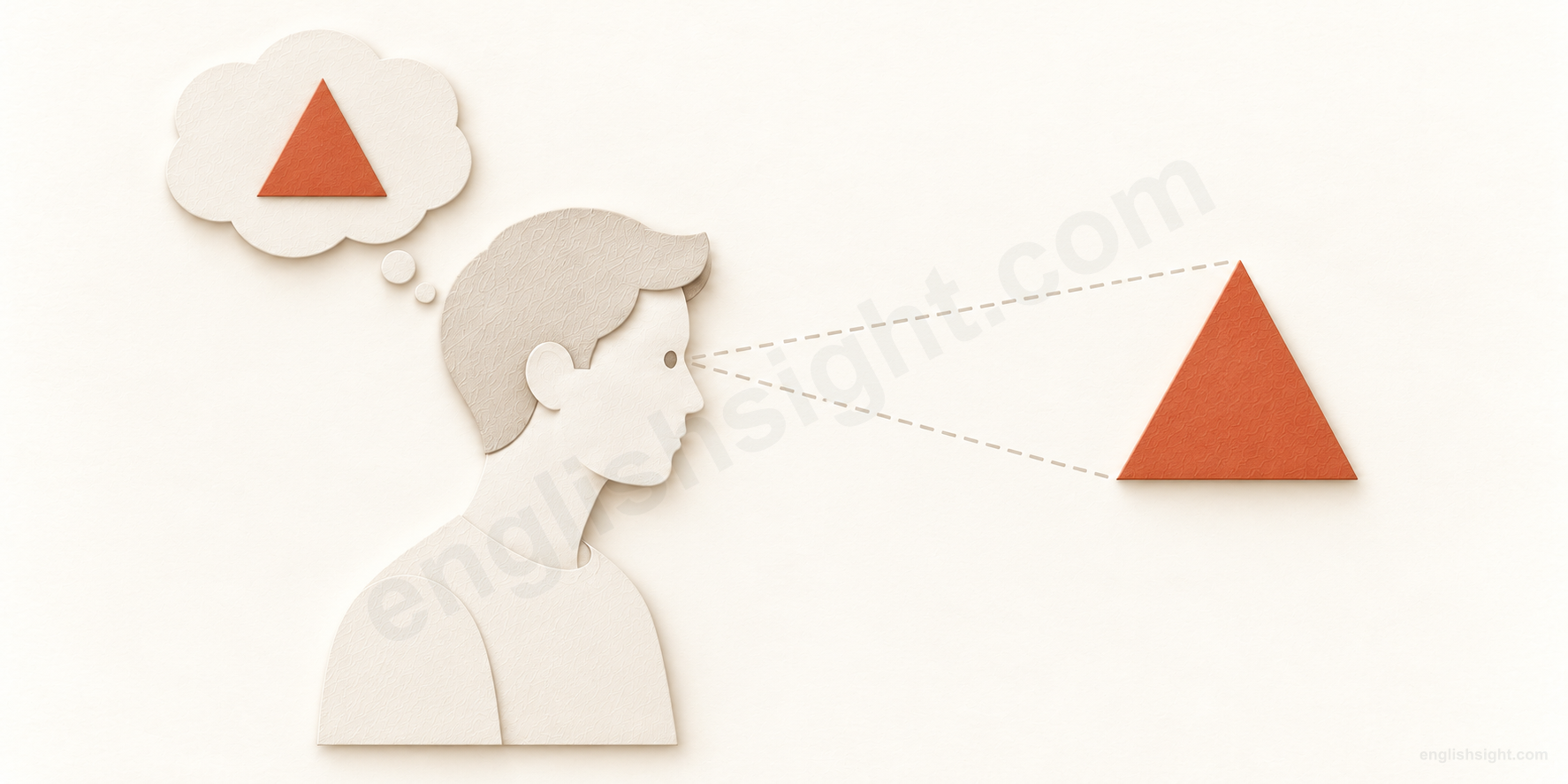
Read the object and the whole construction to understand see.
Something comes into awareness
Something comes into awareness
A triangle is in view.
see
The repeated triangle suggests recognition.
The observer sees it.
The thought bubble is a memory link between seeing and understanding.
An object is visible to an observer; the same triangle inside a thought bubble suggests mentally recognizing it.
The arrows represent a relation, not necessarily a change or a flow of light. Social and managing expressions must also be learned as whole patterns.
See can connect an observer with a visible thing, an event, or an idea that becomes clear. Other uses concern meetings, responsibility, and established expressions.
The drawing offers a memory link between perception and understanding. It cannot generate every meaning and does not represent a shared image in every speaker’s mind.
01
Sight, action, and information
Objects and complements distinguish what is perceived and how an event is presented.
01
see + object; can see; see to + verb
can see
perceive with your eyes
Situation
The river is in view.
Meaning in context
You perceive it.
Perception is different from directing your eyes.
Look at directs attention; see reports perception; watch suggests attention over time. Can see commonly reports present visibility. I cannot see to read means the light or your sight is insufficient. See for yourself invites personal checking.
Example
From this window, I can see the river.
Watch the difference Usually say I can see it, rather than I am seeing it, for ordinary sight.
02
see + object + bare infinitive / -ing; be seen to do / be seen doing
see someone do / doing
perceive an action
Situation
Mia crosses the road.
Meaning in context
You witness the crossing.
The following verb changes the viewpoint.
See Mia cross presents the event as a whole; see Mia crossing presents it in progress, without asserting that you saw its completion. In the passive, the bare infinitive gains to: Mia was seen to cross. Was seen crossing keeps -ing.
Example
I saw Mia cross the road.
Watch the difference Active: saw her leave, not saw her to leave. Passive: she was seen to leave.
03
see + object + adjective / past participle
see someone happy / something damaged
perceive a condition or what happens to something
Situation
Your work is destroyed.
Meaning in context
You experience the painful sight or knowledge.
The object has the described condition.
An adjective describes the object: I like to see you happy. A past participle can present a passive event or result. Seeing work destroyed does not mean you arranged its destruction. Likewise, must be seen to act stresses public awareness of action.
Example
It hurts to see your work destroyed.
Watch the difference In this perception use, seeing something repaired means witnessing the repair or result. To arrange a repair, use have something repaired or see to it that it is repaired.
04
see + film / performance / match
see a film / a show
watch or attend a particular performance
Situation
A play is performed.
Meaning in context
You attend it.
The object names entertainment.
See can report the experience of a film, show, or match. Watch highlights spending time following it. For the general activity, watch TV is the usual expression.
Example
We saw a play on Saturday.
Watch the difference Use watch TV for the activity; see a programme for a particular programme.
05
see + reference; as we have seen
see page 12
consult information or refer back to it
Situation
You need the timetable.
Meaning in context
You consult another page.
The reader is directed to information.
See page 12 is an instruction to consult that page; see also adds a related reference. As we have seen recalls an earlier explanation. I see from your email that… can report information learned by reading.
Example
For the full timetable, see page 12.
Watch the difference This use does not require a picture; the object can be text.
02
Understanding, judgment, and experience
Mental uses extend awareness; they do not always involve eyes.
06
see + noun / that-clause / wh-clause; I see
I see what you mean
understand or realize
Situation
The door was stuck.
Meaning in context
The reason becomes clear.
Mental clarity resembles being able to see.
I see acknowledges understanding, not necessarily agreement. See the point means understand the reason; see no reason or nothing wrong expresses a judgment. I do not see why not commonly accepts a suggestion.
See reason and see sense mean accept a reasonable argument or stop behaving unwisely. After we explained the risk, she saw sense means our explanation persuaded her to think more sensibly.
Example
Now I see why the door would not open.
Watch the difference See does not normally take a direct person object to mean understand that person: use understand you.
07
see + object + as + noun / -ing; as I see it
see something as…
regard something in a particular way
Situation
There is a delay.
Meaning in context
You interpret it as an opportunity.
As introduces your classification.
The same situation can be seen differently. See it as a chance classifies it; as I see it and as far as I can see mark a viewpoint. Be seen as gives the passive assessment.
Example
I see this delay as a chance to rest.
Watch the difference Keep as in see it as a chance; this is an opinion, not a physical transformation.
08
see + quality / something + in + person / thing
see something in someone
recognize a quality or attraction
Situation
A player is developing.
Meaning in context
The coach recognizes her potential.
In identifies who or what has the quality.
See potential in someone recognizes an ability. What do you see in him? asks what attracts you to him, sometimes critically. This is the see something in pattern, not a separable particle verb.
Example
Her coach sees real potential in her.
Watch the difference What do you see in it? asks about its appeal, not what is physically inside it.
09
see + object + -ing; see + event + coming
see yourself doing; see it coming
imagine a possibility or anticipate an event
Situation
You consider a future home.
Meaning in context
You picture yourself by the sea.
Context separates imagination from witnessed action.
Here living is imagined, not observed. I cannot see her agreeing means agreement seems unlikely. I did not see it coming says an event, often a problem, was unexpected.
Example
I can see myself living near the sea.
Watch the difference Do not assume see + object + -ing always describes something happening now.
10
person / time / place + see + event / change
see changes / difficult times
experience events or be their setting
Situation
Changes occur in the town.
Meaning in context
The town has a history of change.
A time or place can be the grammatical witness.
A person can see hardship; a year can see a rise in prices; a place can see major events. The subject need not have eyes. This extends experience and is especially useful in reports.
Example
This town has seen many changes.
Watch the difference The town is not looking at anything; see presents events in its history.
03
Meetings and personal contact
The person, destination, tense, and situation reveal the social purpose.
11
see + person / place; see a lot of + person
see a friend / see the city
meet, visit, or spend time with
Situation
Your aunt is elsewhere.
Meaning in context
You visit her.
Context tells whether the meeting is planned.
I saw Jo at the market may be a chance encounter. Go and see someone suggests a visit; see the city means visit its sights. See a lot of someone means meet them often.
Example
We went to see our aunt on Sunday.
Watch the difference See someone does not by itself mean meet them for the first time.
12
see + professional; see + person + about + matter
see a doctor; see someone about…
have or give a consultation
Situation
You have a dental appointment.
Meaning in context
You will consult the dentist.
The meeting is purposeful.
See a doctor can mean consult one, not merely notice one. The doctor will see you now means receive you for an appointment. About introduces the matter discussed. The progressive is natural for a planned appointment.
Example
I am seeing a dentist tomorrow.
Watch the difference Unlike ordinary visual perception, an arranged meeting can use am seeing.
13
be seeing + person; be seeing each other
be seeing someone
have a romantic relationship
Situation
Someone asks about your personal life.
Meaning in context
They ask whether you are dating.
The progressive often signals an ongoing relationship.
Be seeing someone can mean dating. Context still matters: seeing my accountant is normally a meeting, not romance. Seeing a lot of each other can simply describe frequent contact.
Example
Are you seeing anyone at the moment?
Watch the difference Do not assign the dating meaning to every meeting with a person.
14
see + person + home / out / to + place
see someone home / out
accompany someone to a destination
Situation
A guest is leaving.
Meaning in context
You accompany them to the gate.
The destination makes this an escorting use.
See someone home offers company or protection. See someone out means accompany them to the exit; it need not mean expel them. These are established social uses, not mere visual observation.
Example
Let me see you to the gate.
Watch the difference Say see you out, not see out you; distinguish this from seeing someone off on a journey.
15
see you + later / soon / tomorrow
See you later!
say goodbye informally
Situation
You part for now.
Meaning in context
You expect further contact.
The expression works as a farewell.
See you is a familiar goodbye, with an optional time. It can suggest the next meeting without making a precise appointment. I will be seeing you is another conversational farewell.
Example
See you tomorrow!
Watch the difference This is informal; it does not promise a literal visual encounter in every context.
04
Checking, responsibility, and particle combinations
Keep different meanings and object positions separate.
16
see + if / whether / wh-clause
see if / what…
find out or try what is possible
Situation
You do not know the opening status.
Meaning in context
You check it.
A clause supplies the unanswered question.
You can check by looking, asking, or reading. See if I can help adds trying to help, without promising success. See whether has a similar checking use.
Example
I will see if the shop is open.
Watch the difference See if does not itself guarantee that the answer will be yes.
17
see + that-clause; see to it that + clause
see that; see to it that
make sure an action or result occurs
Situation
Copies need distributing.
Meaning in context
You take responsibility for distribution.
An instruction assigns responsibility.
Here see means ensure, not just discover. See that everyone gets a copy gives a similar instruction. Compare I see that everyone has a copy, which can simply report noticing this fact.
Example
Please see to it that everyone gets a copy.
Watch the difference After see to it that, use a full clause; it is part of the established expression.
18
see to + task / person / need
see to something
deal with something needing attention
Situation
Tickets need arranging.
Meaning in context
You take care of them.
To is a preposition introducing the responsibility.
The speaker undertakes the task, perhaps buying or collecting the tickets. See to a guest means attend to their needs. The whole combination supplies the managing meaning.
Example
I will see to the tickets.
Watch the difference Keep the object after to: see to them, not see them to.
19
see about + noun / -ing
see about doing something
investigate or arrange a practical matter
Situation
The roof needs repair.
Meaning in context
You look into arrangements.
About introduces the matter to pursue.
Seeing about repairs may involve enquiries before action. It does not report watching repairs happen. We will see about that! can instead challenge a claim or refuse to accept it immediately.
Example
We need to see about repairing the roof.
Watch the difference When an action follows about, use -ing: repairing the roof, not repair the roof or to repair the roof. A noun is also possible: see about the repairs.
20
see + person + off; see off + noun
see someone off
say goodbye at the departure point
Situation
Lina is leaving by train.
Meaning in context
You accompany her before departure.
Off belongs to the farewell-at-departure expression.
The person seeing someone off usually stays behind. A noun can follow off, but a pronoun goes between see and off. This differs from simply saying See you!
Example
We saw Lina off at the station.
Watch the difference Say saw her off, not saw off her.
21
see off + opponent / threat; see + object + off
see off a challenge
defeat or drive away
Situation
The opposing team challenges you.
Meaning in context
You overcome the challenge.
This is a separate established meaning of see off.
Especially in British usage, see off can mean defeat a rival; it can also mean make an unwanted person or animal leave. No friendly farewell is implied.
Example
The home team saw off a strong challenge.
Watch the difference The opponent or threat determines this reading; off does not always mean a friendly send-off.
22
see through + person / deception
see through a lie
recognize what is being concealed
Situation
Someone offers a misleading excuse.
Meaning in context
You recognize the deception.
The apparent explanation becomes transparent.
The idea of looking through a surface helps memory, but recognizing hidden intentions is an established meaning. Literal see through glass still means physical vision.
Example
She saw through his excuse immediately.
Watch the difference Keep the object after through: see through it, not see it through for this meaning.
23
see + task / project + through
see something through
continue until completion
Situation
The work is unfinished.
Meaning in context
You stay with it to the end.
The object is the task you complete.
Through marks an endpoint in this established expression. See a project through can include supervising it to completion, not personally doing every part. The noun may also follow through; a pronoun cannot.
Example
The work is difficult, but we will see it through.
Watch the difference See it through means complete it; see through it means detect its hidden nature.
24
see + person + through + difficulty / period
see someone through
provide enough help or resources to endure
Situation
Winter brings expenses.
Meaning in context
The savings support you until it ends.
A resource can be the subject; a person receives support.
Help, money, or determination can see someone through a difficult period. Unlike completing a project, the focus is sustaining the person. The difficult period can be omitted when understood.
Example
These savings will see us through the winter.
Watch the difference Say see us through, not see through us, which suggests detecting our intentions.
25
see out + period / agreement; see + object + out
see out a contract
continue until the agreed period ends
Situation
Time remains on the contract.
Meaning in context
She stays until its end.
Out points to the end of a duration.
This use often concerns a contract, term, or remaining period. It differs from escorting a person out. That coat will see me out can humorously mean it will last for the rest of my life.
Example
She plans to see out her contract.
Watch the difference The object matters: see the visitor out escorts someone; see the contract out completes its duration.
26
see over + building / place
see over a house
visit and inspect a place
Situation
You are considering a flat.
Meaning in context
You inspect it in person.
The whole place is the object of inspection.
This phrasal use is British. Looking around a property can help you decide whether to rent or buy it. Literal see over a wall only describes a line of sight.
Example
We want to see over the flat before renting it.
Watch the difference Do not confuse inspecting a building with being tall enough to see over an obstacle.
05
Managing a conversation
These complete expressions handle thought, explanation, decisions, and uncertainty.
27
let me see; let us / let’s see
Let me see. / Let’s see.
pause to think or remember
Situation
You search your memory.
Meaning in context
You allow yourself thinking time.
The expression manages the conversation.
Let me see can introduce thought, calculation, or recollection. In Let me see your ticket, however, see can literally request inspection. Let’s see can invite joint checking.
Example
Let me see—where did I leave the keys?
Watch the difference Use context to distinguish thinking from a request to look at something.
28
I will / we will see; see what I can do
We’ll see.
postpone a decision
Situation
Someone asks permission.
Meaning in context
You leave the answer undecided.
A future answer is reserved.
We will see often means a decision will come later. It may sound cautious or noncommittal. I will see what I can do promises an attempt or consideration, not guaranteed permission.
Example
“Can we leave early?” “We will see.”
Watch the difference We will see is not automatically yes.
29
wait and see; it remains to be seen + wh-clause
wait and see; remains to be seen
wait for an uncertain outcome
Situation
The plan has not been tested.
Meaning in context
Its success is still unknown.
Time will reveal the answer.
Wait and see postpones judgment until events clarify things. It remains to be seen is a more formal way to say an outcome is unresolved. You will see can confidently predict later confirmation.
Example
It remains to be seen whether the plan will work.
Watch the difference Remains to be seen does not promise success or failure.
30
you see, + explanation; statement + , you see
you see
introduce or emphasize an explanation
Situation
You describe your commute.
Meaning in context
You supply the reason.
You see addresses the listener conversationally.
This discourse expression draws attention to a reason or background information. It does not test eyesight. See? after a demonstration can instead ask whether the listener now understands.
Example
I walk to work, you see, because the buses are so slow.
Watch the difference You see can sound insistent or patronizing if repeated too much.
31
seeing that / seeing as + clause
seeing that / seeing as
give a reason based on a known situation
Situation
Everyone is present.
Meaning in context
Their presence justifies starting.
The whole expression acts like because.
Seeing that introduces a reason; seeing as is informal. This fixed use does not mean someone is physically watching a clause or that see is being used progressively.
Example
Seeing that we are all here, let us begin.
Watch the difference Use a clause after that or as, not a noun alone.
06
Established figurative expressions
A memory connection helps, but these expressions need to be learned as units.
32
see eye to eye with + person + on / about + issue
see eye to eye
agree in opinion
Situation
You discuss spending.
Meaning in context
Your opinions differ.
Shared perspective is the memory link.
This idiom concerns agreement, not matching eye height. With names the other person; on or about names the issue. People can agree on one topic and differ on another.
Example
We do not see eye to eye on spending.
Watch the difference Keep eye singular in the fixed phrase eye to eye.
33
see the light
see the light
finally understand or accept a better course
Situation
He resists changing his plan.
Meaning in context
The costs persuade him to reconsider.
Understanding is pictured as illumination.
This idiom often suggests a change in attitude or behavior, beyond merely receiving information. A religious conversion is also possible in the right context; this example concerns a practical realization.
Example
After checking the costs, he finally saw the light.
Watch the difference Do not infer literal light or religious belief without supporting context.
34
see red
see red
suddenly become very angry
Situation
Someone unfairly blames a child.
Meaning in context
You become furious.
This is an idiom for an emotional reaction.
No red object is necessary. Learn see red as a unit; the sight-to-understanding model does not predict this meaning. A literal color description needs a suitable visual context.
Example
I saw red when they blamed the child.
Watch the difference The idiom has no article: see red, not see the red.
35
have / has seen better days
have seen better days
be old, worn, or past its best
Situation
The sofa used to be better.
Meaning in context
It is now worn.
Past experience provides a polite comparison.
The expression often describes an object in poor condition, sometimes gently or humorously. A building or business can also be past its best. The subject need not be able to see.
Example
This sofa has seen better days.
Watch the difference The phrase describes its present condition by comparing it with a better past.
36
see fit + to-infinitive; as + subject + see fit
see fit to…; as you see fit
judge something appropriate
Situation
You have use of a room.
Meaning in context
You may decide how to use it.
Fit means suitable within this expression.
See fit to act means decide that acting is appropriate; as you see fit gives someone discretion. The tone can be formal, or critical when describing an unwelcome decision.
Example
Use the room as you see fit.
Watch the difference This fit concerns suitability, not physical fitness or size.
37
cannot see the wood / forest for the trees
not see the wood / forest for the trees
miss the main point by focusing on details
Situation
Attention stays on individual commas.
Meaning in context
The larger purpose is overlooked.
Individual trees hide the whole wood as a metaphor.
British English commonly uses wood; American English uses forest. Both idioms criticize attention to details that prevents understanding the whole situation. This is not an ordinary account of eyesight.
Example
We are arguing over commas and cannot see the wood for the trees.
Watch the difference Learn the full phrase; for means roughly because of here.
Grammar and limits of the picture
Forms and tense
Forms: see, sees, saw, seen, seeing; pronunciation /siː/. Say I saw it yesterday and I have seen it before. Ordinary sight and understanding usually avoid the progressive; appointments and dating permit it.
Perception is not causation
Seeing someone leave does not cause their departure. The active bare infinitive becomes to + verb in the passive. Some passive constructions describe public perception: a leader must be seen to act.
Scope
This course covers the modern verb and common expressions, not a frequency ranking or every regional idiom. The noun see meaning a bishop’s jurisdiction and the poker sense of matching a bet are outside its everyday focus.
Choose by construction and context
Read the situation before choosing the English expression.
1. An observer witnessed Lina leave. Which passive sentence is standard?
2. You recognized that an excuse was dishonest. Which expression fits?
3. You have a dental appointment tomorrow. Which form is natural?
4. A parent replies We will see to a request. What is implied?
5. You ask someone to make sure copies reach everyone. Choose the instruction.
Sources and teaching notes
Usage was checked in the publisher pages below. The explanations, examples, and drawing are original teaching material; visual links are memory aids.
The drawing is a teaching analogy, not a universal mental image.