Understand plant seeds, new beginnings, recipe instructions, and tournament rankings.
A beginning from which growth can develop
A beginning from which growth can develop
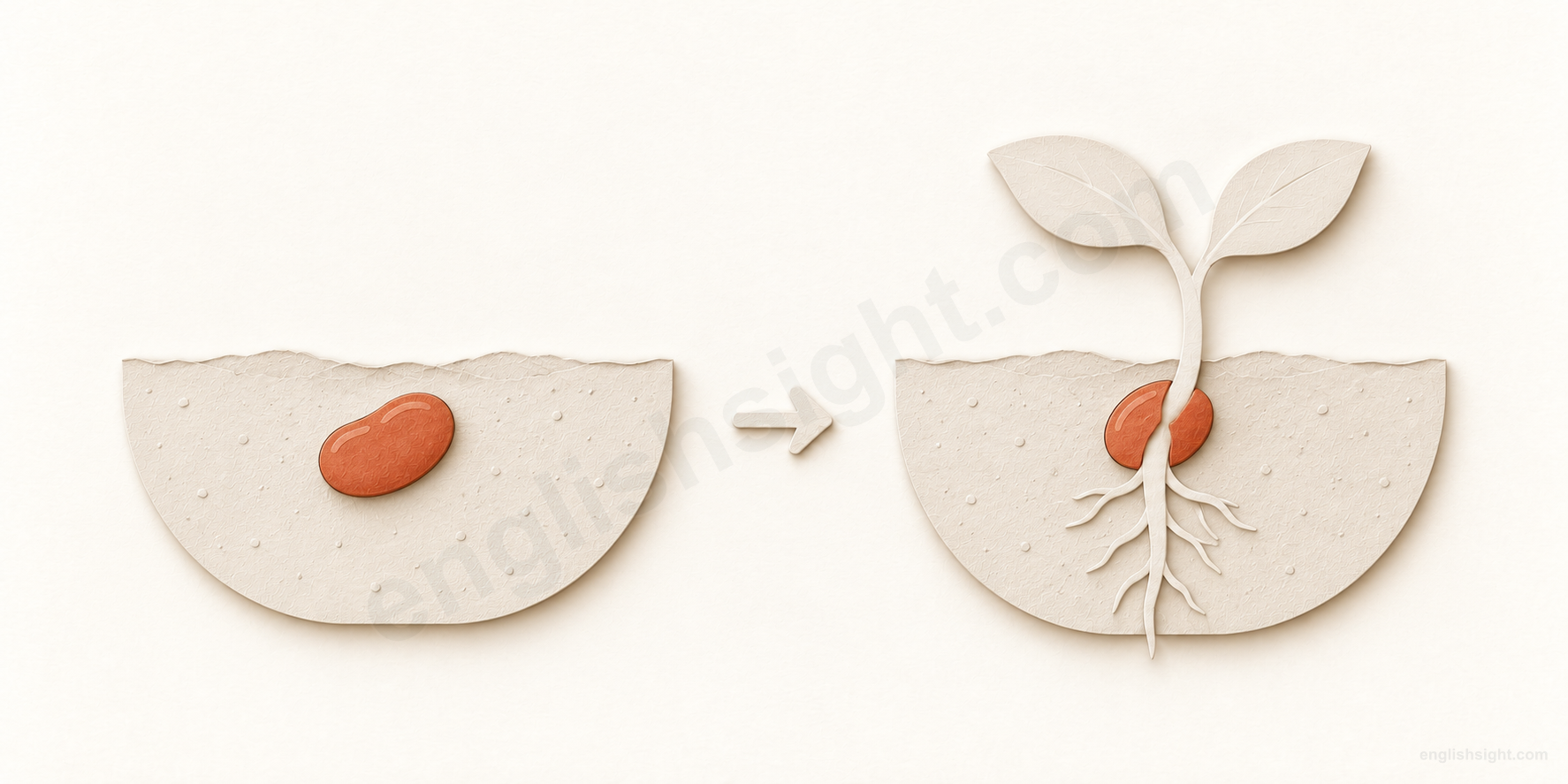
A seed below the soil surface
seed
A root and a leafy shoot develop
Under suitable conditions, growth can begin.
A seed is a small beginning from which something larger can grow.
A seed is a small beginning from which a plant, or figuratively a larger development, can grow.
The sketch shows a possible growth process. It explains the plant sense and a useful metaphor, while cooking, sporting, and fixed idiomatic uses need their own explanations.
A seed can be a small starting point for a new plant. This helps explain why ideas and projects can also have seeds: something small can begin a much larger development.
The connection is useful, but it does not predict every use. Seed the lawn adds seeds; seed the peppers removes them. A top seed is a sporting competitor, and go to seed can describe neglect.
01
Seeds and the life of a plant
Name a seed, put it in the ground, and describe the different stages of growing and producing new seeds.
01
a seed; two / several seeds; a/an + plant or fruit name + seed
a seed / seeds
a plant part from which a new plant can grow
Starting situation
You open a fruit and find several small seeds.
What follows / what is meant
You can name each seed or count them together.
One seed is an individual object; seeds is the ordinary countable plural.
Use a seed for one and seeds for more than one. A seed can develop into a new plant; it is not already a young plant. That young plant is a seedling.
An apple seed or orange seed is often called a pip in British English. Seed is the usual North American word for these fruit parts. The words overlap here; pip is not a replacement for seed in every expression.
In a sentence
There are five seeds inside this apple.
Watch the difference A seedling has already started growing as a young plant. Do not use seedling for an ungerminated seed.
02
some / more + seed; a packet of seed / seeds; seed + noun
grass seed / a packet of seed
seeds treated as a supply or material
Starting situation
You need enough seeds to cover a patch of ground.
What follows / what is meant
You buy an amount of grass seed, without counting each piece.
Uncountable seed presents the material collectively.
Grass seed treats the supply as a mass: We need more seed. A packet of seed and a packet of seeds can both be natural; the first emphasizes the contents as a supply, the second the individual pieces.
Before another noun, seed commonly stays singular: a seed packet or a seed pod. This noun modifier tells you what the packet contains or what the pod holds; it does not mean there is only one seed.
In a sentence
We need more grass seed for the bare patch.
Watch the difference For a counted individual, say a seed. For the collective material, say some seed, not a seed meaning an entire supply.
03
plant / sow + seeds + in + place
plant / sow seeds
put seeds in the ground so they can grow
Starting situation
You have seeds ready for a garden bed.
What follows / what is meant
The seeds are placed in the soil for growing.
The seeds are the object of plant or sow.
Plant seeds and sow seeds both describe putting seeds into growing conditions. Sow points specifically to sowing seed; plant is wider and can also take a young plant or a tree as its object.
In sow the seeds in pots, in pots names the place. In sow carrot seeds, carrot identifies the kind. These are ordinary verb-and-noun combinations, not phrasal verbs made from seed.
In a sentence
We sowed the bean seeds in small pots.
Watch the difference The object of sow seeds is the seed itself. In seed a lawn, the lawn is the object instead.
04
grow + plant + from seed; a seed + sprouts / germinates
grow from seed
start growing a plant using seed rather than an existing young plant
Starting situation
You choose between seeds and plants that have already started growing.
What follows / what is meant
Your plants begin from seeds.
From marks the starting source, not the soil or location.
Grow tomatoes from seed means begin with seeds, rather than buy young tomato plants. Seed is commonly uncountable in this expression. From a seed is also possible when one particular seed matters.
A seed sprouts or germinates when growth begins. A person grows a plant from seed; the seed itself grows into a plant. Keep the grower and the growing thing distinct.
In a sentence
Maya grows all her tomatoes from seed.
Watch the difference From seed tells how growing starts. In soil tells where it happens; these phrases answer different questions.
05
seed + area + (with + crop); area + be seeded + (with + crop)
seed a lawn with grass
put seeds into an area of ground
Starting situation
An area of ground has been prepared.
What follows / what is meant
Seeds have been spread there for new plants.
With the verb seed, the area can be the direct object.
Seed the lawn means sow seed on it. In seed the field with oats, the field is the area receiving seed and with oats names what you sow. This with-phrase is optional when the crop is already clear.
The passive is useful when the work matters more than the worker: The field was seeded with grass. A newly seeded lawn has recently been sown; it need not already have visible grass.
In a sentence
The bare area was seeded with grass last week.
Watch the difference A newly seeded lawn has had seed added. Seeded peppers in a recipe can mean the seeds have been removed.
06
a plant + seeds; plants + seed; a plant + seeds itself / plants + seed themselves
plants seed / seed themselves
plants produce seeds or spread by their own seeds
Starting situation
The plants have reached a stage when they can reproduce.
What follows / what is meant
They produce seeds, and new plants may grow without someone sowing them.
The plant can be the subject, rather than a gardener.
The plants are seeding describes the plants producing seeds. No object is needed for that meaning. Plants seed themselves when their own seeds give rise to further plants.
The reflexive themselves points back to the plants: nobody needs to replant each new one. It does not give plants a conscious intention. This is a gardening use, not a claim that every seed survives.
A plant in seed is at the seed-bearing stage. In seed describes its state; it does not mean that somebody is sowing the plant.
In a sentence
These flowers seed themselves around the garden.
Watch the difference The flowers are seeding has plants as producers. We are seeding the field has people sowing an area.
07
plant + go / run to seed
go / run to seed: plants
reach the stage of producing flowers and seeds
Starting situation
You have been growing leafy vegetables for their leaves.
What follows / what is meant
The plants start producing flowers and seeds.
The whole expression names a stage in the plant’s life.
When lettuce goes to seed, it moves into flowering and seed production. Run to seed is another form of the expression. To does not introduce an infinitive: seed here is a noun.
The expression can matter to gardeners harvesting leaves or preventing weeds from spreading. It does not mean the plant returns to being a tiny seed, and it is not automatically a negative judgment about all seed production.
In a sentence
The lettuce has gone to seed, so we will sow another row.
Watch the difference Use the fixed form to seed, without a: gone to seed. A building going to seed has a different, figurative meaning.
02
Seeds in food and recipes
Seeds may be an ingredient to keep or a part to remove. The food and the instruction decide which.
08
plant name + seeds; seeded + bread; seedless + fruit
sesame seeds / seeded bread
seeds used as food or included in food
Starting situation
You choose an ingredient or a type of bread.
What follows / what is meant
You identify the seeds it contains.
Seeds can be an ingredient, rather than something being planted.
Sesame seeds and sunflower seeds name seeds used as food. In a food description, seeded bread means bread containing seeds. The noun seed still names the plant part; the setting changes its use.
Seedless fruit is described as having no seeds. Seeded can also mean with seeds removed in recipe instructions, so it is not a reliable opposite of seedless without context. A seeded loaf contains seeds; seeded tomatoes in a recipe may have had them taken out.
In a sentence
She sprinkled sesame seeds over the bread.
Watch the difference Do not assume every use of seeded means seeds added. Check whether you are reading a food label or a preparation instruction.
09
seed / deseed + fruit or vegetable; remove the seeds from + food
seed / deseed the peppers
remove the seeds from fruit or vegetables
Starting situation
The cut peppers still contain seeds.
What follows / what is meant
The seeds have been removed for the recipe.
With this cooking use, the object is the food being prepared.
Seed the peppers means take their seeds out. Deseed, also written de-seed, expresses the same action and is familiar in British recipes. Remove the seeds from the peppers is an explicit alternative.
This verb meaning goes in the opposite practical direction from seed a lawn: you remove seeds from the peppers but add them to the lawn. Learn the action with its object and context, rather than assigning one direction to seed.
In a sentence
Halve and seed the peppers before chopping them.
Watch the difference Seed the peppers does not normally tell a cook to add seeds. A noun-shaped verb can have a conventional removal meaning.
03
Small beginnings and support for growth
Ideas, feelings, projects, and businesses can have seeds too. These uses borrow the possibility of later development, rather than a literal plant.
10
the seeds of + feeling / process / result
the seeds of change / doubt
early causes or beginnings of a later development
Starting situation
A situation contains something that may lead to a larger change.
What follows / what is meant
You identify that small beginning, even before the full result appears.
The following of-phrase names the possible development.
The seeds of change compares an early cause with a seed that can grow. The seeds of doubt names the beginning of doubt, not some physical part of a feeling. The plural is especially usual in this figurative pattern.
The metaphor can describe helpful or harmful developments: seeds of success or seeds of conflict. It is expressive language, often found in discussion and writing; it does not guarantee that the development will happen.
In a sentence
That first meeting contained the seeds of a lasting friendship.
Watch the difference The seeds are the beginning or cause, not the completed result. Do not treat every occurrence as literal gardening.
11
sow / plant the seeds of + result; plant a seed in + someone’s mind
sow / plant the seeds of something
start something that can develop later
Starting situation
A comment or action introduces the beginning of a feeling or process.
What follows / what is meant
That feeling or process may develop over time.
Sow or plant supplies the action of introducing a beginning.
Sow the seeds of distrust describes causing distrust to begin. The image extends the literal planting of seeds, but the whole expression is an established way to discuss later consequences.
Plant a seed in someone’s mind can describe introducing an idea: Her question planted a seed in my mind. Plant the seeds of doubt makes the feeling explicit. These expressions need not mean the person immediately accepts a complete plan or belief.
In a sentence
His unanswered questions planted the seeds of doubt in her mind.
Watch the difference The later result comes from the full expression and context. Seed alone does not mean persuade or prove.
12
raise / receive / provide + seed money / capital / funding
seed money / capital / funding
money provided to get a business or project started
Starting situation
A new project needs resources to begin.
What follows / what is meant
It receives money for its early work.
Seed marks the starting role of the money, rather than money for buying seeds.
Seed money and seed capital name money used to start a business or project. Seed funding can name that money or the act of providing it. These are business and project terms, not a promise of future success.
Use raise seed funding, receive seed money, or provide seed capital. Money, capital, and funding are normally uncountable here: some seed money or a round of seed funding, not three seed moneys.
In a sentence
The team used the seed funding to build its first working model.
Watch the difference Seed money is an established compound. In a business context it means starting funds, not a gardening purchase.
13
seed + project / industry / development
seed a project / an industry
introduce support or a starting stimulus for development
Starting situation
A project or industry needs something to get development going.
What follows / what is meant
An initial input helps development begin.
The project or field of activity is the object receiving the initial stimulus.
Seed a project extends seed a field: you introduce something that can start growth, such as early resources or support. This is especially useful in business, policy, or technical discussion; help start is a simpler everyday alternative.
What grows need not be beneficial. Seed an outbreak can describe introducing infection that then spreads. The object supplies the kind of development; seed itself does not mean improve or guarantee success.
In a sentence
The small grant helped seed a local repair project.
Watch the difference This is the transitive verb seed, with an ordinary object. It is not a separable phrasal verb or a special causative construction.
04
Sporting seeds and fixed expressions
Learn the sporting meaning, go to seed for decline, and bad seed for a harsh judgment about a person. These established uses need more than the plant sketch.
14
the top / number one / second + seed
the top / number one seed
a competitor given a ranked position in a tournament draw
Starting situation
Organizers identify strong competitors before a tournament.
What follows / what is meant
You refer to one by the seeding position they were given.
A seed is a competitor in this sporting context.
The top seed or number one seed is the competitor given the highest seeding position for that event. Other expressions include the second seed and the third seed. Players or teams can be seeds.
Seeding helps arrange the draw so leading competitors avoid meeting one another in early rounds. Being the top seed is not winning the tournament, and a tournament’s seeding is not necessarily identical to an overall world ranking.
In a sentence
The top seed lost in the second round.
Watch the difference A seed here is a ranked competitor, not a plant part or a predicted winner who cannot lose.
15
player / team + be seeded + ordinal number; a seeded / top-seeded + competitor
be seeded second / a seeded player
be assigned a ranked position for a tournament
Starting situation
Organizers decide how strong competitors will be placed in the draw.
What follows / what is meant
A player has a particular seeding position.
The passive highlights the competitor receiving the position.
She is seeded second means she has the second seeding position for the event. Organizers seed the players is the active form. Sports reports often use the passive or an adjective: a seeded player, the top-seeded team.
An unseeded player has no seeding position of this kind, but can still enter and win. The position concerns the tournament arrangement; it is not a guarantee about the order in which competitors will finish.
In a sentence
Rina is seeded second in this year’s tournament.
Watch the difference Seeded second describes a pre-event position; finished second describes the final result.
16
person / place + go / run to seed
go / run to seed: neglect
deteriorate because of insufficient care
Starting situation
A place or person was previously better cared for.
What follows / what is meant
The condition becomes poorer or less tidy through neglect.
The whole idiom carries a negative evaluation.
A hotel that has gone to seed has become shabby or poorly maintained. The idiom can also describe a person becoming less well cared for or fit. Applied to people, it can sound unkind or judgmental.
This established figurative meaning differs from a plant simply producing seeds. It describes decline, not the hopeful beginning used in seed funding. Learn both meanings of go to seed with their contexts.
In a sentence
The old hotel has gone to seed since it closed.
Watch the difference A person who has gone to seed is not beginning to succeed or grow. The idiom has its own negative meaning.
17
someone + be + a bad seed
a bad seed
a person judged to be bad by nature
Starting situation
Someone believes a person is fundamentally dishonest or harmful.
What follows / what is meant
They use a harsh label for that person, rather than describe one isolated mistake.
The whole expression refers to a person and expresses a negative judgment.
A bad seed is an informal expression, used especially in North American English, for someone regarded as bad by nature or likely to influence others badly. The phrase presents the speaker’s judgment; it does not establish that someone is born bad.
He is a bad seed labels the person. He did something wrong describes an action and is a less sweeping claim. The idiom is separate from bad seeds in a gardening context, which can simply mean seeds unsuitable for growing.
In a sentence
His neighbours called him a bad seed after he repeatedly cheated them.
Watch the difference A bad seed is a strongly negative label for a person. It does not merely mean a beginner, an unseeded player, or someone who made one mistake.
Keep the context and the whole expression
A useful connection, with limits
The seed-to-growth connection is a teaching model, not a picture shared by every English speaker. It supports plant and figurative beginning uses; it does not make every seed a literal plant or every development a success.
Forms, sounds, and objects
Seed is pronounced /siːd/. The countable plural is seeds, while collective seed is often uncountable. Verb forms are seed, seeds, seeded, seeding; seeded has two syllables, /ˈsiːdɪd/. The verb can be progressive for an activity, transitive with an area or food, intransitive with a plant, and passive when an area or competitor receives an action.
Read the object before choosing the action
Seed a field adds seeds; seed a pepper removes them; seed a player assigns a tournament position. These are separate conventional uses of the verb. The with in seed a field with grass is a preposition, and to in go to seed belongs to a fixed expression. Neither makes a general family of separable phrasal verbs.
What this lesson leaves outside
Technical uses such as cloud seeding, crystal seeding, and computing seeds need subject-specific explanations. Literary seed meaning descendants, old-fashioned reproductive uses, and specialized compounds are outside this everyday selection. No claim is made to cover every dictionary entry or rank uses by frequency.
Choose the meaning that fits the situation
Check the object and the context. The same word can point to different actions.
1. A recipe says, “Seed the peppers.” What should you do?
2. You need a supply for a bare lawn, rather than one individual piece. Which request fits?
3. A player is seeded second. What does this tell you?
4. Someone says an old hotel has gone to seed. What is the likely meaning?
5. A comment planted the seeds of doubt. What did the comment do?
Sources and teaching notes
Usage was checked against the publisher pages below. Explanations and examples are original. The growth sketch is a teaching interpretation, not evidence that all meanings follow one rule.
The diagram shows a useful connection; it does not represent a picture shared by every native speaker.