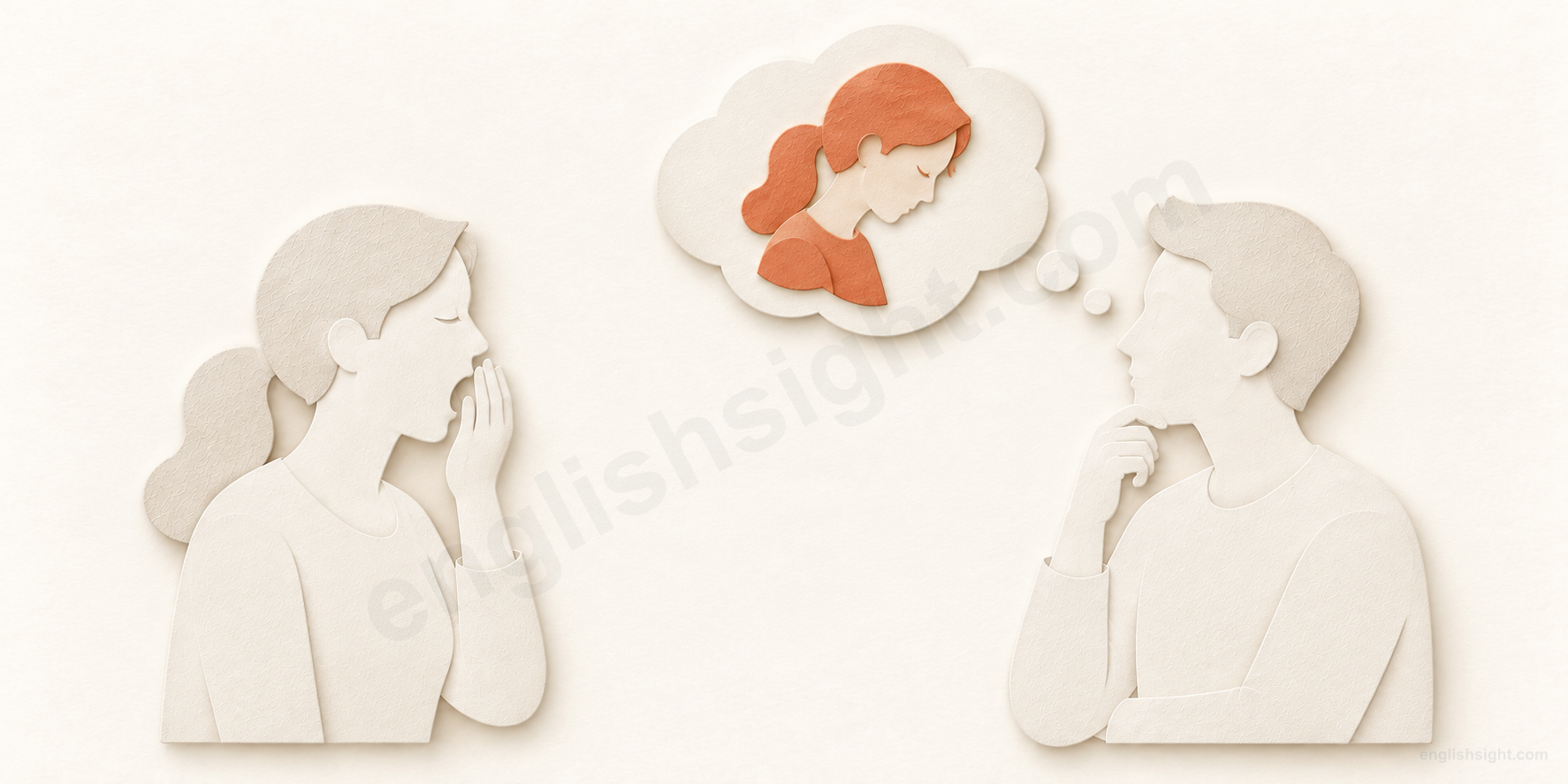
Use seem to present what appears true, with room for judgment.
From clues to a judgment
From clues to a judgment
A woman yawns with her hand raised to her mouth.
seem
He forms an impression of tiredness, shown in his thought-cloud.
The man facing her considers the visible signs.
Her yawn gives him an impression of tiredness.
Notice signs, form an impression, and keep the distinction between an impression and a direct assertion.
The diagram explains an evidential viewpoint, not movement or a physical change. Common constructions specify what is being judged.
Seem often leaves a small gap between the clues and the conclusion: this is how the situation appears to someone. The conclusion may be correct; seem does not mean false.
The sketch is a teaching aid, not a claim that every English speaker visualizes the word in the same way.
01
Qualities, identities, and viewpoints
Use an adjective, a description, a comparison, or an explicit evaluator to describe how something strikes someone.
01
seem + adjective
seem tired
appear to have a quality
Clues / situation
You notice her yawning.
Judgment / result
You judge that she is tired.
The quality is an impression, not a change of state.
Seem links the subject to an adjective. You may judge from behavior, sound, information, or appearance; you do not need to see the person.
Compare She is tired, which states the condition more directly. She gets tired describes becoming tired. Seem does neither automatically.
She doesn’t seem herself today means her health, mood, or behavior seems unlike her usual self. It does not cast doubt on who she is.
In a sentence
She seems tired after the journey.
Watch the difference Use an adjective: seems happy, not seems happily.
02
seem + noun phrase; seem to be + noun / prepositional phrase
seem (to be) a good choice
give the impression of being a thing or kind
Clues / situation
You consider the room and the meeting.
Judgment / result
You tentatively classify it as suitable.
A noun phrase identifies or evaluates the subject.
Seem to be a good choice presents an assessment rather than a confirmed fact. A prepositional phrase can follow be too: The house seems to be in good condition.
Seem a good choice is also possible, especially in British usage. With longer noun phrases, seem to be is often an easy neutral choice.
In a sentence
This room seems to be a good choice for the meeting.
Watch the difference The noun is a description of the subject, not an object being acted on.
03
seem + adjective + to + person; it seems to + person + that-clause
It seems to me that…
identify whose impression it is
Clues / situation
You assess the plan.
Judgment / result
You express your own judgment.
To me names the person doing the judging.
It seems to me that… makes the viewpoint explicit. The plan seems reasonable to me similarly identifies the evaluator after the adjective.
Compare It seems to be ready: to be begins an infinitive. In seems to me, to is a preposition followed by a person.
In a sentence
It seems to me that we need more time.
Watch the difference Say It seems to me that…, not It seems me that….
04
seem like + noun; seem as if / as though + clause
seem like / as if…
compare an impression with a thing or imagined situation
Clues / situation
People are looking toward your group.
Judgment / result
You infer a waiting situation.
The complement can be a comparison rather than a bare quality.
Seem like a good idea uses a noun phrase after like. Seem as if or as though introduces a clause: the observed situation resembles what that clause describes.
Informal English also uses It seems like everyone is waiting. The meaning need not imply that the situation is false or imaginary.
In a sentence
It seems as if everyone is waiting for us.
Watch the difference Use as if plus a clause, not as if a good idea. Use seem tired without like when giving a plain adjective.
02
Activities, earlier events, and existence
Following grammar tells us whether the impression concerns an action, an earlier event, a whole situation, or existence.
05
seem + to-infinitive; seem to be + -ing
seem to know / be working
appear to do something or be doing it
Clues / situation
You hear typing upstairs.
Judgment / result
You infer that Leo is working.
The infinitive supplies the apparent activity.
Leo seems to know the answer describes apparent knowledge. Leo seems to be working describes an activity apparently in progress. The -ing belongs to working, not to seem.
Leo doesn’t seem to know and Leo seems not to know both express an impression of not knowing; the first is especially ordinary in conversation.
In a sentence
Leo seems to be working upstairs.
Watch the difference Say He seems to know, not He seems know. Normally avoid He is seeming.
06
seem to have + past participle
seem to have forgotten
apparently have done something earlier
Clues / situation
The password does not come to mind.
Judgment / result
You conclude that you have forgotten it.
The perfect infinitive points to an earlier event or resulting situation.
Seem to have forgotten places forgetting before the present judgment. Seem to be forgetting instead describes an apparent ongoing process.
I seem to have… can also soften an admission. The speaker may be fairly sure; seem does not always mean only a weak guess.
In a sentence
I seem to have forgotten my password.
Watch the difference Keep have plus the past participle: to have forgotten, not to have forget.
07
it + seems + (that) + clause
It seems that…
present an apparent situation
Clues / situation
You check information about the shop.
Judgment / result
Your conclusion concerns its Monday schedule.
The whole clause supplies what appears true.
In It seems that the shop closes early, it is a grammatical placeholder, not a particular object. That introduces the situation being judged.
The shop seems to close early presents a similar judgment with the shop as subject. It seems can rely on reports, not only visible evidence.
In a sentence
It seems that the shop closes early on Mondays.
Watch the difference After that use a full clause with its own subject and verb.
08
there seems to be + singular; there seem to be + plural
There seems to be…
suggest that something exists
Clues / situation
You inspect the ticket page.
Judgment / result
You think two tickets remain.
There introduces existence; it does not name a place.
There seems to be a problem and There seem to be two problems describe apparent existence. The noun phrase after be controls standard agreement.
The tickets seem cheap judges existing tickets. There seem to be tickets says they apparently exist. The constructions answer different questions.
In a sentence
There seem to be two tickets left.
Watch the difference In careful standard English, use seem with plural tickets; not There seems to be two tickets.
03
Everyday responses and cautious wording
These established patterns handle difficulty, tact, and replies to previous information. Their communicative functions belong to the full expression.
09
cannot / could not seem to + verb
cannot seem to…
try but be unable to manage something
Clues / situation
You try several times to open the file.
Judgment / result
You still cannot open it.
The familiar negative pattern conveys difficulty despite effort.
I can’t seem to open this file normally reports an unsuccessful attempt, not uncertainty about whether you are capable. The whole expression carries this everyday meaning.
Compare I don’t seem to need it: that gives an impression of no need and does not imply repeated attempts. Cannot seem is not a separable phrasal verb.
In a sentence
I can’t seem to open this file.
Watch the difference Do not read can’t as saying that forming an impression is impossible.
10
it would seem + (that) + clause
It would seem that…
make a conclusion less direct
Clues / situation
The delivery has not arrived.
Judgment / result
You cautiously suggest an address error.
Would can soften a conclusion rather than mark a condition.
It would seem that… often presents an inference cautiously or tactfully. It can introduce unwelcome news without making the statement as blunt as We used the wrong address.
The expression is somewhat more formal than It seems…. It does not by itself mean the mistake is imaginary or that a condition must follow.
Strange as it may seem, the cheaper ticket is refundable means although it may seem surprising. This adjective-first as construction introduces a concession, not the comparison expressed by as if.
In a sentence
It would seem that we have used the wrong address.
Watch the difference Polite wording changes tone, not the evidence or the truth of the claim.
11
so it seems; it seems so; it doesn’t seem so
So it seems.
agree that a previous statement appears true
Clues / situation
Someone asks about a cancellation.
Judgment / result
You say the available evidence supports it.
So stands for the earlier statement.
So it seems and It seems so refer back to a preceding proposition. They let you acknowledge an apparent situation without repeating the whole clause.
It doesn’t seem so gives a negative impression. As it seems is not the ordinary standalone answer for this use.
In a sentence
“Has the meeting been cancelled?” “So it seems.”
Watch the difference The reply expresses appearance or available information; it does not promise official confirmation.
Use the impression, then read the construction
An impression is not automatically false
Seem can express uncertainty, a well-supported inference, or polite distance. It is not a fixed percentage of confidence.
Grammar and scope
Forms are seem, seems, seemed, seemed; the spelling seeming exists, but the linking verb is normally not progressive. It has no ordinary object to passivize, no productive causative pattern, and no everyday particle-verb family. Historical senses and derived seeming / seemingly are outside this verb lesson.
Choose the interpretation
Read the clues and the whole pattern before answering.
1. A friend yawns, and you infer that she is tired. Which sentence presents your impression?
2. You tried repeatedly but could not open the file. Which expression captures that difficulty?
3. You cannot remember your password now and infer that you forgot it earlier. Which form fits?
Sources and teaching notes
Definitions and usage were checked against the sources below. Explanations, example sentences, and the diagram were written for this lesson; the visual connection is a teaching interpretation.
This diagram helps explain a connection; it is not a picture shared by every native speaker.