Connect personal identity with the same-person relations in myself and self- words.
Keep the individual in view
Keep the individual in view
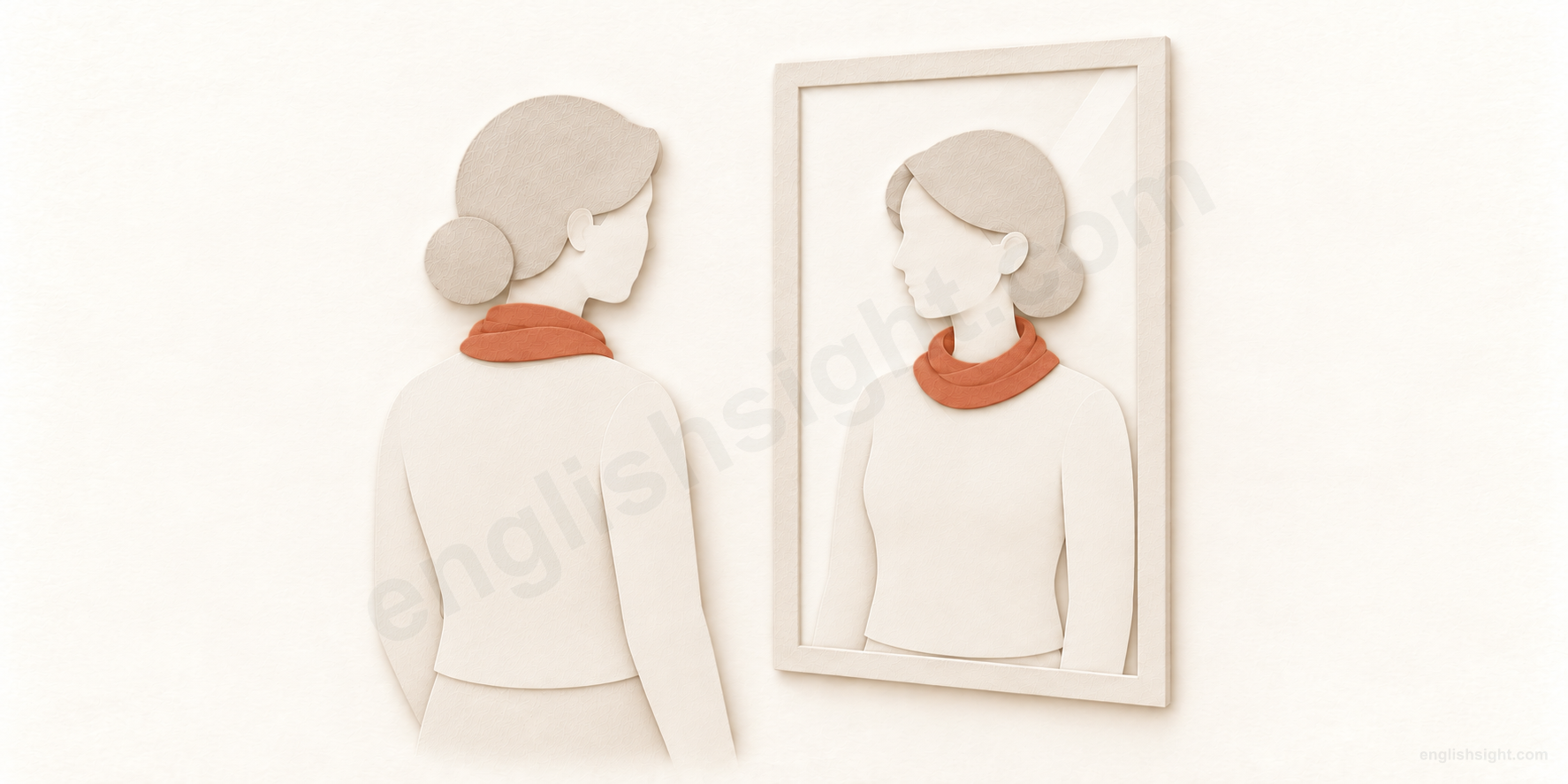
A woman faces a mirror.
self
The image in the frame is her own reflection.
Recognize the same individual.
One person and her own reflection: the reference stays with the same individual.
Self directs attention to the individual concerned: who they are, or a relation involving that same person or thing.
The mirror is a teaching analogy for recognizing the same person. Identity is more than appearance, and no literal reflection or change of state is required by the word.
Self directs attention to the individual concerned: who they are, or a relation involving that same person or thing. As a noun, it names identity or a particular side or state of a person; in related forms, grammar tells us how the reference works.
Compare her true self, she reminded herself, and a self-taught artist. These are a noun phrase, a reflexive pronoun, and a compound adjective. They are related, but they cannot replace one another in a sentence.
01
A person’s identity, condition, and different sides
As a noun, self lets us talk about who a person is, how they normally are, or how they compare across settings and time.
01
possessive + true / real / inner self; a sense of self; the self
your true / inner self; a sense of self
the individual you understand yourself to be
Situation / reference
You act differently to please different people.
What the expression describes
You ask which feelings and values really belong to you.
Self can name personal identity, rather than a separate person inside the body.
Your true or real self is the person you genuinely are; your inner self concerns your private feelings and character. These expressions let you discuss identity as something you can understand, express, or hide.
A sense of self is your awareness of having your own identity. In more formal discussion, the self treats this identity as a general subject: The essay examines the self and society. This is a way of speaking about people, not proof of a particular psychological theory.
Self is a noun here. A possessive and a description make phrases such as her true self; the ordinary object pronoun is her, and the reflexive is herself. Those forms do different grammatical jobs.
In a sentence
Writing about her childhood helped Mara understand her inner self.
Watch the difference In ordinary conversation, use I understand myself, not I understand self.
02
be + possessive + usual self; feel like + possessive + old self
your usual / old self
your familiar health, mood, or behavior
Situation / reference
A cheerful friend has been quiet during an illness.
What the expression describes
She is laughing and joining conversations again.
Old self refers to a familiar condition, not necessarily an elderly person.
Be your usual self and feel like your old self compare someone now with how they normally are. The comparison may concern energy, mood, appearance, or behavior; context supplies the particular quality.
After a good rest, I felt like my old self again describes recovery. He was his usual quiet self describes continuity rather than recovery. Not quite myself and not feeling herself express a similar departure from the normal state using reflexive pronouns.
In a sentence
After a quiet weekend, Leo felt like his old self again.
Watch the difference My old self often means the familiar me; my older self specifically compares ages.
03
possessive + younger / former / future self; plural selves
your younger / future self
the same person viewed at another time
Situation / reference
You compare your present choices with another stage of your life.
What the expression describes
You describe that earlier or later version of you.
The adjective supplies the time; self supplies the personal reference.
My younger self means me when I was younger. My future self means the person I will be later. A writer may address a younger or future self as a useful way of reflecting on decisions.
The plural is selves, pronounced /selvz/: our younger selves. It can refer to several people at earlier stages, or to different imagined versions of one person. It does not automatically mean separate physical people.
In a sentence
I saved the notes so my future self could understand the decision.
Watch the difference Write selves as the plural noun, not selfs; write her younger self, not her younger herself.
04
possessive + public / private / professional self
your public / private self
the way a person behaves in a particular setting
Situation / reference
A reserved colleague meets close friends after work.
What the expression describes
She shows a more playful side of her personality.
One person may be described through different social sides.
Your public self is how you present yourself where others can see you; your private self is the side shown in personal life. Your professional self similarly concerns how you behave at work.
Her public and private selves differ uses the plural noun to contrast aspects of one person. The phrase need not suggest dishonesty: people often behave differently with customers, family, and friends.
In a sentence
His professional self is calm, even when he feels nervous inside.
Watch the difference Do not infer a medical condition from an ordinary reference to different selves.
05
be + a shadow / ghost of + possessive + former self
a shadow of your former self
much weaker or less effective than before
Situation / reference
A once powerful team loses many experienced players.
What the expression describes
It performs far below its previous level.
A shadow is a conventional comparison with a stronger past version.
Be a shadow of your former self is an idiom for a substantial loss of strength, influence, ability, or vitality. Be a ghost of your former self is a related form.
The expression can describe a person, organization, or team. It is a strong, often sad or critical judgment. Simply changing interests does not make someone a shadow of their former self.
In a sentence
After losing its best players, the club was a shadow of its former self.
Watch the difference This is an idiom of decline, not a literal shadow or a neutral description of being older.
06
think of self; personal interest expressed by self
think only of self
put personal advantage ahead of others
Situation / reference
A decision affects both one person and a whole group.
What the expression describes
The person considers only their own benefit.
Bare self can refer formally to personal interest.
In formal or critical language, self can stand for someone’s own advantage or pleasure. In a sentence such as He thinks only of self, the criticism comes from only and the surrounding situation.
Everyday speech usually prefers He only thinks about himself or She puts herself first. Talking about your true self is not automatically selfish; identity and personal advantage are different uses.
In a sentence
The speech asked the volunteers to put service before self.
Watch the difference Bare self in this meaning sounds formal or rhetorical, not like a general replacement for me.
07
note to self: + reminder; possessive + good self
note to self; your good self
refer to yourself in a reminder or someone in marked polite wording
Situation / reference
You realize that you forgot something useful.
What the expression describes
You turn the lesson into a brief reminder to yourself.
These are established noun phrases with a particular tone.
Note to self introduces a reminder addressed to the speaker. It appears in actual notes and also in light or humorous comments about a mistake. The instruction can follow a colon.
Your good self is a very polite, sometimes playful or old-fashioned way to refer to you. We hope your good self can join us is much more marked than We hope you can join us. The two expressions share personal reference, not the same social function.
In a sentence
Note to self: check the train times before leaving home.
Watch the difference These fixed uses do not make Self forgot the keys a normal sentence.
02
The same participant: myself, yourself, itself
The -self / -selves forms can refer an object back to a subject, add personal emphasis, or work with a preposition. The construction changes the relation.
A reflexive pronoun links an object back to the subject.
In Nina introduced herself, Nina and herself refer to the same person. Nina introduced her normally introduces a different woman. The reflexive can also follow a preposition: I wrote a reminder to myself.
The forms are myself, yourself, himself, herself, itself, ourselves, yourselves, and themselves. One person addressed as you takes yourself; several people take yourselves. Oneself goes with general one in formal language; everyday general advice more often uses you and yourself.
Use the whole pronoun as one word. Bare self normally cannot replace it. Some verbs, such as enjoy, commonly use a reflexive in this sense: Enjoy yourselves! By contrast, ordinary I washed and I got dressed can describe personal routines without an explicit reflexive.
In a sentence
Nina introduced herself to the new neighbors.
Watch the difference Myself is not a more formal substitute for I or me: say Please email me in an ordinary request.
People think a repair was done by someone you hired.
What the expression describes
You explain that you personally did the repair.
The reflexive adds emphasis; it is not the repaired object.
I repaired the chair myself emphasizes who did the work. The chair remains the object. I myself repaired the chair is another possible placement, with emphasis close to the subject.
Compare I hurt myself: myself is the object there, so removing it changes the sentence structure. An emphatic reflexive can be removed while leaving the main event intact. Emphasis on personal involvement does not always guarantee that nobody helped.
In a sentence
I checked every address myself before sending the invitations.
Watch the difference Myself cannot normally stand alone as the subject: use I checked, not Myself checked.
10
(all) by + reflexive; on + possessive + own
by myself
without other people present
Situation / reference
Your housemates go out.
What the expression describes
You spend the evening at home alone.
By + reflexive can describe being alone without saying how you feel.
Be or go by yourself can mean that no one is with you. Live by myself describes a living arrangement. It does not by itself mean I feel lonely or I dislike the arrangement.
All strengthens the expression: I was all by myself. On my own is a common alternative. The same pattern changes with the subject: she went by herself; the children stayed by themselves.
In a sentence
I spent the afternoon by myself and enjoyed the quiet.
Watch the difference Alone describes company; lonely describes an unhappy feeling. They are not interchangeable.
11
do + object + (all) by + reflexive; machine + verb + by itself
do something by yourself
complete an action without help
Situation / reference
A shelf needs assembling.
What the expression describes
You assemble it without anyone helping.
With an activity, by + reflexive can emphasize independence.
I assembled it by myself usually means I did the work without another person’s help. Other people may still have been in the room. The activity and context distinguish this meaning from physical solitude.
I assembled it myself emphasizes my role; I assembled it all by myself makes the lack of assistance clearer. For a machine, It starts by itself usually means automatically, without someone starting it, rather than without other machines nearby.
In a sentence
The child fastened her coat by herself while her father watched.
Watch the difference By herself does not always mean no one else was there.
12
have + thing + (all) to + reflexive
have something to yourself
have exclusive use of something
Situation / reference
Other visitors leave the reading room.
What the expression describes
You are the only person using it.
To + reflexive after have can mark something as unshared.
Have the room to myself means that I can use it without sharing it with anyone else. The thing remains the object of have; to myself describes the exclusive arrangement.
Compare I was by myself in the room: that says I was alone. I had the room to myself highlights my exclusive use of the room. I sent a message to myself uses the same words to myself for a different relation: I am the recipient.
In a sentence
On Monday morning, I had the whole pool to myself.
Watch the difference To myself does not mean without assistance; check the verb and the complete pattern.
13
be + reflexive; not feel / seem + reflexive
be yourself
act naturally rather than put on a different personality
Situation / reference
You worry about pretending to be impressive at a meeting.
What the expression describes
A friend encourages you to act in your normal way.
The person’s own character is the reference point.
Be yourself encourages someone to behave naturally. The positive advice is not an instruction to become a different person. It relates to the noun phrase your real self.
Context matters: You don’t seem yourself today usually comments on unusual health, mood, or behavior. It does not mean the speaker doubts your identity. Both uses compare behavior or state with what is familiar for that individual.
In a sentence
You don’t need to copy the other speakers; just be yourself.
Watch the difference Do not translate be yourself as a literal command to exist or to identify your name.
14
thing + in itself; in itself, + clause
in itself
considered on its own, apart from related circumstances
Situation / reference
An activity is enjoyable, but getting there takes hours.
What the expression describes
You separate your opinion of the activity from the journey.
In itself limits what part of a situation is being evaluated.
The class in itself was useful evaluates the class independently of other considerations. It allows a contrast such as but the journey was exhausting.
This is not the same as by itself, which may describe solitude, independence, or automatic operation. In itself is an established way of narrowing the assessment, not a physical location inside an object.
In a sentence
The walk in itself was easy, but finding the starting point was difficult.
Watch the difference Changing in to by can change the meaning; learn the whole expression.
15
do / make + something + for + reflexive; see / think + for + reflexive
for yourself; see / think for yourself
mark your own benefit or rely on your own observation and judgment
Situation / reference
You hear conflicting descriptions of a room you may rent.
What the expression describes
You inspect it and make your own assessment.
For identifies a personal interest or an independent point of view, depending on the verb.
I made lunch for myself means that I was the intended beneficiary or person eating it. Compare I made lunch by myself: that emphasizes doing the preparation without help. The meal could be for someone else.
See for yourself invites someone to check directly instead of relying only on a report: Go upstairs and see for yourself. Think for yourself asks them to form their own opinion. Neither expression means that they must be physically alone.
These familiar combinations depend on the whole construction. Self-reference identifies the relevant person, for contributes the relation, and see or think supplies the kind of independent activity.
In a sentence
The photos are useful, but I want to see the room for myself.
Watch the difference For myself can identify a beneficiary or independent perspective; it does not automatically mean without help or without company.
03
Reading common self- compounds
Self- often relates something to the person or thing concerned. Learn whether the whole word means care for yourself, action by yourself, automatic operation, or something more conventional.
16
make time for / prioritize + self-care
self-care
care directed toward your own well-being
Situation / reference
You notice that you have neglected rest and regular meals.
What the expression describes
You make time to look after your own needs.
Self- identifies the person who receives the care.
Self-care is a noun for looking after yourself. A simple sentence such as I make time for self-care treats this as an activity, not as a person or a product.
Here the person caring and the person cared for coincide. This is one relation expressed by self-; it does not mean every self- word refers to health. Write the conventional compound self-care, not self care as a freely interchangeable phrase.
In a sentence
She began making time for self-care during a busy month.
Watch the difference This word names care for yourself; it does not mean that you must do everything without support.
17
show / exercise / lose / regain + self-control
self-control
manage your own reactions and behavior
Situation / reference
You feel an urge to shout during a disagreement.
What the expression describes
You keep your voice steady.
The person controls their own response rather than another person.
Self-control is the capacity to manage your emotional reactions or impulses. We commonly speak of showing, exercising, losing, or regaining self-control.
In He lost his self-control, lost does not mean that he misplaced an object. It means that he stopped managing his reaction. Self- supplies the relation to his own behavior; control supplies the kind of regulation.
In a sentence
It took self-control to answer the rude message calmly.
Watch the difference Self-control is normally uncountable: say a lot of self-control, not many self-controls.
18
have / build + self-confidence; high / low self-esteem; keep / lose self-respect
self-confidence; self-esteem; self-respect
describe different positive attitudes toward yourself
Situation / reference
You discuss both someone’s abilities and how they value themselves.
What the expression describes
You choose the noun that matches the intended attitude.
The words overlap, but the second part of each compound matters.
Self-confidence concerns trust in your abilities: practice may increase your self-confidence before speaking. Self-esteem concerns how positively you regard your own character and worth: a person may have low self-esteem even while performing a task well.
Self-respect concerns a sense of dignity and standards you can stand by. Refusing to accept humiliating treatment can be described as keeping your self-respect. These distinctions help with word choice; the feelings can influence one another.
All three are normally uncountable nouns. Have confidence in yourself is a useful alternative to have self-confidence; the self- compound is not a reflexive pronoun.
In a sentence
Practising her talk gave her more self-confidence in front of an audience.
Watch the difference Self-confidence is not necessarily arrogance, and low self-esteem is not a claim about actual ability.
19
be / feel + self-conscious + about + noun / -ing
feel self-conscious about something
feel awkward because of attention to how others see you
Situation / reference
You begin speaking in a language you are learning.
What the expression describes
You worry about how your voice sounds to others.
This familiar adjective is more specific than simply being conscious of yourself.
Feel self-conscious about your accent or appearance means feeling embarrassed or uncomfortable because you are thinking about other people’s reactions. About introduces what concerns you.
In reviews, self-conscious can also criticize a deliberately noticeable style: self-conscious humor draws attention to the way its effects are produced. That use need not describe a shy person. Learn these conventional meanings with the compound rather than translating its parts mechanically.
In a sentence
At first, I felt self-conscious about speaking into the microphone.
Watch the difference It does not simply mean awake, and it is not the same as confident.
20
a self-taught + person; be / become + self-employed
self-taught; self-employed
describe independent learning or working for yourself
Situation / reference
You explain how someone learned a skill and how they work.
What the expression describes
You distinguish their training from their employment arrangement.
Self- can point to independent activity; the complete word determines which activity.
A self-taught photographer learned the skill independently rather than through someone teaching them. Books and other learning materials can still be involved. Self-taught says how the person learned, not whether the work is good.
A self-employed photographer works for themselves rather than as an employee of a company. It says how they work, not how they trained. Someone can be both self-taught and self-employed, either one, or neither.
Both are adjectives: a self-taught musician; she is self-employed. Taught and employed are fixed parts of these words, not a reason to invent self-teached.
In a sentence
Our self-taught photographer became self-employed last year.
Watch the difference Self-employed does not mean unemployed, and self-taught does not mean unskilled.
21
self-service + café / checkout; self-closing + door
self-service; self-closing
identify who performs the action
Situation / reference
You compare a café where customers collect food with a door that closes automatically.
What the expression describes
You see two different uses of self- in descriptions.
Customers serve themselves; a self-closing door closes through its own mechanism.
A self-service café expects customers to serve themselves instead of having someone bring everything to them. The café does not serve itself; the customer supplies the relevant person.
A self-closing door closes automatically after use. Similarly, a device described with self- may perform a process without a person carrying out every step. Self-service and automatic operation are related ideas of independence, but they assign the action to different participants.
In a sentence
We collected our trays in the self-service café.
Watch the difference Self-service does not guarantee that a process is automatic or that no staff are present.
22
be + self-explanatory; a self-explanatory + title / diagram
self-explanatory
clear without an additional explanation
Situation / reference
A short instruction already makes the required action clear.
What the expression describes
The reader understands it without extra guidance.
The information itself supplies what the reader needs.
A self-explanatory title or diagram is easy enough to understand without a separate explanation. This is an established adjective, not a claim that a title can literally speak.
The relationship is about sufficiency: the item itself makes its meaning clear. It is not the same relation as self-taught, where a person learns independently. The common self- element helps you look for a relation to the relevant person or thing; the rest of the word still needs to be learned.
In a sentence
The three pictures were self-explanatory, so we needed no extra instructions.
Watch the difference Calling something self-explanatory is a judgment about clarity; another reader may still need help.
Choose the form and read the whole expression
Noun, pronoun, and combining form
Self /self/ has the noun plural selves /selvz/. My self can occur when discussing my identity as a noun, but the reflexive myself is one word. Her true self and she herself have different grammar. Self- is a combining form in compounds, usually written with a hyphen; check the established spelling rather than inventing a form.
Match the person and number
Use myself with I, yourself with singular you, yourselves with plural you, and ourselves with we. Himself, herself, itself, and themselves follow the referent. Contemporary English also uses themselves with singular they. Formal general one takes oneself; ordinary advice often uses you and yourself.
Reflexive does not mean reciprocal
They introduced themselves means each person gave their own introduction. They introduced each other means each introduced another person. A reflexive points back to the relevant subject; it does not by itself mean that two people acted on one another.
Do not add self everywhere
In ordinary English, say I washed and I got dressed when no contrast is needed. Say Please contact me, not Please contact myself merely to sound formal. Some polite uses of yourself occur, but neutral you is the safer everyday choice. Not every verb followed by a reflexive is a phrasal verb.
The scope of this lesson
This lesson covers the everyday noun, key related pronoun patterns, and a selection of useful self- compounds. It does not list the entire productive compound family or every verb-specific reflexive idiom. Specialist self/nonself in immunology, the botanical verb self, textile and color adjectives, and obsolete uses are outside the main lesson. Passive, causative, and tense families are not separate senses of this noun or combining form.
Follow the reference
Choose the expression that fits both the situation and the grammar.
1. After being ill, you feel healthy and energetic again. Which expression describes this familiar condition?
2. Nina tells new neighbors who Nina is. Which sentence expresses that action?
3. A child ties her shoes without help while her parent watches. Which sentence fits?
4. Everyone else has left, and you can use the whole room without sharing it. Which phrase emphasizes exclusive use?
5. A photographer learned independently, but now works as an employee of a newspaper. Which description is supported?
6. You enjoy a quiet walk without company. What does by myself directly tell the listener?
Sources and teaching notes
Usage and grammar were checked against the dictionary pages below. The explanations, examples, and mirror analogy were created for this lesson; the analogy is a teaching interpretation.
The diagram is a teaching aid, not a picture shared by every native speaker.