Explore sense as a bodily ability, an awareness, a meaning, and practical judgment.
From a signal to awareness
From a signal to awareness
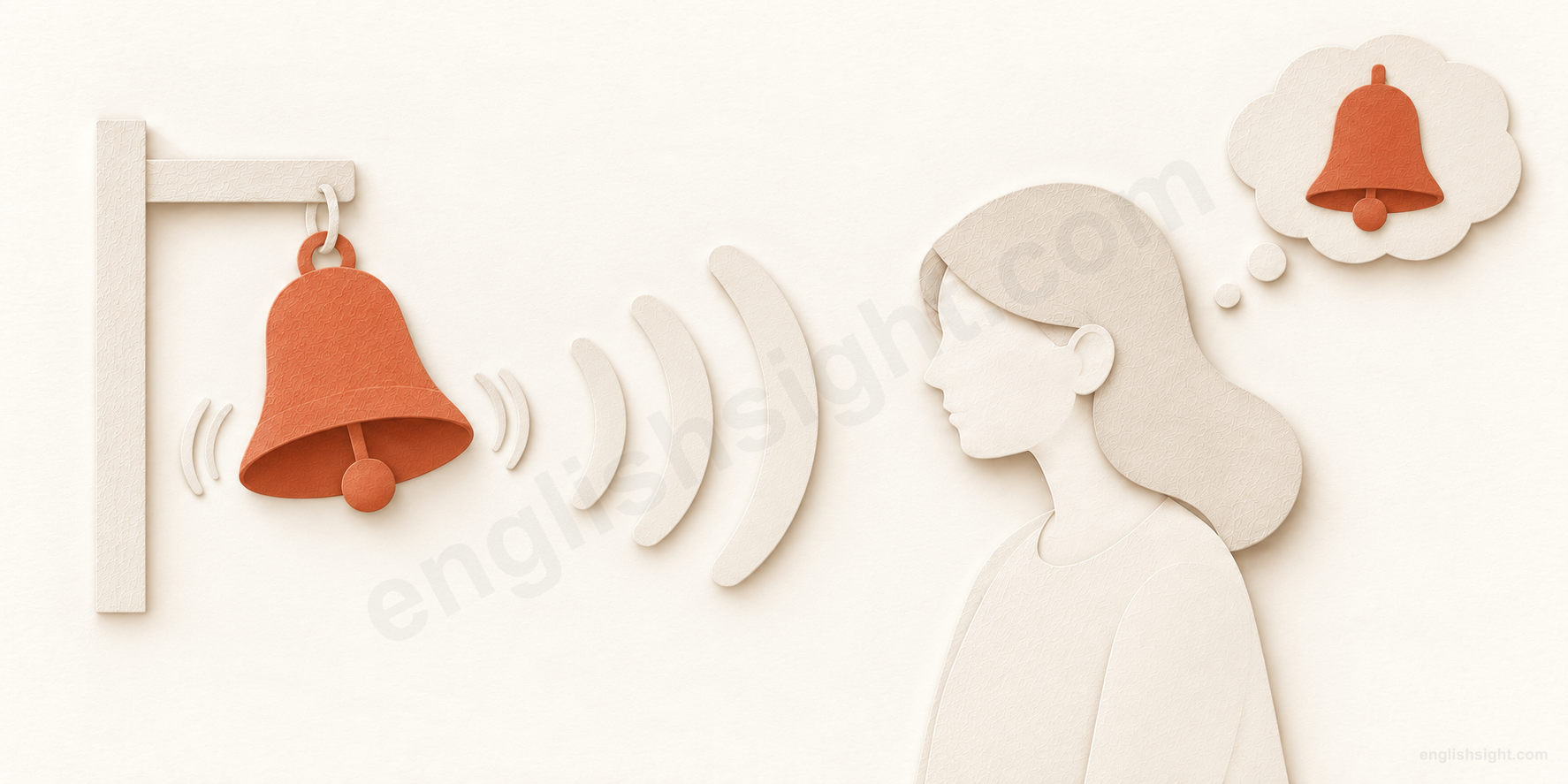
A bell rings nearby.
sense
The listener becomes aware of the ringing.
Its sound reaches a listener.
The bell makes a sound; the listener becomes aware of it.
To sense something is to become aware of it; the noun can name an ability to perceive, a feeling or awareness, an interpretation, or sound judgment.
The hearing example illustrates perception becoming awareness. Feelings, meanings, and practical judgment are related branches to learn in context, rather than literal sounds traveling into the mind.
Sense belongs to a family of perception, awareness, understanding, and judgment. Your sense of hearing lets you notice sound; a sense of relief is a feeling; a sense of a word is a meaning. These are related uses, not interchangeable definitions.
Start with the whole expression. The instructions make sense, I make sense of the instructions, and I sense a problem give different roles to the subject and to what follows. The diagram offers one concrete route into the family; it cannot predict every idiom.
01
The senses: ways of noticing
Start with physical perception and the abilities that make it possible. An intuitive sixth sense is a different, established expression.
01
a sense; the senses; the five senses
the senses / the five senses
physical ways of receiving information
Situation
You notice light, sound, and the smell of food.
What is noticed or judged
You describe the bodily abilities involved.
Senses names abilities; eyes and ears are organs used by those abilities.
A sense is a way the body receives information. Sight, hearing, smell, taste, and touch form the traditional list called the five senses. The plural the senses can refer to them together.
Use your senses means pay attention to what you can perceive. The evidence of your senses means what your own seeing, hearing, and other perception tell you. This is the physical branch illustrated by the diagram.
The traditional list is useful vocabulary, not a claim that the body detects only five kinds of information: balance and body position are also discussed as senses.
In a sentence
The garden offers something for all five senses.
Watch the difference Do not use senses to mean the body parts themselves: an ear is an organ, while hearing is a sense.
02
have / lose + a / your sense of + smell / taste / hearing / touch / balance
a sense of smell / lose your sense of taste
a particular sensory ability, or a change in it
Situation
A dog detects a scent that you cannot notice.
What is noticed or judged
You compare how well each can smell.
Of names the ability; keen or poor describes how well it works.
A keen sense of smell is a strong ability to detect smells. A poor sense of hearing is a limited ability to hear. Lose your sense of smell describes losing that ability, rather than one smell disappearing.
A sense of taste can mean the physical ability to taste food. In discussions of clothing or art, taste can instead concern judgment about what is attractive; context decides. Have a good sense of balance concerns keeping the body steady.
A sense of warmth can instead name a physical sensation: I felt a sense of warmth as the sun came out. Here warmth is what you experience, rather than a separate ability. Compare a sense of smell, which names an ability.
In a sentence
The dog has a much keener sense of smell than I do.
Watch the difference Use the noun smell after of: a sense of smell. Smelly is an adjective and does not name this ability.
03
have a sixth sense about / for something
a sixth sense
an intuitive ability to notice or anticipate something
Situation
Someone anticipates trouble without explaining the clues.
What is noticed or judged
You describe their intuition.
The established expression goes beyond the traditional five senses.
A sixth sense describes an intuition: a person feels that something is true or about to happen without being able to explain how they know. It can describe an experienced person noticing subtle signs.
The phrase can also appear in stories about unusual powers. In everyday praise it need not claim a supernatural ability or a scientifically numbered extra sense. Learn the expression as a whole.
In a sentence
Mina seems to have a sixth sense for trouble.
Watch the difference A sixth sense is intuition, not another name for common sense or good eyesight.
02
Feelings, values, and impressions
A sense of something can be a feeling, an awareness of importance, or an impression. The words after of tell you which kind.
04
have / feel + a sense of + feeling; give someone a sense of security
a sense of relief / loss / security
a feeling that you experience
Situation
You finish an anxious wait.
What is noticed or judged
You feel that the pressure has lifted.
The noun after of identifies the feeling rather than a bodily organ.
A sense of relief is a feeling of relief. A sense of loss concerns something or someone missing; a sense of security concerns feeling safe. Have, feel, give, and create can introduce these experiences.
In a false sense of security, false means that the safety you feel is not supported by the actual situation. Feeling safe and being safe are different claims. This branch concerns inner awareness, so the diagram’s external sound is only an analogy.
In a sentence
Keeping a spare key gives me a sense of security.
Watch the difference A sense of security reports a feeling; it does not guarantee that the arrangement is secure.
05
a strong / deep sense of + duty / responsibility / justice
a sense of duty / responsibility / justice
an awareness of what matters or ought to be done
Situation
You promised to check on a neighbor.
What is noticed or judged
You feel responsible for keeping the promise.
Sense can describe an awareness that guides behavior.
A sense of duty is a feeling that you ought to do something. A sense of responsibility makes you take obligations seriously. A sense of justice concerns fairness, and a sense of right and wrong concerns moral judgment.
These are related combinations, not interchangeable labels. A person may act from duty without enjoying the task. The phrase does not claim that their judgment is always correct.
In a sentence
A sense of responsibility kept Jo working until the report was accurate.
Watch the difference Do not replace of with for in this pattern: a sense of duty, not a sense for duty.
06
develop / gain / lose + a sense of + belonging / identity / purpose / community / urgency
a sense of belonging / identity / purpose
a feeling of connection or direction in life
Situation
A new member begins helping in a local group.
What is noticed or judged
They feel connected and have a reason to contribute.
The complement identifies what the person experiences as meaningful.
A sense of belonging means feeling that you fit into a group or place. A sense of identity concerns who you are; a sense of self concerns your awareness of yourself as a person. A sense of purpose means feeling that what you do has a worthwhile aim.
A sense of community highlights connection among people. A sense of urgency instead means feeling that action is needed soon. These use the same noun pattern, but the different complements contribute the specific experience.
In a sentence
Helping at the library gave Amir a sense of purpose.
Watch the difference A purpose is an aim; a sense of purpose is the feeling of having an aim that matters.
07
have / get a sense (that) + clause; get a sense of + noun / what-clause
have / get a sense that… / a sense of what…
form an impression or gain some understanding
Situation
The team gives short, hesitant answers.
What is noticed or judged
You form an impression about their confidence.
A clause can supply the content of the awareness.
Have a sense that something is wrong presents an impression, often without firm evidence. Get a sense that suggests the impression forms as you listen or observe. You can also say I have the sense that…, with the pointing to a particular impression.
Get a sense of what the work involves means gain some idea of it. Of can introduce a noun or a what/how clause; that introduces a statement directly. The impression may be accurate, but the expression does not promise proof.
In a sentence
After the call, I got a sense that the team needed more time.
Watch the difference Use a sense that they are worried, or a sense of their worry; do not insert of before a plain that-clause.
08
have / give something + a sense of occasion
a sense of occasion
a feeling that an event is special or important
Situation
You arrange a simple meal to mark a birthday.
What is noticed or judged
The setting makes it feel like a celebration.
The whole expression concerns the importance of an event.
An event can have a sense of occasion, and music or decorations can give it one. A person with a sense of occasion understands that the event deserves particular attention or behavior.
The phrase does not mean an ability to remember dates. It names the special quality or awareness attached to this occasion. Of links sense to occasion; it is not a particle in a phrasal verb.
In a sentence
The live music gave the small ceremony a sense of occasion.
Watch the difference Keep occasion singular without an article inside this fixed phrase: a sense of occasion.
03
A feel for what fits
These combinations describe an ability to appreciate, judge, or find your way, or an inclination to enjoy particular experiences. They do not name additional bodily organs.
09
have / keep / lose + a / your sense of humour
a sense of humour / humor
an ability to enjoy or recognize what is funny
Situation
A small mistake interrupts a meeting.
What is noticed or judged
Someone responds with a gentle joke.
This sense is an appreciative ability, not a physical sense organ.
A sense of humour is an ability to appreciate what is funny, and sometimes to make other people laugh. Have a good sense of humour praises that ability. Humour is the usual British spelling; humor is the usual American spelling.
Lose your sense of humour can mean stop finding a situation funny, especially under pressure. It need not mean permanently losing an ability. The expression belongs to the understanding-and-appreciation branch.
In a sentence
Even when the slides failed, Maya kept her sense of humour.
Watch the difference Normally include a determiner: She has a good sense of humour, not She has good sense of humour.
10
have / show + a sense of fun / adventure
a sense of fun / adventure
an enjoyment of playful or exciting experiences
Situation
Friends suggest trying an unfamiliar activity.
What is noticed or judged
You are willing to explore and enjoy the experience.
These combinations concern an attitude toward experiences, rather than an extra bodily sense.
A sense of fun is a playful attitude and an enjoyment of amusing activities. A sense of adventure is an enthusiasm for new or exciting experiences. The shared pattern expresses appreciation or inclination; the complement tells you what the person enjoys.
For example, Her sense of fun made even the packing enjoyable praises her playfulness. His sense of adventure led him to try a new route highlights his willingness to explore. A sense of humour concerns recognizing or creating what is funny; these related expressions are not exact synonyms.
In a sentence
Leah’s sense of adventure led her to try camping for the first time.
Watch the difference A sense of adventure describes an attitude, not proof that an activity is safe or that the person knows how to do it.
11
have a good / poor sense of direction; lose your sense of direction
a sense of direction
an ability to find your way or know your aim
Situation
You leave the station in an unfamiliar town.
What is noticed or judged
You can work out which way to go.
Direction can be spatial or a figurative aim.
Someone with a good sense of direction finds their way easily. A poor sense of direction means they readily get lost. The phrase describes orientation, rather than how sharp their eyesight is.
Figuratively, losing a sense of direction in life or work means no longer knowing what to aim for. The surrounding words tell you whether the difficulty is navigation or purpose; the two uses should not be confused.
In a sentence
I have a poor sense of direction, so I saved a map on my phone.
Watch the difference Sense of direction is not the route itself: ask for directions when you need route instructions.
12
a good / poor sense of + timing / rhythm / style; good dress / business sense
a sense of timing / rhythm / style; business sense
an ability to judge what works in a particular area
Situation
You need to choose when to speak.
What is noticed or judged
You notice when the other person is ready to listen.
The named area determines the kind of judgment.
A sense of timing is an ability to choose a suitable moment; in music and performance it can concern timing precisely. A sense of rhythm concerns recognizing or keeping a beat. A sense of style concerns what looks attractive or suits a setting.
Dress sense and fashion sense are established noun combinations for clothing judgment. Business sense concerns practical commercial judgment. These are useful related collocations, but skill in one area does not imply skill in the others.
In a sentence
Rosa has a good sense of timing and waits until questions are invited.
Watch the difference Do not add a in good business sense or good dress sense; compare a good sense of timing.
13
keep / lose + a / your sense of proportion
keep / lose a sense of proportion
judge the relative importance of things
Situation
One small error is taking up all your attention.
What is noticed or judged
You compare it with the larger situation.
Proportion concerns importance, not only physical size.
Keep a sense of proportion means avoid treating a minor matter as though it were a disaster. Lose your sense of proportion means stop judging its seriousness reasonably.
This is a mental comparison, not a rule to dismiss problems. What counts as proportionate depends on the circumstances. The expression combines the judgment branch of sense with proportion, the relationship between parts or amounts.
In a sentence
We missed one deadline, but let’s keep a sense of proportion.
Watch the difference The phrase does not mean measuring the dimensions of an object or keeping its shape.
04
Meaning, understanding, and what makes sense
Sense can name an interpretation. Make sense can describe something understandable or a sensible action; make sense of gives the interpreting role to a person.
14
a sense of a word; the general sense of + message / passage
a sense of a word; the sense of a message
a particular meaning, or the overall meaning conveyed
Situation
You meet the word light in two different sentences.
What is noticed or judged
You distinguish its meanings.
Here sense is about interpretation, not a feeling.
A word can have several senses. Light can concern brightness or describe something that is not heavy. Each interpretation is a sense. In this use sense is countable: one sense, two senses.
The sense of a message can also be its overall meaning rather than each exact word. Catching the general sense of a paragraph means understanding its main point. This language-and-meaning branch is related to understanding; a ringing bell alone does not explain it.
In a sentence
In this sentence, light has the sense of “not heavy.”
Watch the difference A meaning is a sense; a sentence is a grammatical unit. Sense and sentence are different words.
15
in the sense of + noun phrase; in the sense that + clause
in the sense of… / in the sense that…
specify exactly how an expression or claim is meant
Situation
You call a service free.
What is noticed or judged
You explain which interpretation of free you intend.
Of introduces a noun phrase; that introduces a full clause.
In the sense of “without payment” identifies the intended meaning of free. In the sense that no payment is required explains that meaning with a subject and verb.
The same patterns can qualify a broader claim: The course is free in the sense that you pay no fee, although you still need to buy a book. The phrase narrows the interpretation and can prevent misunderstanding.
In a sentence
The club is open in the sense that anyone can apply to join.
Watch the difference Say in the sense that anyone can apply, not in the sense of anyone can apply.
16
in a / one sense, + clause; in some senses; there is a sense in which + clause
in a sense / in one sense / in some senses
say that something is true from a particular viewpoint
Situation
A project failed to meet its target but taught the team a lot.
What is noticed or judged
You describe one respect in which it succeeded.
The phrase limits a claim rather than expressing complete agreement.
In a sense means from one way of looking at it. It does not normally mean by using one of your bodily senses. In one sense can set up a contrast with another interpretation; in some senses refers to more than one respect.
There is a sense in which… introduces a qualified claim in a fuller form. These are useful when the unqualified statement would be too broad, not merely when you are uncertain of a fact.
In a sentence
In a sense, the failed experiment was useful: it showed us what to change.
Watch the difference In a sense does not mean in every way; check which part of the claim is being qualified.
17
in the broadest / strictest / literal sense; in every sense of the word; in no sense
in the broadest / strictest sense; in every / no sense
set the range of a meaning or the strength of a claim
Situation
People disagree about what counts as education.
What is noticed or judged
You explain whether you mean learning broadly or formal schooling.
The modifier tells us how widely an interpretation applies.
In the broadest sense includes a wide range; in the strictest sense applies a narrow or exact definition. In the literal sense selects the non-figurative reading.
In every sense of the word strongly emphasizes that a description fully applies: a friend in every sense of the word. In no sense rejects a description entirely. Fronted in no sense takes inversion in formal writing: In no sense is this a guarantee. The ordinary order is This is in no sense a guarantee.
In a sentence
The museum is a classroom in the broadest sense of the word.
Watch the difference A broad interpretation is not necessarily a literal one. Broad and literal describe different aspects of meaning.
18
something makes (perfect / little / no) sense (to someone)
make sense / make no sense / make sense to someone
be understandable or fit a logical explanation
Situation
The instructions are missing a step.
What is noticed or judged
You cannot follow how the parts fit together.
The thing or person being understood is the subject of make sense.
These instructions make sense means you can follow them. Does that make sense? checks whether an explanation is clear. That makes sense can also acknowledge that new information explains a situation.
A person who isn’t making sense is speaking unclearly or incoherently. To me identifies the person who understands; perfect, little, and no strengthen or limit the claim. The expression says something can be understood or explained, not necessarily that it is true.
In a sentence
Once I saw the diagram, the instructions made sense to me.
Watch the difference Say It makes sense to me, not It makes me sense. Do not add a before uncountable sense here.
19
it makes sense (for someone) to + verb; something makes financial / business sense
It makes sense to… / make financial sense
be a reasonable or worthwhile course of action
Situation
Two people need to travel to the same place.
What is noticed or judged
You judge that sharing a taxi is practical.
The claim is about whether an action is sensible.
It makes sense to share a taxi means doing so is a reasonable choice. You might understand a plan perfectly but still think it makes no financial sense because it costs too much.
In It makes sense for us to leave early, for us names the people who would act. Financial, economic, and business sense focus on particular practical considerations. Whether an action makes sense can depend on the person’s goals and circumstances.
In a sentence
It makes sense for us to share a taxi because we are going to the same hotel.
Watch the difference Make sense has two important uses: understandable and sensible. Clear instructions can describe a plan that is still unwise.
20
someone + make sense of + something
make sense of something
manage to understand or interpret something
Situation
You receive several confusing bills.
What is noticed or judged
You try to work out what the charges mean.
The person doing the interpreting becomes the subject.
I can’t make sense of this bill means I cannot understand it. Compare The bill doesn’t make sense: there the bill is the subject, and you describe its lack of clarity or logic.
Of introduces the material being interpreted, including pronouns: make sense of it. The phrase can concern words, events, behavior, or experience. It is an established expression; do not move of or treat sense of as a separable particle verb.
In a sentence
Can you help me make sense of these charges?
Watch the difference Use I can’t make sense of it, not I can’t make it sense or I can’t sense of it.
05
Practical judgment and familiar idioms
Here sense concerns reasonable choices. Some expressions use uncountable sense, while others keep the fixed plural senses.
21
use / have / show + common sense / good sense
common sense / good sense
practical, reasonable judgment
Situation
You need to carry a large box down some stairs.
What is noticed or judged
You decide to ask for help rather than take an avoidable risk.
Uncountable sense concerns judgment about how to act.
Use your common sense asks someone to think practically. Good sense praises sound judgment. Have no sense criticizes someone’s judgment and can sound insulting; it does not mean that they cannot see or hear.
Common sense is not identical to expert knowledge, and calling something common sense does not prove that everyone agrees. The phrase presents a choice as practically reasonable. It’s common sense to ask for help uses it as an uncountable noun phrase.
In a sentence
It was common sense to ask someone to help with the heavy box.
Watch the difference Do not count this meaning as a common sense or two common senses. Compare two senses of a word.
22
have the (good) sense to + verb; have enough sense to + verb; have the sense not to + verb
have the sense to do something
be sensible enough to take a particular action
Situation
A journey may take longer than expected.
What is noticed or judged
You prepare before leaving.
The to-infinitive names the sensible action.
Have the sense to check the route praises or expects a reasonable precaution. Have the good sense to… and have enough sense to… also connect practical judgment with an action. In She had the sense not to reply immediately, not negates the action she wisely avoided.
The expression can be critical when someone failed to act wisely: He didn’t have the sense to save a copy. It judges the decision rather than the person’s ability to perceive a signal. The can be replaced in related patterns, but learn this construction with its determiner.
In a sentence
Nia had the sense to download the tickets before leaving home.
Watch the difference Say the sense to check, not the sense of check. The infinitive names an action, not a feeling.
23
there is no / little sense in + -ing; what is the sense in / of + -ing?
There is no sense in doing something.
say that an action is pointless or unwise
Situation
You cannot change yesterday’s result.
What is noticed or judged
You decide that repeating the same argument will achieve nothing.
In introduces the activity whose value is being questioned.
There’s no sense in arguing means arguing will not be useful or sensible in this situation. What’s the sense in arguing? and What’s the sense of arguing? ask what useful purpose it serves, often rhetorically. Little sense allows a small amount of justification rather than none.
There’s a lot of sense in her suggestion is the positive counterpart: the suggestion contains sound reasoning. Compare I have no sense of direction, which describes a limited ability, not the usefulness of an action.
In a sentence
There’s no sense in arguing about a decision we cannot change.
Watch the difference After in or of, use arguing, not argue. Learn There’s no sense in arguing as the standard statement; the question What’s the sense of arguing? is also possible.
24
talk sense; talk / knock some sense into + someone
talk sense / talk some sense into someone
speak sensibly, or try to persuade someone to act sensibly
Situation
A friend wants to spend money they cannot afford to lose.
What is noticed or judged
You try to persuade them to reconsider.
Adding into someone changes sensible speech into an attempt to influence a person.
You’re talking sense means your words are reasonable. Talk some sense into someone means try to get that person to think or act more sensibly. Into introduces the person being persuaded, not the topic of the conversation.
Knock some sense into someone is a stronger, potentially aggressive version. It can be figurative, but its wording may suggest force; talking is the clearer neutral choice. None of these expressions involves physically transferring a sense organ.
In a sentence
Could you talk some sense into Ben before he buys that broken van?
Watch the difference A request such as Could you talk some sense into Ben? or an attempt with try does not report success. In a completed account such as I finally talked some sense into him, the speaker normally presents the persuasion as successful.
25
see sense / reason; make + someone + see sense
see sense / see reason
come to accept a reasonable view
Situation
Someone insists on an impractical arrangement.
What is noticed or judged
After discussion, they agree to change it.
See here concerns understanding, not eyesight.
See sense means start to be reasonable or recognize that a different view is sensible. See reason is a related established expression. The speaker usually treats their own judgment as the reasonable one.
Make someone see sense uses the causative construction make + person + bare verb. We made him see sense reports that he did come to think more reasonably. We tried to make him see sense reports an attempt that may have failed. The causative grammar comes from make, while sense remains a noun in see sense.
In a sentence
After we showed him the timetable, he saw sense and chose an earlier train.
Watch the difference Use make him see sense, not make him to see sense. Do not confuse see sense with make sense.
26
come to + possessive + senses; bring + someone + to + possessive + senses
come to your senses / bring someone to their senses
start thinking sensibly again; in a recovery context, regain consciousness
Situation
You are about to send an angry message.
What is noticed or judged
You pause and decide against it.
Come describes a change in the person; bring adds a cause of the change.
Come to your senses means stop behaving foolishly and begin thinking sensibly again. The possessive changes with the person: I came to my senses; she came to her senses; they came to their senses.
Bring someone to their senses says that a person, event, or fact caused the change. The extra participant comes from bring, not from a hidden object of sense. In this everyday idiom the plural senses refers to clear judgment, not five separately restored sensory abilities.
Come to your senses can also mean regain consciousness after fainting or being unconscious: After fainting, Eva came to her senses on the sofa. This is a different reading from reconsidering a foolish decision. The surrounding situation tells you which recovery is meant.
In a sentence
Seeing the full cost brought us to our senses, and we cancelled the order.
Watch the difference Keep senses plural and match the possessive to the person: she came to her senses, not she came to my sense.
27
in + possessive + right senses; take leave of + possessive + senses; out of + possessive + senses
in your right senses / take leave of your senses
describe reasonable judgment, or criticize apparently irrational behavior
Situation
Someone proposes an obviously reckless plan.
What is noticed or judged
You strongly question their judgment.
The fixed plural belongs to idioms about clear thinking.
No one in their right senses would do that presents an action as something a reasonable person would reject. It is strong criticism, not a neutral description of someone’s hearing or vision.
Have you taken leave of your senses? and Are you out of your senses? are dramatic, old-fashioned ways to question someone’s judgment. Take leave of your senses is an idiom, not literal travel. For a neutral everyday concern, That seems unwise is usually less confrontational.
In a sentence
No one in their right senses would agree to pay before seeing the contract.
Watch the difference These expressions can offend. They usually express the speaker’s criticism, not a medical assessment.
06
Sense as a verb
A person can sense a presence or an unspoken feeling; a device can sense a physical change. The following noun or clause supplies what is detected.
28
someone + sense + noun phrase
sense danger / a presence / tension
become aware of something, often from subtle signs
Situation
The room falls quiet as you enter.
What is noticed or judged
You become aware that the mood has changed.
The subject is the perceiver; the direct object is what they detect.
Sense tension means notice or become aware of tension, even without an explicit statement. Sense danger, a change, an opportunity, and someone’s presence follow the same transitive pattern. Sense can also concern direct physical perception; it does not always mean guessing.
Unlike see, hear, or smell, sense leaves the particular sensory channel unspecified. For one clear smell, I smell smoke is more specific than I sense smoke. A sensed impression can still be mistaken, so the word alone does not establish certainty.
In a sentence
I sensed tension as soon as I entered the room.
Watch the difference Sense takes a direct object here: I sensed danger, not I sensed of danger.
29
sense (that) + clause; sense + how / what-clause
sense that… / sense how…
be aware of a situation or someone’s state
Situation
A friend answers very briefly.
What is noticed or judged
You realize that they would prefer to stop talking.
A clause supplies what is sensed.
Sense that introduces a proposition: I sensed that she wanted to leave. That can be omitted: I sensed she wanted to leave. A how- or what-clause can instead express the state or information perceived: I could sense how worried he was.
The ordinary awareness pattern uses simple forms such as sense, sensed, or could sense. Sensing is also a valid participle: Sensing a change in mood, she paused. Do not confuse a participial opening with a requirement to use a progressive tense.
In a sentence
I could sense how disappointed Ravi was, although he said very little.
Watch the difference Do not put to before the clause: I sensed that she was worried, not I sensed to that she was worried.
30
sense + someone / something + -ing; sense + someone / something + bare infinitive
sense someone doing / do something
be aware of an action without specifying a sensory channel
Situation
You are facing away from the doorway.
What is noticed or judged
You notice that someone is moving behind you.
The person after sense performs the following action.
I sensed someone moving behind me uses someone as the person detected and moving as the action in progress. The construction does not say that you caused them to move.
Sense someone do something is also possible: I sensed something move in the dark. The bare form can present an event as a whole, while -ing views it in progress; the surrounding situation matters. Do not add to in these active patterns.
In a sentence
I sensed someone standing behind me before I turned around.
Watch the difference Say I sensed someone move or moving, not I sensed someone to move.
31
device + sense + physical signal; signal + be sensed + by a device
a device senses movement / heat
detect a physical signal automatically
Situation
Someone approaches an automatic door.
What is noticed or judged
Its detector registers movement.
A machine can detect a signal without having a human feeling.
A device can sense light, movement, pressure, or temperature. The subject is equipment; the object is the physical quantity or change it detects. A sensor is the device or component that performs the sensing.
Passive forms are possible when the detected thing is the focus: Movement is sensed by the detector. This is ordinary transitive passive grammar. The fact that a door senses movement does not itself describe what the door then does; opening is a separate programmed response.
In a sentence
The automatic door senses movement and opens.
Watch the difference A machine sensing movement is detecting it; it is not being described as having feelings or common sense.
Read the noun pattern and the whole expression
Countable, singular, and uncountable uses
A physical sense and a meaning can be counted: five senses, two senses of a word. Feelings and abilities commonly use a sense of… or your sense of…. Practical judgment uses uncountable sense: some sense, good sense, common sense. Fixed idioms may require senses in the plural.
Sense is not sentence, sensible, or sensitive
A sentence is a grammatical unit; a sense is a meaning or another use taught here. Sensible describes reasonable judgment. Sensitive concerns reacting readily or being aware of feelings. A sensible decision and a sensitive person make different claims.
Noun and verb forms
Noun sense /sens/ has plural senses /ˈsensɪz/. Verb forms are sense, senses, sensed, sensed, sensing; sensed ends in /st/. For ordinary awareness, start with simple forms such as I sense a problem or I could sense her disappointment. Sensing also occurs as a participle. Machine detection permits natural passive forms.
Expressions have their own grammar
Make sense, make sense of, see sense, and come to your senses are established expressions, not a set of separable phrasal verbs formed from the verb sense. Of, in, to, and into belong to particular constructions. The diagram supplies a memory aid, not a test of whether a new combination is grammatical.
Coverage and tone
The lesson covers everyday noun and verb uses and selected familiar idioms. Formal interpretation patterns and old-fashioned criticism are labeled. Technical senses in mathematics, genetics, computing hardware, philosophical accounts of sense and reference, and the euphemism in the biblical sense are outside this beginner lesson. No frequency ranking or universal mental image is claimed.
Choose the sense and the construction
Use the situation to decide who perceives, who understands, and what is being judged.
1. The bill is confusing, and you cannot understand it. Which sentence gives you the role of interpreter?
2. You understand the plan clearly, but it would waste money. Which sentence questions its practical value?
3. After the difficult journey, you feel that you are safe. Which phrase names that feeling?
4. Arguing again will achieve nothing. Which sentence uses the construction correctly?
5. You reconsider an unreasonable purchase after learning the full cost. Which expression fits?
6. You notice a person moving behind you without turning around. Which active construction is standard?
7. You are praising someone’s practical judgment, rather than naming a word meaning. Which phrase fits?
Sources and teaching notes
The dictionaries below support the meanings and constructions. Explanations, examples, and the diagram were created for this lesson; the visual connection is a teaching interpretation.
The diagram is a teaching aid; English speakers do not all share one mental picture of sense.