Use separate for independent things, for things moving apart or being divided, and for boundaries or differences between them.
A boundary between things
A boundary between things
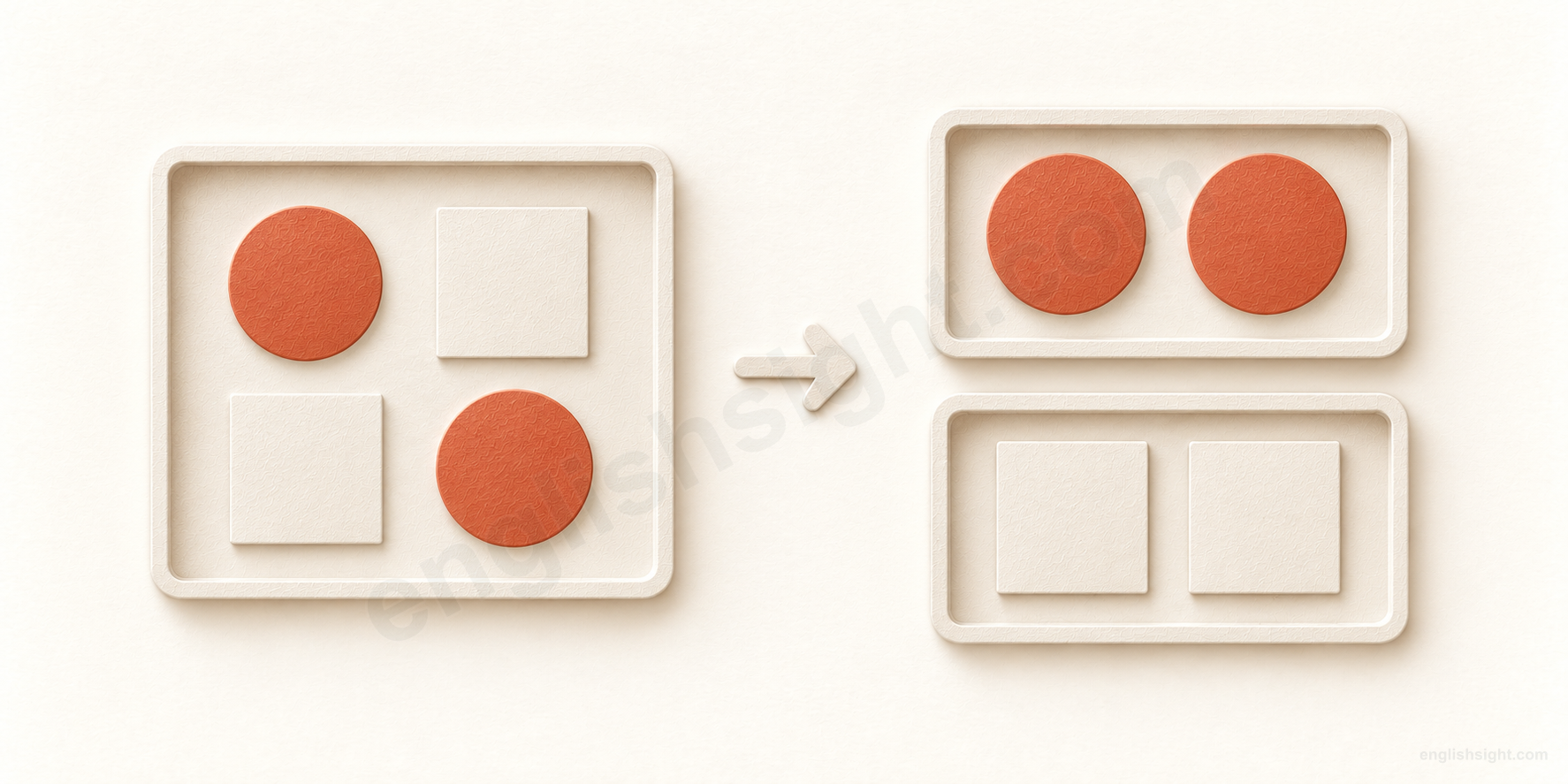
Two round pieces and two square pieces are mixed in one tray.
separate
The round pieces are in one tray and the square pieces in another.
The pieces are separated into groups by shape.
The same four pieces form two separate groups, without being cut or broken.
Separate describes things as apart or distinct, or expresses a change that makes them so.
The sketch shows one action: sorting a mixed group into distinct groups. The adjective can describe an independent state without any earlier sorting; other uses can concern a continuing boundary, a difference, or an ended connection.
A separate room is a room of its own. To separate objects is to move or keep them apart, or sort them into distinct groups. Objects can also separate without a person causing it. Read the grammar to tell a state from a change.
The same idea of a boundary helps connect physical arrangements with differences in information, time, or relationships. This is a teaching model, not a claim about a single picture in every English speaker’s mind.
01
Independent things and continuing arrangements
The adjective describes a state: individual units, distinct matters, or things kept apart. It need not imply an earlier act of division.
01
separate + noun; subject + be + separate
a separate room / entrance / check
a unit of its own, rather than something shared or joined
Situation
Two guests want a room each.
Meaning or result
Each guest has a room of their own.
Separate describes the arrangement; it does not describe an action.
In separate rooms, each room is its own space. A separate entrance serves as another entrance of its own. In American restaurants, separate checks are individual bills rather than one bill for the table.
The adjective can stand before a noun or follow be: The two entrances are separate. It does not say that somebody first split one room or entrance into two. The independent units may always have existed.
In a sentence
We are travelling together, but we have booked separate rooms.
Watch the difference Separate rooms can be identical in size and design. Different rooms can emphasize different qualities; separate emphasizes their individual identity or use.
02
a separate + issue / matter / incident; on + number + separate occasions
a separate issue / on separate occasions
a different individual matter or event
Situation
People are discussing the price and the delivery date.
Meaning or result
You treat the delivery date as another issue.
A boundary in the discussion can matter without any physical gap.
That is a separate issue tells the listener to distinguish one topic from the topic currently being discussed. The topics can still be connected in a wider situation; separate identifies a useful distinction here.
On three separate occasions counts three individual events. The same thing may have happened each time. Likewise, three separate calls need not be three different kinds of call.
In a sentence
The delivery date is a separate issue; let’s agree on the price first.
Watch the difference Separate does not always mean unrelated in every possible way. Read what is being counted or treated independently.
03
keep + object + separate + from + noun; remain / stay separate
keep something separate from something else
maintain a distinction or prevent things from being mixed
Situation
Work messages and personal messages use different accounts.
Meaning or result
You maintain that arrangement.
Keep supplies the idea of maintaining; separate names the state.
In keep work separate from personal life, work is the object of keep and separate describes the state you maintain. From introduces the other side of the distinction. Remain separate and stay separate describe continuation without naming an agent.
Compare I separate the messages, which describes an action, with I keep the messages separate, which stresses the resulting or continuing arrangement. To describe how you do something, use the adverb separately: We answer the messages separately.
In a sentence
I keep work messages separate from personal messages.
Watch the difference Use from for this contrast: separate from the others. Do not use separate with the others to mean apart from them.
02
Moving apart, sorting, and coming apart
The verb describes who or what moves apart or becomes distinct. From names the other side or source; into names the resulting groups; out can highlight a component picked from the rest.
04
separate + plural object; separate A from B; separate A and B
separate two people / separate A from B
make people or things move apart
Situation
Two dogs are fighting beside the gate.
Meaning or result
Their owners move them apart.
The subject causes the objects to move apart.
Separate can take a plural object: separate the dogs. With separate one dog from the other, from names the other participant. Separate A and B also names both participants; it need not mean two independent actions.
This is an ordinary transitive verb, so a passive is possible: The dogs were separated by their owners. Separate does not specify the method, the amount of force, or how long they remain apart.
In a sentence
The owners quickly separated the two dogs.
Watch the difference The objects may remain whole and unharmed. Separate is not automatically cut, break, or destroy.
05
something + separates + from + something; separate + object + from + something
separate from the rest
come away from something to which it was attached
Situation
A label is attached to a box.
Meaning or result
The label comes away from the box.
The subject undergoes the change; no external agent is required in the sentence.
The label separated from the box describes a loss of attachment. It does not say that the label intentionally moved away. From names what it came away from.
Compare I separated the label from the box, where I causes the change, and The label was separated from the box, where a passive leaves the cause unstated. Separate can also describe organizations ending a connection, but the context must establish that wider relationship.
In a sentence
The label separated from the box when it got wet.
Watch the difference An intransitive sentence such as The label separated is already complete when the context supplies what came apart.
06
separate + object + into + groups; subject + separate + into + groups
separate into groups
divide a collection into distinct groups
Situation
All the buttons are mixed together.
Meaning or result
Round buttons and square buttons form two groups.
Into names the groups that result.
Separate the buttons into two groups names a whole collection first and its resulting groups after into. The criterion for sorting comes from context, such as shape or size.
A group of people can also separate into smaller groups without an object: We separated into pairs. Compare separate the round buttons from the square ones: from sets one category against another, while into identifies the resulting arrangement.
In a sentence
Separate the buttons into two groups according to shape.
Watch the difference Use into for the result and from for the contrasting group. Separate the buttons from two groups would describe taking buttons away from those groups.
07
separate + eggs; separate + ingredient + from + mixture / other ingredient
separate the eggs
put egg yolks and whites into separate containers in a recipe
Situation
A recipe needs yolks and whites for different steps.
Meaning or result
The yolks and whites are ready in different bowls.
The cooking context supplies which parts are separated.
In a recipe, separate the eggs is a familiar shortened instruction to separate the yolks from the whites. It does not normally mean put each whole egg in its own place.
The same verb works with other ingredients and mixtures: a process can separate cream from milk. From names the material being distinguished from the ingredient being removed; the verb itself does not specify the technique.
In a sentence
For the filling, separate three eggs and save the whites.
Watch the difference Learn the recipe shorthand with its context. Outside cooking, the object eggs does not automatically supply yolks and whites.
The mixture changes without a person being the grammatical subject.
The dressing separates describes what happens to the mixture. Oil and vinegar separate names the ingredients as a plural subject. Both constructions can describe the same visible change.
The verb does not necessarily describe a mistake or damage. Whether separation is wanted depends on the process. Separate out can also describe a component becoming distinct from a mixture.
In a sentence
The dressing separates if you leave it standing for a while.
Watch the difference The dressing is separating is possible for a change in progress. This action use differs from the adjective in The containers are separate.
09
separate out + noun; separate + noun / pronoun + out; separate out (from + noun)
separate something out
pick out or extract a component from a larger collection
Situation
Some reusable clips are mixed with damaged ones.
Meaning or result
The reusable clips have been taken out as a group.
Out highlights a component becoming distinct from the rest.
You can separate out the reusable clips or separate the reusable clips out. With a personal pronoun object, put it between the verb and the particle: separate them out. A following from phrase can identify the source collection.
This established particle construction can also concern ideas: separate out the different questions in a long complaint. In an intransitive use, a component separates out by itself. Out does not always mean motion out of a physical container.
In a sentence
Separate the reusable clips out before you throw the rest away.
Watch the difference Say separate them out, not separate out them. From is a preposition; out is the movable particle in this construction.
10
get / be + separated + from + person or group; be separated by + cause
get separated from someone
lose contact with someone or move apart after being together
Situation
You and your friends are walking through a crowd.
Meaning or result
You can no longer find the others.
Get highlights a change into the separated situation.
We got separated from our friends often describes an unwanted loss of contact. It does not mean that the friends’ relationship has ended. The surrounding situation tells us whether the separation was accidental.
We were separated from our friends can describe the resulting situation or a passive event. By can introduce a cause, as in separated by a crowd. From names who or what someone is apart from.
In a sentence
We got separated from our friends near the station entrance.
Watch the difference Do not infer a breakup from every use of separated. Compare We got separated in the crowd with We are separated after ten years of marriage.
03
Boundaries, intervals, and differences
A wall, a period of time, a distinguishing quality, or a score gap can separate things. Sometimes the relation is static or mental rather than physical movement.
11
boundary + separates + A + from B; A + be separated + from B + by + boundary
a wall separates A from B
a boundary lies between two places or things
Situation
Two areas lie on opposite sides of a wall.
Meaning or result
The wall forms their boundary.
The subject is the thing between them, rather than a person moving them.
A wall separates the garden from the road describes an existing layout. There need not be an event in which the wall pushes anything away. A river or a fence can be the subject in the same way.
The passive changes the viewpoint: The garden is separated from the road by a wall. From names the other area; by introduces the boundary. Separate A and B is also possible when both areas are named together.
In a sentence
A low wall separates the café terrace from the pavement.
Watch the difference Present simple separates can describe a continuing arrangement. Do not automatically read it as repeated physical movement.
12
time / distance + separates + plural object; things + be separated by + interval
time or distance separates two things
an interval lies between two places, people, or events
Situation
One interview is at ten and the other is at eleven.
Meaning or result
There is a one-hour interval between them.
The subject measures the gap; no physical dividing object is needed.
An hour separates the interviews describes the interval from one to the other. In The villages are separated by a narrow valley, the separating space is expressed after by.
The same relation can concern years between events or distance between people. It need not imply hostility, an ended relationship, or an obstacle that cannot be crossed.
In a sentence
Just one hour separates the two interviews.
Watch the difference The singular measure one hour takes separates here. Separate agrees with its subject, not with the plural interviews after it.
13
separate + idea / category A + from + idea / category B
separate fact from opinion
recognize or treat two kinds of information as distinct
Situation
A report mixes observations with personal judgments.
Meaning or result
You identify which statements belong to each kind.
The separation takes place in analysis, not necessarily on paper.
Here the subject is a person or process doing the distinguishing. From contrasts the kinds of information. The sentence can describe recognizing a difference without moving or deleting any words.
Separate work from pleasure can similarly mean keeping two activities distinct. Such distinctions can be difficult or incomplete: I cannot separate my feelings from my judgment describes their connection, rather than a failure to move physical objects.
In a sentence
When you read the report, try to separate fact from opinion.
Watch the difference Separate fact from opinion does not mean remove every opinion or assume that every claimed fact is correct.
14
feature + separates + A + from B; what + separates + A + from B?
what separates A from B
a feature makes one thing different from another
Situation
Two services offer similar features.
Meaning or result
One feature marks a difference between them.
The feature is the subject; it creates or explains a distinction.
What separates this service from the others? asks for a distinguishing feature. A possible answer is The personal support separates it from the others. Nothing has to move.
Compare separate fact from opinion, where a person makes a distinction, with Reliability separates this model from its competitors, where a quality accounts for the difference. The difference can be favorable or unfavorable; separate alone does not mean better.
A difference of opinion can also separate people: Their views on the plan are the only thing that separates them. Here the difference is a disagreement; the people need not be physically apart or have ended their relationship.
In a sentence
What separates this service from the cheaper alternatives?
Watch the difference Do not assume the feature is an advantage until the context says so. Poor support could also separate one service from the others.
15
number + points + separate + competitors; nothing / little + to separate + competitors
only two points separate the teams
a score difference places competitors apart
Situation
One team has 42 points and the other has 40.
Meaning or result
The difference between their scores is two points.
The separating amount is a measured difference in performance or score.
Two points separate the teams states the size of the score gap. It does not identify which team is leading unless the context does. A small amount is often introduced by only or just.
There is nothing to separate the players can mean that their performance is equally good or that no meaningful difference can be found. That evaluation is not always a claim that every numerical statistic is identical.
In a sentence
With a minute left to play, only two points separate the teams.
Watch the difference Two points take the plural verb separate. This gap concerns scores, rather than the physical distance between the players.
04
People parting and relationships changing
A couple separating and friends taking different routes are different situations. Context and the whole expression establish the kind of connection that ends.
16
couple + separate; separate from + partner; be separated (from + partner)
separate from a partner / be separated
stop living together as a couple
Situation
A couple have shared a home and relationship.
Meaning or result
They no longer live together as a couple.
This relationship use is more specific than simply being in different places.
They separated describes the change. She separated from her partner names the other person with from. They are separated describes their present relationship status.
Separated is not the same as divorced: a married couple can live apart while still legally married. Conversely, being in different cities for work does not by itself mean a couple have separated in this sense.
In a sentence
They separated last spring, but they are not divorced.
Watch the difference Use separated for this status. They are separate usually describes two distinct people or units, not their marital status.
17
people + go + our / your / their + separate ways
go our separate ways: different directions
leave one another and travel in different directions
Situation
You and a friend have walked together to a junction.
Meaning or result
You head toward different destinations.
A shared journey ends, without necessarily ending the friendship.
We went our separate ways can describe the ordinary moment when people leave one another. The possessive changes with the subject: My friends and I went our separate ways; they went their separate ways.
The phrase may also be used after a meeting or meal when people go home. Read the context before interpreting it as the end of a personal or business relationship.
In a sentence
At the junction, we said goodbye and went our separate ways.
Watch the difference Keep ways plural in this established expression. The route meaning does not imply a quarrel.
18
people + go + possessive + separate ways; decide to go + possessive + separate ways
go their separate ways: end a connection
end a shared relationship, partnership, or course of life
Situation
Two people have been running a studio together.
Meaning or result
They decide to work independently.
The shared path is figurative, rather than a road.
In a business or personal context, go their separate ways can mean stop working or living together. It can describe a breakup, former collaborators choosing different projects, or school friends following different lives.
The phrase does not by itself tell us whether the ending was friendly, whether the people still talk, or whether any legal divorce occurred. Those facts require context.
In a sentence
After closing the studio, the two designers went their separate ways.
Watch the difference Use context to distinguish an ended partnership from simply travelling in different directions.
05
An idiom and a clothing noun
These established uses need their full expression or context. They are recognition extensions, not a rule for inventing new meanings.
19
separate / sort + the wheat + from + the chaff
separate the wheat from the chaff
distinguish the worthwhile parts from what is less useful
Situation
A search returns many useful and unhelpful results.
Meaning or result
You identify the results worth keeping.
An established farming image becomes a judgment about value or usefulness.
The idiom compares useful material to grain and unwanted material to its outer covering. In discussion, it can concern ideas, information, products, or people rather than literal crops.
Learn the whole expression, including the and from. Sort the wheat from the chaff is a related form. Calling people chaff can sound dismissive, so a plain expression such as identify the strongest candidates is often more tactful.
In a sentence
With so many online reviews, it takes time to separate the wheat from the chaff.
Watch the difference This idiom involves evaluation, rather than any neutral division into two groups. Do not apply it to people without considering the tone.
individual garments that can be combined into different outfits
Situation
A shopper wants tops and trousers that work in several combinations.
Meaning or result
The garments can be mixed and matched.
This plural noun names clothing items, rather than an action.
In clothes shopping, separates are individual garments such as tops, skirts, jackets, or trousers that you can wear in different combinations. This is a useful recognition item in clothing descriptions.
The noun has the short final sound of the adjective, /ˈseprəts/, rather than the verb’s /eɪ/ sound. Compare The shop sells separates with The screen separates the rooms: the same spelling has a different grammatical job and pronunciation.
In a sentence
She prefers separates that she can combine in different ways.
Watch the difference This clothing noun does not mean any collection of separate objects. Read the shopping or fashion context.
Read the sound, grammar, and context
Adjective and verb have different endings
The adjective commonly sounds like /ˈseprət/; the verb is /ˈsepəreɪt/. Both begin with the main stress on the first syllable. The verb forms are separate, separates, separated, separating. Keep the a in the spelling: separate, not seperate.
Separate, separated, and separately
Separate is the adjective in separate rooms. Separated can be a past participle or describe a resulting state; for a couple, are separated has a specific relationship meaning. Separately is the adverb in We paid separately: it says how the payment was made. Compare We asked for separate bills, where separate describes bills.
Choose from, into, by, and out for their jobs
Separate A from B contrasts two sides; separate a collection into groups names the result; separated by a wall names a boundary or cause. Separate out is a particle construction, with separate them out as its pronoun order. The ordinary from and into patterns are not all phrasal verbs.
A state does not require a previous split
Two separate buildings may always have been independent. A wall separates two gardens without repeatedly moving them. In contrast, We are separating the papers can describe an action in progress, and The papers were separated can be passive. Separate overlaps with divide, but does not require cutting or making equal shares.
Additional expressions to recognize
Under separate cover is formal business wording for sending something in another envelope: The signed form will follow under separate cover. Separate the men from the boys and separate the sheep from the goats are established expressions for distinguishing people by ability or another judged quality. They can sound judgmental; the first also has explicitly gendered wording. Plain alternatives such as identify the strongest performers are easier to use neutrally.
Choose the relation
Check the subject, the complement, and the situation. A physical gap is only one possibility.
1. Two rooms have always existed independently. Which wording describes that arrangement?
2. You sort a mixed pile of buttons and end up with two groups. Which instruction names the result?
3. You have identified reusable clips and want to pick them out. Which pronoun order fits?
4. A married couple no longer live together as partners, but remain legally married. Which sentence fits?
5. A fence lies between two gardens. What does The fence separates the gardens mean here?
6. Two friends say goodbye at a junction and go their separate ways. What does this context establish?
Sources and teaching notes
Word classes, meanings, constructions, and expressions were checked against the publisher pages below. Explanations, examples, and the principle sketch are original teaching material. The visual model helps connect uses; it is not evidence that every expression has one historical origin.
The sketch is a teaching model of a relation, not a picture shared by every native speaker.