From shelter from sunlight to colour variations, fine distinctions, and familiar expressions.
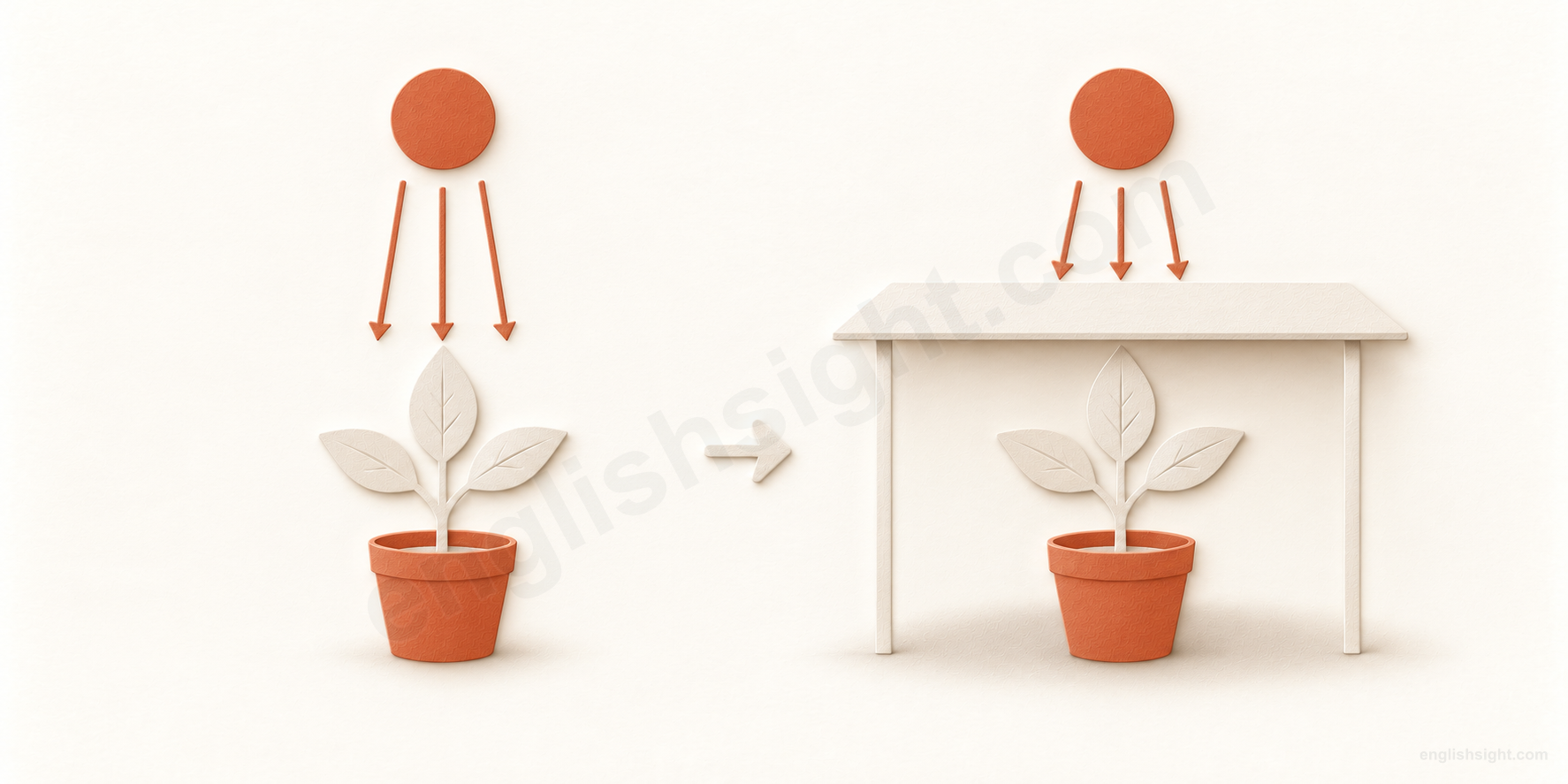
A screen changes direct exposure
A screen changes direct exposure
Direct sunlight reaches the plant.
shade
The same plant is sheltered from direct sunlight.
An overhead canopy stops the direct rays.
The canopy shades the plant; the plant is in the shade.
Something blocks direct light from reaching a place or object, leaving it sheltered from that light.
This model explains shelter and screening. Colour versions, fine differences, and idioms need the separate explanations below; the sketch is a teaching aid, not a universal mental image.
In its physical light-related use, shade is the shelter created when something screens direct light; to shade something is to give it that protection. The screen, the protected object, and the light have different roles.
Other everyday uses concern particular colours and small differences. Fixed expressions add meanings such as outshining or showing disrespect. Follow each construction rather than forcing every use into the same sunlight picture.
01
Light, shelter, and things that screen it
Start with direct light meeting a barrier. Then distinguish the sheltered area, the action of screening, and the things used as screens.
01
in / into the shade (of something); provide / give shade; in partial shade
in the shade / provide shade
a place or condition sheltered from direct sunlight
Starting situation
Sunlight falls on the open path.
Meaning or result
A tree offers a place out of the direct sun.
Shade names the protection or sheltered area, not the outline of the object blocking the light.
When choosing somewhere to rest, you can ask to sit in the shade or move into the shade. The shade of a tree identifies what screens the sunlight. Trees, awnings, and buildings can provide shade without anyone deliberately doing anything.
This noun is uncountable: some shade, plenty of shade, or a patch of shade. In the shade is a normal location phrase; gardening descriptions also use in shade, full shade, and partial shade. Partial shade means limited sun exposure, not total darkness.
A shadow is often a visible dark shape cast by a particular object. A tree can cast a shadow and provide shade at the same time: shade focuses on shelter, shadow on the dark shape. The distinction is about focus, not two entirely separate physical effects.
Example in context
We moved the chairs into the shade of the apple tree.
Watch the difference For shelter, say We found some shade, not We found a shade. A shade usually names a screen or a colour variation.
02
shade + object + from / against + light; be shaded by + screen
shade the plants from the sun
keep direct light off a person, place, or thing
Starting situation
The plants receive strong direct sunlight.
Meaning or result
A screen stops that light from falling directly on them.
The subject supplies the screen; the object is what receives protection.
In The trees shade the terrace, the trees block some direct sunlight. A person can also shade something deliberately, for example by placing a screen above young plants. From or against names the light or heat being kept off.
The passive is useful when the protected place matters most: The terrace is shaded by trees. By introduces the screening thing; from introduces what is being screened out. Shaded can describe a continuing condition, not just an action happening now.
The diagram uses the same plant before and after a screen is added. It illustrates a change in direct exposure; it does not promise that all light, heat, or risk has disappeared.
Example in context
A fabric screen shades the seedlings from the afternoon sun.
Watch the difference Distinguish The plants are in the shade (location) from The screen shades the plants (screening action or relation).
03
shade + possessive + eyes + with + hand; shade your eyes from / against the sun
shade your eyes
hold something between your eyes and bright light
Starting situation
Glare makes it hard to see a distant sign.
Meaning or result
A raised hand screens the glare while you look.
The eyes are protected from glare, rather than shut or hidden from everyone.
Shade your eyes often describes holding a hand above them, like a small visor. With tells us what you use; from or against tells us what light you block. You can keep looking while shading your eyes.
In the phrase shade her eyes with her hand, the possessive identifies whose eyes are affected. This is an ordinary verb plus object, not a special particle verb. Cover her eyes may instead suggest preventing her from seeing.
Example in context
Nina shaded her eyes with one hand and read the sign across the road.
Watch the difference Shading your eyes does not mean closing them; choose close or cover if preventing sight is the intended action.
04
a shade for / on a lamp; a lampshade; a shaded lamp
a lamp shade
a cover that controls the light from a lamp
Starting situation
A bare bulb gives an uncomfortable glare.
Meaning or result
A cover screens or softens the light.
A shade is the physical cover; shade without an article can be the resulting shelter.
On a lamp, a shade is a countable object: a shade, two shades, the shade on the bedside lamp. Lampshade is also a standard word. The object can direct or soften the light without making the whole room dark.
The verb also occurs in descriptions such as a shaded lamp: the light has a screen or cover. That does not necessarily mean the lamp stands in a tree’s shade. The surrounding noun tells you which relationship is intended.
Example in context
We replaced the cracked shade on the bedside lamp.
Watch the difference A shade is not normally the bulb itself. The shade affects light from the bulb.
05
a window shade; pull down / lower / raise the shades
pull down the shades
lower window coverings, especially in North American English
Starting situation
Sunlight enters through an uncovered window.
Meaning or result
A lowered covering reduces incoming light or visibility.
Here shades are countable window coverings, not sunglasses or patches of darkness.
A window shade is a covering you can raise or lower, often a roller. In North American English, pull down the shade and lower the shades are ordinary instructions. British English generally uses blind for this type of covering; blind is also used in North America.
Window context disambiguates the plural. We lowered the shades concerns the windows, whereas We wore shades concerns glasses. Pull down describes the movement of the covering; it does not turn shade itself into a phrasal verb.
Example in context
Please lower the window shade before the afternoon meeting.
Watch the difference Do not assume all curtains are called shades. A window shade usually names a particular screening covering, often one that rolls up.
06
wear / put on shades; a pair of shades
a pair of shades
sunglasses, in informal speech
Starting situation
Bright sunshine calls for dark glasses.
Meaning or result
Someone puts on their sunglasses.
The plural noun shades can name one pair of sunglasses.
In a clothing or holiday conversation, shades is an informal word for sunglasses. Use plural agreement: My shades are in the bag. To count one item, say a pair of shades.
There is a real screening connection to light, but the plural has an established meaning: one shade is not the usual way to name one pair of sunglasses. Sunglasses is clearer in neutral or formal instructions.
Example in context
I left my shades in the car, so I went back for them.
Watch the difference Use them or they for shades, even when you mean one pair.
02
Colour, drawings, and small differences
Shade also names a colour variation or a fine difference. Read the full construction to tell a colour choice, a pencil action, a small amount, and a gradual transition apart.
07
a light / dark / pale shade of + colour; different shades of + colour
a shade of blue
one particular variation of a colour
Starting situation
Several samples are all described as blue.
Meaning or result
You choose the exact version you want.
Shade distinguishes versions within a colour family; it need not mean a dark colour.
A pale shade of blue and a deep shade of blue identify different colour versions. Here shade is countable: one shade, several shades, or different shades of the same colour. Of introduces the colour family.
You can ask Which shade do you prefer? when the colour choices are already clear. Everyday shade includes light and bright versions, not only colours made darker. Technical art terminology may use shade more narrowly for a colour mixed with black; that is not a rule for every ordinary conversation.
Colour is the broader term. A colour name such as blue may be enough; shade is useful when you need a more exact choice for paint, fabric, or makeup.
Example in context
The two cushions are different shades of blue.
Watch the difference A light shade is natural. Do not infer that shade must always mean dark blue or black.
08
light and shade; use shade in a drawing / painting
light and shade
the contrasting bright and dark parts of an image
Starting situation
A drawing has little contrast.
Meaning or result
Different dark and bright areas give it depth.
Shade here concerns the pictured effect of light, not a sheltered seat outdoors.
Artists use light and shade to suggest a face’s shape, a rounded object, or distance. In this expression shade is uncountable: the artist’s use of shade, rather than a count of separate colours.
Compare three shades of brown, which counts colour versions. A drawing may use only one pencil and still show light and shade. The contrast can be represented without adding several different colours.
Example in context
The artist uses light and shade to make the stone look round.
Watch the difference Here shade names darkness as represented in the picture; the paper need not be sitting out of the sun.
09
shade + area; shade in + area; shade + area / it + in
shade in the area
add darker marks to part of a drawing or diagram
Starting situation
A shape has an outline but no filling.
Meaning or result
Pencil or colour marks distinguish its inside.
The drawing’s area receives the marks; in emphasizes filling that area.
Shade the area tells someone to make it darker or give it tone. Shade in the area also highlights marking its interior. On a map, chart, or worksheet, the shaded area can simply identify a category or answer; realistic shadows are not required.
This in pattern allows the object before or after in: shade in the circle or shade the circle in. A pronoun normally goes between them: shade it in. In a portrait, shade one side of the face may mean adding tone gradually instead of filling it with a flat block.
Example in context
Shade in the three squares that represent empty seats.
Watch the difference With a pronoun, use shade it in, not shade in it. With no in, shade it is also possible.
10
shades of meaning / opinion / feeling; different shades of + abstract noun; a shade of + feeling
shades of meaning / opinion
fine distinctions within a broad category
Starting situation
Two expressions communicate roughly the same idea.
Meaning or result
You notice that one is warmer or more forceful.
A shared category can contain meaningful differences, like different versions of one colour.
Shades of meaning points to small differences between expressions, not different colours printed on a page. Shades of opinion similarly acknowledges a range of positions rather than only two opposing camps.
The noun is usually plural in this use: several shades of meaning. A singular form can identify one particular nuance when the context supports it. This is a useful comparison with colour variation, not proof that every abstract difference is visually represented.
A shade of a feeling can also mean a small amount or trace: There was a shade of disappointment in her voice. Here it is the amount of disappointment that is slight, rather than a set of different opinions or meanings. The surrounding noun and context distinguish these uses.
Example in context
The class discussed the shades of meaning between “confident” and “arrogant”.
Watch the difference Use of to introduce the category: shades of meaning. This does not say the meanings are identical.
11
a shade + adjective / comparative; a shade too + adjective; a shade + ahead of / behind + comparison target
a shade too small / a shade lighter
slightly or by a small amount
Starting situation
A size is close to right, or two things are almost equal.
Meaning or result
A small difference still matters.
A shade modifies a degree, rather than naming a colour or an outdoor place.
A shade too small means a little too small. A shade lighter makes a small comparison; lighter may concern weight or colour, depending on context. The phrase can also modify an ordinary adjective: a shade nervous. It can also precede a phrase such as behind the leaders: Our team is a shade behind the leaders means it is only a little behind.
Keep a in this degree expression. A shade, a little, and a bit can often serve similar purposes here. The speaker has not measured an exact amount, and the phrase does not guarantee that the difference is unimportant.
Example in context
These shoes are a shade too small for me.
Watch the difference Do not drop the article: a shade too small, not shade too small.
12
one colour / quality shades into another; shade to + colour
shade into something
develop into something through small, hard-to-separate changes
Starting situation
A quality is present in one form.
Meaning or result
It merges gradually into a different quality.
Into introduces the emerging state; no object is being put inside a container.
A colour can shade into another colour. A feeling or attitude can also shade into another: concern may become anxiety gradually, without one clear dividing moment. The transition is central; become alone does not emphasize the same fine gradation.
The first state is the subject and the new state follows into. This pattern is not separable: concern shades into anxiety, not concern shades anxiety into. Colour descriptions also use shade to a paler colour.
Unlike shade the plants, this use does not require a screening object or a reduction in sunlight. The connection is with gradual differences between shades, and the full pattern must be learned.
Example in context
As the questions continued, her curiosity shaded into suspicion.
Watch the difference Shade into describes a gradual transition, not an instant switch or a physical journey.
03
Comparisons and established expressions
These expressions have conventional meanings. The light-and-dark connection can help you remember some of them, but it cannot supply their whole meaning or their register.
13
shades of grey (British) / gray (American); with / without / no shades of grey
shades of grey / gray
moral complexity rather than a simple division into right and wrong
Starting situation
Someone sorts every person or action into entirely good or entirely bad.
Meaning or result
Other details make that judgement less clear-cut.
The colour contrast stands for intermediate moral judgements, not literal paint samples.
Shades of grey describes situations in which right and wrong are difficult to separate. A story with morally mixed characters can contain shades of grey; a story with a perfect hero and a wholly evil villain may have none.
This expression is often contrasted with seeing things in black and white. Grey is the usual British spelling and gray the usual American spelling. Learn the full plural expression; do not treat it as a special meaning of every occurrence of grey or shade.
Example in context
The novel explores shades of grey: even its most generous character sometimes acts selfishly.
Watch the difference Context matters: a shop selling shades of grey may simply offer different grey colours.
14
put + person / thing + in the shade; be put in the shade by + person / thing
put someone or something in the shade
make another achievement seem less impressive by comparison
Starting situation
One design already seems good.
Meaning or result
A much stronger design draws the attention.
The comparison concerns relative impact, not physical light.
If one performance puts another in the shade, it makes the other look less remarkable. It does not necessarily make the other bad: both can be good, with one clearly standing out.
Learn the full expression with put, the object, in, and the shade. A passive is possible: Our display was put in the shade by theirs. The new display need not deliberately try to embarrass anybody.
The idea of being less visible can help you remember it. However, it is an established comparison, not a general instruction to interpret every mention of shade as failure.
Example in context
The new museum’s collection puts the old exhibition in the shade.
Watch the difference This is stronger than saying one thing is a shade better, which describes only a small difference.
15
throw shade at + person / thing; shade + person (slang); no shade
throw shade at someone
show disrespect or make a cutting criticism, often indirectly
Starting situation
Someone makes a pointed remark about another person.
Meaning or result
Listeners recognize the put-down behind the wording.
Shade here is social criticism, not shelter or a change in colour.
Throw shade is slang. It often describes a mocking remark or dismissive reaction that communicates contempt without a straightforward insult. At names the target: throw shade at a rival. The noun shade is uncountable in this use.
The verb shade someone also occurs as slang for treating them with disrespect or criticizing them dismissively: The host shaded the singer during the interview. This direct-object verb is separate from shade someone from the sun.
No shade can signal that a remark is not intended as an insult. It does not make a hurtful remark harmless; tone and context still matter. In a neutral report, criticize or make a dismissive remark is usually clearer.
Example in context
Was he throwing shade at our team when he called the match “an easy workout”?
Watch the difference This is slang, not a neutral synonym for every disagreement. There is no ordinary article in throw shade.
16
shades of + person / period / remembered situation
shades of…
used to say that something recalls an earlier person, thing, or period
Starting situation
A new situation has a familiar feature.
Meaning or result
It brings an earlier experience or style to mind.
The expression points to a resemblance, not literal colours or sunglasses.
A speaker may react with Shades of our school days! when a strict new rule recalls school. This informal, often playful expression can stand alone as a comment rather than form a complete sentence.
After of, name what is recalled: a person, a period, a style, or a situation. Do not confuse shades of the 1970s, a reminder of that period, with shades of blue, a selection of colours. Context supplies the distinction.
Example in context
Matching uniforms and morning inspections—shades of our school days!
Watch the difference The usual reminder expression uses plural shades. It does not mean that the two situations are identical.
17
shade + match / contest / encounter (British, informal)
shade a contest
win or have the better of a contest by a narrow margin
Starting situation
The two sides are closely matched.
Meaning or result
One side finishes only slightly ahead.
Here shade is a verb of a small competitive advantage.
British sports reporting sometimes uses shade a match, a contest, or a close encounter for a narrow win. This informal use belongs with small differences, rather than the large contrast expressed by put in the shade.
The contest follows the verb directly. For a beginner giving a neutral result, win narrowly is more widely useful. Recognizing the sports use prevents a report from being mistaken for a reference to sunshine or disrespect.
Example in context
The visitors shaded a close contest by a single point.
Watch the difference This regional sports use is not the same as shade someone in slang, which can mean insult them.
Read the role and the whole expression
Countability changes with the meaning
Shelter, artistic light and shade, and slang disrespect normally use uncountable shade. A lamp or window shade and a colour shade are countable. Sunglasses are plural shades; use a pair of shades for one pair.
Shade and shadow overlap, but focus differently
Shade commonly focuses on relief from direct sun. A shadow commonly focuses on a dark shape made by blocking light; shadow also has an uncountable darkness use. They are not interchangeable in every phrase.
Verb forms and object positions
The regular forms are shade, shades, shaded, shading. Physical screening and drawing allow progressive and passive forms when appropriate. Shade it in is separable; shade into a new state is not. These are not one general family of identical particle verbs.
Coverage boundary
This lesson selects modern practical uses and a small number of recognition uses. Literary shade meaning a dead person’s spirit, the shades of night, technical rendering terminology, and specialized price reduction or biased-reporting uses are not developed. It is not a complete historical dictionary or a frequency ranking.
Choose the meaning in context
Look at what follows shade and what is happening in the situation.
1. You want a place to sit out of the direct sun. Which sentence is natural?
2. You are talking informally about one pair of sunglasses. Which sentence fits?
3. A worksheet tells you to fill one outlined circle with pencil marks. Replace “the circle” with a pronoun.
4. A bag is a shade heavier than yours. What does this say?
5. Her curiosity shaded into suspicion. What happened?
6. A speaker throws shade at a rival with a mocking compliment. What is the intended effect?
Sources and teaching notes
The source pages below were read to check meanings, constructions, and register. Explanations and examples are original; the diagram is a teaching model of direct-light screening.
The diagram illustrates a useful relation; it does not claim that every English speaker pictures shade in the same way.