From shaking a bottle to trembling, greeting, losing a worry, and changing a system.
Repeated movement around a position
Repeated movement around a position
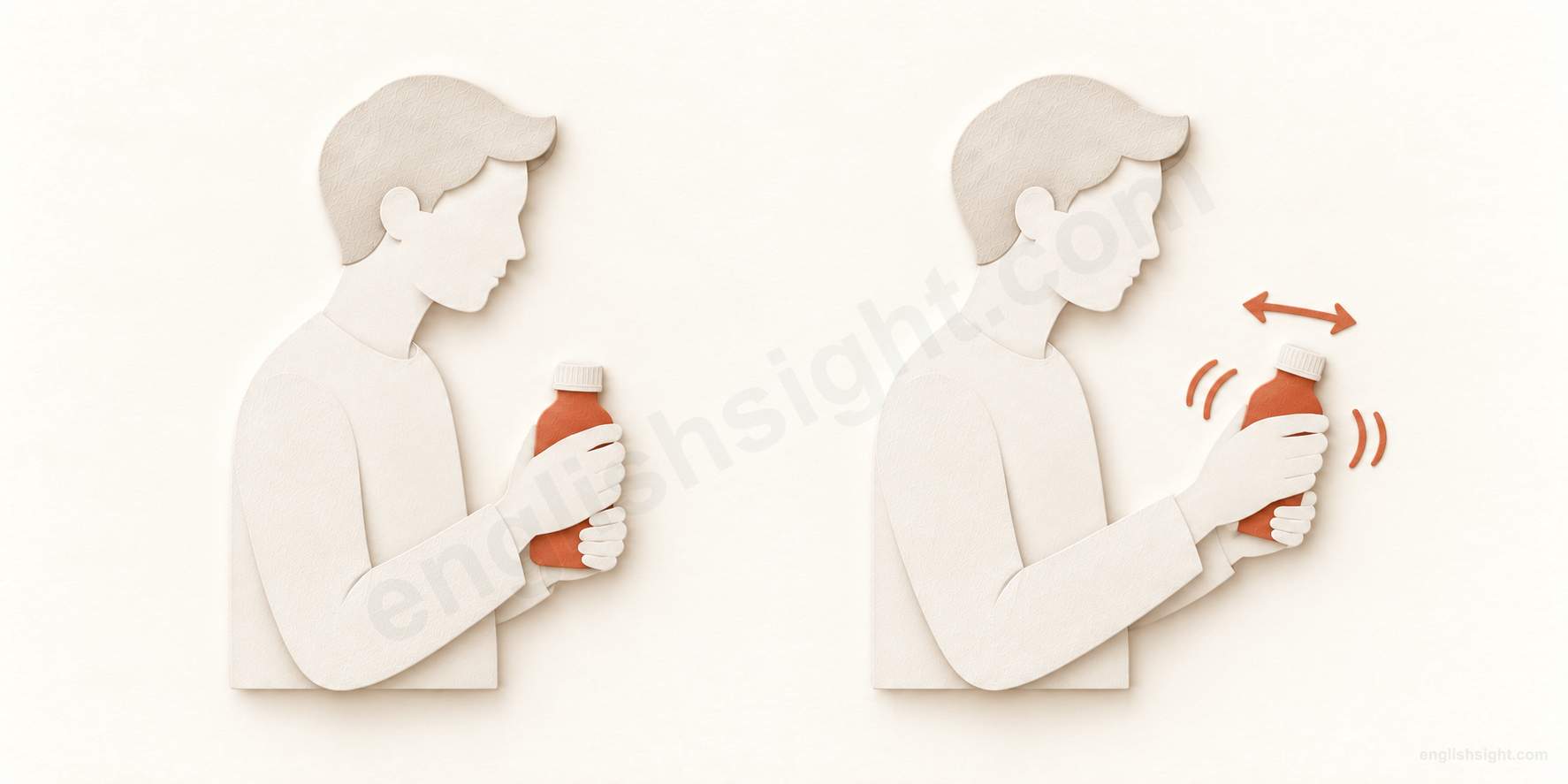
A person holds a closed bottle still.
shake
The bottle is being shaken near the same position.
The person makes short, quick back-and-forth movements with the bottle.
The same bottle goes from stillness to repeated movement. Shaking alone does not guarantee mixing.
To shake is often to move, or make something move, with short, quick movements back and forth or up and down.
The bottle represents a thing that can move. The sketch shows stillness followed by repeated motion, not a necessary change of location, successful mixing, or a permanent final state. Emotional and idiomatic uses need the explanations below.
Shake often describes short, quick movements back and forth or up and down. Something may shake by itself, or a person or force may make it shake. Some uses extend the idea of physical disturbance to feelings, confidence, or an established arrangement.
Handshakes, drinks, and fixed expressions need their own explanations. The movement model helps connect uses, but it does not predict every meaning of shake with a small word. It is a teaching aid, not a claim that every English speaker imagines the same picture.
01
Physical movement and its results
Start with short, quick movements. Sentence structure tells you whether something moves, someone moves it, or the movement causes a result.
01
shake + object; shake well before use
shake the bottle
make something move quickly back and forth
Situation before
The ingredients have settled in a closed bottle.
Action or result
You move the bottle repeatedly to mix them.
The subject causes the object to move; mixing is the purpose in this situation.
Shake takes an object when someone makes that object move in short, quick movements. You can shake a bottle, a branch, or a blanket. The motion may be sideways or up and down; it need not carry the object to a new place.
On a label, Shake well before use leaves the object understood. Shake is about the movement, while mix describes combining ingredients. Stir usually means moving a spoon or similar tool through the contents; shake does not mean stir in every context.
Shake up can also describe physical shaking: Shake up the dressing before you pour it means shake it to mix the ingredients. Shake up a pillow means shake it to make it fuller and restore its shape. In these uses, shake it up has a physical object; compare shaking up a system or upsetting a person below.
In a sentence
Close the lid and shake the bottle for a few seconds.
Watch the difference Shake is irregular: shook in the simple past, shaken after have or be.
02
thing + shake; cause + shake + thing
the windows shake
move with repeated small, quick movements
Situation before
A heavy truck passes the house.
Action or result
The windows move and rattle.
The moving thing is the subject; no object is required.
The windows shake describes what the windows do. The truck shakes the windows names a cause and an object. The windows are shaken by the truck is a passive version, although the simpler active sentences are often easier in everyday descriptions.
The subject can be the ground, a building, a machine, or a part of one. Shake suggests repeated disturbance. Sway often suggests a slower side-to-side movement, and vibrate can describe especially rapid small movements.
In a sentence
The windows shake whenever a heavy truck passes.
Watch the difference Do not add an object when you only mean that the subject itself moves.
03
shake + object + adjective; shake oneself
shake something loose / someone awake
cause a result by shaking
Situation before
A screw is held in place.
Action or result
Repeated movement makes it loose.
The adjective states the result; shake supplies the means.
In shake a screw loose, the screw becomes loose because something shakes it. The adjective describes the object after the action. Similarly, She gently shook him awake means the shaking brought him out of sleep.
This is a result construction, not a phrasal verb made from shake and an adjective. A dog can also shake itself after getting wet: the reflexive object identifies its own body as what it moves.
In a sentence
The vibration shook one of the screws loose.
Watch the difference Shook loose describes a result. Shook loosely would describe how something moved and is not the same construction.
04
shake + material + out of / off / into / onto + place
shake sand out of a shoe
move contents somewhere by shaking their container
Situation before
Sand is inside your shoe.
Action or result
The sand falls out as you move the shoe.
The object names the material moved; the following phrase gives its route or destination.
You can shake sand out of a shoe or shake salt onto food. The shoe or salt container is what you physically move, but sand or salt is the grammatical object because it is the material you cause to move.
Out of specifies movement from inside; onto specifies a destination on a surface. Compare shake the shoe, which names the moving container without saying that anything comes out. These directional complements are understandable from the situation, rather than separate arbitrary meanings for each preposition.
In a sentence
I shook the sand out of my shoes before going inside.
Watch the difference Keep the roles clear: shaking sand out of a shoe removes sand; shaking a shoe does not by itself state that result.
05
give + object + a shake; a shake of the head
give something a shake
perform an act or short spell of shaking
Situation before
The jar needs mixing.
Action or result
You shake it briefly.
A countable noun packages the action as one event.
Give the jar a shake is an everyday alternative to Shake the jar. A shake can be a short burst containing several quick movements, not necessarily exactly one movement. A good shake means a thorough or vigorous one in this context.
A shake of the head names the head gesture as a noun: She answered with a shake of her head. Of links the movement to the body part. The noun is countable, so use a shake or a description such as a quick shake.
In a sentence
Give the jar a quick shake before you pour the sauce.
Watch the difference In this pattern give does not describe handing the jar to another person.
02
Bodies, voices, gestures, and handshakes
Distinguish uncontrolled trembling from deliberate gestures and socially conventional hand movements.
06
person / body part + shake (with / from + cause)
shake with cold / fear / laughter
make involuntary repeated body movements
Situation before
You wait outside without a warm coat.
Action or result
Your body starts trembling.
Shaking may be involuntary and need not express fear.
A person, hands, legs, or shoulders can shake without a direct object. With can name the cause or accompanying feeling: shaking with cold, anger, fear, or laughter. From cold is also possible. Unlike shake the bottle, the subject is experiencing the motion rather than deliberately moving another object.
Shiver is especially associated with cold, while shake and tremble also work for strong emotion. Shake like a leaf emphasizes visible trembling, often from fear or nerves. Informal shake in your boots or shoes means be very frightened; actual footwear or visible movement is not required.
In a sentence
My hands were shaking with cold as I unlocked the door.
Watch the difference Do not assume that every shaking person is frightened; context supplies the cause.
07
voice + shake (with + emotion); in a shaking voice
a shaking voice
sound unsteady because of emotion
Situation before
A speaker is nervous about telling the news.
Action or result
The voice sounds unstable.
The voice is the subject, and the movement is heard as vocal unsteadiness.
Her voice shook describes a sound that is difficult to keep steady, often through nerves, anger, or distress. You can say Her voice shook with emotion or speak in a shaking voice. This does not necessarily mean the voice is loud.
Compare She shook her head, where she deliberately makes a gesture. A shaking voice usually signals a loss of steadiness rather than an intentional message. The speaker might be trying to stay calm.
In a sentence
His voice shook as he thanked everyone for their help.
Watch the difference Shout means speak loudly. A voice can shake even when someone speaks quietly.
08
shake + possessive + head; shake one’s head at + something
shake your head
turn your head from side to side as a response
Situation before
Someone offers you another drink.
Action or result
You answer with a sideways head movement.
The gesture can convey refusal, doubt, sadness, or disbelief.
Shake your head commonly means respond without words, often to say no. At a surprising claim, someone may shake their head in disbelief instead. At can introduce what prompts the reaction: He shook his head at the price.
Nod your head commonly describes an up-and-down movement used for yes or agreement. These are conventional uses described in English, not a rule about every culture or every individual gesture. Read the surrounding situation.
In a sentence
“Would you like more coffee?” I shook my head.
Watch the difference Use the appropriate possessive: I shook my head, not I shook the head in this ordinary pattern.
09
shake + possessive + fist + at + person
shake your fist at someone
wave a closed hand to express anger or a threat
Situation before
A driver cuts in front of a cyclist.
Action or result
The cyclist raises and moves a clenched fist.
At identifies the target of the angry gesture.
A fist is a closed hand. Shake your fist at someone describes moving it as a sign of anger or threat; it does not by itself say you hit the person. Someone can similarly shake a stick at a target.
This is a gesture with an ordinary prepositional target, not the greeting shake hands with someone. Compare She shook her hand to dry it, which concerns a body movement and has no necessary angry meaning.
In a sentence
The cyclist shook his fist at the careless driver.
Watch the difference At marks the target of anger; with in shake hands with marks the other participant in a greeting.
10
shake hands (with + person); shake someone’s hand; shake someone by the hand
shake hands with someone
greet or acknowledge someone by holding and moving hands
Situation before
Two people meet for the first time.
Action or result
They briefly clasp and move their hands.
Each person participates in a conventional greeting or acknowledgment.
You can say We shook hands, I shook hands with Jo, or I shook Jo’s hand. The first pattern uses plural hands even when you are describing a single person’s participation: I shook hands with the manager.
The gesture can also mark congratulations or reconciliation. Shake someone by the hand is another established pattern, somewhat more descriptive than the ordinary shake hands with. It does not mean shake the person’s whole body.
In a sentence
I shook hands with the new coach after the game.
Watch the difference Say We shook hands or I shook her hand; avoid We shook hand.
11
shake on + agreement; shake hands on + agreement
shake on it
confirm an agreement with a handshake
Situation before
Two people agree on a price.
Action or result
They use a handshake to mark the agreement.
On introduces the deal or matter being agreed.
Let’s shake on it means let’s confirm this agreement with a handshake. It stands for the proposed arrangement. You can also say shake on the deal or shake hands on the deal.
This conventional social use shares the hand movement with greetings, but the communicative purpose is agreement. The phrase does not itself establish what terms were agreed or what legal effect they have.
In a sentence
“Twenty pounds for the chair?” “Agreed. Let’s shake on it.”
Watch the difference On the deal names the agreement; with the buyer names the other person.
03
Disturbed feelings, beliefs, and persistent states
Physical unsteadiness offers a useful teaching link to emotional disturbance and weakened certainty. Some other uses describe getting free of a state.
12
event + shake + person (up); be / feel shaken (up)
be shaken (up) by something
feel deeply upset after an experience
Situation before
Someone has a frightening near miss.
Action or result
They feel unsettled even though they are unhurt.
The disturbance is emotional; actual bodily shaking is not required.
The incident shook me and The incident shook me up describe a strong upsetting effect. The person affected is the object. I was shaken by the incident or I felt shaken describes that person’s resulting condition.
Up belongs to the established expression shake someone up; it does not mean upward movement. Standard forms include It shook me up and I was shaken up. Informal shook up also occurs, but shaken up is the useful neutral form to learn. For the emotional sense, prefer It shook me to a progressive such as It is shaking me.
In a sentence
Nobody was hurt, but we were badly shaken by the crash.
Watch the difference Shaking describes ongoing trembling; shaken describes being affected or disturbed. They are not interchangeable.
13
shake + confidence / faith / belief; shake the foundations of + institution
shake someone’s confidence
weaken someone’s certainty or trust
Situation before
You trust a system to work reliably.
Action or result
A failure makes you less sure of it.
An abstract belief becomes less secure, rather than physically moving.
Shake can take confidence, faith, trust, or a belief as its object. A failure shook her confidence in the product means her confidence weakened. It does not necessarily disappear completely.
Shake the foundations of an institution and shake it to its foundations present a more dramatic challenge to its basic assumptions or stability. The foundation image is figurative in these uses. The diagram’s loss of physical steadiness is a memory link, not proof that all such expressions have one literal meaning.
In a sentence
The repeated errors shook my confidence in the service.
Watch the difference Say confidence in something. Shake confidence does not mean increase someone’s confidence.
14
cannot / cannot seem to + shake + feeling / illness; shake something off
can’t shake a feeling / a cold
be unable to get rid of something persistent
Situation before
An uneasy thought keeps returning.
Action or result
You still cannot leave it behind.
The unwanted thing remains despite an attempt to dismiss or recover from it.
I can’t shake the feeling that… means the feeling persists. The clause after that explains its content. You can also say I can’t shake this cold when an illness continues, or I can’t shake off this cold.
This get-rid-of sense is especially natural in negative or difficulty contexts. Off makes removal explicit but is not compulsory with familiar objects such as a feeling or a cold. Nothing is being physically shaken.
In a sentence
I can’t shake the feeling that I have forgotten something.
Watch the difference Use that + a clause to spell out a feeling’s content. A noun phrase such as this uneasy feeling can also stand alone: I can’t shake this uneasy feeling.
15
shake + person / oneself + out of + state
shake someone out of a mood
cause someone to leave an unhelpful mental state
Situation before
A friend is absorbed in gloomy thoughts.
Action or result
Something surprising breaks that mental state.
The person is moved figuratively out of an attitude or mood.
Shake someone out of something describes disrupting a mood, habit, or attitude, often to make the person pay attention or act differently. The noise shook me out of my daydream means it broke my absorption.
The object can be reflexive: I need to shake myself out of this mood. Out of identifies the state being left. Unlike shake sand out of a shoe, there is no literal container here; the state-as-place connection is a teaching comparison.
In a sentence
Her unexpected question shook me out of my gloomy mood.
Watch the difference The person goes before out of: shake me out of it, not shake out of me it.
04
Off, out, up, and down
Read the object and the whole combination. Each particle has several established uses, and one diagram cannot predict them all.
16
shake off + noun; shake + noun / pronoun + off
shake something / someone off
remove something or break contact by a quick movement
Situation before
Water clings to an umbrella.
Action or result
A sharp movement sends the drops away.
Off adds separation from a surface or contact.
Shake the water off your umbrella and shake off the water describe removing water by movement. With a pronoun, use shake it off. You can also shake a hand off your arm or shake someone off when a quick movement breaks their grip.
The object after shake can name the thing removed, rather than the thing you physically move. In The dog shook itself, the dog moves its own body; in The dog shook the water off, the water is what gets removed. These sentences describe related events from different angles.
In a sentence
I shook the water off my umbrella before folding it.
Watch the difference Say shake it off, not shake off it. Off expresses separation, not a destination below.
17
shake off + unwanted condition; shake + it + off
shake off a cold / a bad mood
recover from or get free of something unwanted
Situation before
A minor illness or gloomy feeling lingers.
Action or result
It finally stops affecting you.
Removal is figurative: the unwanted condition no longer holds on.
Shake off a cold, tiredness, a habit, or a reputation means get free of its continuing effect. The meaning belongs to the whole combination and object. A person need not move their body, and recovery may take time.
Compare shake off water, where visible movement removes liquid. A figurative sentence such as She shook off the criticism means she stopped letting it affect her. The expression does not explain how that happened, and it is not advice about treating an illness.
In a sentence
A short walk helped me shake off my gloomy mood.
Watch the difference Shake off describes getting free of the effect, not physically throwing a mood away.
18
shake off + pursuer; shake + person / pronoun + off
shake off a pursuer
escape someone who keeps following
Situation before
Another runner stays close behind you.
Action or result
You move far enough ahead to lose them.
The separation concerns pursuit rather than physical contact.
Shake someone off can mean lose a pursuer or follower. In a race it may mean pull ahead so that a rival cannot keep up. In a chase it means escape the person following.
Compare He grabbed my sleeve, but I shook him off: there, a body movement ends contact. A follower may never touch you. Informal shake someone without off can also mean lose a pursuer; learning shake someone off gives you a clear everyday pattern.
In a sentence
The runner sped up but could not shake off her rival.
Watch the difference A pursuer is the object being lost; shaking with fear describes how the subject feels and moves.
19
shake out + cloth; shake + cloth / it + out
shake out a blanket
open, spread, or clear a cloth by shaking it
Situation before
A blanket is folded or dusty.
Action or result
You open it with quick movements.
Out can describe opening something to its full spread.
Shake out a blanket or shake a blanket out means hold and move it so that it opens, lies more freely, or loses dust. Which purpose matters depends on the situation. The blanket is the object being opened or cleared.
Compare shake crumbs out of a blanket: the crumbs are the object being removed, and out of introduces their starting place. With a pronoun for the blanket, say shake it out. The surface similarity does not make the two grammatical arrangements identical.
In a sentence
We shook out the picnic blanket and spread it on the grass.
Watch the difference Shake it out can refer to opening a cloth, not only emptying a container.
20
situation / things + shake out; how + clause
see how things shake out
see what the eventual result will be
Situation before
The plan is still changing.
Action or result
Its final form or result will become clear.
This use concerns an outcome, not shaking a physical object.
How things shake out asks how a situation will ultimately turn out. It is useful when several decisions or events are still interacting and the final arrangement is uncertain.
Things is the subject, and there is no direct object. Compare shake out the blanket, where a person acts on a cloth. The result meaning is an established use of the whole expression; out does not mark movement out of a literal container.
In a sentence
We will decide where to stay once we see how the travel plans shake out.
Watch the difference Do not insert an object into this outcome pattern: things shake out; someone shakes a blanket out.
21
shake up + organization; shake + things / it + up
shake up a system
make major changes to an established arrangement
Situation before
A team follows an old routine.
Action or result
New arrangements disrupt the usual way of working.
The existing order is disturbed and reorganized.
Shake up a team, organization, or system means change it substantially. Shake things up is a conversational way to suggest doing things differently. It may express enthusiasm for change, but the verb does not guarantee that the changes improve anything.
The verb is two words: shake up the team or shake the team up. A pronoun goes between them: shake it up. The related noun is a shake-up, also written shakeup in American English: a management shake-up. Compare shaking a person up emotionally, where a person is the object and the result is emotional upset.
In a sentence
The new director wants to shake up the way the team works.
Watch the difference Up does not predict a positive result or physical upward movement.
22
shake + person + down + for + money
shake someone down for money
use threats to obtain money from someone
Situation before
Someone demands payment through intimidation.
Action or result
The target is pressured to hand over money.
This North American informal expression describes extortion.
Shake someone down for money means obtain or try to obtain money through threats or intimidation. For can name what is demanded: money, a payment, or a bribe. This use is especially associated with North American informal reporting.
The phrasal verb is separable: shake down a shopkeeper or shake a shopkeeper down; with a pronoun, shake him down. There need not be any literal shaking. The noun a shakedown can refer to this kind of demand.
In a sentence
The shopkeeper said the gang had tried to shake her down for money.
Watch the difference This describes coercion, not an ordinary request for payment.
23
shake down + person / place; shake + person / place + down
shake a place down
search a person or place very thoroughly
Situation before
Investigators suspect something is hidden.
Action or result
They search the location closely.
The search sense is distinct from demanding money.
In North American informal usage, shake someone or somewhere down can describe a very thorough search. A sentence about officers shaking down a cell may concern searching for hidden objects, with no payment involved.
This meaning cannot be selected from down alone. The object and surrounding account tell you whether the expression concerns a search or extortion. The related noun shakedown also has a search meaning, so the same caution applies when reading it.
In a sentence
The officers shook the cell down for hidden tools.
Watch the difference Do not assume every report of a shakedown involves money; check what was sought.
24
new situation / arrangements + shake down
wait for arrangements to shake down
allow a new arrangement to become established
Situation before
A new schedule has just started.
Action or result
People gradually establish a workable routine.
Here the arrangement is the subject and no person is searched.
Shake down can be intransitive: a new situation shakes down as it becomes established. It is informal. Let the new arrangements shake down gives them time to settle into a stable pattern.
Compare shake someone down, which has a direct object and can mean search or extort money. A literal use also exists: shaking can make loose contents settle lower. The figurative arrangement sense is best learned from its own context, without inventing a rule that down always means calm.
In a sentence
Let the new arrangements shake down before we change the schedule again.
Watch the difference The subject here is the arrangement; adding a person as an object can produce a very different meaning.
05
Drinks and fixed everyday expressions
Learn these nouns and idioms as whole expressions, including their articles, plural forms, tone, and regional limits.
25
a / two + flavor + shake(s); a protein shake
a chocolate shake
a milkshake or a blended drink of a named type
Situation before
You choose a drink from a café menu.
Action or result
You order a flavored shake.
Shake is a countable drink noun in this use.
A chocolate shake is a chocolate milkshake. The flavor normally comes before shake: a vanilla shake, two strawberry shakes. This established short form names a drink, rather than an instruction to move a container.
You will also see protein shake for a drink containing a protein supplement. Do not assume every drink called a shake has the same ingredients; the menu or product description supplies them. The noun is a separate vocabulary item to recognize in ordering and shopping.
In a sentence
I ordered a vanilla shake and a sandwich.
Watch the difference A shake names the drink; shaking names the action. A vanilla shaking is not the menu item.
26
get / have + the shakes
get the shakes
experience noticeable involuntary trembling
Situation before
Someone feels very nervous before speaking.
Action or result
Their body starts trembling.
The fixed plural noun describes a condition rather than a single deliberate action.
The shakes is an informal expression for bodily trembling, for example with nerves or illness. People can get the shakes or have the shakes. The phrase itself does not identify the cause.
Compare Give the bottle a shake: a shake is a countable event performed on an object. In the shakes, the plural form and the article the are part of the established expression. It is descriptive language, not a medical diagnosis.
In a sentence
I sometimes get the shakes before speaking to a large audience.
Watch the difference Keep the plural and article: the shakes, not a shakes.
27
give + person + a fair shake; get a fair shake
give someone a fair shake
give someone fair treatment and a reasonable chance
Situation before
A newcomer is being judged too quickly.
Action or result
You ask that they get a proper chance.
This is an informal fairness idiom, especially in North American English.
Give someone a fair shake means treat them fairly and give them a reasonable opportunity. Get a fair shake takes the recipient’s viewpoint. The idiom is useful for opportunities at work, in education, or in a competition.
The meaning belongs to the entire phrase. It does not mean shake the person’s hand, and no physical movement is required. The word fair supplies a judgment about treatment; a fair shake is not a promise that the person will succeed.
In a sentence
Give the new assistant a fair shake before judging her work.
Watch the difference This is informal and especially North American; a fair chance is a straightforward alternative.
28
be no great shakes (as + role / at + activity)
be no great shakes
be ordinary or not especially good at something
Situation before
Someone asks about your cooking ability.
Action or result
You admit that you are not very skilled.
The fixed plural phrase gives a modest or critical evaluation.
I’m no great shakes as a cook means I am not a particularly good cook. Something can also be no great shakes: The meal was no great shakes means it was unremarkable or disappointing.
This informal expression may be self-deprecating or dismissive. As introduces a role; at can introduce an activity or skill: no great shakes at drawing. Do not interpret it as saying there was no movement or no disturbance.
In a sentence
I’m no great shakes at baking, but I can make soup.
Watch the difference The ordinary idiom is no great shakes, with plural shakes; not no great shake.
29
in two shakes; in a couple of shakes
in two shakes
very soon or very quickly
Situation before
Someone asks how soon you will be ready.
Action or result
You promise only a short wait.
The expression gives an informal time estimate, not a count of movements.
I’ll be ready in two shakes is a casual promise that you will not take long. In a couple of shakes is another form. These are informal expressions to recognize in relaxed conversation.
These expressions do not specify an exact number of seconds. Use a stated time when precision matters. The small, quick movements in the literal word offer a memory connection, but the idiomatic timing is conventional.
In a sentence
I just need my coat; I’ll be ready in two shakes.
Watch the difference Do not treat two shakes as a literal unit of time.
30
shake a leg!
shake a leg
hurry up or get started
Situation before
People are moving too slowly to catch the bus.
Action or result
Someone urges them to get going.
The whole idiom gives an informal, old-fashioned or playful instruction.
Shake a leg! tells someone to hurry or begin. It often sounds playful or old-fashioned, and its imperative tone can be too familiar in a formal request.
It is not an instruction to make one leg tremble. Collins also records a dancing sense, but in the hurry-up situation the intended action is getting moving. Hurry up or Let’s get going is a more straightforward alternative.
In a sentence
Shake a leg! The bus leaves in five minutes.
Watch the difference Do not use this idiom as a neutral description of someone whose leg is shaking.
31
more + plural noun + than you can / could shake a stick at
more … than you can shake a stick at
a humorously large number of something
Situation before
A shop has an unusually wide choice.
Action or result
You emphasize how much choice there is.
The full comparison is an informal exaggeration of quantity.
The market has more cheeses than you can shake a stick at means it has a great many cheeses. Replace the noun to fit the context: more apps, more prizes, or more books than you can shake a stick at.
This is a humorous fixed comparison, not a practical task involving a stick. Compare shake a stick at someone, which can literally describe a threatening gesture. Can or could occurs in the idiom; the point is an impressive quantity, not physical ability.
In a sentence
The shop sells more kinds of tea than you can shake a stick at.
Watch the difference Keep the whole comparison together; shake a stick by itself does not mean have a lot.
Choose the construction as well as the meaning
Forms and pronunciation
The main forms are shake /ʃeɪk/, shakes, shaking, shook /ʃʊk/, and shaken /ˈʃeɪkən/. Use I shook it yesterday but I have shaken it. Shaked is not the standard past form. Informal shook up occurs for emotional upset; shaken up is the neutral form taught here.
Who moves, and who causes movement?
The glass shook describes the glass moving. The blast shook the glass adds a cause. The glass was shaken by the blast is passive. Shake something loose or shake someone awake adds a result adjective. Ordinary physical action can be progressive: She is shaking the bottle. The emotional shock sense normally favors forms such as The news shook her or She was shaken.
Particles and pronouns
Shake it off, shake it out, shake it up, and shake them down put an object pronoun before the particle in these separable uses. With a noun, both positions are often possible. Shake hands with Jo, shake on a deal, and shake your fist at Jo are different constructions; with, on, and at introduce a participant, agreement, or target.
Limits of the movement model
Shaken confidence and a system shake-up can be understood through disturbance or loss of stability. A fair shake, no great shakes, and the drink noun should be learned as established expressions. No literal motion is required, and the diagram does not prove a single historical origin for all uses.
Scope and priorities
This lesson covers ordinary modern verb and noun uses, major particle combinations, and selected informal expressions. Specialist timber, roofing, geology, music, and historical dance senses are outside its scope. Old-fashioned or regional expressions are labeled for recognition; this is not a measured frequency ranking.
Check the roles and the whole expression
Choose the form or interpretation that fits each situation.
1. You moved the bottle yesterday. Which form fits?
2. A machine makes the floor move. Which sentence explicitly names the cause and the moving object?
3. You decline an offer with a side-to-side head movement. Which expression fits?
4. After a frightening incident, you feel upset but your body is no longer trembling. Which sentence clearly describes the emotional result?
5. You want to stop letting an unpleasant comment affect you. Which pronoun position is standard?
6. The account says officers shook a cell down for hidden objects. What happened?
7. The travel plans are still changing. What does see how they shake out mean?
8. A manager asks colleagues to give a new worker a fair shake. What is requested?
Sources and teaching notes
Modern meanings, constructions, and usage labels were checked against the dictionary pages below. The explanations and examples are original; connections to the movement diagram are teaching interpretations.
The movement sketch is a teaching aid, not a picture shared by every native speaker.