From cutting edges to clear details, quick minds, exact times, and musical pitch.
Contact concentrated at a fine point
Contact concentrated at a fine point
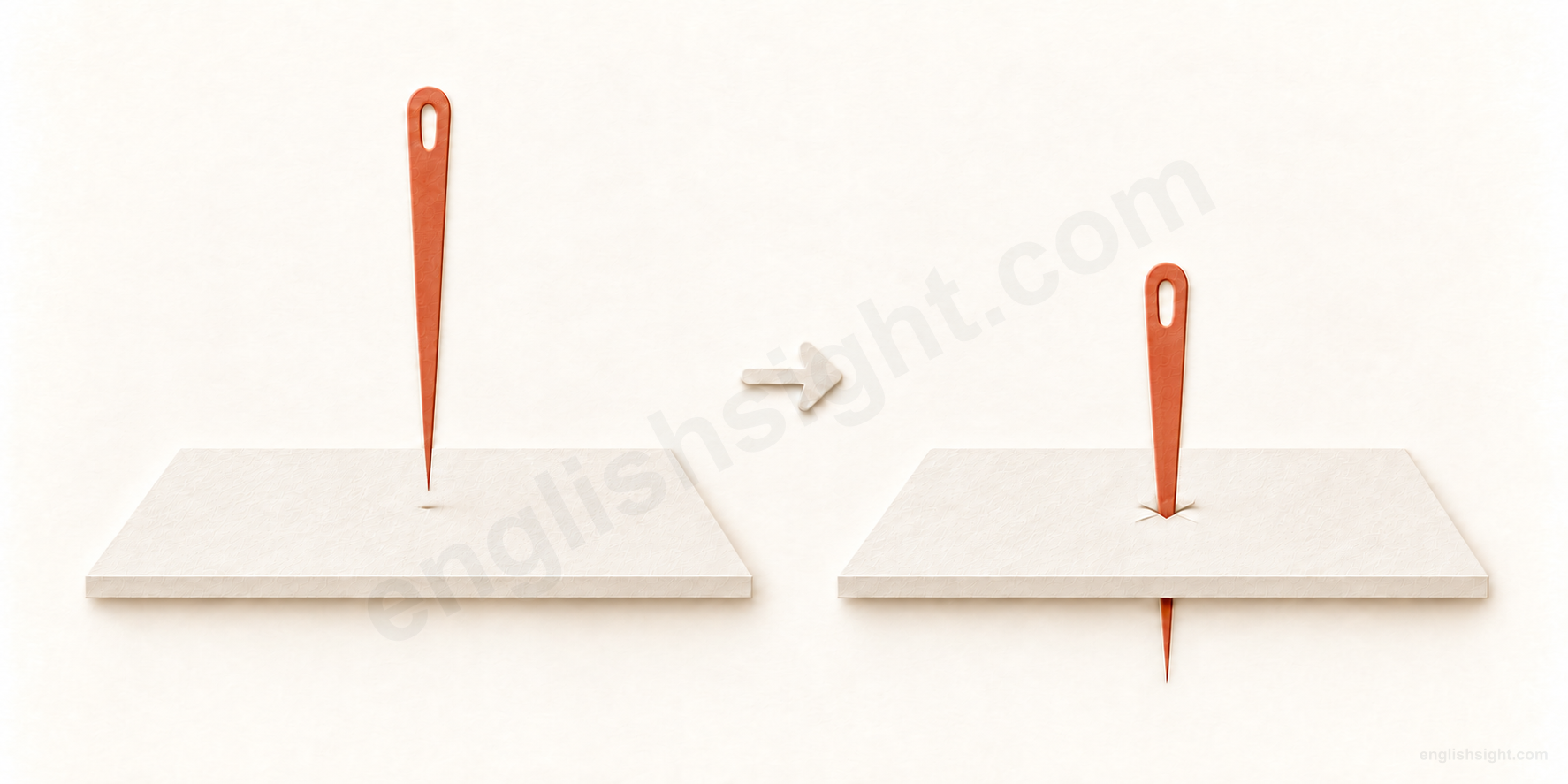
A fine needle point above an intact sheet.
sharp
The needle pierces the sheet through a small opening.
Pressed downward, the point concentrates contact in a tiny area.
A sharp point can pierce a sheet when pressed.
A sharp edge or point concentrates contact into a narrow area, making cutting or piercing possible.
The sketch illustrates the physical starting point. Related senses often emphasize distinctness, intensity, or abruptness; exact-time and music uses need separate learning.
Start with a fine edge or point that can cut or pierce. In many related uses, sharp highlights something that stands out clearly or strikes abruptly: an image, a change, a sound, or a remark.
This is a teaching connection, not a rule that derives every meaning from a knife. Time expressions, musical notation, and idioms have established conventions of their own.
01
Edges, points, and shapes
Start with what can cut or pierce, then distinguish pointed shape from actual cutting ability.
01
sharp + tool / edge / point; tool + be + sharp
a sharp knife / point
able to cut or pierce easily
Situation
You need to slice a firm tomato.
What is described
A fine cutting edge enters the skin cleanly.
Sharp describes the edge or point, and also the tool that has it.
A knife is sharp when its edge cuts effectively; a needle or pencil can have a sharp point. The object is the subject in This knife is sharp, or sharp comes before the noun in a sharp knife. No cutting has to be happening now.
The diagram uses a fine point contacting a sheet as a physical teaching model. A knife cuts along an edge; a needle pierces at a point. Neither needs to look dramatically spiky. Blunt is the usual opposite for a point or edge; dull is also used, especially for a blade. As sharp as a razor and razor-sharp intensify the description.
In a sentence
This knife is sharp enough to slice the tomatoes thinly.
Watch the difference Sharp describes a condition; use sharpen when you mean make a knife or pencil sharp. A sharp knife is not the same as a pointed knife.
02
sharp + corner / angle / peak / features
sharp corners / features
pointed or angular rather than rounded
Situation
A table has corners that project into the room.
What is described
You describe their shape and possible danger.
A sharp shape need not be a useful cutting tool.
Sharp corners, sharp angles, and sharp mountain peaks have narrow or angular outlines. Sharp features describes a face with noticeably pointed or angular parts, such as the nose or chin. It does not mean that the person is clever or unkind.
The physical connection is the narrow point or edge. Compare a sharp knife, which normally concerns cutting performance, with a sharp corner, which concerns shape. An acute angle is a mathematical category; sharp angle is an ordinary description rather than a precise measurement.
In a sentence
The low table has sharp corners.
Watch the difference Do not assume every sharp object is a blade or every sharp face expresses anger.
02
Effects on the senses
A sensation can strike strongly without any blade being present. The noun identifies the kind of experience.
03
a sharp pain in + body part; a sharp pang of + emotion
a sharp pain / pang
a piercing, intense feeling
Situation
You twist your body while lifting a box.
What is described
A sudden localized pain catches your attention.
The cutting comparison describes how the sensation feels, not its cause.
A sharp pain is typically intense and piercing, often sudden. It contrasts with a dull ache, which is less piercing and may feel more spread out. Sharp does not itself identify a medical cause or tell us how long the pain lasts.
A sharp pang of guilt or jealousy applies the same striking quality to an emotion. Pang names a sudden painful feeling; the of-phrase names the emotion. This is a figurative extension, not a claim that a physical cut has occurred.
In a sentence
I felt a sharp pain in my shoulder when I lifted the box.
Watch the difference Pain can be sharp and recurring or persistent; do not define sharp as always lasting only a second.
Sharp identifies a biting sensory quality; it does not always express dislike.
A sharp taste may be tart, acidic, or strongly tangy, depending on the food. A sharp cheese has a strong, developed flavour; it need not taste like lemon. A sharp smell similarly penetrates your awareness, as vinegar can.
The food or smell is described, not the person tasting it. Sharp can be pleasant in a balanced sauce or unpleasant in another context. Sour describes acidity more directly; spicy usually concerns spices or heat, so the words are not interchangeable.
In a sentence
The sauce tastes sharp, so I added a little honey.
Watch the difference Sharp cheese does not mean a cheese cut into pointed pieces.
05
a sharp wind / frost
a sharp wind / frost
bitingly cold or severe weather
Situation
You leave a sheltered doorway.
What is described
The cold wind stings your exposed face.
The cold feels cutting even though nothing physically cuts you.
A sharp wind is cold in a biting way; a sharp frost is severe. These weather combinations describe an intense effect or severity, rather than a pointed shape.
Strong wind mainly concerns force. Sharp wind adds a cold, uncomfortable quality, so a warm strong wind is not automatically sharp. The word is not a general replacement for bad in all weather descriptions.
In a sentence
A sharp wind blew across the empty platform.
Watch the difference A sharp frost does not mean that the frost formed quickly; here sharp emphasizes severity.
06
a sharp + knock / crack / cry / whistle
a sharp knock / cry
a sound that strikes the ear distinctly
Situation
You are sitting in a quiet room.
What is described
A sudden crisp knock interrupts the silence.
A sharp sound can be sudden, piercing, or crisply distinct.
A sharp knock or crack has a clear, abrupt impact. A sharp cry or whistle can be high and piercing. The noun helps decide which qualities matter; a knock need not be high-pitched.
Compare a sharp voice meaning a harsh or irritated manner with a sharp sound meaning an acoustic quality. They can overlap in one utterance, but a sharp knock does not express a person’s attitude by itself. Musical sharp has a separate technical meaning.
In a sentence
A sharp knock at the door woke the dog.
Watch the difference Do not treat sharp as a technical measurement of pitch or volume in ordinary sound descriptions.
03
Abrupt changes and clear boundaries
Sharp can describe a sudden change or a clearly defined difference. Read whether the sentence concerns movement, quantity, or clarity.
07
a sharp bend / turn; take a sharp left; turn sharp left / right
a sharp turn / turn sharp left
a sudden, pronounced change of direction
Situation
The road runs straight beside a field.
What is described
It changes direction abruptly near a bridge.
Sharp concerns the angle or abruptness of the turn, not simply speed.
A sharp bend or turn changes direction markedly rather than gradually. Take a sharp left uses left as a noun for a left turn. The car may take the turn slowly and still make a sharp turn.
In British English, turn sharp left or sharp right uses sharp as an adverb. Turn sharply to the left is another natural form. A short sharp movement or a sharp intake of breath similarly emphasizes an abrupt, forceful action.
In a sentence
Take a sharp left just after the bridge.
Watch the difference A sharp turn and a fast turn describe different features of the movement.
08
a sharp rise / fall in + quantity; quantity + rise / fall + sharply
a sharp rise / fall
a large, rapid change in amount
Situation
Ticket sales are steady for several weeks.
What is described
Sales rise substantially within a short period.
Sharp says how the quantity changes; rise or fall supplies the direction.
A sharp increase, rise, fall, drop, or decline is marked and rapid. A sharp rise in prices and a sharp fall in prices point in opposite directions; sharp alone predicts neither.
Use an in-phrase for what changes and by for the amount of a change: a sharp rise in costs, or Costs rose sharply by twenty percent. Sharply is the usual adverb with rise and fall. A high price describes a level, while a sharp rise describes a change.
In a sentence
There was a sharp fall in ticket sales after the holiday.
Watch the difference In ordinary prose write Sales fell sharply, rather than Sales fell sharp.
09
a sharp image; image + be + sharp; bring + object + into sharp focus
a sharp image / in sharp focus
details and boundaries are easy to distinguish
Situation
A camera image looks blurred.
What is described
After focusing, small details become clear.
A sharp image has clear definition, not a physically cutting surface.
A sharp photograph or outline lets you distinguish details and edges. The picture is sharp is natural after be; it is not limited to a position before the noun. Blurred, blurry, or out of focus gives the opposite idea in photography.
Bring an image into sharp focus means make it clearly focused. Figuratively, an event can bring a problem into sharp focus by making it easier to recognize clearly. This concerns definition, not necessarily brightness, colour, or attractiveness.
In a sentence
The second photograph is much sharper than the first.
Watch the difference Bright and sharp are different: a bright photograph can still be blurred.
10
in sharp contrast to + noun; draw a sharp distinction between A and B
a sharp contrast / distinction
a clearly marked difference
Situation
Two rooms are next to each other.
What is described
One is quiet while the other is full of noise.
The boundary between the compared situations is easy to notice.
In sharp contrast to introduces a striking difference from a comparison point. Draw a sharp distinction between A and B means treat or explain them as clearly different categories. A difference need not appear suddenly to be sharp.
This shares the clear-boundary idea with a sharp image. It differs from a sharp change, which concerns a change over time or position. Sharply divided opinions are strongly separated, rather than opinions that physically cut anything.
In a sentence
The library was quiet, in sharp contrast to the busy café next door.
Watch the difference Use contrast to or contrast with for comparison; the standard fixed frame here is in sharp contrast to.
04
Thinking, speaking, dealing, and dressing
With people, sharp may praise alertness or style, criticize a harsh manner, or warn of questionable business conduct.
11
a sharp mind; person + be / stay + sharp; sharp of + person + to + verb
a sharp mind / stay sharp
quick to understand, judge, or respond
Situation
A small error is hidden in a complicated plan.
What is described
A quick-thinking colleague notices it.
With a mind or thinker, sharp usually praises mental ability.
A sharp student understands quickly; a sharp mind notices connections and flaws. Stay sharp means remain mentally alert and effective, for example through practice or attention. It does not mean become physically pointed.
It was sharp of you to spot that praises a perceptive action: of you identifies the person who showed the quality. Razor-sharp wit or a mind as sharp as a razor intensifies the praise. Context matters because a sharp operator can instead suggest questionable dealing.
In a sentence
It was sharp of Mina to notice the missing page number.
Watch the difference Intelligent sharp and harsh sharp are different senses; She is sharp needs context.
12
have sharp eyes / hearing; a sharp eye for + noun; keep a sharp lookout for + noun
sharp eyes / keep a sharp lookout
good perception and careful attention
Situation
You need to spot a small trail sign.
What is described
Someone watches carefully for it.
Seeing well, noticing details, and actively watching are related but distinct.
Sharp eyes or sharp hearing describes sensitivity or the ability to notice small details. Have a sharp eye for detail emphasizes noticing a particular kind of thing; for introduces the area of perception or judgment.
Keep a sharp lookout for something means watch attentively for it. That describes active vigilance, not a guarantee of excellent eyesight. A sharp-eyed reader may notice a typo even when the page itself is a sharp, clear image: one phrase describes the observer and the other the object.
In a sentence
Keep a sharp lookout for the small blue trail sign.
Watch the difference A sharp eye for design concerns perception or judgment, not an eye’s physical shape.
13
be sharp with + person; a sharp reply / criticism; have a sharp tongue
be sharp with someone / a sharp tongue
speak in a harsh, irritated, or severely critical way
Situation
A colleague asks an ordinary question.
What is described
You answer more harshly than you intended.
With names the recipient of the harsh manner.
Be sharp with someone describes an impatient, stern, or unfriendly way of speaking. A sharp reply or sharp words can sting emotionally. Sharp criticism emphasizes severity; it need not mean that the criticism is accurate.
Have a sharp tongue describes a tendency to make biting or hurtful remarks. It is an idiomatic description of speech, not anatomy. Compare a sharp wit, which can praise clever humour, though clever humour can also be unkind. She spoke sharply uses the ordinary manner adverb.
In a sentence
I’m sorry I was sharp with you during the meeting.
Watch the difference Sharp with someone concerns manner; sharp at maths is not the standard pattern for this meaning.
14
sharp practice; a sharp operator / trader
sharp practice / a sharp operator
clever dealing that may be unfair or dishonest
Situation
A seller hides an important condition in small print.
What is described
Customers question whether the dealing is fair.
This use expresses suspicion or disapproval, rather than simple praise.
Sharp practice refers to unfair or questionable business methods, often methods that exploit someone while avoiding obvious rule breaking. Sharp is not claiming that the practice is careful training. Practice here concerns a way of operating.
A sharp operator is skilled at advancing personal interests, with possible overtones of dishonesty. That differs from calling someone a sharp thinker. The surrounding situation controls the evaluation; do not assume every sharp person is dishonest.
In a sentence
Customers accused the seller of sharp practice over the hidden fees.
Watch the difference Sharp practice can be criticized without a claim that a court has found it illegal.
15
a sharp suit / dresser; person + look + sharp
a sharp suit / look sharp
neat and stylish in appearance
Situation
Someone changes into a well-fitted jacket.
What is described
You compliment their polished appearance.
Here sharp evaluates style, not intellect or politeness.
A sharp suit, a sharp dresser, and You look sharp praise a neat, stylish appearance. A dresser here is a person considered in terms of how they dress, not a piece of furniture. The style use is often informal.
The adjective follows look in You look sharp. Compare the British informal command Look sharp!, meaning hurry up, covered separately. The same two words do different jobs because the sentence form and situation differ.
In a sentence
You look sharp in that new jacket.
Watch the difference Looking sharp does not mean looking angry or having angular facial features in this clothing context.
05
Exact times, musical pitch, and medical objects
Some established uses need their own grammar and conventions. Do not predict them just from a pointed object.
16
at / by + clock time + sharp
at nine sharp
at exactly the stated clock time
Situation
You arrange a meeting with a fixed start.
What is described
Everyone is expected at precisely nine.
Sharp follows the time expression and strengthens its exactness.
At nine sharp means at nine exactly. Sharp is an adverb here and normally comes after the clock time, as in The doors open at nine sharp. It is useful for an emphatic instruction and can sound firm.
At nine gives the time without extra emphasis. By nine sharp sets an exact latest limit because by contributes the deadline meaning. Sharp itself does not mean before, after, or approximately. Sharply is not substituted for sharp in this time pattern.
In a sentence
The coach leaves at six thirty sharp.
Watch the difference Use at six sharp, not at sharp six or at six sharply.
17
note letter + sharp; a sharp; sharps and flats
F sharp / a sharp
a note raised by one semitone, or the musical sign ♯
Situation
A score names a pitch using a letter and a sign.
What is described
The player reads F sharp rather than F natural.
A named sharp is a musical convention; it is not automatically out of tune.
F sharp, written F♯, is a semitone above F natural. Sharp follows the letter name. A semitone is also called a half step. In the usual written convention, the sign appears before the note on the staff even though we say sharp after the letter.
As a countable noun, a sharp can mean the sign or a note affected by it; the plural is sharps. A piece in F sharp minor can be performed perfectly in tune. Flat indicates a semitone lower than the named natural note; natural cancels a previous sharp or flat in the relevant notation context.
In a sentence
This passage uses F sharp rather than F natural.
Watch the difference A sharp is a pitch sign or note, not a loud or piercing sound by definition.
18
note + sound / be + sharp; sing / play + sharp
sing sharp / sound sharp
produce a pitch higher than the intended pitch
Situation
A singer is aiming for a particular note.
What is described
The pitch comes out slightly too high.
Out-of-tune sharp is relative to the intended pitch, not necessarily a semitone above it.
The note sounds sharp describes its pitch as too high. She is singing sharp uses sharp as an adverb. The error may be tiny; it does not have to equal one semitone. Singing flat means producing a pitch too low.
This differs from singing F sharp, which names the intended note and says nothing about an error. Volume and harshness are separate: a softly sung note can still be sharp. Read whether sharp names a pitch or judges accuracy.
In a sentence
The final note sounded a little sharp.
Watch the difference Do not interpret singing sharp as always singing notes marked ♯ or always singing loudly.
19
sharps; a sharps container; sharps disposal
sharps / a sharps container
medical objects with cutting edges or points
Situation
A clinic labels a container for certain used instruments.
What is described
The label groups needles and similar pointed or edged objects.
Sharps is a noun category, commonly plural, rather than an adjective missing its noun.
In medical contexts, sharps names objects such as needles and blades that can pierce or cut. You may see the word on a sharps container or in the phrase sharps disposal. This is useful recognition vocabulary for signs and workplace information.
The final s remains in the noun used before container: a sharps container. This technical category grows directly from the physical quality. It is distinct from the musical plural sharps; the setting tells you which noun is intended.
In a sentence
The clinic ordered three new sharps containers.
Watch the difference Do not read a clinic’s sharps label as a reference to music, or treat sharps as the ordinary plural adjective for all sharp things.
06
Expressions to learn as a whole
These phrases carry meanings and tones beyond the literal meanings of their individual words.
20
look sharp!; had better look sharp
Look sharp!
hurry or act quickly
Situation
A group is moving too slowly to catch a train.
What is described
Someone urges the others to speed up.
This British informal command is about action, not appearance.
Look sharp! and You’d better look sharp can tell someone to hurry or act promptly. Oxford labels this British and informal. It can sound brusque when used as a direct order.
Contrast You look sharp in that suit, where look links the person to an adjective describing appearance. In the command, the whole established expression supplies the hurry meaning. Look is not a separable particle verb here.
In a sentence
Look sharp, or we’ll miss the last train!
Watch the difference Do not translate the command as an instruction to make your eyesight sharper.
21
not (exactly) the sharpest tool in the box / knife in the drawer
not the sharpest tool in the box
an indirect way to call someone unintelligent
Situation
A speaker wants to criticize someone’s judgment.
What is described
They use a familiar comparison with a blunt tool.
The phrase is humorous in form but can be insulting.
Not the sharpest tool in the box and not the sharpest knife in the drawer suggest that someone is not very intelligent. The negative comparison echoes sharp meaning mentally quick, but the full phrases are conventional idioms.
He’s not exactly the sharpest tool in the box adds an ironic softener. It can still be hurtful and is unsuitable as a neutral description of a learner. The sentence is not a claim about actual tools or a formal assessment of ability.
In a sentence
“He sent his password to a stranger? Not the sharpest tool in the box.”
Watch the difference Do not assume humorous wording makes this polite to say about someone.
22
at the sharp end (of + activity / organization)
at the sharp end of something
directly facing the difficult or demanding part of an activity
Situation
A policy is designed in an office.
What is described
Front-line staff deal with its practical problems.
The sharp end is the demanding point of involvement, not a literal end of an object.
At the sharp end of a business or service places someone where the practical pressure, responsibility, difficulty, or danger is greatest. It often contrasts direct experience with planning from a distance. The expression is mainly British and informal.
At introduces the position; of names the activity. It need not mean danger in every use: a customer-service team may work at the sharp end of a business without facing physical risk. The phrase does not automatically mean the most senior job.
In a sentence
The support team works at the sharp end of the service, answering customers all day.
Watch the difference The sharp end is not simply the final stage or the most profitable part.
23
give + person + a short, sharp shock; a short, sharp shock
a short, sharp shock
a brief but severe punishment or unpleasant jolt
Situation
Someone proposes a quick, severe response to misconduct.
What is described
They describe it as a short, sharp shock.
Short concerns duration; sharp concerns the force of the impact.
This British expression often describes a brief, harsh punishment intended to change behaviour. It can also refer more broadly to an unpleasant jolt that makes someone recognize a difficult reality. The context tells you whether punishment is meant.
The expression describes a proposed effect; it does not prove that the punishment will work or endorse it. A short shock concerns duration, while adding sharp emphasizes severity. The complete phrase is useful for recognizing news and discussion.
In a sentence
The coach described the one-match suspension as a short, sharp shock.
Watch the difference A shock here need not be an electric shock or a medical condition.
Read the noun, grammar, and context
One model has limits
An image can be sharp without being dangerous, a sharp thinker can be kind, and F sharp can be in tune. The physical diagram is a teaching anchor, not an explanation of every convention or a shared mental image of all English speakers.
Forms and word classes
The adjective has sharper and sharpest. Sharp commonly follows be, look, sound, or taste, and also comes before a noun; named musical notes put it after the letter. Sharps is a plural noun, not a plural adjective. The main adjective senses do not require passive or causative verb patterns.
Sharp, sharply, sharpen, sharpness
Use sharply for ordinary manner or degree: speak sharply, rise sharply, sharply divided. Keep sharp in at nine sharp, sing sharp, and British turn sharp left. Sharpen means make or become sharp, literally or figuratively; sharpness names the quality. The specialist music verb sharp is outside the main lesson.
Coverage boundary
This selection covers modern everyday adjective uses, established adverb patterns, the basic music and medical nouns, and useful idioms. It does not rank them by measured frequency or teach every regional, historical, technical, or compound use.
Choose the meaning in context
Use the whole expression to decide which meaning fits.
1. A photographer says the image is sharp. What does this tell you?
2. “I was sharp with Leo.” What is the speaker admitting?
3. Which sentence naturally emphasizes an exact departure time?
4. A singer performs F sharp perfectly in tune. Is this contradictory?
5. Sales were low, then increased rapidly by a large amount. Which description fits the change?
6. “Look sharp, or we’ll miss the bus!” What does this British informal command mean?
Sources and teaching notes
The publisher pages below were read to check senses, patterns, and idioms. Explanations and example sentences are original. The fine-point diagram is a teaching model, not dictionary evidence.
The diagram is a teaching aid, not a claim that all native speakers picture sharp in the same way.