Name the animal, count it correctly, and recognize the expressions built around it.
An individual within a flock
An individual animal within a flock
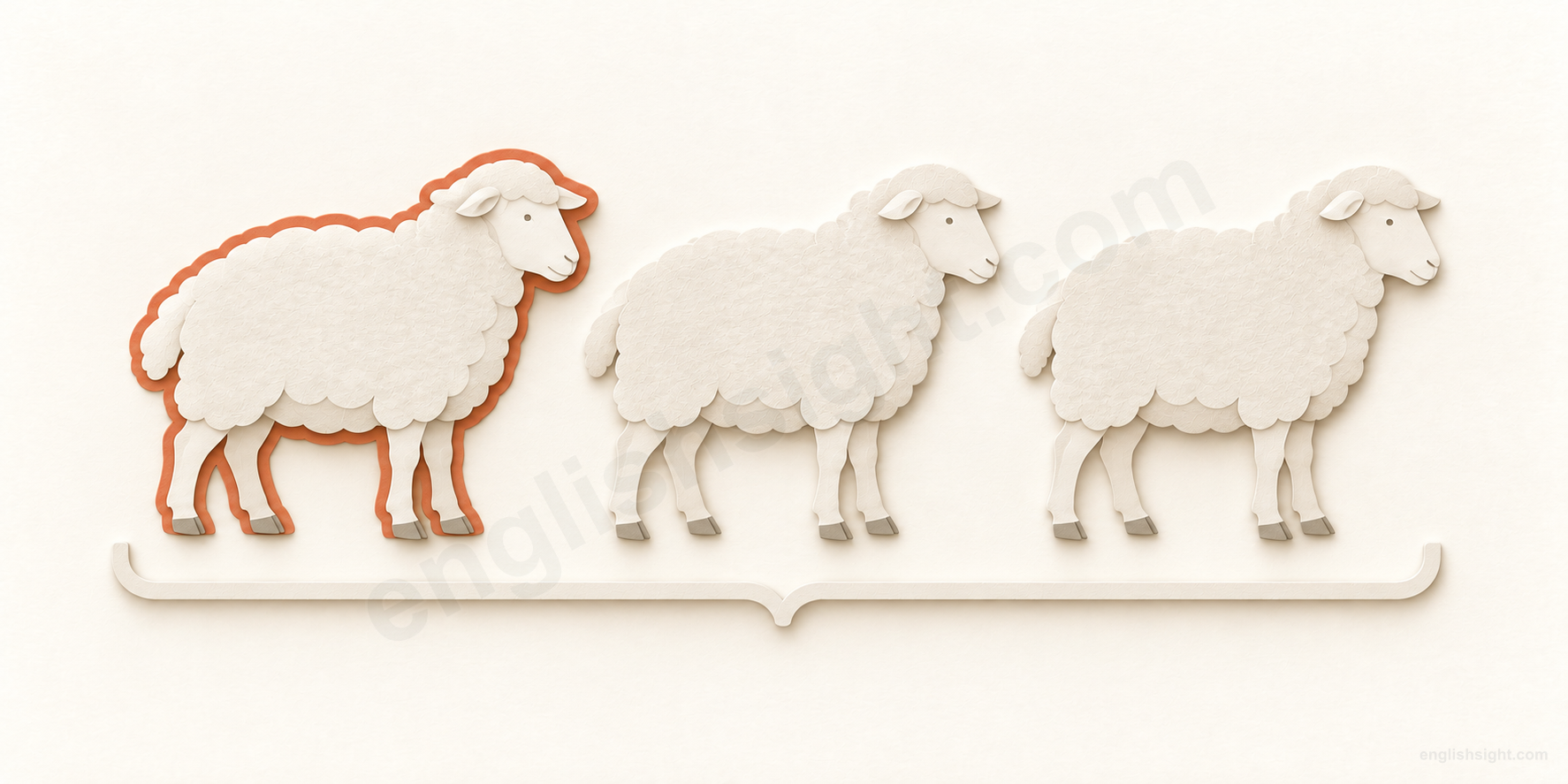
One highlighted animal is a sheep.
sheep
The three sheep together form a small flock.
The same noun names each animal and more than one.
One sheep; three sheep. Flock names the group.
Sheep names an animal of this kind; it can refer to one individual or several together without changing its form.
The sketch compares one member with a small flock, rather than showing a before-and-after change. It anchors the animal meaning and number pattern; it does not predict every idiom.
Sheep /ʃiːp/ most often names a familiar farm animal. The same form works for one animal and many: a sheep is resting; several sheep are resting.
Expressions about people draw on different associations with sheep: following a flock, standing apart, appearing harmless, or needing guidance. Those associations help memory, but each fixed expression needs its own meaning.
01
Name, count, and describe the animals
Start with the animal. Number words and agreement tell you whether sheep refers to one animal or several; nearby nouns can name age, sex, or a group.
01
a sheep; a ewe; a ram; a lamb
a sheep
a wool-bearing animal, often kept on a farm
Situation
You see an animal with a woolly body and a narrow face.
What you mean
You identify it as a sheep.
Sheep names the animal without specifying its sex.
A sheep can be male or female. If those distinctions matter, ewe names a female and ram a male; lamb names a young sheep. A lamb is still a sheep, just as a puppy is still a dog.
The picture highlights a woolly outline as a recognition aid. It does not define every breed or mean that sheep must always have a full woolly coat. Sheep and goats are different animals; sheep is not a general word for both.
In a sentence
The lamb stayed close to the other sheep.
Watch the difference Do not use sheep to mean only a female animal.
02
a / one sheep is…; two / many sheep are…; sheep’s + noun
one sheep, two sheep
use the same noun form for singular and plural
Situation
You count one animal, then another.
What you mean
The number changes, but sheep stays the same.
The determiner, context, and verb carry the number distinction.
Sheep is a countable noun with an unchanged plural: a sheep, two sheep, many sheep. One sheep is missing; two sheep are missing. Use a singular verb for one animal and a plural verb for several.
To make a general statement, use plural sheep without an article: Sheep need water. For a particular known animal or group, use the sheep; context and agreement show the number. The sheep is outside refers to one, while The sheep are outside refers to more than one.
For possession, write a sheep’s coat for one animal and the sheep’s coats for several animals. The irregular plural does not end in s, so its possessive also takes ’s. In both cases, the surrounding words clarify the number.
In a sentence
There are five sheep beside the gate.
Watch the difference Use five sheep, not five sheeps. The noun is countable even though its plural has no ending.
03
a flock of sheep; two flocks of sheep
a flock of sheep
name a group of sheep
Situation
Several sheep are together in a field.
What you mean
You describe them as one flock.
Flock supplies the group meaning; sheep names its members.
A flock of sheep is the usual group expression to learn first. You can count the groups: two flocks of sheep. Compare three sheep, which counts individual animals.
In The flock is small, singular flock presents the group as a unit. In The sheep are resting, plural sheep refers to its members. British English can also use plural agreement with collective nouns when emphasizing the members.
In a sentence
A small flock of sheep rested near the wall.
Watch the difference A flock of sheep does not mean a particular number of animals.
02
Farm work and products
The verb tells you what someone does with the animals. Product names distinguish the living animal from its wool and meat.
Animals need care, and some must be moved to another field.
What you mean
Different verbs describe different parts of the work.
The action comes from the verb, not a new meaning of sheep.
Keep sheep describes having and looking after them; raise sheep describes rearing them. A sheep farm is a farm where sheep are kept, and a sheep farmer does this work. Here sheep modifies another noun; it does not become a verb.
Herd sheep means move or gather them as a group: They herded the sheep into a pen. Sheep graze when they eat growing grass, and bleat when they make their characteristic call. Compare The sheep are grazing with The farmer is herding the sheep: the animals and the farmer perform different actions.
In a sentence
They keep sheep on the hills above the village.
Watch the difference Herding moves a group; raising animals is not the same as physically lifting them.
05
sheep’s wool; keep sheep for wool / meat; some lamb / mutton
sheep’s wool; lamb; mutton
distinguish an animal from its products
Situation
You discuss animals on a farm or food in a shop.
What you mean
The noun you choose identifies the animal, material, or meat.
Sheep names the animal; wool, lamb, and mutton serve different purposes.
Sheep’s wool names the fibre obtained from sheep. Wool is a material noun: a wool sweater is made from wool. Keeping sheep for wool describes the purpose of keeping them, not a separate meaning of sheep.
Lamb can name a young animal or its meat. A lamb is countable; lamb as food is normally uncountable: We bought some lamb. Mutton is meat from a fully grown sheep. At a butcher’s, ask for lamb or mutton when that is the meat you mean; sheep by itself normally names the animal.
In a sentence
We bought some lamb for the stew.
Watch the difference A lamb in a field is an animal; some lamb on a plate is food.
03
Sleep, social judgments, and fixed sayings
These expressions use familiar associations with sheep, but their meanings belong to the whole phrase. Learn the situation and tone with the words.
06
count sheep; try counting sheep
count sheep
imagine counting sheep while trying to fall asleep
Situation
You are lying awake in bed.
What you mean
You try an imagined counting routine.
The bedtime context gives counting sheep its familiar purpose.
Count sheep commonly refers to imagining sheep passing one by one, often over a fence, and counting them to try to fall asleep. The phrase names the routine, not a promise that sleep follows.
A farmer can also literally count sheep to check how many are present. Compare I counted the sheep before closing the gate with I was counting sheep in bed. The situation distinguishes an inventory from the bedtime expression.
In a sentence
I lay awake counting sheep until I heard the rain.
Watch the difference Counting sheep at bedtime does not require real animals.
07
follow / behave like sheep; call people sheep
like sheep
follow other people without independent judgment
Situation
One person starts doing something.
What you mean
Other people copy without considering it for themselves.
The comparison criticizes unthinking conformity.
Calling people sheep, or saying they act like sheep, is disapproving. It presents them as easily led. Like marks a comparison; it does not change the people into animals.
The criticism concerns independent thought, not simply doing something together. People can choose the same action after careful discussion. The animal image is a cultural comparison, not evidence that actual sheep never make choices.
In a sentence
We followed the crowd like sheep instead of checking the sign.
Watch the difference Calling someone a sheep can be insulting; it is not a neutral synonym for a team member.
08
be the black sheep of + family / group
the black sheep of the family
a member whom a family or group regards as disreputable or unacceptable
Situation
A family has expectations about respectable behavior.
What you mean
One member is treated as a disgrace or outsider.
The expression reports a group’s judgment about one of its members.
The black sheep of a family or group is someone its members regard as bringing shame or failing to meet their standards. It is more negative than simply being different. A person may use the expression about themself, sometimes with humor.
A black sheep in a field can literally be an animal with dark wool. The figurative phrase does not refer to a person’s skin colour, and the family’s judgment is not proof that the person has done anything wrong.
In a sentence
After the scandal, he became the black sheep of the family.
Watch the difference Do not use black sheep as a neutral label for anyone whose hobbies differ from yours.
09
be a wolf in sheep’s clothing
a wolf in sheep’s clothing
someone harmful who appears friendly or harmless
Situation
Someone presents a reassuring, friendly manner.
What you mean
Their hidden intention is hostile.
The contrast is between outward appearance and concealed danger.
A wolf in sheep’s clothing looks harmless but is really dangerous or hostile. The whole expression carries that contrast; clothing is an imagined disguise, not ordinary fashion advice.
A quiet person is not automatically a wolf in sheep’s clothing. The phrase accuses someone of hiding a harmful nature or intention. Use the full form sheep’s clothing, with the possessive, rather than sheep clothes.
In a sentence
The friendly visitor was a wolf in sheep’s clothing, planning to steal their files.
Watch the difference The phrase is a strong accusation, not just a description of someone surprising.
10
separate / sort out the sheep from the goats
separate the sheep from the goats
distinguish the capable or suitable from the rest
Situation
A group’s abilities have not yet been tested.
What you mean
A demanding task reveals differences in performance.
This fixed contrast evaluates people or things; it is not the like-sheep criticism.
Separate the sheep from the goats, also sort out the sheep from the goats, means distinguish the good or capable from those judged less good or capable. A test or task can be the subject that reveals the distinction.
The expression can also evaluate things, such as products. The criterion comes from the situation. It does not mean simply make two arbitrary groups, and it can sound harsh when used about people.
In a sentence
The practical test will separate the sheep from the goats.
Watch the difference Learn the fixed order: sheep from goats. The idiom is not a general rule about which animal is better.
11
a lost sheep; care for / look for lost sheep
a lost sheep
an animal that has strayed; figuratively, a person seen as needing guidance
Situation
An animal is away from the flock, or someone lacks direction.
What you mean
Someone searches for it or offers guidance.
The figurative use transfers the idea of straying and needing care.
A lost sheep can literally be an animal separated from its flock. Applied to a person, the image can suggest someone who has lost their way in life and needs help or guidance, often in religious language.
The phrase can convey care, but it also casts the other person as needing guidance. It differs from black sheep, which emphasizes a group’s disapproval, and like sheep, which criticizes conformity.
In a sentence
The volunteer described the lonely newcomer as a lost sheep in need of support.
Watch the difference For a visitor who only needs street directions, lost visitor is usually a plainer description.
12
may / might as well be hanged for a sheep as (for) a lamb
might as well be hanged for a sheep as a lamb
a saying about doing a bigger wrong when punishment seems inevitable
Situation
Someone expects blame or punishment for a small offence.
What you mean
They use that expectation to justify going further.
The proverb expresses a rationale, not a recommendation.
The saying reasons that if punishment will be the same, someone may as well gain more by doing the bigger wrong. Modern speakers can use it figuratively or jokingly; it need not concern theft, animals, or actual execution.
Learn it for recognition as a traditional saying, rather than as a basic daily request. Oxford records both hanged and hung, and an optional second for: for a sheep as for a lamb. The meaning belongs to the proverb as a whole.
In a sentence
“They’ll blame me for being late anyway; I might as well be hanged for a sheep as a lamb,” he said, ordering another coffee.
Watch the difference Do not interpret the saying as advice that a larger wrong is sensible or harmless.
Keep the animal, number, and idiom distinct
Countable, with an unchanged plural
Sheep takes a, one, two, or many. The absence of a plural ending does not make it a material noun. Use is for one animal and are for more than one.
A noun in ordinary modern use
In sheep farm, sheep modifies farm as a noun. This lesson has no productive verb, passive, causative, or phrasal-verb family to learn. Verbs such as keep, herd, and count supply the action.
Images carry different judgments
Like sheep criticizes conformity; black sheep conveys disapproval by a group; a wolf in sheep’s clothing warns of concealed hostility. Their meanings cannot all be reduced to “gentle.”
Scope
This lesson covers the everyday animal noun, practical combinations, and established expressions, with two further expressions for recognition. Specialist breed names, the leather sense of sheep, the investment acronym SHEEP, and the additional expression make sheep’s eyes at are not expanded. Sheepish and sheepskin are separate vocabulary items.
Choose the expression that fits
Read the number, situation, and speaker’s attitude.
1. You can see four animals. Which sentence uses the standard plural?
2. Which phrase counts two groups rather than two individual animals?
3. Someone lies in bed imagining sheep passing one by one. What are they doing?
4. A person hides hostile plans behind a friendly manner. Which expression matches?
5. At a butcher’s, you want meat from a young sheep. Which request fits?
Sources and teaching notes
The dictionary entries below support the usage inventory. Explanations, examples, and the visual teaching model were written for this lesson; the sources do not claim a shared mental picture.
The diagram is a teaching aid, not a mental picture shared by every English speaker.