From a board for storage to products, unused plans, and useful life.
A supporting surface for stored objects
A supporting surface for stored objects
A level board fixed to the wall.
shelf
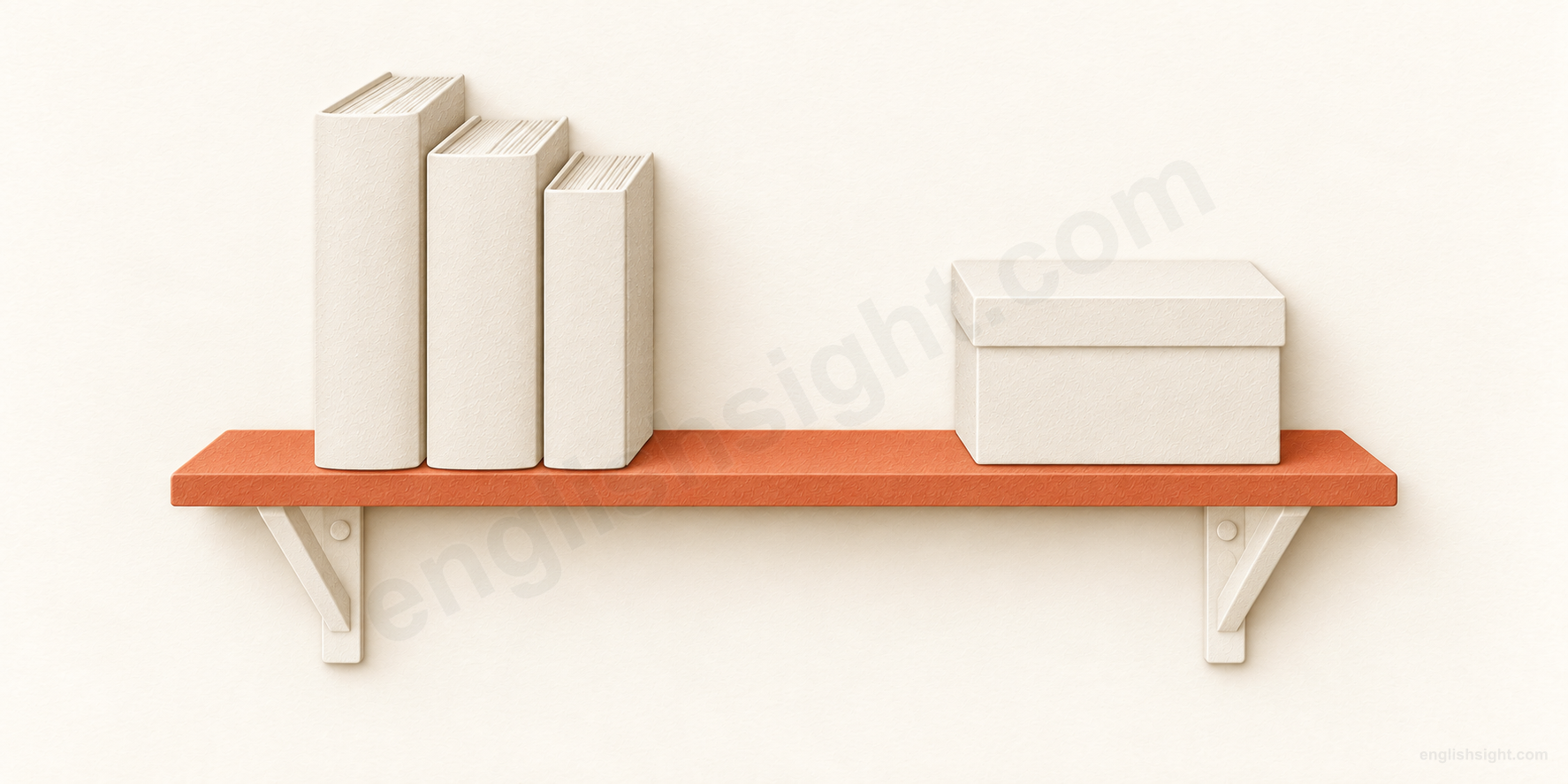
The board supports the stored objects.
Three books and a lidded box rest on its top surface.
The shelf is the supporting surface; the objects rest on it.
A shelf is a horizontal support on which things can be kept or displayed.
The drawing shows a stable support relationship, so no movement arrow or before-and-after change is needed. Natural shelves share a shape; fixed expressions add meanings that the drawing alone cannot predict.
A shelf gives objects a supporting surface, usually above the floor. Start with that relation: the board supports, and the objects rest on it.
Expressions about sales, stored plans, and useful life build different connections with shelves. Learn their whole patterns; this is a teaching model, not a claim about a picture shared by every English speaker.
01
Supports, locations, and storage
Start with the physical shelf, then use verbs and prepositions to say what is installed, stored, or removed.
01
a / the + shelf; number + shelves
a shelf / two shelves
a level support for keeping objects on
Situation
You need a place for books above the floor.
What this communicates
A horizontal board holds them.
The shelf is the supporting surface, not the objects it holds.
A shelf is a countable noun: a shelf, the shelf, three shelves. It may be attached to a wall or form one level inside furniture or an appliance. A bookcase can contain several shelves; the whole bookcase is not usually called one shelf.
The spelling and sound change in the plural: shelf /ʃelf/ becomes shelves /ʃelvz/. Say one shelf is empty but two shelves are empty. In the diagram, the long board supports the books and box; it does not enclose them like a drawer.
In a sentence
This bookcase has five shelves, but only one shelf is empty.
Watch the difference The plural is shelves, not shelfs. A singular countable shelf normally needs a determiner.
02
be / put something on a shelf; take something from / off a shelf
on the top shelf / off the shelf
locate an object or describe moving it away from its support
Situation
Someone asks where the bowls are.
What this communicates
You identify their storage level.
On expresses support; from and off identify where something is removed.
Use on a shelf for an object resting on its surface. Top, middle, bottom, upper, and lower identify a level: The bowls are on the bottom shelf. In the cupboard describes the larger enclosure; on the shelf describes the surface inside it.
Put the bowl on the shelf describes placing it there. Take the bowl from the shelf or take it off the shelf describes removal. These are ordinary verb-and-preposition combinations; shelf itself still names the support. Taking a bowl off a shelf does not automatically invoke the ready-made meaning of off the shelf.
In a sentence
Please take the blue bowl off the top shelf.
Watch the difference On the shelf is the usual location for an object supported by it; in the shelf is not the ordinary equivalent.
03
put up / install shelves; stock / restock shelves (with goods)
put up shelves / stock the shelves
install the supports or fill them with goods
Situation
A shop has a bare wall and boxes of goods.
What this communicates
Workers install shelves, then arrange goods on them.
The verb tells you whether the shelf itself or its contents change.
Put up or install shelves means attach or fit the supports. Stock, restock, or stack the shelves concerns filling existing shelves with goods. You can stock the shelves with rice; the with-phrase names the goods.
Compare We put up two shelves with We put two boxes on the shelves. Up belongs to put up in the installation expression; on introduces the boxes’ destination. These meanings come from the complete verb patterns, not a new verb meaning of shelf.
In a sentence
After we installed the shelves, we stocked them with jars of jam.
Watch the difference Stock the shelves means supply goods, not buy or install the boards.
04
a shelf of + plural noun; more / enough / little shelf space
a shelf of books / shelf space
talk about a shelf’s contents or the room available on shelves
Situation
Books fill one level and leave little room for more.
What this communicates
You describe both the collection and the remaining capacity.
Of can introduce the contents; space names the available room.
A shelf of books can mean the books occupying one shelf, treated as a group or amount. It does not say that the board is made of books. Compare a wooden shelf, which describes its material.
Shelf space is room on shelves for storing or displaying things. In We need more shelf space, space is uncountable. This is useful at home and in shops, where brands compete for display room. Shelf stays singular when it modifies space.
In a sentence
A whole shelf of cookbooks left no shelf space for the new plates.
Watch the difference Use shelf space for capacity and shelves for the countable supports: more shelf space, three more shelves.
02
Products and shopping
Shop shelves also help us talk about availability, demand, and standard products.
05
product + hit the shelves; take a product off the shelves; remove a product from the shelves
hit the shelves / take a product off the shelves
become available for sale or be withdrawn from sale
Situation
A new product is ready for shops.
What this communicates
Customers can buy it; later a retailer may withdraw it.
Shop shelves can stand for retail availability.
When a product hits the shelves, it goes on sale. No physical collision is meant. On store shelves or on supermarket shelves can likewise describe goods available to customers.
The patterns take a product off the shelves and remove a product from the shelves can mean stop selling it, rather than move one item for a customer. The context distinguishes withdrawal from an ordinary shopping action: I took a jar off the shelf only describes picking up that jar.
In a sentence
The new cereal hit the shelves in May, but the shop removed it a week later.
Watch the difference Off the shelves can signal withdrawal; buy something off the shelf can instead mean buy a standard ready-made product.
06
product + fly / be flying / flew off the shelves
fly off the shelves
sell very quickly
Situation
Customers want the new game.
What this communicates
The shop sells its copies rapidly.
The whole expression describes strong sales, not flight or withdrawal.
In These games are flying off the shelves, repeated purchases are imagined as rapid movement away from a display. The product is the grammatical subject; customers do the buying. The expression is lively and common in sales reports or conversation.
Contrast The shop took the games off the shelves, which may mean it stopped selling them. With fly off the shelves, demand is the point. You can use a past form too: The games flew off the shelves.
In a sentence
The new card game is flying off the shelves this week.
Watch the difference Fast sales do not necessarily mean every copy has sold out.
07
buy something off the shelf; an off-the-shelf + noun
buy off the shelf / an off-the-shelf solution
choose something already available instead of specially made
Situation
Your team needs software without a custom development project.
What this communicates
It buys a standard package.
Availability and standard design matter, even without a physical shelf.
Buy something off the shelf means obtain an existing standard product rather than commission one for your particular needs. Software and business solutions can be described this way even when delivered online. The shelf supplies a useful image of something already waiting to be bought.
Use hyphens when the phrase comes before a noun: an off-the-shelf package. Write We bought the package off the shelf without hyphens in that adverbial pattern. Ready-made does not by itself mean suitable for every buyer; customization may still be needed.
In a sentence
We chose an off-the-shelf booking system for the small hotel.
Watch the difference This does not mean second-hand, discounted, or taken away without payment.
03
Being unused, lasting, and judging quality
Learn these whole expressions. The storage image can help, but it does not determine every established meaning.
08
leave / keep something on the shelf; something + sit / remain on the shelf
leave a plan on the shelf
leave something unused or without active attention
Situation
A proposal has been written.
What this communicates
Nobody acts on it for now.
Something stored away can become a metaphor for something neglected.
A plan that stays or sits on the shelf is not being used or carried forward. It may exist on paper or as a file; no real shelf is necessary. Unlike an off-the-shelf solution, it is available in some sense but not being acted on.
The phrase on the shelf also has an old-fashioned use about someone, especially a woman, regarded as unlikely to marry. It can sound insulting because it treats a person as unwanted stock. Recognize that meaning in older material; use ordinary descriptions such as single when that is what you mean.
In a sentence
The transport plan has sat on the shelf since the election.
Watch the difference Literal on a shelf does not imply neglect. A frequently used dictionary may sit on your shelf.
09
have a long / short shelf life; a shelf life of + period
a long shelf life
the time a product can be stored before becoming too old to sell or use
Situation
A packaged product is kept for later sale or use.
What this communicates
Its usable storage period eventually ends.
Life measures a period of time, not the size or strength of the shelf.
Shelf life is a compound noun, usually singular, for how long a product keeps before deterioration makes it too old to sell or use. It is not the period spent on one particular shelf and can apply to storage at home as well as in a shop.
Useful patterns are have a short shelf life, extend the shelf life of a product, and a shelf life of six months. When you need the plural, life becomes lives: products with different shelf lives. The expression describes storage duration; the actual conditions and time depend on the product.
In a sentence
The supplier says these sealed paints have a shelf life of two years.
Watch the difference Do not confuse shelf life with how long something lasts after you start using it.
10
the shelf life of + idea / trend; have a short shelf life
the shelf life of an idea
how long something remains useful, relevant, or popular
Situation
A joke is fresh and attracts attention.
What this communicates
People eventually stop finding it interesting.
The compound extends storage life to continuing relevance.
Figuratively, shelf life is the period for which an idea, trend, joke, or similar thing retains value or appeal. There is no physical product going bad. The comparison concerns losing usefulness over time.
A short shelf life means it becomes dated quickly. It does not mean the idea was never useful, and it does not identify an exact expiry date unless the speaker supplies one.
In a sentence
Jokes about yesterday’s news often have a short shelf life.
Watch the difference The figurative meaning belongs to shelf life as a unit, not to shelf alone.
11
top-shelf + noun; on the top shelf (literal location)
top-shelf service
excellent quality, especially in North American usage
Situation
A customer praises a hotel.
What this communicates
They call its service exceptionally good.
The compound adjective can evaluate quality rather than physical height.
Top-shelf before a noun can mean of a very high standard, especially in North American English. Top-shelf service praises quality; it does not locate the service on a board.
British top-shelf magazines can instead refer to adult magazines with sexual content. That established use is different from the quality meaning. Contrast both with on the top shelf, which simply identifies the highest storage level.
In a sentence
The small hotel is known for its top-shelf service.
Watch the difference Context and region matter; top-shelf does not always mean excellent.
04
Natural formations and the related verb
Recognize the shape extension in geography and the spelling change from shelf to shelve.
12
a shelf of rock; the continental shelf; an ice shelf
a shelf of rock / the continental shelf / an ice shelf
a natural ledge or broad projecting layer
Situation
You look at a cliff or a map of a coast.
What this communicates
You identify a shelf-like natural formation.
The connection is shape and position, not furniture or storage.
A shelf of rock is a ledge projecting from a larger rock face. It resembles a shelf in form, but nobody has installed a board. A shelf in nature does not have to be perfectly level.
The continental shelf is the submerged edge of a continent, extending out beneath relatively shallow sea. An ice shelf is a broad layer of ice attached to land and extending over the sea. These are established geographical terms; an ice shelf is not just any floating piece of ice.
In a sentence
The seabirds rested on a narrow shelf of rock above the water.
Watch the difference The shared shape helps memory, but continental shelves and ice shelves are different formations.
13
shelve + books / plan; a proposal + be shelved
shelve the books / shelve a proposal
use the related verb for storing items or setting a plan aside
Situation
Books need putting away, or a proposal needs a decision.
What this communicates
The books are stored, or work on the proposal stops.
Shelve is a separate verb; shelves can be its present-tense form or the noun plural.
For the ordinary storage action use shelve /ʃelv/: We shelve the returned books. Its forms are shelve, shelves, shelved, shelving. She shelves books has a verb; two shelves has a plural noun. In both cases shelves is pronounced /ʃelvz/.
Shelve a proposal means decide not to proceed with it, for a time or permanently. Passive wording is natural: The proposal was shelved. This connects with leaving something on the shelf, but does not promise that the plan will be revived later.
In a sentence
The committee shelved the proposal until it could find more funding.
Watch the difference Use shelve for these standard verb meanings; shelf is the noun. A plan can be shelved permanently too.
Read the whole expression
A shelf is one support
A bookcase or shelving unit may contain several shelves. A shelf can be inside a cupboard, fridge, or oven as well as attached to a wall.
On and off do not each have one fixed meaning
On a shelf can be ordinary storage; on the shelf can describe something unused. Off the shelves can mean removed from sale, while off the shelf can describe a standard product. Context and the verb decide.
Grammar and boundaries
The main headword here is the countable noun shelf. Shelve is introduced as a related verb, not a particle-verb family of shelf. Specialist mining and archery senses and regional slang are outside the lesson.
Choose the meaning in context
Use the verb, the surrounding words, and the situation.
1. A bookcase contains three separate horizontal supports. Which form fits?
2. A team buys an existing software package rather than ordering custom software. Which description fits?
3. Customers are buying a new toy much faster than the shop expected. Which sentence expresses this?
4. The board decides to stop pursuing a project for now. Which sentence fits?
5. Someone says an online joke has a short shelf life. What do they mean?
Sources and teaching notes
The linked dictionaries support the meanings, grammar, and expressions. Explanations and examples are original; the diagram is a teaching interpretation, not evidence of a universal mental image.
The diagram illustrates a support relationship. It does not claim that every native speaker pictures shelf in the same way.