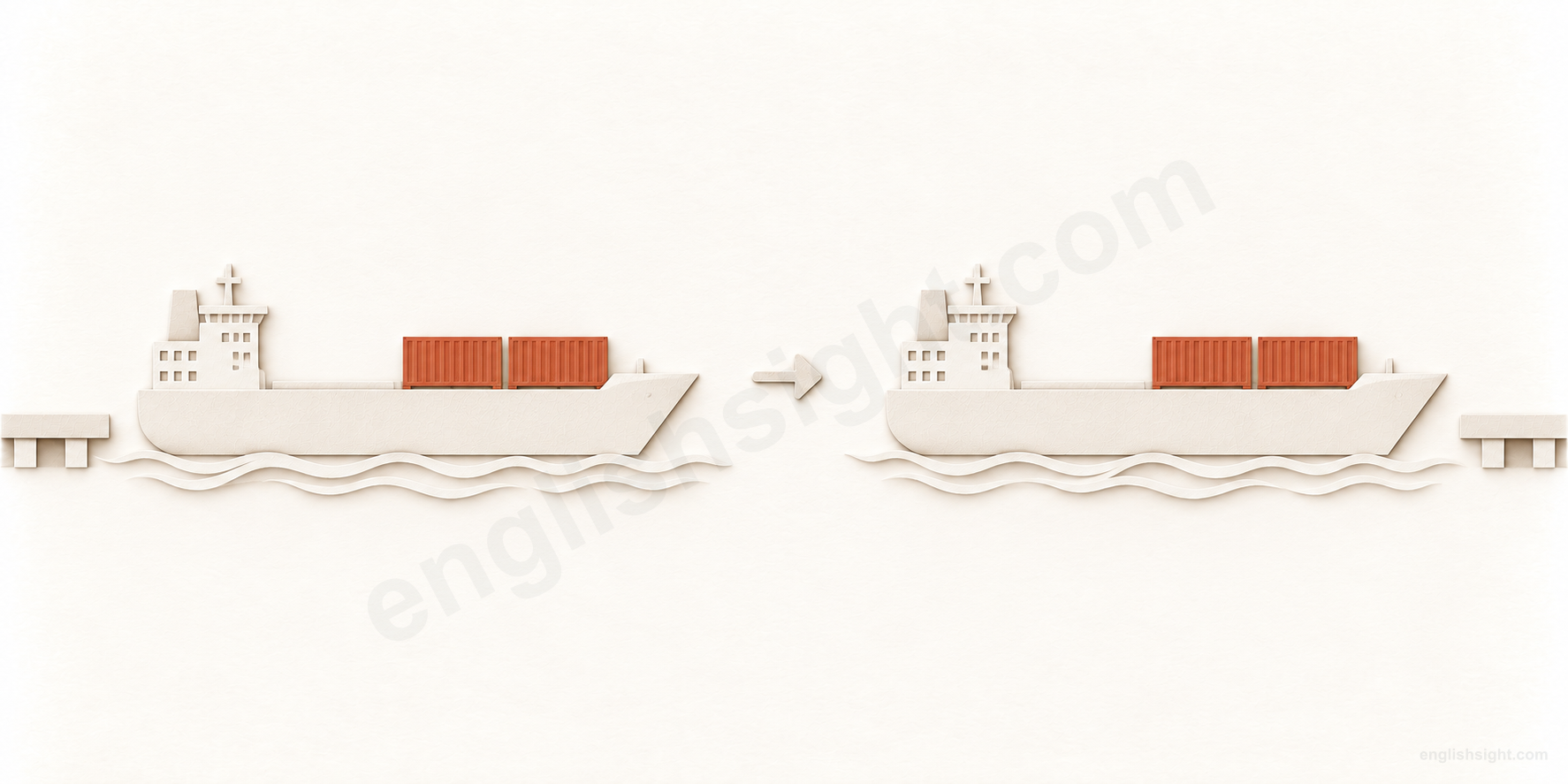
A carrier on water—and sending things on their way.
Connect the vessel with transport, then learn the distinct meanings supplied by grammar, context, and idioms.
A vessel carries its load
Carry a load across water
The cargo ship leaves the quay with two containers aboard.
ship
It approaches the destination quay with the same two containers still aboard.
The vessel carries its cargo across the water.
The ship carries its cargo with it.
A ship is a large vessel that carries people or goods across water; to ship goods is to send them toward a destination by transport.
The picture shows the carrier and its load moving together. Modern shipping can use other transport. Water intake, relationship slang, and fixed idioms cannot be predicted from this picture.
A ship carries people or goods across water. As a verb, ship commonly means arrange for something to be transported, even when the carrier is a truck or a plane.
That connection is useful, but it does not explain every modern use. Product releases, seawater coming aboard, fan pairings, and fixed expressions each need their own context. The picture is a teaching aid, not a claim that all English speakers imagine the same scene.
01
Ships, journeys, and life aboard
Name the vessel, describe travel by water, and distinguish getting aboard from leaving in an emergency.
01
a / the + ship; plural ships; cargo / container / cruise / merchant + ship
a ship / ships
a large vessel for carrying people or goods on water
Situation / starting point
Cargo needs to cross the sea.
What happens / what is meant
A large vessel carries it on the water.
The noun names the carrier, not the cargo or the journey.
Ship is countable: a ship, the ship, three ships. A cargo ship transports goods; a container ship carries large freight containers. A cruise ship takes passengers on holiday, while a merchant ship is used in commercial trade. A fleet is a group of ships.
The noun usually suggests a large seagoing vessel. Boat is a broader everyday word and often suggests something smaller, but naming conventions vary: there is no single size rule that settles every case. A ship can have engines or sails.
In a sentence
A container ship carried the bicycles across the ocean.
Watch the difference Do not use ship for every water vehicle automatically; a small rowing boat is normally a boat.
02
travel / go + by ship; on / aboard / on board + a / the ship; on board ship
travel by ship / be on a ship
describe a means of transport or a location aboard
Situation / starting point
You choose how to cross the sea.
What happens / what is meant
You travel aboard a particular vessel.
By names the means; on or aboard locates a person or thing.
Travel by ship describes the transport method, with no article before ship. Travel on a ship describes being on one vessel; use on the ship when speaker and listener know which one. Aboard the ship and on board the ship also mean on it.
A passenger is normally on a ship, even in a cabin inside it. In the ship can emphasize a physical interior, but it is not the usual travel expression. On board ship is an established article-free form, especially in accounts of life at sea.
In a sentence
We travelled by ship and spent three nights on board.
Watch the difference Say by ship for the method, not by a ship; a particular vessel needs on or aboard in this travel pattern.
03
board + a / the ship; get on / off + a / the ship; the ship docks at + port
board / get on / get off a ship
join or leave a vessel in ordinary travel
Situation / starting point
The passengers wait on the quay.
What happens / what is meant
They go aboard before departure.
The movement comes from board, get on, or get off; ship remains a noun.
Board a ship and get on a ship mean enter it for travel. Get off or leave the ship describes the opposite movement. Board takes its object directly: board the ship, without on.
A ship may dock at a port, meaning reach its dock, or lie at anchor, held in place by an anchor. The captain commands it and the crew work aboard it. The ship’s deck is its floor-like surface; the bow is the front and the stern the back. These are useful collocations, not extra meanings of ship.
In a sentence
We boarded the ship at noon and got off when it docked the next morning.
Watch the difference Board the ship is a verb plus object, not a phrasal verb formed from ship.
04
abandon ship; abandon the ship
abandon ship
leave a vessel because staying aboard is dangerous
Situation / starting point
The vessel can no longer keep its passengers safe.
What happens / what is meant
The captain orders everyone to leave it.
Abandon ship is an emergency expression, not an ordinary arrival.
Abandon ship is a fixed expression that commonly has no article. It names leaving a vessel in danger, for example because it is sinking. Abandon the ship is also grammatical when referring to a particular vessel.
The expression can be used figuratively for giving up on a project in trouble. The emergency meaning comes from the whole phrase; ship alone does not mean danger. Compare get off the ship for an uneventful end to a journey.
In a sentence
After the collision, the captain ordered the crew to abandon ship.
Watch the difference Do not use abandon ship as the normal instruction for passengers leaving at their destination.
02
Sending goods and people
The modern verb extends beyond sea transport. Follow the sender, what is sent, and the direction or stage of delivery.
05
ship + goods + to + person / place; ship + goods + from…to…; ship + goods + by air / road / rail / sea
ship something to someone
arrange for goods to be transported
Situation / starting point
A seller has packed your order.
What happens / what is meant
A carrier takes it toward your address.
Shipping concerns transport; it does not require a ship.
The sender is the subject, the item sent is the object, and to introduces its destination or recipient. You can ship a parcel by air, road, rail, or sea. From names the starting point: ship goods from a warehouse to a customer.
Send is more general: you can send a message or send someone a link. Ship normally suggests transporting goods, equipment, or people, rather than merely communicating information. Shipping costs are transport charges; free shipping means those charges are not added for the customer.
In a sentence
Can you ship this lamp to my sister by air?
Watch the difference Do not infer sea transport from ship as a verb; specify by sea if that distinction matters.
06
goods + ship; goods + be shipped; have / has been shipped
the order ships / has been shipped
report dispatch rather than arrival
Situation / starting point
The order is ready at the warehouse.
What happens / what is meant
It is sent on its way to the customer.
The goods can be the subject without being an intentional sender.
The order ships tomorrow is an intransitive commercial pattern meaning it will be sent for delivery. The order will be shipped tomorrow is passive and has much the same practical meaning. The seller ships the order makes the sender the subject.
Has shipped or has been shipped ordinarily reports dispatch, not arrival at the customer’s home. Compare It has been delivered, which reports arrival or handover. Shipped and shipping double the final p; ships does not. The -ing form can describe an ongoing action: We are shipping your order today.
In a sentence
Your replacement part has been shipped, but it has not been delivered yet.
Watch the difference A shipped status does not by itself guarantee that the parcel has arrived.
07
ship + goods + in / out / back; ship in / out / back + goods; ship + it / them + in / out / back
ship goods in / out / back
specify arrival into a place, dispatch from it, or return
Situation / starting point
One warehouse needs stock; another has damaged goods to return.
What happens / what is meant
Goods are sent in, sent out, or sent back.
The directional word adds a viewpoint to the transport verb.
Ship supplies in means arrange for them to be brought into the place under discussion. Ship orders out means send them away from that place. Ship a damaged item back means return it by a carrier. These transport combinations are understandable from ship plus the direction.
With a noun, both ship the boxes out and ship out the boxes are possible. A personal pronoun goes between the verb and particle: ship them out, ship it back. To introduces a destination and stays with it: ship it back to the seller.
In a sentence
The wrong chairs arrived, so we shipped them back to the seller.
Watch the difference Say ship them back, not ship back them; distinguish outward dispatch from inward delivery by the viewpoint.
08
ship + someone + off + (to + place); be shipped off
ship someone off
send someone away to stay elsewhere, often with a critical tone
Situation / starting point
A family decides where an elderly relative will live.
What happens / what is meant
They send him away without much regard for his wishes.
The person is being sent; off emphasizes removal from here.
Ship someone off is often disapproving: the speaker may feel that the person is being treated like something to move out of the way. No sea journey is required. It is less neutral than send someone to stay somewhere.
To names the destination: ship someone off to school or to relatives. This particle pattern is separable: ship him off, not ship off him. It can be passive too: He was shipped off to stay with relatives.
In a sentence
She objected when the family tried to ship her off to a distant care home.
Watch the difference Choose a neutral send or arrange for someone to stay when you do not intend this dismissive or critical tone.
09
someone + ship out; ship out for + destination
ship out
leave for a voyage or an assignment
Situation / starting point
A sailor has completed preparations in port.
What happens / what is meant
The sailor leaves on the next assignment.
Here the person leaving is the subject; there is no transported object.
The crew ships out tomorrow means the crew departs, especially by ship. Military personnel can also ship out for an assignment. This intransitive use differs from ship the equipment out, where someone sends equipment.
For can introduce the destination: ship out for an island or a posting. Ship out belongs especially to nautical, military, and informal contexts; ordinary travellers can simply say leave or depart.
In a sentence
The sailors said goodbye to their families before shipping out for the island.
Watch the difference In They shipped out, they are leaving; in They shipped it out, they are sending an object.
03
Products, seawater, and online pairings
These uses need their own contexts. A product release connects with dispatch; incoming seawater and romantic pairings require separate explanations.
10
company + ship + product; product + ship; product + ship with + included item / feature
ship a product / the software ships
release a product for customers to obtain
Situation / starting point
A new version has been prepared and tested.
What happens / what is meant
The company makes it available to customers.
The dispatch idea extends to commercial availability, including software.
A company can ship a new model or a software version. The product itself can be the subject: The software ships next week. In this business use, a digital product need not travel in a box or on a boat.
Ships with describes what is included when a product is supplied: The camera ships with two batteries. With introduces the accompanying item or feature; it does not mean that the camera transports the batteries as an independent action.
In a sentence
The new camera ships next month and ships with two batteries.
Watch the difference Use context to distinguish product availability from a particular customer’s dispatch date.
11
boat / ship + ship water
ship water
take water in over the side of a vessel
Situation / starting point
Waves rise above the side of a small vessel.
What happens / what is meant
Water comes into it over the side.
The boat or ship is the subject; water comes in rather than being sent away.
A boat that is shipping water is taking water over its sides. The subject is the vessel and water is the object. This nautical use runs in the opposite direction from shipping goods out.
The phrase is useful when reading about rough seas or an accident. It does not mean deliberately delivering drinking water, although a company can ship bottled water in the ordinary transport sense.
In a sentence
As the waves grew higher, the boat began to ship water.
Watch the difference Read the subject: a boat shipping water usually has seawater coming aboard; a supplier shipping water is sending a product.
12
ship + A and B; ship + A with B; ship + them; a favourite ship
ship two characters
want or support a romantic pairing
Situation / starting point
Two fictional characters are close, but not a couple.
What happens / what is meant
Some viewers hope they will become a couple.
This informal branch comes from relationship, not water transport.
In fan discussions, I ship them means I would like those people or characters to be romantically involved. Ship A and B and ship A with B both occur. It expresses a fan’s preference; it does not establish that the pair are actually dating.
A ship can also be a desired romantic pairing: That is my favourite ship in the series. Both this noun and the verb are slang. They are separate from the ordinary vessel and dispatch meanings, so the cargo diagram does not explain them.
In a sentence
I ship Maya and Leo, although the story never makes them a couple.
Watch the difference Shipping two people is not proof of a real relationship; identify the informal fan context.
04
Organizations, opportunities, and relationships
A ship can supply a useful metaphor, but the established expression decides the meaning and tone.
13
someone + run a tight ship
run a tight ship
manage an organization with efficiency and close control
Situation / starting point
A café needs reliable staff and clear routines.
What happens / what is meant
Its manager keeps work organized and standards firm.
The organization is compared with a well-managed vessel.
The subject is a manager or leader, and the ship is figuratively the business, team, or household. Tight suggests firm control and efficient organization; it does not describe the vessel’s physical width.
The expression can show admiration for efficiency, although it may also suggest a demanding manager. It does not require a literal captain, and run here means manage rather than move quickly.
In a sentence
Our café manager runs a tight ship: every order is checked before it leaves the kitchen.
Watch the difference The fixed expression uses a tight ship; changing tight to small loses the established meaning.
14
someone + jump ship; jump ship to + organization
jump ship
leave a vessel without permission, or suddenly leave an organization
Situation / starting point
An employee belongs to a company.
What happens / what is meant
The employee leaves unexpectedly to join another.
Leaving the shared vessel supplies a metaphor for changing allegiance.
Literally, a sailor who jumps ship leaves the vessel they serve on without permission. Figuratively, an employee, member, or supporter jumps ship by leaving an organization suddenly, often for a competitor.
The fixed phrase has no article. It does not necessarily mean a physical jump or a dangerous escape. For an ordinary planned departure with no sense of switching sides, leave the company is more neutral.
In a sentence
After the takeover, two senior designers jumped ship to a rival company.
Watch the difference Jump off the ship describes physical movement; jump ship has these established departure meanings.
15
a sinking ship; leave / desert a sinking ship; like rats leaving a sinking ship
leave a sinking ship
leave an organization that appears to be failing
Situation / starting point
A business is losing money and people doubt its future.
What happens / what is meant
Members leave before its situation gets worse.
The failing organization is compared with a vessel going under.
An organization described as a sinking ship is in serious trouble. Leaving or deserting a sinking ship means withdrawing from it rather than staying through its difficulties.
Like rats leaving a sinking ship is especially critical: it suggests people care only about saving themselves and not those left behind. Do not treat that extra phrase as a neutral description of every resignation.
In a sentence
When the funding disappeared, several partners left what they saw as a sinking ship.
Watch the difference The metaphor conveys someone’s judgment of likely failure, not proof that failure is inevitable.
16
that ship has (already) sailed
that ship has sailed
say an opportunity has passed or a decision is already beyond changing
Situation / starting point
Someone asks to reopen a decision after the deadline.
What happens / what is meant
The speaker says that option is no longer available.
A departed vessel suggests a chance that can no longer be taken.
That ship has sailed commonly closes off a possibility: it is too late to take the opportunity or change the course of events. The present perfect connects the earlier departure with the situation now.
This is informal and can sound dismissive, especially when someone still hopes for a different outcome. It is the whole expression, not the noun ship by itself, that carries the opportunity meaning.
In a sentence
“Could we still choose a different venue?” “That ship has sailed; the booking is final.”
Watch the difference It does not mean the proposed idea succeeded; it says the relevant chance or choice has passed.
17
(like) ships that pass / ships passing in the night
ships that pass in the night
people whose lives briefly touch or whose schedules rarely overlap
Situation / starting point
Two housemates work at different times.
What happens / what is meant
They see each other only briefly between shifts.
Separate journeys suggest a brief encounter rather than shared time.
Like ships that pass in the night can describe people who meet briefly and then go separate ways. It can also describe people with different schedules who rarely have time together, even when they share a home.
Read the situation rather than assuming a romantic meaning. The image highlights brief contact and separation; no real night journey is required. Ships passing in the night is a familiar variation of the comparison.
In a sentence
With our opposite shifts, we are like ships that pass in the night.
Watch the difference The expression need not mean strangers who never meet again; it can concern people who already know each other.
18
when + someone’s ship + comes in
when your ship comes in
when hoped-for wealth or success finally arrives
Situation / starting point
Someone dreams of being able to afford a major purchase.
What happens / what is meant
They imagine the future success that would make it possible.
The arriving ship represents future good fortune, not an actual booking.
When my ship comes in points to the day I become wealthy or successful. Speakers often use it hopefully or humorously about something they cannot yet afford.
The possessive changes with the person: my ship, her ship, their ship. In a future-time clause after when, comes is the normal form: When my ship comes in, I’ll…. This idiom is separate from an order shipping or a real vessel arriving.
In a sentence
When my ship comes in, I’ll buy a little house by the sea.
Watch the difference The idiom expresses hoped-for fortune; it is not a reliable promise that money is on its way.
19
shape up or ship out
shape up or ship out
warn someone to improve or leave
Situation / starting point
A team member repeatedly ignores agreed standards.
What happens / what is meant
The leader gives a blunt choice: improve or go.
Ship out means leave in this warning; shape up contributes improvement.
The whole expression is a forceful, informal warning, often about a job or position. It presents two alternatives: meet the required standard or leave. It is not a neutral invitation to practise a skill.
The idiom combines two established particle expressions. Neither a ship nor physical body shape is necessary. Use more specific, considerate wording when explaining a real performance problem.
In a sentence
After another missed deadline, the team leader told him to shape up or ship out.
Watch the difference This phrase can sound threatening; it is unsuitable as a casual request for a small improvement.
Keep the carrier, action, and context separate
Pronunciation and forms
Ship is /ʃɪp/, with a short vowel; sheep is /ʃiːp/. The noun plural is ships. Verb forms are ship, ships, shipped, shipping. The final p doubles before -ed and -ing.
Who sends, and what is sent?
The seller ships a parcel is transitive. The parcel is shipped is passive. The parcel ships tomorrow is an intransitive dispatch pattern. These do not mean the parcel has already reached its recipient. Ship is an action verb and can be progressive; it has no general ship someone to do something causative pattern.
A suffix is not a vessel
The -ship in friendship, ownership, and musicianship is a suffix expressing such ideas as a state, status, or skill. Do not explain these words as boats. The romantic-pairing slang is shortened from relationship and is also outside the transport picture.
Scope of this lesson
The lesson covers everyday transport, shopping, product, and familiar figurative uses, with ship water included for recognition. Detailed sailing classifications, historical crew-hiring and equipment senses, and specialist sports uses are outside the main course. This is a selection of useful expressions, not a frequency ranking or an exhaustive dictionary.
Read the whole expression
Choose the sentence or interpretation that fits the situation.
1. A shop sends a lamp by air. Can it naturally say that it ships the lamp?
2. The order status says “Shipped”. What does that normally tell you?
3. You are describing your means of crossing the ocean. Which expression fits?
4. You must return the wrong chairs through a carrier. Which sentence places the pronoun correctly?
5. A viewer says “I ship them”, although the characters are not a couple. What does the viewer mean?
6. A colleague says “That ship has sailed” about reopening a final decision. What is the point?
Sources and teaching notes
Usage was checked against the publisher pages below. Explanations, English examples, and the compatibility sketch were written for this lesson; the connecting picture is a teaching model.
The picture connects a vessel with its load; it is not a universal mental image or a rule for every idiom.