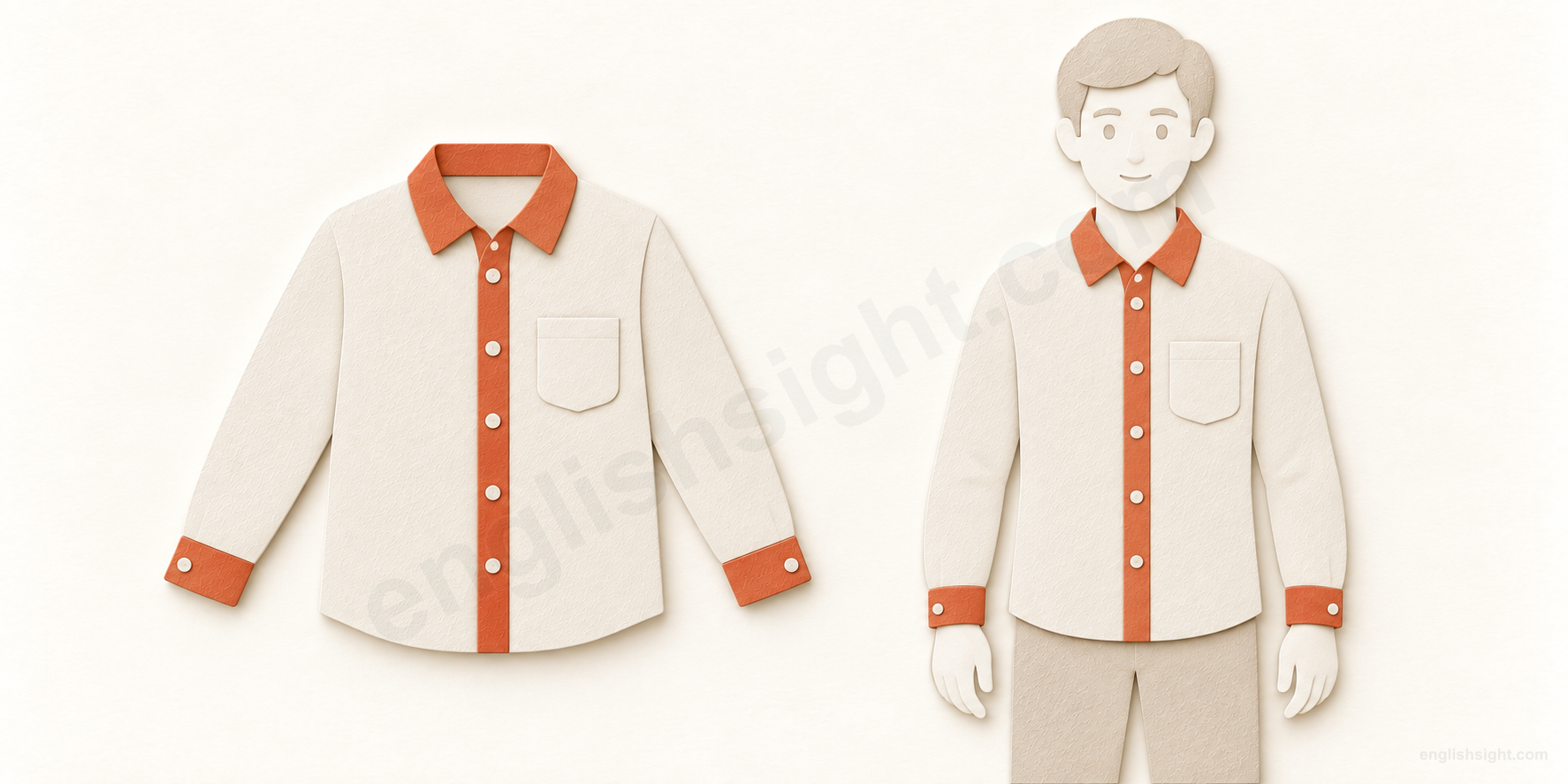
Name the clothing, describe how it is worn, and recognize expressions that go beyond clothes.
Cloth shaped to fit the upper body
Cloth shaped to fit the upper body
The unworn shirt on the left has a body section and two sleeves.
shirt
On the right, a person wears the matching design over the torso and arms.
The collar sits around the neck, and each sleeve ends at a wrist.
A shirt covers the upper body; the collar and buttons belong to this design.
A shirt is a garment shaped to cover the upper body, typically with openings for the head and arms; many designs have a collar and a front fastening.
The picture anchors the clothing meaning. It does not make buttons compulsory for every type, and it does not predict the meanings of the idioms.
A shirt is something you can choose, put on, button, wash, and pack. Begin with the garment itself, then notice what the surrounding words add.
A collar and a front fastening are familiar features, but shirt also appears in names such as T-shirt and football shirt. Fixed expressions like lose your shirt need to be learned as complete expressions.
01
Recognize and choose a shirt
Start with the garment, then use descriptions, parts, and specific names to say exactly what you mean.
01
a / the / possessive + shirt; number + shirts
a shirt / two shirts
an individual garment for the upper body
Situation or starting point
You need something to wear above your trousers.
Meaning in context
You choose one shirt.
Shirt names a garment; it does not name the act of dressing.
Shirt is a countable noun: a shirt, my shirt, two shirts. One shirt is one item, even though it usually has two sleeves. Say a shirt, not a pair of shirts, when you mean one garment.
A familiar example has a collar and fastens down the front. The word also occurs in names for other designs. It is not restricted to clothing for men.
In a sentence
I packed two shirts for the weekend.
Watch the difference Clothes is a general plural word. A shirt identifies one kind of clothing; a clothes is not standard English.
02
a + description + shirt; a shirt with + feature
a short-sleeved cotton shirt
describe a shirt’s material, pattern, or design
Situation or starting point
A shop has several shirts in your size.
Meaning in context
You specify the design you want.
Descriptions narrow down which garment you mean.
A cotton shirt tells us the material; a striped shirt tells us the pattern. Long-sleeved and short-sleeved describe how much of the arms the sleeves cover.
Use short sleeves as a noun phrase, but short-sleeved before shirt: a shirt with short sleeves, a short-sleeved shirt. Sleeved describes the garment, not the length of the wearer’s arms.
In a sentence
Do you have a short-sleeved cotton shirt in blue?
Watch the difference Say a short-sleeved shirt, not a short-sleeve person. Material names can modify shirt directly: a cotton shirt.
03
shirt + pocket / collar / cuff / button; the + part + of + a shirt
a shirt collar / a shirt pocket
name a part belonging to a shirt
Situation or starting point
You need to say where a pen is.
Meaning in context
You identify the pocket on the garment.
Shirt can modify another noun to identify the kind of part.
In shirt pocket, pocket is the main noun and shirt says what it belongs to. A shirt collar is around the neck; shirt cuffs are at the ends of long sleeves.
Compare the collar of my shirt and my shirt collar. Both identify the same part. The first noun normally stays singular in a compound: shirt buttons, even when you are talking about several buttons.
In a sentence
There is a spare button in the shirt pocket.
Watch the difference A shirt sleeve is part of a garment, not a separate shirt. Pluralize the main noun: shirt pockets.
04
a T-shirt; a polo shirt
a T-shirt / a polo shirt
distinguish familiar casual shirt designs
Situation or starting point
You want comfortable casual clothing.
Meaning in context
You select a specific kind of shirt.
The full name identifies the design more precisely than shirt alone.
A T-shirt usually pulls over the head and has no collar. Short sleeves are familiar, but long-sleeved T-shirts exist too.
A polo shirt has a collar and a short opening with a few buttons near the neck, rather than the full opening of a typical buttoned shirt. You do not have to play polo to wear one.
Both names contain shirt, but their designs differ. Use the specific name when the difference matters; do not assume that every shirt has buttons all the way down.
In a sentence
I wore a T-shirt yesterday and a polo shirt today.
Watch the difference T-shirt does not mean every short-sleeved shirt. A short-sleeved shirt can have a collar and a full front opening.
05
a dress shirt; a shirt and tie
a dress shirt
name a shirt suitable for smart or formal clothing
Situation or starting point
An invitation calls for smart clothes.
Meaning in context
You choose the appropriate shirt.
Dress modifies the kind of shirt; it is not a verb here.
In North American English, a dress shirt can be a smart long-sleeved shirt suitable for wearing with a tie. It need not be white.
The term also has a narrower formalwear meaning: a white shirt worn with a suit and bow tie. Check the occasion and local usage rather than assuming every dress shirt is a special evening shirt.
In a sentence
He bought a pale blue dress shirt to wear with his suit.
Watch the difference A dress shirt is a kind of shirt, not a dress. The whole compound names one garment.
02
Wear, adjust, and identify clothing
The surrounding verb or phrase supplies the action or clothing state. Shirt continues to name the garment.
06
wear / have on / be in + a shirt; put a shirt on; take a shirt off
wear / put on / take off a shirt
distinguish having a shirt on from changing that state
Situation or starting point
The shirt is beside you.
Meaning in context
After you put it on, you are wearing it.
The verb supplies the state or action; shirt remains the garment.
Wear a shirt, have a shirt on, and be in a shirt describe clothing already on the body. The woman in the green shirt identifies someone by what she is wearing.
Put on a shirt describes getting it onto your body. Take off a shirt reverses that action. You can put your shirt on or put on your shirt; with it, say put it on and take it off.
Compare She is wearing a shirt, a current state, with She is putting on a shirt, an action in progress. Shirt itself is a noun in all these patterns.
In a sentence
I put on a clean shirt, and now I am wearing it.
Watch the difference Put it on, not put on it. Do not use wear to mean the moment of putting clothes on.
Button your shirt and button up your shirt both mean fasten its buttons; up can emphasize fastening it fully. It does not mean the action has already finished: She is buttoning up her shirt describes an action in progress. Unbutton your shirt means undo the buttons; you can still be wearing it afterward.
Button your shirt up and button it up are also possible. In these clothing phrases, shirt is the object of the verb button; it has not become a verb itself.
In a sentence
Please button up your shirt before the photograph.
Watch the difference Unbuttoning a shirt opens its fastening; taking it off removes the garment. These are different actions.
08
tuck a shirt in / into + trousers; roll up + shirt sleeves
tuck in a shirt / roll up shirt sleeves
adjust where the hem and sleeves sit
Situation or starting point
The hem hangs loose and your sleeves reach your wrists.
Meaning in context
You place the hem inside the waistband and shorten the sleeves by folding.
In and up describe different adjustments to different parts.
Tuck your shirt into your trousers means push its lower edge inside the waistband. Tuck your shirt in is the shorter pattern; with a pronoun, say tuck it in. Leave your shirt untucked means leave that edge hanging outside.
Roll up your shirt sleeves means fold them back repeatedly so they cover less of your arms. It does not mean put on a shirt. The separate expression roll up your sleeves can also mean prepare to work; that figurative meaning belongs to the whole phrase, not to shirt.
In a sentence
She tucked her shirt in and rolled up her shirt sleeves before washing the dishes.
Watch the difference Tuck the hem in; roll the sleeves up. Do not treat in and up as interchangeable instructions.
09
a football / team shirt; a player’s shirt number
a football shirt / a shirt number
refer to a team’s upper-body sports garment
Situation or starting point
You want to show support for your team.
Meaning in context
You wear its team shirt.
A sports shirt can identify a team or player without a buttoned front.
A football shirt is the top associated with a football team, worn by players or supporters. In this context, shirt does not require a collar or full front fastening.
A player’s shirt number is the number displayed on the garment and associated with that player in the team. It is not the clothing size; number nine and size medium answer different questions.
In a sentence
Her favourite player’s shirt number is nine.
Watch the difference A shirt number identifies a player; a shirt size tells you whether the garment fits.
10
in + possessive + shirt sleeves / shirtsleeves
in your shirt sleeves
wearing a shirt without a coat or jacket over it
Situation or starting point
It is warm, so you remove your jacket.
Meaning in context
You remain in your shirt sleeves.
The expression concerns the missing outer layer, not missing sleeves.
In his shirt sleeves describes someone wearing a shirt without a jacket or coat over it. It can suggest informality or warm weather in a situation where an outer layer might be expected.
The written form in his shirtsleeves is also used. Neither spelling means sleeveless: a person in shirt sleeves may have long sleeves fully down.
In a sentence
The guests left their jackets inside and sat outside in their shirt sleeves.
Watch the difference In shirt sleeves does not mean wearing only detached sleeves, and it does not mean bare arms.
03
Read the whole expression
These established expressions concern impatience, money, generosity, or personality. Their meanings cannot be generated just by looking at the garment.
11
Keep your shirt on!
Keep your shirt on!
tell someone to stop being angry or impatient
Situation or starting point
Someone is impatient about a short delay.
Meaning in context
You tell them to calm down.
The whole expression gives an informal instruction about emotion.
Keep your shirt on! can mean stop getting so annoyed or impatient. In a conversation about a delay, the instruction is usually about the person’s reaction, not their clothes.
It can sound teasing or dismissive, especially when the listener has a serious concern. Please wait a moment is a gentler practical request. In an actual dressing situation, keep your shirt on can still be literal.
In a sentence
“Why is this taking so long?” “Keep your shirt on! I am nearly ready.”
Watch the difference Do not infer the idiom merely from keep + clothing. Learn the full phrase and use context to choose the meaning.
12
lose + possessive + shirt; lose your shirt on + venture
lose your shirt (on something)
lose all or a very large part of your money
Situation or starting point
Someone risks a large amount in a business deal.
Meaning in context
The deal fails and they lose heavily.
Shirt represents resources in an established financial expression.
Lose your shirt is an informal way to describe a very large financial loss, especially from a failed investment, business venture, or bet. The speaker may exaggerate; the person need not literally have no money left.
On can introduce the venture that caused the loss: lose your shirt on a deal. A missing garment after a trip is a different, literal use of lose your shirt.
In a sentence
He lost his shirt on a restaurant that closed after three months.
Watch the difference Lose your shirt describes a bad financial result; it does not simply mean spend a lot or forget where your shirt is.
13
put + possessive + shirt + on + person / outcome
put your shirt on somebody / something
bet or risk a great deal on a predicted winner or success
Situation or starting point
You are very sure a competitor will win.
Meaning in context
You consider staking a large amount on that outcome.
The idiom refers to a stake, while ordinary put on refers to dressing.
This informal, chiefly British expression means bet a great deal, potentially everything, on someone or something. It can also express strong confidence without reporting an actual bet.
Compare put your shirt on a horse, a betting expression, with put your shirt on, an instruction to dress. In I wouldn’t put my shirt on it, the speaker says they would not rely on that outcome strongly enough to stake everything.
In a sentence
The team looks strong, but I would not put my shirt on them winning.
Watch the difference This phrase expresses a risky stake or confidence, not a guarantee. The negative often signals caution rather than certainty of defeat.
14
give someone the shirt off your back; take the shirt off someone’s back
give someone the shirt off your back
give even what you need yourself; be extremely generous
Situation or starting point
Someone needs help, and you have little to spare.
Meaning in context
You are willing to give even essential possessions.
A basic item of clothing can stand for the last things a person has.
Saying someone would give you the shirt off their back praises extreme generosity. It need not describe an actual shirt or a completed gift; would often describes the person’s willingness.
The same image can describe exploitation when the verb changes: They would take the shirt off your back means they would take everything, even what you need. Giving willingly and being stripped of possessions have opposite interpersonal meanings.
In a sentence
My neighbour would give you the shirt off her back if you needed help.
Watch the difference Keep track of whose back: in She would give you the shirt off her back, she is the generous owner and you receive help.
15
be + a stuffed shirt; plural stuffed shirts
a stuffed shirt
a person criticized as too formal, serious, or old-fashioned
Situation or starting point
Someone dislikes a person’s rigid formality.
Meaning in context
They use an insulting description of that person.
The compound refers to a person, not a garment filled with material.
A stuffed shirt is an informal, disapproving label for someone whose manner seems excessively formal, serious, or old-fashioned. The judgment belongs to the speaker; it is not a neutral job title.
Use it as a countable noun: a stuffed shirt, a group of stuffed shirts. Calling someone this can be rude. The ordinary clothing picture is only a memory aid; the meaning is conventional.
In a sentence
I expected a stuffed shirt, but the director was relaxed and friendly.
Watch the difference Stuffed shirt does not mean every person who wears smart clothes, and it is not a neutral synonym for manager.
Keep the garment and the expression distinct
Count one garment correctly
Shirt is normally countable: a shirt, shirts. A pair of shirts is two shirts, not one. In shirt pocket, shirt modifies the main noun; it is still connected to the clothing meaning.
Features are typical, not universal
The pictured collar and buttons make one familiar design easy to recognize. T-shirts and sports shirts broaden the range. The name does not restrict the wearer’s gender.
Clothing state versus change
Wear and be in describe what is on someone. Put on, take off, button, and tuck describe actions affecting the shirt. These are constructions with other verbs, not phrasal verbs formed from shirt.
Register and scope
The idioms are informal; stuffed shirt is disapproving. Regional labels vary across dictionaries. The lesson covers modern clothing uses and selected established expressions, rather than every historical garment name or specialized compound.
Choose the intended meaning
Use the situation and the whole expression, not shirt alone.
1. You need one garment to wear above your trousers. Which request names one shirt?
2. The shirt is beside you. You want someone to get dressed in it. Which instruction fits?
3. Someone is in his shirt sleeves at a meeting. What does this expression tell you?
4. A failed business deal cost Mara nearly all her savings. Which sentence uses the money idiom?
5. A friend says Keep your shirt on! when you complain about waiting. What is the likely message?
6. Someone says Mina would give you the shirt off her back. What quality is being praised?
Sources and teaching notes
The linked dictionary entries support the uses and regional notes. Explanations and examples are original; the clothing sketch is a teaching aid.
The picture anchors a familiar clothing design; speakers need not share one mental picture.