A covering for a foot—and expressions about its wearer.
Start with the foot, the fitted covering, and the sole; then learn the phrases that move beyond footwear.
A foot, its covering, and the sole
A fitted covering between foot and ground
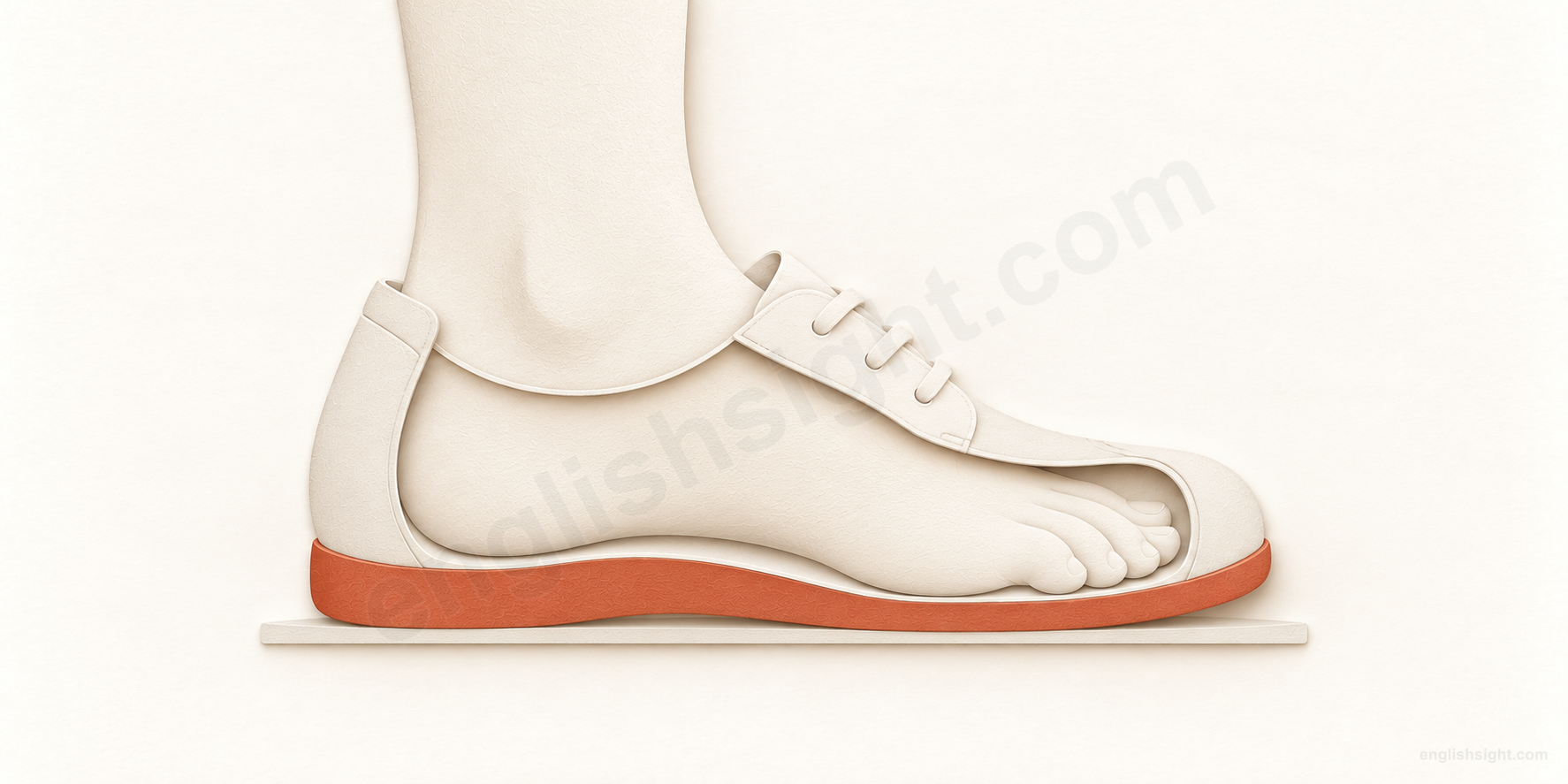
The foot is visible inside the cutaway.
shoe
The sole separates the foot from the ground.
The upper fits around the foot.
The upper surrounds the foot; the sole lies between foot and ground.
A shoe fits around a foot, with a sole beneath it that separates the foot from the ground.
The cutaway sketch makes the enclosed foot visible to explain the fit and protective layer. It illustrates the physical starting point; figurative expressions need their own explanations.
A shoe is a countable object worn on a foot. The physical relationship is useful: an outer covering fits around the foot, with a sole beneath it. Shoes usually come as a matching pair.
English also uses shoe for a horse’s protective fitting and as a verb for fitting it. Expressions about people’s shoes can refer to their circumstances or responsibilities. These are established uses, not meanings you can predict from the drawing alone.
01
Shoes in everyday life
Count shoes, describe them, and choose verbs for putting them on, wearing them, and looking after them.
01
a shoe; shoes; a pair of shoes; two pairs of shoes
a shoe / a pair of shoes
one foot covering or a matching set of two
Situation
One shoe is under the bed; the other is by the door.
What this expresses
You find both and have a complete pair.
Shoe counts individual objects; pair counts sets of two.
A shoe covers a foot and has a sole underneath. One shoe is one object, not automatically a whole pair. Use shoes for two or more: These shoes are wet.
A pair of shoes has a singular head noun, pair: This pair is wet. Two pairs means four shoes in two matching sets. Shoes itself is an ordinary count noun, so a shoe and three shoes are both possible.
In a sentence
One shoe is missing from this pair.
Watch the difference Say a pair of shoes, not a pair of shoe; footwear is the broader uncountable category.
02
put on / take off + shoes; put / take + them + on / off; wear shoes; have shoes on
put on / wear / take off your shoes
distinguish dressing actions from the state of being dressed
Situation
Your shoes are beside the door.
What this expresses
You put them on and then wear them outside.
The action comes from put on or take off; shoe names the object.
Put on your shoes describes getting them onto your feet. Wear shoes and have your shoes on describe the resulting state. Take off your shoes describes removing them.
These are patterns with put, wear, have, and take, not phrasal verbs headed by shoe. With a pronoun, say put them on and take them off. With the noun, put your shoes on and put on your shoes are both natural.
Slip your shoes on suggests putting them on quickly or easily; kick your shoes off suggests removing them with a kicking movement. These specify how you dress or undress, rather than adding senses to shoe.
In a sentence
Please take your shoes off before you come in.
Watch the difference I am wearing shoes describes the present state; I am putting on shoes describes the action.
03
shoe size; shoes fit + person; shoes are too tight / too big; try shoes on
shoe size / these shoes fit
ask for footwear that is the right size
Situation
The first pair feels too small.
What this expresses
You ask for a larger size and try another pair.
Fit describes how the shoes match the feet, not simply their size label.
What’s your shoe size? asks for a size category. Shoe stays singular before size. In These shoes fit me, the shoes are the subject and me is the person they fit.
These shoes are too tight and These shoes pinch describe pressure or discomfort. A pair can have your usual size label without fitting your feet well: fit concerns both size and shape. Try the shoes on means put them on briefly to check how they fit or look.
In a sentence
These shoes are my usual size, but they pinch at the toes.
Watch the difference Use These shoes fit me, not I fit these shoes, when saying the shoes are the right size for you.
describe purpose, material, or a footwear-related place
Situation
You need footwear for long walks.
What this expresses
You choose walking shoes rather than a dressier pair.
Words around shoe narrow the kind or identify something related to shoes.
Walking shoes and running shoes name footwear suited to particular activities. Leather shoes names the material. Comfortable shoes evaluates how they feel. These descriptions can combine: comfortable leather shoes.
Shoe shop, shoe polish, and shoe size use singular shoe before another noun. The head noun tells you whether you mean a shop, a cleaning product, or a size. Shoe is not made into a new verb by being used this way.
Footwear includes shoes, boots, sandals, and other types. When contrasting styles, shoe often means the lower style as opposed to a boot, which covers more of the ankle or leg. Specific names are useful when that distinction matters.
In a sentence
I bought some walking shoes at the shoe shop.
Watch the difference Keep shoe singular in shoe shop even though the shop sells many shoes.
05
tie / polish + shoes; break in + new shoes; break them in; have shoes resoled
tie / polish / break in your shoes
fasten, clean, or make footwear more comfortable through use
Situation
A new pair feels stiff, and the laces are loose.
What this expresses
You tie the laces and wear the shoes gradually.
These actions are supplied by the accompanying verb, not separate senses of shoe.
Tie your shoes normally means fasten their laces. Tie your shoelaces states the object more precisely; not every type of shoe has laces. Polish your shoes means clean or shine them with polish.
Break in new shoes means wear them until they become more flexible and comfortable. With a pronoun, say break them in. The verb phrase is break in; shoes is its object. A sole is the bottom part, while a heel is the raised back part. Have shoes resoled means arrange for new soles to be fitted.
In a sentence
I’m breaking in these shoes before the trip.
Watch the difference Breaking shoes in is not the same as breaking them: it means making them comfortable through wear.
02
Protecting an animal’s feet
Shoe also names a horseshoe and the work of fitting one. This verb has a familiar irregular form.
06
a horse’s shoe; a horseshoe; lose a shoe
a horse’s shoe
a protective metal fitting for a hoof
Situation
A horse’s hoof needs a protective fitting.
What this expresses
A curved metal shoe is attached beneath it.
A horse’s shoe protects the hoof; it does not enclose a human foot.
In a horse-related context, shoe can mean horseshoe, the curved metal piece fitted beneath a hoof. It is countable: a shoe, two shoes. Calling it a horseshoe makes the meaning clear without context.
The connection with ordinary footwear is protection at the foot. This is a related object sense, not an instruction to put a person’s leather shoe on an animal.
In a sentence
The horse lost a shoe on the trail.
Watch the difference In this context a lost shoe is a horseshoe, not a rider’s shoe.
07
shoe + horse; shoe / shoes / shod / shoeing; be shod; have + horse + shod
shoe a horse / have a horse shod
fit a horse with horseshoes
Situation
The farrier prepares the horse’s feet.
What this expresses
The horse has horseshoes fitted.
As a verb, shoe takes the horse as its object.
A farrier shoes horses as part of caring for their feet. Shoe is transitive here. The usual past tense and past participle are shod: The farrier shod the horse; the horse was shod yesterday. Shoed is also recorded in dictionaries.
The -ing form keeps the e: shoeing. Have a horse shod means arrange for someone to do this work. For everyday human dressing, say put your shoes on; shoe yourself is not the ordinary equivalent.
In a sentence
We had the horse shod before the long ride.
Watch the difference Shod is the past form of shoe, not the past form of the verb show.
03
People’s situations and responsibilities
Several established expressions use shoes to stand for the situation or role of their wearer.
08
be in + possessive + shoes; if I were in your shoes, I would + verb
be in someone’s shoes / if I were in your shoes
be in another person’s situation, or give advice from that position
Situation
A friend must choose between two difficult options.
What this expresses
You consider what you would do in that situation.
The imagined wearer stands for a person with particular circumstances.
Be in someone’s shoes means be in that person’s position or situation, often a difficult one. I wouldn’t want to be in his shoes expresses sympathy or concern, not a dislike of his footwear.
If I were in your shoes, I would… introduces advice by imagining the listener’s circumstances. Were is a standard form in this hypothetical pattern. The idiom uses plural shoes and a possessive: her shoes, your shoes, Daniel’s shoes.
In a sentence
If I were in your shoes, I’d ask for more time.
Watch the difference In your shoes can also be literal; use the surrounding situation to decide.
09
put + myself / yourself / ourselves + in + possessive + shoes
put yourself in someone’s shoes
imagine another person’s experience before judging
Situation
You are annoyed that a colleague needs help.
What this expresses
You imagine handling the same workload yourself.
Put yourself asks for a change of viewpoint, not an actual transfer of shoes.
Put yourself in her shoes invites deliberate empathy: consider her pressures, choices, or feelings. Be in her shoes describes a position; put yourself in her shoes asks you to imagine it.
The reflexive must match the person: I put myself in his shoes; try to put yourself in his shoes. This is a fixed figurative expression, not shoe followed by a particle.
In a sentence
Put yourself in Maya’s shoes before you criticize her.
Watch the difference Keep the reflexive: put yourself in her shoes, not put you in her shoes, for this invitation to empathize.
10
step into + possessive + shoes; fill + possessive + shoes; have big shoes to fill
fill / step into someone’s shoes
replace a person in their work or role
Situation
An experienced team leader leaves.
What this expresses
Another person takes over the responsibilities.
The role belongs to the previous wearer; replacing them may be demanding.
Step into someone’s shoes emphasizes taking over their position or continuing their work. Fill someone’s shoes emphasizes doing the role adequately. Their uses overlap; they are not a strict contrast in every context. Fill somebody’s boots is a variant for replacing them in a role.
She has big shoes to fill means the previous person set a high standard. It does not describe anyone’s physical shoe size. Keep the possessive or the established big shoes to fill wording, rather than inventing a new literal shoe action.
In a sentence
When our coach retires, someone will have big shoes to fill.
Watch the difference Fill her shoes concerns replacing her in a role; put yourself in her shoes concerns understanding her situation.
04
Fixed expressions beyond footwear
Learn these expressions as wholes. Their meanings depend on convention and context, not on the physical shoe alone.
11
the shoe is on the other foot; the boot is on the other foot
the shoe is on the other foot
the positions of advantage or authority have reversed
Situation
You once assessed another person’s work.
What this expresses
That person now assesses yours.
The whole expression describes a reversal between the people involved.
This idiom is especially associated with North American English; British English also uses the boot is on the other foot. The former subordinate, critic, or person at a disadvantage may now have the stronger position.
The other foot supplies the image of reversal, but the idiomatic meaning is learned as a whole. It does not mean that any event has simply changed or that someone put a shoe on incorrectly.
In a sentence
I used to review her work; now the shoe is on the other foot.
Watch the difference Do not confuse a reversal of positions with merely understanding someone else’s position.
12
if the shoe fits (, wear it)
if the shoe fits (, wear it)
accept a remark if it applies to you
Situation
Someone makes a general criticism.
What this expresses
A listener objects as though the criticism is personal.
Fit here means that the description applies to the listener.
If the shoe fits, wear it suggests that a person should accept a criticism that describes them. It can be teasing or pointed. It is not a gentle expression of empathy, and it can sound confrontational.
This is chiefly North American wording. British English also uses if the cap fits, wear it. In a shoe shop the same words could be literal, so the context matters.
In a sentence
“Are you saying I never listen?” “If the shoe fits…”
Watch the difference The idiom does not offer fashion advice; it challenges someone to accept an applicable criticism.
13
wait for the other shoe to drop; the other shoe dropped
wait for the other shoe to drop
expect a further event that seems bound to happen
Situation
One worrying announcement has been made.
What this expresses
You remain tense while expecting the next development.
The second shoe suggests an anticipated next event, often an unwelcome one.
The expression describes waiting for an expected follow-up, often with anxiety. After a first problem, a person may feel that more trouble is coming. The event feels likely to that person; the idiom does not prove that it will occur.
The other shoe dropped means the anticipated development happened. Learn the full phrase: this meaning cannot be recovered from the noun shoe alone. It is especially associated with American English.
In a sentence
After the first round of cuts, the staff waited for the other shoe to drop.
Watch the difference This is about expecting a next event, not about taking over someone’s job.
14
shake in + possessive + shoes / boots
shake in your shoes
be very frightened or nervous
Situation
You face a situation that scares you.
What this expresses
You feel intensely nervous.
The image is bodily trembling; the established phrase expresses fear.
Shake in your shoes is informal and vivid. Shake in your boots is another established form. The phrase can describe real fear, exaggeration, or ironic mock fear.
Your shoes is part of the expression even if the person is not literally wearing shoes. The shoes themselves are not the ones feeling afraid.
In a sentence
I was shaking in my shoes before the audition.
Watch the difference This expression means fear, not being cold, unless the context is explicitly literal.
15
know / see + where the shoe pinches
where the shoe pinches
the point that causes trouble or worry
Situation
A plan looks workable, but one part creates difficulties.
What this expresses
You identify the real source of the problem.
Physical pressure provides an image for a troublesome point.
Know or see where the shoe pinches means understand the source of difficulty. This figurative phrase is useful to recognize, but for plain everyday explanations, the main problem is… is often simpler.
Compare These shoes pinch my toes: that can describe literal painful pressure. In the idiom, where introduces the troublesome point in a situation, rather than a place inside actual footwear.
In a sentence
The schedule looks fine, but the travel costs are where the shoe pinches.
Watch the difference Do not read this as a shoe-size complaint when the speaker is discussing a plan or budget.
Keep the object, the verb, and the idiom distinct
Sound and forms
Shoe is pronounced /ʃuː/; shoes is /ʃuːz/. The written oe is not pronounced as two separate vowel sounds. The noun plural is shoes. The verb normally has shod as its past tense and past participle; shoeing keeps the e.
Wear, not normally shoe, for people getting dressed
For everyday routines use put on your shoes, wear shoes, and take your shoes off. The verb shoe is especially useful with horses. Be shod in can also describe a person wearing a particular kind of footwear, but that wording is more literary or formal than wear.
A model with boundaries
Footwear can help you remember a wearer’s position or role, but the full idioms are conventional. Nothing in the physical shoe guarantees that a phrase will mean empathy, criticism, fear, or an expected event.
Scope
This lesson covers ordinary footwear, practical collocations, the horse-related noun and verb, and selected established idioms. Mechanical brake shoes, camera accessory shoes, card-dealing shoes, and other specialist objects are outside the main lesson. Separate words such as shoestring and shoehorn need their own explanations.
Choose what the whole expression means
Use the situation and the construction to choose the answer.
1. A box contains two matching shoes. Which description counts the set correctly?
2. Your shoes are already on your feet. Which sentence describes the state?
3. You want a friend to imagine a colleague’s difficult circumstances. Which expression fits?
4. A respected coach is leaving. The replacement will need to meet a high standard. Which expression fits?
5. A farrier fitted horseshoes yesterday. Which sentence uses the usual past form?
Sources and teaching notes
The linked dictionaries support the senses and expressions. The explanations and examples are original, and the cutaway is a teaching model. The coverage inventory records specific source locations and exclusions.
The diagram illustrates a physical relationship; it does not claim that every English speaker imagines the same picture.