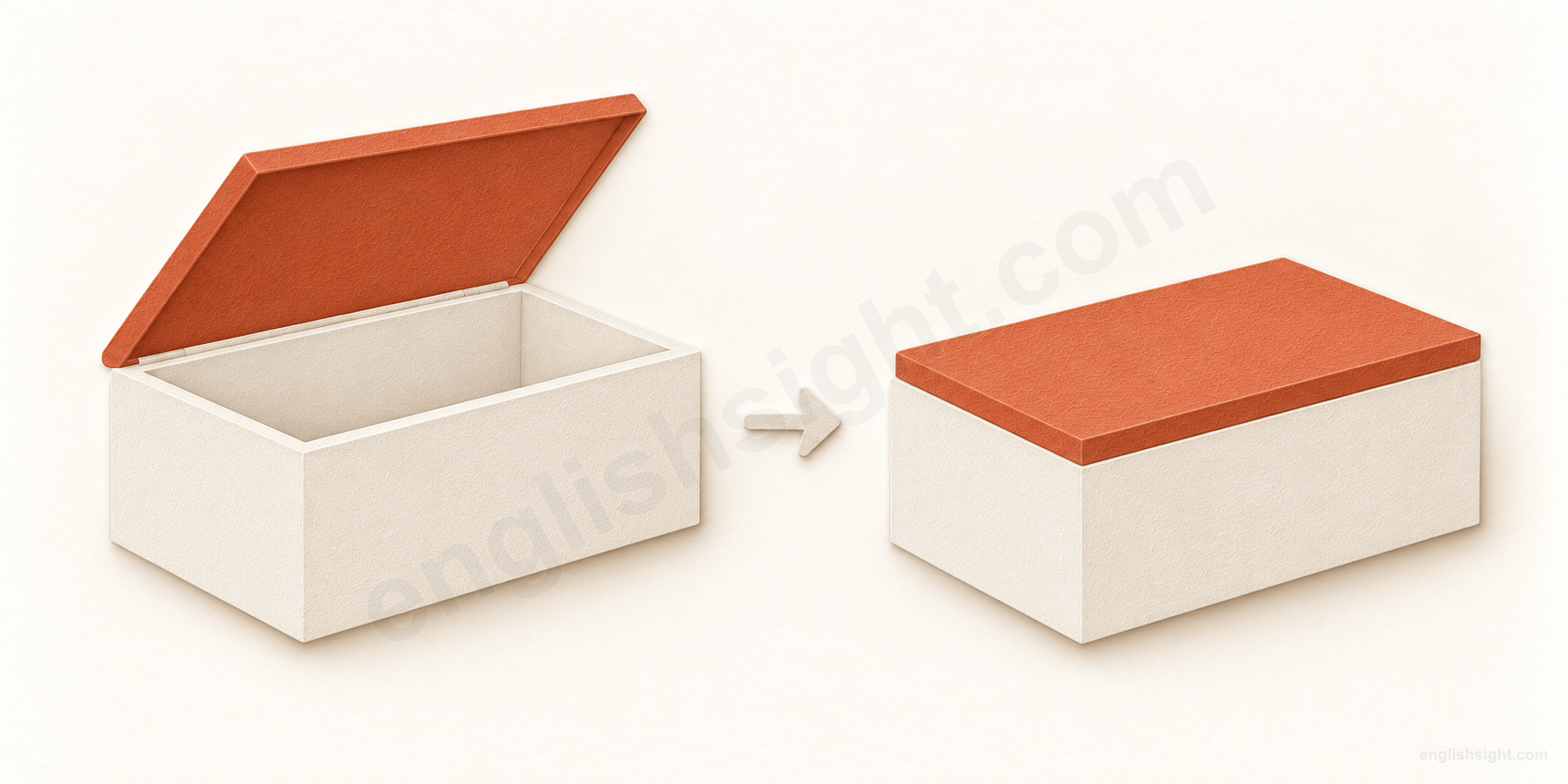
From a closed opening to stopped operations, blocked access, and withheld speech.
An opening becomes closed
An opening is no longer open
The lid is raised, leaving the box open.
shut
The lid covers the opening; the box is shut.
The lid moves down over the opening.
The same box goes from open to shut. Shut does not itself mean locked or closed with force.
Bring the open parts together so that the opening is no longer open.
The box illustrates physical closure. Stopping a system or excluding a person shares a useful connection with closing access, but each established expression needs its own grammar and context.
Shut often describes making or becoming closed. A door covers an opening; a book’s parts come together. From there, useful connections lead to stopping operation and blocking access or contact.
Particles and fixed phrases contribute their own meanings. This lesson offers a memory model supported by ordinary uses, not a claim that every English speaker pictures the same scene or that every phrase can be predicted from one image.
01
Close an opening, describe the result
Start with doors, containers, eyes, and mouths. The subject may cause closure, undergo it, or already be in the closed state.
01
shut + object
shut the door / a book
move something into a closed position
Situation before
A door leaves a doorway open.
State or outcome
You move the door across the opening.
The object is what you bring into a closed position.
In Shut the door, the subject causes the closure and the door is the object. Shut a box may mean closing its lid; shut a book means bringing its covers and pages together.
The useful connection is the loss of an open gap, not a particular pushing motion. You can pull a door shut. Shut does not itself say that you lock it or use force.
In a sentence
Please shut the cupboard after you take out a plate.
Watch the difference For ordinary devices, use turn off or shut off the television; shut the television is not the usual instruction.
02
shut + possessive + eyes / mouth
shut your eyes / mouth
bring eyelids or lips together
Situation before
Your eyes or mouth are open.
State or outcome
The relevant parts come together.
The body part closes; the context supplies the purpose.
Shut your eyes describes lowering your eyelids. Shut your mouth can literally describe bringing your lips together, for example during a dental examination.
Neither action automatically means sleeping or refusing to speak. However, Shut your mouth! used to a speaker is an insulting order to stop talking; tone and situation matter.
In a sentence
Maya shut her eyes while her friend counted to ten.
Watch the difference Say shut your eyes, not shut your sight. A literal description and a rude command can have the same words.
03
thing + shut; thing + will not / won’t shut
The door won’t shut.
become closed, or fail to close
Situation before
You try to close a drawer.
State or outcome
It catches before reaching its closed position.
With no object, the subject is the thing that closes.
The drawer shuts easily describes how the drawer moves. I shut the drawer describes what I do. An intransitive sentence does not require a human agent.
Won’t shut often reports a practical failure, such as a jam or an overfilled suitcase. It need not suggest that an object has a will. Doors can also shut automatically.
In a sentence
This drawer won’t shut because a spoon is caught at the back.
Watch the difference The window shut is an active intransitive clause; The window was shut by the caretaker is passive.
04
be / stay / remain shut; keep + object + shut
be / keep / stay shut
be closed or continue to be closed
Situation before
A window is already closed.
State or outcome
You leave it in that state.
Shut after be or keep describes a state.
The window is shut says it is not open. Keep the window shut asks someone to maintain that state; stay or remain shut says the state continues.
In everyday learner English, prefer a closed window before the noun and The window is shut after it. Shut before a noun does occur, but is less usual. Tightly shut describes how firmly the parts meet.
In a sentence
Keep the lid shut while you carry the box.
Watch the difference Has shut normally reports a completed event; is shut normally describes the resulting state.
05
verb + object + shut; object + verb + shut
push / blow / slam shut
reach the closed state through a particular action
Situation before
A door is open.
State or outcome
A gust moves it until the opening is closed.
The first verb gives the action; shut gives the result.
The wind blew the door shut combines a cause and a resulting state. The door blew shut leaves out an object because the door itself undergoes the change.
Push the door shut and slam the door shut share the result but describe different actions. Slam adds force and noise; shut alone does not. This is a result construction, not a phrasal verb called push shut.
In a sentence
A gust blew the kitchen door shut.
Watch the difference Compare push the door with push the door shut: the second explicitly states that closure is achieved.
06
business + shut; shut + business; business + be shut
The shop shuts at six.
stop being open for customers
Situation before
Customers can enter during the afternoon.
State or outcome
Trading ends for the day.
An institution can shut without a particular door being mentioned.
Shut can describe the end of business hours or a longer closure. We shut the café early has an object; The café shuts early does not. The café is shut describes its current availability.
This business use is especially British English. Close is a widely usable alternative. A time such as at six suggests a daily schedule; next year may introduce permanent closure, so shut alone does not settle the duration.
In a sentence
The village shop shuts at six on weekdays.
Watch the difference A shop that is shut is unavailable now; the sentence alone does not say it has gone out of business.
02
Stop a business, machine, or supply
Down highlights the ending or suspension of operation; off commonly marks equipment stopping or a supply being cut.
07
shut down; shut + business + down; shut down + business
shut down a factory
end or suspend an operation
Situation before
The factory is producing goods.
State or outcome
Production stops for an extended repair.
Down directs attention to operation stopping.
A business can shut down, or an authority or owner can shut it down. The passive is common when the cause matters: The plant was shut down for inspection.
Closure can be temporary or permanent. A café shutting at its usual evening hour is normally just closing; shut down often suggests a broader interruption or ending of the operation.
In a sentence
The company shut the plant down for a month of repairs.
Watch the difference With a pronoun, say shut it down, not shut down it. Down does not mean physical movement toward the ground.
08
shut down + machine / system; shut + it + down
shut down a computer
stop a machine or system from operating
Situation before
A computer is running.
State or outcome
Its operating session ends.
The same operation-ending expression applies to a system.
Shut down the computer and shut the computer down are both possible. The computer shut down describes the event without naming an agent; was shut down can present it as someone’s action.
For computers, shutting down commonly includes ending processes rather than simply cutting the electricity. Shutting a laptop’s lid is a physical action and does not necessarily shut its system down.
In a sentence
Save your work before you shut the computer down.
Watch the difference Shut down is a two-word verb; shutdown is the related noun, as in a planned shutdown.
09
shut off + equipment; shut + equipment + off; equipment + shut off
shut off the engine
stop equipment from working
Situation before
An engine is running.
State or outcome
You stop its operation.
Off marks the equipment becoming inactive.
You can shut off an engine or alarm, and a device may shut off by itself. Turn off is a common alternative for everyday electrical devices.
Shut off and shut down overlap with machinery. Shut off often highlights switching or cutting operation; shut down often concerns a whole operating system or process. Neither particle supplies one rule for every device.
In a sentence
The heater shuts off when the room reaches the set temperature.
Watch the difference Say shut it off with a pronoun. Do not use shut off as a general replacement for closing a book.
10
shut off + supply; shut + supply + off
shut off the water / gas
stop a supply from flowing
Situation before
Water is reaching the building.
State or outcome
The supply is interrupted.
The object is the supply being cut, not a door.
Shut off the water describes stopping its flow, for example at a valve. A supplier can also shut off a service. The house still exists; what stops is the supply reaching it.
This use extends the blocking connection to flow. Compare shut the tap, which describes closing the fitting, and shut off the water, which names the interrupted supply.
In a sentence
They shut off the water while they replaced the broken pipe.
Watch the difference The water was shut off reports interrupted supply; the water was shut is not the usual expression.
03
Keep inside, keep outside, cut contact
In, out, away, and off from identify different relationships. The object and context tell you whether the barrier is physical or social.
11
shut + person / thing + in + place; shut + oneself + in
shut someone in a room
keep someone inside by closing access
Situation before
A cat is in a room with the door open.
State or outcome
The door is closed, keeping the cat inside.
In places the affected person or thing on the inside.
Shut the cat in the kitchen means close access so that the cat cannot leave. Shut yourself in your room can describe choosing privacy. The reflexive identifies the subject as the person staying inside.
In can be followed directly by a place: shut him in the room. With no place stated, shut him in is possible. Compare shut him out, which prevents entry instead.
In a sentence
We shut the cat in the kitchen while the front door was open.
Watch the difference Say shut it in the room, not shut in it the room. Being shut in does not by itself identify a jail.
12
shut + body part / object + in + door / lid
shut a finger in the door
trap something by closing a door or lid on it
Situation before
A finger is in the gap beside an open door.
State or outcome
The door closes on it and traps it.
Here in identifies the closing gap where something is caught.
Shut your finger in a door means accidentally close the door on the finger, painfully trapping it. The same pattern can concern an object caught under a lid or in a closing door.
Compare shut the cat in the kitchen: the cat is enclosed in a room. With a finger in the door, the finger is caught between closing parts, not placed in a room. The nouns and physical situation select the reading.
In a sentence
I shut my finger in the car door while I was unloading the bags.
Watch the difference This sentence reports an accident; it does not mean you intentionally closed your finger like a book.
13
shut + object / oneself + away; shut away + noun
shut something / yourself away
keep out of view or withdraw to be alone
Situation before
Objects are on display, or a person is among others.
State or outcome
The objects are hidden away, or the person withdraws.
Away emphasizes separation from ordinary view or contact.
Shut something away means put it where people cannot see or find it. Shut someone away similarly means keep that person apart from others. Shut yourself away means go somewhere to be alone: She shut herself away to finish her essay.
Withdrawal may accompany sadness, but the expression does not itself diagnose a condition. Oxford includes working alone, whereas Collins highlights withdrawal associated with feeling depressed.
In a sentence
The letters were shut away in a drawer for years.
Watch the difference Keep the reflexive before away: shut herself away, not shut away herself.
14
shut up + building; shut + object + up; shut + someone + up in + place
shut up a house / shut someone up in a room
close a building or confine someone
Situation before
A holiday house is in use.
State or outcome
It is closed for the season.
The object determines which meaning of shut up is intended.
Shut up a house means close it, typically when leaving it unused. Shut someone up in a place means keep them there and prevent them from leaving.
Compare The cottage was shut up for winter with The dog was shut up in the shed. Neither is the conversational command to stop talking. Here up belongs to established closure or confinement expressions.
In a sentence
They shut the cottage up before returning to the city.
Watch the difference Shut her up without a place is usually understood as silence her; supply the place when you mean confinement.
15
be shut off from + noun; shut + oneself + off from + noun
be shut off from / shut yourself off
be separated from contact or access
Situation before
A village has contact with neighboring towns.
State or outcome
Heavy snow blocks that contact.
From identifies what the subject is separated from.
A place can be shut off from the outside world by a physical barrier. A person can shut themselves off from friends by avoiding contact. The barrier need not be a literal door.
Compare shut someone out of your life: that focuses on excluding them. Shut yourself off from others focuses on your own withdrawal. Both can describe social separation from different viewpoints.
In a sentence
Deep snow left the village shut off from the outside world.
Watch the difference In shut herself off from friends, from belongs before the group she avoids; off alone does not name that group.
16
shut out + noun; shut + object + out (of + place)
shut out the noise / shut someone out
prevent entry
Situation before
Noise enters through an open window.
State or outcome
A closed window reduces what gets inside.
Out identifies what is kept on the outside.
Shut out can concern people, light, cold, or sound. A physical barrier may prevent entry without anyone intentionally excluding someone: a window can shut out street noise.
Use shut someone out of a room when naming the place they cannot enter. If someone lacks a key, lock someone out specifically highlights locking; shut out does not require a lock.
In a sentence
Thick curtains shut out most of the morning light.
Watch the difference With a pronoun use shut it out or shut them out. Do not confuse out with in, which keeps the object inside.
17
shut + person + out of + activity / life
shut someone out of a decision
exclude someone from involvement
Situation before
Residents want to help plan a change.
State or outcome
The committee excludes them from discussions.
An activity can be treated as something people have access to.
Shut people out of a process means prevent them from participating. Shut someone out of your life means deny personal closeness or involvement, even without a physical barrier.
Compare shut the door: an object moves. In shut me out, the person is the excluded participant. The figurative connection concerns access, not a hidden door in every situation.
In a sentence
The committee shut local residents out of the planning process.
Watch the difference Use out of for the excluded activity: shut us out of the discussion, not shut us out from to discuss.
18
shut out + thought / feeling / memory; shut + it + out
shut out a memory
try to keep a thought or feeling from awareness
Situation before
A memory keeps returning.
State or outcome
Someone tries not to think about it.
The excluded object is mental content.
Shut out a thought, memory, or feeling means prevent or try to prevent yourself from attending to or experiencing it. The grammatical object is the unwanted mental content.
This differs from shutting another person out: one concerns your thoughts, the other their involvement. The expression can describe attempted or achieved exclusion from awareness; it does not mean that the memory has been erased.
In a sentence
He tried to shut out the memory and concentrate on the next task.
Watch the difference Do not interpret shut out a memory as deleting a stored computer file.
19
shut out + opponent; shut + opponent + out
shut out the other team
prevent an opponent from scoring
Situation before
Two teams play a match.
State or outcome
One team finishes with no points or goals.
Sports usage gives exclusion a precise scoring meaning.
In sports reporting, especially in North American usage, shut out an opponent means keep that opponent from scoring. A 2–1 win is not a shutout because both teams scored.
The opponent is the object: We shut them out. The related noun is one word, shutout. This scoring sense is an established specialization, not something you can predict from every use of out.
In a sentence
Our team shut the visitors out and won three–nil.
Watch the difference Do not use shut out merely to mean defeat: the losing side must fail to score in this sense.
04
Silence, secrecy, and surprise
These expressions concern communication. Learn their tone as well as their meaning: some are rude commands, while others report silence or express astonishment.
20
shut up; shut + person + up; shut up + noun
shut up / shut someone up
stop talking or make someone stop
Situation before
Someone continues talking.
State or outcome
They stop, or another person silences them.
Up forms an established expression about speech.
He finally shut up reports that he stopped talking; The announcement shut them up says it made them quiet. It can also concern an animal making noise: shut the dog up means make it stop barking or making other noise. The transitive expression is separable: shut the speaker up, shut up the speaker, but shut him up.
As a command, Shut up! is usually rude. Shut your mouth! and Shut your face! are also insulting commands. Could we have some quiet, please? is a more suitable general request.
In a sentence
Everyone shut up when the missing dog walked into the room.
Watch the difference Reporting that someone shut up is not the same as politely asking them to be quiet. Adding please need not remove the insult.
21
Shut up! + surprised reaction
“Shut up!” — surprise
express astonishment or disbelief
Situation before
A close friend shares unexpected good news.
State or outcome
You respond with excited surprise.
Here the exclamation need not ask for silence.
In very informal conversation, Shut up! can react to something astonishing, rather like No way! A delighted voice and continued interest help distinguish it from the rude order.
This is recognition vocabulary for a context-dependent use. It can easily be misunderstood, especially outside a familiar relationship; Really? is a less risky way to express surprise.
In a sentence
“I got the lead role!” “Shut up! That’s fantastic!”
Watch the difference Do not assume every Shut up! is friendly surprise. Context, relationship, and intonation decide the reading.
22
keep + possessive + mouth shut (about + noun)
keep your mouth shut about something
keep a secret or refrain from voicing an opinion
Situation before
You know about a surprise party.
State or outcome
You do not reveal the plan.
Keeping the mouth shut is a figurative way to describe withholding speech.
Keep your mouth shut about something commonly means do not reveal it. Without about, it can also mean say nothing or refrain from expressing an opinion: I disagreed but kept my mouth shut.
The expression is informal and may sound harsh when directed at another person. Please keep this confidential is a neutral request about a secret. It does not mean you must physically close your lips all day.
In a sentence
I promised to keep my mouth shut about the surprise party.
Watch the difference Keep my mouth shut reports continued silence; shut my mouth may describe just the physical movement.
05
Established expressions beyond a literal opening
Eyes, ears, doors, and shops occur in familiar figurative expressions. Read each complete phrase rather than calculating its meaning from shut alone.
23
shut + possessive + eyes to + noun
shut your eyes to a problem
deliberately ignore something that needs attention
Situation before
Evidence of a problem is available.
State or outcome
Someone refuses to acknowledge it.
To introduces what is knowingly ignored.
This idiom concerns a refusal to face facts, not the position of the eyelids. It often criticizes ignoring something that ought to be dealt with.
Shut your eyes physically may help you rest; shut your eyes to a problem describes avoidance even while you can see it. Close your eyes to has the same idiomatic pattern.
In a sentence
We cannot shut our eyes to the broken equipment any longer.
Watch the difference Use to plus the issue. Shut your eyes because of bright light is a literal action with a different structure.
24
shut + possessive + ears to + noun
shut your ears to advice
refuse to listen or pay attention
Situation before
Someone offers advice.
State or outcome
The listener rejects it without considering it.
The ears phrase describes refusal to attend.
Shut your ears to advice or criticism means refuse to listen to it. The words do not say the advice is correct; the speaker may criticize or approve the refusal depending on context.
You might hear the actual words perfectly and still shut your ears to them. Close your ears to is an alternative. The complete body-part idiom supplies the figurative meaning.
In a sentence
He shut his ears to our advice and bought the damaged car.
Watch the difference This is a refusal to listen, not an inability to hear caused by poor hearing.
25
shut the door on + noun / -ing form
shut the door on a possibility
rule out or greatly reduce an opportunity
Situation before
Further talks are still possible.
State or outcome
A decision removes that possibility.
A closed door models lost access to a future option.
Shut the door on something means make it unlikely or impossible, or refuse to consider it. A negative form can preserve an option: We haven’t shut the door on a compromise.
The object after on is the option or prospect. No physical door is required. Close the door on is an alternative; the full phrase, rather than shut alone, carries this established metaphor.
In a sentence
The new deadline shuts the door on applying this year.
Watch the difference Distinguish shutting the door on an opportunity from shutting someone out of a room or group.
26
shut the door in + person’s + face
shut the door in someone’s face
close a door against someone or rudely reject them
Situation before
Someone seeks entry or a conversation.
State or outcome
They receive an abrupt refusal.
The phrase highlights an unfriendly rejection.
Literally, you shut the door hard when someone is trying to enter. Figuratively, you refuse to meet or talk to them in a rude way.
The phrase normally suggests discourtesy. It differs from shut the door on an option, which focuses on a lost possibility rather than how a person is treated.
In a sentence
I asked for a meeting, but the manager shut the door in my face.
Watch the difference A figurative refusal does not prove that an actual door moved. Read the situation.
27
can / could + verb + with + possessive + eyes shut
do something with your eyes shut
do something very easily because it is familiar
Situation before
You have repeated a task many times.
State or outcome
You feel it needs almost no thought.
Closed eyes are an exaggeration of ease.
I could do it with my eyes shut means the task is so familiar that it feels effortless. It is usually figurative, rather than a report that you actually close your eyes.
The expression does not advise ignoring safety. Compare shut your eyes to a problem: that means avoid recognizing it, whereas with your eyes shut comments on ability or familiarity.
In a sentence
I’ve assembled this model so often I could do it with my eyes shut.
Watch the difference The phrase with your eyes shut can also be literal. The claim about great ease depends on context.
28
shut up shop (for the day / for good)
shut up shop
finish work for the day or cease business
Situation before
A business is trading.
State or outcome
It closes, temporarily or permanently.
The whole fixed expression concerns ending business.
Shut up shop is an informal expression especially associated with British English. It may mean finish for the day or stop trading permanently; a phrase such as for good makes the permanent reading clear.
The idiom normally has no article before shop, and can be used of an office or firm. Compare shut the shop up, a separable construction referring to closing a particular shop building.
In a sentence
We shut up shop early on Friday and went home.
Watch the difference Do not interpret up shop as an instruction telling a shop to stop talking.
29
put up or shut up
put up or shut up
back your words with action or stop making the claim
Situation before
Someone repeatedly claims that they can do a task better.
State or outcome
Another person challenges them to demonstrate it.
The whole phrase challenges someone to act instead of just talking.
Put up or shut up tells someone to do or demonstrate what they have been talking about, rather than continue making unsupported claims. Here put up concerns producing action or evidence; it is not a literal instruction to put an object above you.
The phrase can sound confrontational and is especially associated with British English in Oxford’s entry. It is useful to recognize, but Could you show us how? is a more neutral request for a demonstration.
In a sentence
After Leo kept saying he could repair it faster, Nina told him to put up or shut up.
Watch the difference Learn the full phrase. Shut up supplies the stop-talking alternative; shut alone does not mean prove your claim.
Choose the whole construction
Forms and pronunciation
Shut /ʃʌt/ has the same base, past, and past-participle form: shut, shut, shut. Use shuts for he/she/it and shutting with double t. I shut it yesterday is past; I have shut it is perfect. Avoid shutted.
Action, state, and cause
The gate shut is intransitive; I shut the gate is transitive; The gate was shut by staff is passive. The gate is shut normally describes a state. Get the gate shut can request achieving that result, while get someone to shut it asks them to act. Make someone shut it uses the bare verb. Not every be + shut sentence foregrounds an agent.
Shut and close overlap, but not everywhere
Both work with doors, books, and eyes. Use close, not shut, for many conventional abstractions such as close an account or close a meeting. Use shut off / turn off for equipment and supplies, and shut down for systems and operations. Particles are meaningful parts of established expressions, not interchangeable decorations.
Scope and model limits
This course covers the modern verb, its everyday closed-state adjective, main particle expressions, and familiar idioms. Rare nouns relating to the act of closing or welded metal, specialist phonetics, historical senses, and separate compounds such as shut-eye and open-and-shut are not expanded. The box is a teaching aid; it does not explain every idiom by itself.
Read the object, particle, and situation
Choose the expression or interpretation that fits the clues.
1. The lid is already closed, and you want it to remain that way during the journey. Which instruction fits?
2. You have finished using the computer. Which pronoun order is standard?
3. The cat is inside the kitchen. You close the door to keep it there. What did you do?
4. A plumber stops the water supply during a repair. Which sentence fits?
5. The home team wins 4–1. Did it shut the visitors out?
6. The managers know about a serious fault but deliberately ignore it. Which expression describes this?
7. A close friend smiles and exclaims “Shut up! That’s wonderful!” after unexpected good news. What is the likely reading?
Sources and teaching notes
Meanings and constructions were checked against the dictionary pages below. Explanations and examples are original; the visual connection is a teaching interpretation.
The diagram is a learning aid, not a picture shared by every native speaker.