A metal, its appearance, and familiar expressions.
Separate what something is made of from what it looks like.
A metal and a color name
Material and resemblance
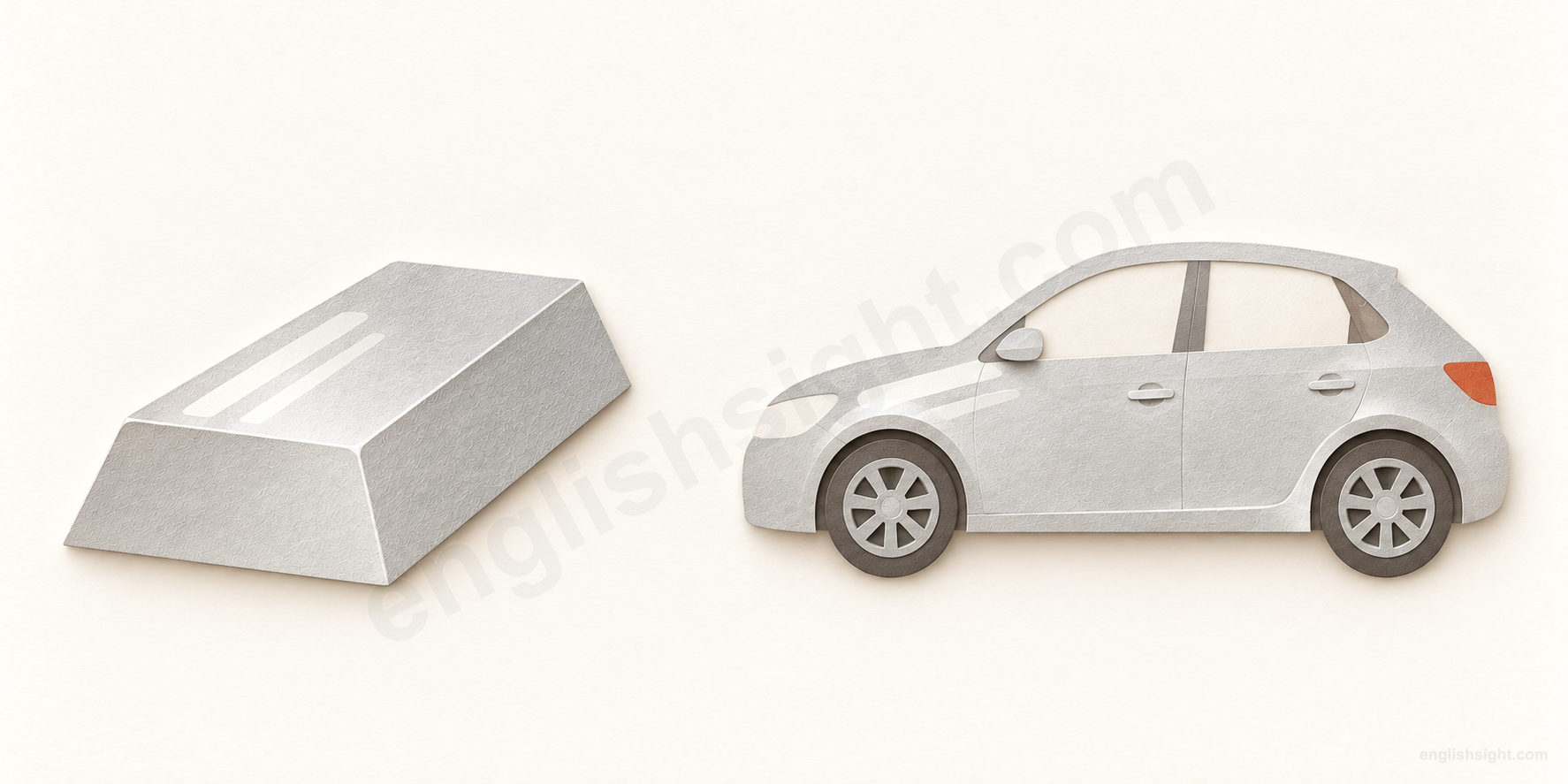
The ingot represents silver as a metal.
silver
The car represents silver as a color.
The matching grey-white appearance connects the metal and color uses.
Similar appearance links the metal and color uses; it does not establish the car’s material.
Silver names a metal; its appearance also names a bright grey-white color.
A silver-colored car need not contain silver. Medals, anniversaries, and idioms require their own conventions; the appearance model does not predict them.
Silver names a metal and a color associated with it. Context can also point to household objects, coins, or a medal. Learn to ask which meaning the sentence needs.
Fixed expressions bring their own meanings. The comparison in the sketch is a learning aid, not a claim that every English speaker imagines the same picture.
01
Material, coating, and color
Begin with what an object contains, then distinguish a similar appearance.
01
be made of silver; silver + object noun
made of silver
name the metal used to make something
Situation
A customer asks what a ring is made of.
What the expression conveys
The answer identifies its material.
Silver is the material; the ring is the countable object.
Silver is a metal used in jewelry and other objects. Made of silver identifies a material; worked in silver describes an artist’s medium. In a silver ring, silver modifies ring.
Treat the material as uncountable: some silver, a piece of silver, or ten grams of silver. Use rings or coins when counting individual objects.
In a sentence
The artist made a small pendant out of silver.
Watch the difference A silver usually does not mean a piece of the raw metal. The medal use is different.
02
solid / sterling silver; a silver-plated + noun
solid silver / sterling silver / silver-plated
distinguish material descriptions from a surface coating
Situation
Two similar-looking spoons have different product labels.
What the expression conveys
The labels describe different material claims.
A silver appearance alone does not establish what is underneath.
Solid silver contrasts with an object that only has a silver coating. Sterling silver names silver of a specified purity standard; it is not simply another way to say silver-colored.
Silver-plated describes a different metal covered with a thin layer of silver. Ask Is it solid silver or silver-plated? when the distinction matters. Solid silver need not mean chemically pure silver.
In a sentence
This spoon is silver-plated, not solid silver.
Watch the difference Do not infer the composition of an object from its color or from a photograph.
03
silver + noun; be / turn silver; a streak of silver
a silver car / silver hair
describe a bright grey-white appearance
Situation
You need to identify a car by its color.
What the expression conveys
You describe it as silver.
The color resembles the metal; the object need not contain it.
Silver as a color adjective can come before a noun or after be: a silver car; The car is silver. Silver hair describes its grey-white appearance, not its material.
The color can also be a noun: a streak of silver. Silvery emphasizes a similar sheen or color, as in silvery light. Neither word by itself proves that actual silver is present.
In a sentence
Look for the silver car beside the blue van.
Watch the difference Silver is a more specific color description than grey, but real surfaces need not look shiny in every light.
02
Objects, awards, changes, and anniversaries
Some uses name objects associated with the metal; others describe a surface change or follow a naming convention.
04
the / family silver; polish / clean the silver
polish the silver
refer collectively to household silver objects
Situation
A family is preparing special tableware for dinner.
What the expression conveys
Someone cleans the silver objects together.
The material name can stand for a collection of objects.
The silver can mean silver household articles, particularly dishes and eating utensils. Family silver can literally refer to such objects passed down in a family. Here polish acts on the objects, not on a color.
The related word silverware covers silver or silver-plated table articles. In North American English it also means ordinary knives, forks, and spoons, even when they are made of another metal.
In informal British sports reporting, silverware can also mean trophies: The club hopes to win some silverware this season. This does not specifically mean second place; compare win silver, which refers to a silver medal.
In a sentence
We polished the silver before setting the table.
Watch the difference Use a silver spoon for one object. The collective silver is normally uncountable.
05
silver as an uncountable noun; an amount in silver
pay in silver
refer to silver or silver-colored coins
Situation
A character in a story opens a purse of coins.
What the expression conveys
The payment is described as silver.
Silver may name coins by their material or appearance.
In silver can mean in silver or silver-colored coins. The coins need not all be made of the precious metal. This use is useful for recognizing older stories and some descriptions of money.
In an ordinary modern request, Do you have any coins? or Do you have any change? will often be clearer. In silver alone does not tell a listener which currency or denomination you mean.
In a sentence
In the story, the traveler pays the ferryman in silver.
Watch the difference For individual objects use silver coins, not three silvers in the material or coin sense.
06
win silver; win a silver medal; win + number + silvers
win silver / win two silvers
report a second-place medal result
Situation
An athlete finishes second in a medal event.
What the expression conveys
The report says that she won silver.
In medal language, silver identifies the award and placing.
Win silver is a familiar way to say win a silver medal. The uncountable form focuses on the award category. A silver or two silvers counts individual silver medals.
Compare She won silver in the final with She won the final. In the medal context, the first means second place; the second ordinarily means first place in that final. This is an established sports convention.
In a sentence
Our swimmers won two silvers on Saturday.
Watch the difference The countable medal use does not make the raw metal generally countable.
07
silver + object; be silvered
a silvered surface
describe applying a silver-like surface layer
Situation
A craft process coats an object’s surface.
What the expression conveys
The surface has a thin silver or silver-like layer.
The verb describes a surface treatment, not necessarily a solid silver object.
As a verb, silver can mean coat a surface with silver or a substance resembling it. It often occurs in the passive: the glass was silvered. The surface is the object that receives the coating.
Forms are silver, silvers, silvered, silvering. This is a technical or craft use rather than a necessary everyday substitute for coat. It has no common particle-verb family to memorize here.
In a sentence
The back of the glass was silvered to make a mirror.
Watch the difference A silvered object has been treated on its surface; it need not be silver all the way through.
08
light / age + silver + object; become silver
moonlight silvered the water
describe something becoming bright like silver
Situation
Moonlight falls on a dark stretch of water.
What the expression conveys
The water takes on a pale, reflective appearance.
Here silvering changes appearance rather than adding metal.
Literary writing uses silver as a verb for giving something a bright silver-like appearance. The cause may be light; no physical metal has to be applied.
Collins also records becoming silvery, including hair with age. In ordinary conversation, Her hair is turning grey or silver is usually a more direct choice than Her hair is silvering.
In a sentence
Moonlight silvered the water beyond the bridge.
Watch the difference Read the cause and context: the same verb can describe actual coating or only an appearance.
The number comes from a naming convention, not the color model.
A silver wedding anniversary marks twenty-five years of marriage. British English also uses silver wedding; silver anniversary is a usual American form.
Silver jubilee, especially in British English, marks twenty-five years since another important beginning, such as the founding of a school. It does not have to be a wedding. Learn the anniversary value with these expressions.
In a sentence
My parents are celebrating their silver wedding anniversary.
Watch the difference Silver does not mean twenty-five whenever it modifies a noun; this interpretation belongs to anniversary expressions.
03
Learn the whole expression
These phrases handle setbacks, privilege, effort, solutions, films, and persuasion. Their meanings cannot be calculated from the color alone.
10
a / the silver lining; a silver lining to something
a silver lining
find a positive aspect of an unwelcome situation
Situation
A course is cancelled, but you unexpectedly have time for another project.
What the expression conveys
You identify one benefit within the disappointment.
The benefit belongs to the same difficult situation.
A silver lining is a positive aspect or result of a bad situation. The familiar saying Every cloud has a silver lining offers an optimistic way to look at difficulty.
The image of brightness against a cloud can help you remember the expression; its meaning belongs to the full phrase. Finding a benefit does not mean that the whole event was good. In conversation, consider whether reassurance is welcome before using the saying.
In a sentence
The course was cancelled, but the silver lining was having more time to finish my project.
Watch the difference Keep lining in the expression. Silver alone does not mean a positive consequence.
11
be born with a silver spoon in + possessive + mouth
be born with a silver spoon in your mouth
describe inherited wealth and privilege
Situation
A person has wealthy parents and financial advantages from birth.
What the expression conveys
Someone comments on that privileged start.
Born points to family background rather than later earnings.
This idiom means being born into a rich, privileged family. The pronoun changes with the person: He was born with a silver spoon in his mouth; They were born with silver spoons in their mouths.
It often carries resentment or criticism, so it can sound judgmental. A literal silver spoon can suggest wealth as a memory aid, but the idiom is not about feeding a baby or owning one particular spoon.
In a sentence
Unlike his wealthy cousins, Ben wasn’t born with a silver spoon in his mouth.
Watch the difference Being rich now does not by itself mean someone was born with a silver spoon in their mouth.
12
hand + person + something + on a silver platter; have something handed to you
hand someone something on a silver platter
give someone a benefit without requiring effort to obtain it
Situation
Someone expects a job without preparing or applying.
What the expression conveys
Another person rejects the expectation of effortless reward.
The recipient gets the advantage without doing the work normally needed.
Have something handed to you on a silver platter means receive it without having to work for it. Active hand someone something on a silver platter names the person providing that easy advantage.
The shorter on a platter is also used. The phrase is often critical, but the central point is lack of required effort, not necessarily wealth. It can describe an opportunity, an answer, or a victory; no actual serving dish is involved.
In a sentence
You can’t expect every opportunity to be handed to you on a silver platter.
Watch the difference Keep on a silver platter together to express the effortless advantage. Hand names the giving action; silver alone does not supply the idiom’s meaning.
13
a / no silver bullet for + problem; not a silver bullet
no silver bullet
reject the idea of one quick, effective solution
Situation
A team faces a difficult problem with several causes.
What the expression conveys
The speaker says a single change will not solve everything.
The phrase evaluates a proposed solution, not a piece of metal.
A silver bullet is a quick and effective solution to a serious problem. It is especially useful in negative statements: There is no silver bullet; This is not a silver bullet.
For introduces the problem or goal: a silver bullet for poor attendance. Calling something no silver bullet does not mean it is useless. It means that it cannot deliver the hoped-for solution by itself.
In a sentence
A new timetable is not a silver bullet for poor attendance.
Watch the difference Learn bullet as part of the expression; replacing it with another object loses this meaning.
14
the silver screen; for / on the silver screen
the silver screen
refer to cinema and the film industry
Situation
A novel is being made into a film.
What the expression conveys
A writer describes its move into cinema.
The screen stands for film as a medium and industry.
The silver screen is an established, somewhat old-fashioned name for cinema or the film industry. It appears in writing about actors and film adaptations.
Use the whole noun phrase: stars of the silver screen; adapted for the silver screen. It is not the usual way to ask about a computer display, even if that display has a silver frame.
In a sentence
Her detective novel is being adapted for the silver screen.
Watch the difference Keep the in this expression. An ordinary silver screen can instead be a literal color description.
15
silver-tongued + person noun; have a silver tongue
a silver-tongued speaker
describe someone skilled at persuasion
Situation
A speaker wins support through skillful language.
What the expression conveys
Someone comments on that persuasive ability.
The description concerns the effect of speech on listeners.
Silver-tongued is a formal adjective for a persuasive speaker. It praises or draws attention to verbal skill; the speaker’s honesty is a separate question.
Use the compound before a noun: a silver-tongued lawyer or salesperson. The related expression a silver tongue also refers to persuasive speech. This established figurative branch is not a claim about the tongue’s physical color.
In a sentence
The silver-tongued candidate persuaded several doubtful voters.
Watch the difference Persuasive does not automatically mean truthful or deceitful. Let the context supply that judgment.
16
cross + person’s + palm with silver
cross someone’s palm with silver
recognize an older expression for paying someone for a favor
Situation
A fortune-teller asks for payment before giving a prediction.
What the expression conveys
The story describes the payment with a traditional expression.
Silver stands for money in the full idiom.
Cross someone’s palm with silver means pay them to do a favor, especially to tell your fortune. You may encounter it in stories or playful language; Pay her is the plain everyday alternative.
The palm is the inside surface of the hand, not a tree. Do not infer a literal crossing motion every time: the established phrase supplies the payment meaning.
In a sentence
The fortune-teller asked us to cross her palm with silver first.
Watch the difference This is useful for recognition, not a neutral general phrase for every purchase.
Choose the meaning from context
Count the object when needed
The material, color, household collection, and coin sense are normally uncountable. A silver ring counts a ring. A silver or two silvers can count medals.
Recognize the word class
Silver can be a noun, a color adjective, or a less usual verb. Dictionaries may classify material modifiers differently. Made of silver makes the material reading explicit; be silver can describe color.
Keep the model within its limits
The sketch compares a metal and a similar appearance. It does not show a car being made from silver, and it does not explain every convention or idiom. A silver wedding is a twenty-fifth anniversary because of the established expression.
Scope of this lesson
This selection covers ordinary material and color uses, key associated nouns, the main verb senses, and useful fixed expressions. Technical chemistry, currency history, species names, and an exhaustive list of silver compounds are outside the lesson.
Which silver do you mean?
Use the object, grammar, and situation to choose.
1. A car is silver. What does that statement by itself establish?
2. A team receives two second-place medals. Which report fits?
3. A spoon has a thin layer of silver over another metal. Which label fits?
4. A cancelled trip gives you unexpected time with a friend. What names that welcome aspect?
5. Someone expects success without doing the work. Which expression addresses that expectation?
6. An invitation says silver wedding anniversary. How long has the couple been married?
Sources and teaching notes
The linked dictionaries support the meanings and usage distinctions. Lesson explanations and examples are original; the material-and-appearance comparison is a teaching model.
The sketch connects material and appearance; it is not a shared mental picture of all native speakers.