Use simple for clear tasks, plain design, and a point stated without extras.
The same purpose, fewer complications
The same purpose, fewer complications
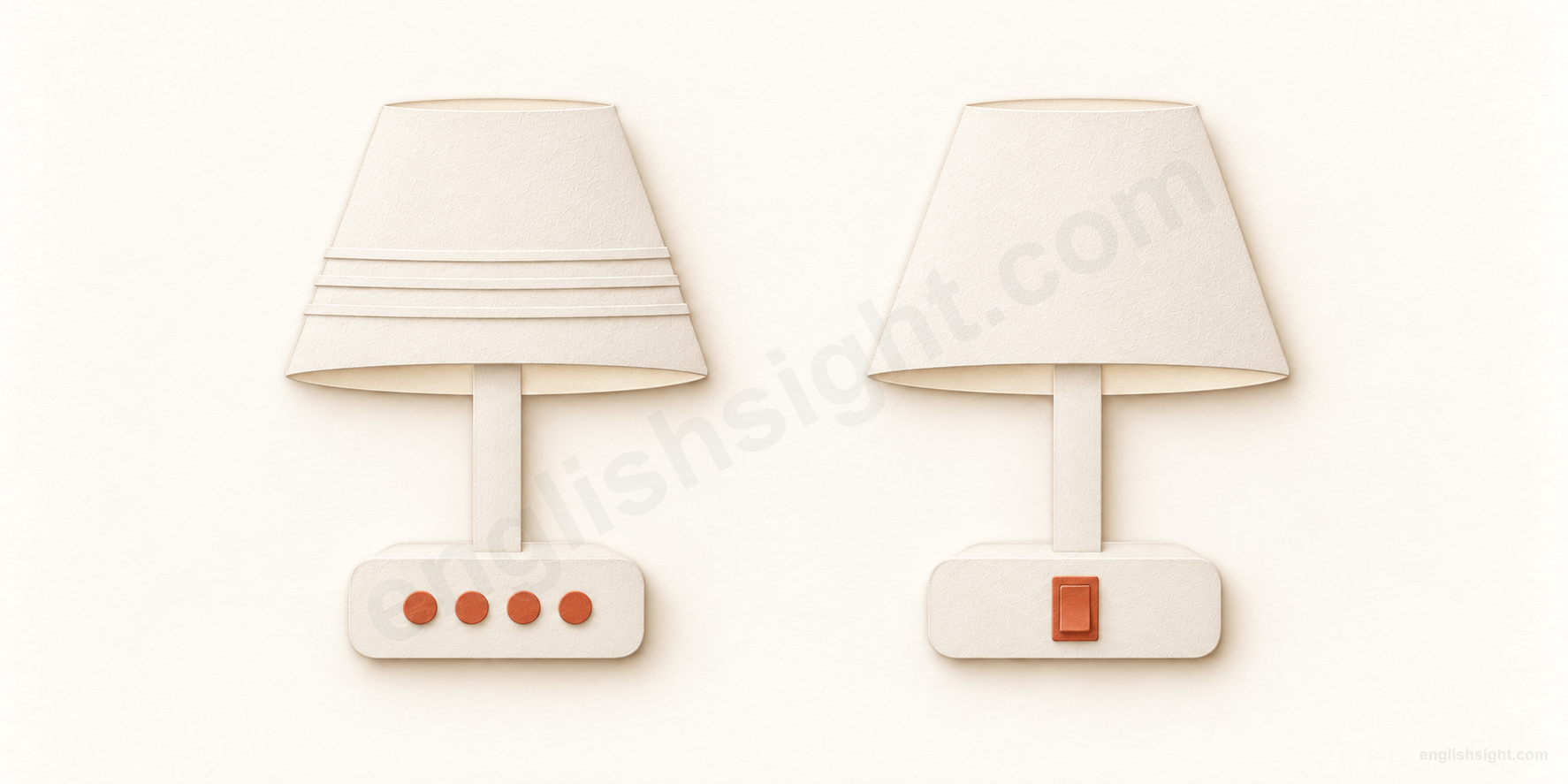
The left lamp has decorative bands and four small control buttons.
simple
The right lamp has a plain shade and one large switch.
Compare two designs with the same purpose: providing light.
The same purpose, fewer details and controls: the right-hand design illustrates simple. These are alternatives, not stages of a change.
Simple presents something as having little complexity or elaboration. What counts as a complication depends on whether we are talking about structure, understanding, effort, or style.
This is a teaching connection, not a definition of all uses. Statements about people and established labels need their own context. Simple describes a quality; it does not itself mean remove parts or become simpler.
A simple design has few features to deal with; a simple explanation makes its point manageable. Simple can also praise an unadorned style or emphasize what the speaker treats as the whole explanation. Context chooses the sense.
The lamps offer a teaching comparison: the same everyday purpose with fewer controls and details. They do not show a physical change required by simple, and they cannot predict every phrase or technical term.
01
Understanding and doing
Choose what is uncomplicated: the information, a task, or the way someone performs it. The sentence pattern identifies who does the action.
01
simple + information noun; in simple terms, + clause
a simple explanation / in simple terms
easy to understand
Situation
A visitor does not know how the heating works.
What the expression conveys
You explain the main point without technical language.
Simple evaluates the explanation, not the visitor’s intelligence.
A simple explanation gives the listener a manageable account. Simple instructions, a simple question, and a simple example use the same adjective before different kinds of information.
In simple terms introduces a less technical account: In simple terms, the sensor tells the light when to turn on. Terms here means words or ways of expressing something, not conditions in an agreement.
In a sentence
Could you give me a simple explanation of how the heating works?
Watch the difference An explanation can be simple but wrong. Clarity does not guarantee accuracy.
02
thing + be + simple + (for somebody) + to + verb
simple to use
easy for someone to perform an action with
Situation
You are choosing a radio for someone unfamiliar with the controls.
What the expression conveys
One radio needs very little explanation.
The radio is what someone uses; it is not the person doing the using.
In This radio is simple to use, the radio is understood as the object of use. Compare The instructions are simple to follow and The lid is simple to remove.
Add for plus a person when the user matters: This radio is simple for my father to use. Easy is often an alternative here. A job can have a simple method yet still demand hours of physical effort.
A simple task is easy to carry out; a simple problem is straightforward to solve. The relevant action can be left unstated when the noun makes it clear. A simple solution may also mean an uncomplicated method, so read the surrounding explanation.
In a sentence
This radio is simple for my father to use.
Watch the difference Do not add a second object: This radio is simple to use, not simple to use it.
03
it + be + simple + (for somebody) + to + verb
It is simple for someone to…
judge how easy an action is
Situation
A file needs to be renamed.
What the expression conveys
You explain that renaming it takes little effort.
It introduces a judgment about an action; for identifies the person doing it.
It is simple to rename the file evaluates the action rename the file. It is a grammatical placeholder here, not the file itself.
In It is simple for Lena to rename the file, Lena does the renaming. Compare The file is simple to rename: that version puts the thing affected at the front. Simple for Lena alone leaves the relevant task to the context.
In a sentence
It is simple for Lena to rename the file on her phone.
Watch the difference Use for to name the person doing the action: simple for Lena to do, not simple to Lena to do.
04
keep / make + object + simple; make + object + simpler
keep it simple / make it simpler
maintain or create an uncomplicated result
Situation
You are planning a sign for the entrance.
What the expression conveys
You choose one clear message instead of adding many details.
Keep maintains a quality; make brings about a quality.
Keep the sign simple asks for an uncomplicated result throughout the design. The object the sign comes between keep and the adjective. Keep it simple is a familiar short instruction when the object is understood.
Make the sign simpler asks for a reduction in complexity. In make it simple for visitors to find us, it points forward to the action and visitors do the finding. These are adjective-complement constructions, not phrasal verbs.
In a sentence
Let’s keep the sign simple so people can read it quickly.
Watch the difference Simple is the adjective after keep or make; simplify is the related verb: We simplified the sign.
05
simpler than…; a simpler way to + verb / of + -ing; the simplest + noun
a simpler way / the simplest way
compare levels of complexity or difficulty
Situation
Two routes require different numbers of changes.
What the expression conveys
You choose the route with fewer complications.
Simpler compares options; simplest selects one within a set.
The usual comparison forms are simple, simpler, and simplest. More simple and most simple are also possible; do not mark them automatically wrong.
A simpler way to get there and a simpler way of getting there both introduce a method. In This route is simpler than the other one, than introduces the comparison. Simpler does not necessarily mean faster.
Simple enough to follow means sufficiently uncomplicated for the purpose. Too simple to be useful means the lack of detail goes beyond what is helpful. Enough follows the adjective; too comes before it.
In a sentence
Is there a simpler way of getting to the station?
Watch the difference Do not combine both comparison forms: simpler, not more simpler.
02
Few parts, plain style, everyday pleasures
Simple can describe how something is put together or how little decoration and luxury it involves. These judgments do not necessarily mean cheap or poor.
06
simple + design / structure / mechanism; be simple in design
a simple design / a simple machine
having few parts or an uncomplicated structure
Situation
Two lamps provide the same kind of light.
What the expression conveys
One has a single switch and few parts to manage.
A simple structure has few features; it need not have exactly one part.
Here simple describes the arrangement itself. A simple design, model, pattern, or mechanism has relatively few interacting features. This is the main connection illustrated by the two lamps.
A simple machine may still require skill to build. Simple describes its structure; easy to build describes the builder’s task. In science lessons, simple machine can also name an established category such as a lever.
In a sentence
We chose a lamp with a simple design and one large switch.
Watch the difference Do not assume simple always means single: a simple design can contain several parts.
07
a simple + meal / dress / room; simple but + adjective
a simple meal / simple clothes
plain and without elaborate extras
Situation
You are preparing dinner on an ordinary evening.
What the expression conveys
You serve familiar food without an elaborate menu.
Simple concerns presentation and extras, not necessarily preparation time.
A simple meal may use just a few ingredients. Simple clothes or a simple dress avoid elaborate decoration. The context tells us whether food, appearance, or equipment is being evaluated.
This can be praise. The pattern simple but elegant deliberately combines little decoration with an attractive result. Plain is close in this sense; easy is not a replacement in simple clothes.
In a sentence
We shared a simple meal of baked potatoes and salad.
Watch the difference Simple does not itself say that something is cheap, badly made, or unattractive.
08
live a simple life / the simple life; enjoy simple pleasures
the simple life / simple pleasures
a life or enjoyment without much luxury or fuss
Situation
Your weekends have become full of costly activities.
What the expression conveys
You enjoy walking and spending quiet time at home.
Simple pleasures can be satisfying without elaborate arrangements.
Live a simple life describes an uncomplicated way of living, often with few possessions or luxuries. The simple life treats that way of living as a recognizable ideal.
The simple things in life and simple pleasures often refer to ordinary sources of happiness. These combinations can express appreciation; they do not mean that the person has no problems or responsibilities.
In a sentence
Her simple pleasures include gardening and breakfast with friends.
Watch the difference A simple life is not the same as an easy life: plain living may involve hard work.
03
Putting the point plainly
Some combinations remove competing explanations or close an argument. Learn their position and tone as whole expressions.
09
the simple fact that + clause; the simple truth is (that) + clause
the simple fact / the simple truth
present a fact as the central point without complications
Situation
A team discusses many explanations for a delay.
What the expression conveys
You draw attention to the missing part.
Simple emphasizes what the speaker treats as the essential fact.
The simple fact that… puts weight on a fact. The simple truth is that… presents a direct account, sometimes an unwelcome one. Neither expression means the fact is about an easy task.
Compare a simple explanation, where understandability is central. In the simple truth, simple can instead exclude excuses, qualifications, or distractions. The speaker’s confidence is not proof.
In a sentence
The simple fact is that we cannot finish without that part.
Watch the difference A that-clause needs a subject and verb: the fact that we cannot finish, not the fact that cannot finish.
10
clause + for the simple reason that + clause
for the simple reason that…
give a direct reason and emphasize its importance
Situation
Someone asks why you walked instead of driving.
What the expression conveys
You give the reason without a long explanation.
That introduces the reason as a full clause.
For the simple reason that means because, with emphasis on a straightforward explanation. The phrase can sound firm when the speaker thinks the reason should settle the question.
Simple belongs to reason here. It does not describe the walking or imply that the decision was easy. Use because for a shorter, less emphatic version.
In a sentence
I walked for the simple reason that my car was at the garage.
Watch the difference Keep that before a clause in this expression; use because of before a noun phrase.
11
the simple act of + noun / -ing; a simple matter of + noun / -ing
the simple act of… / a simple matter of…
present an action or requirement as basic
Situation
A small practical change helps a meeting run smoothly.
What the expression conveys
You identify the action that made the difference.
The following of-phrase identifies the action or requirement.
The simple act of opening a window focuses on an ordinary action that may have a significant result. Simple does not mean its effect is unimportant.
A simple matter of checking one box presents checking as the only uncomplicated requirement. This can underestimate real difficulty. Just a simple mistake similarly minimizes a problem; the context may show that the speaker is being too dismissive.
In a sentence
The simple act of writing down everyone’s name helped me remember them.
Watch the difference After of use writing, not write. A small action can have a large effect.
12
noun / description, pure and simple; statement, plain and simple
pure and simple / plain and simple
emphasize an unqualified description
Situation
Someone describes repeated threats as harmless jokes.
What the expression conveys
You reject that description and call the behavior bullying.
The fixed phrase reinforces the description rather than describing an easy task.
Pure and simple commonly follows the thing being identified: That is bullying, pure and simple. The speaker presents bullying as the whole explanation. The adjective meaning no additions helps remember the phrase, but learn its established form.
Plain and simple can similarly make a judgment blunt: The plan failed, plain and simple. Both expressions can sound forceful or dismissive in disagreement. They do not mean purely and easily.
In a sentence
That is bullying, pure and simple.
Watch the difference The familiar ending is pure and simple. Purely and simply uses different grammar and normally belongs inside the clause.
13
it is (not) that simple; it is as simple as that; not as simple as + clause
It’s as simple as that. / It’s not that simple.
claim a point is straightforward or reject an oversimplification
Situation
A friend suggests that everyone could just work from home.
What the expression conveys
You point out that some jobs require physical presence.
That refers to an explanation or the degree of simplicity just suggested.
It’s as simple as that and It’s that simple say there is no further complication to consider. A speaker may use them to finish an explanation, not merely to measure task difficulty.
It’s not that simple challenges this framing: there are other factors. Not as simple as it looks compares the reality with an appearance. These are degree and comparison patterns; that does not always point to a physical object.
In a sentence
“Why doesn’t everyone work from home?” “It’s not that simple; some jobs need people on site.”
Watch the difference Saying it is simple does not make it simple for everyone. Check whose circumstances the claim assumes.
04
Describing people carefully
A modest way of life is different from a judgment about intelligence. The surrounding noun and the speaker’s tone matter.
14
a simple + person / occupation; have simple tastes
a simple person / a simple farmer
ordinary or unpretentious in a particular context
Situation
A successful artist talks about her modest preferences.
What the expression conveys
She describes herself as someone who likes an ordinary life.
With people, simple can concern modest tastes or social position.
I’m a simple person with simple tastes can express a lack of pretension. A simple farmer can identify an ordinary person without special status. The second phrase may sound old-fashioned or patronizing when used by someone else.
This does not automatically describe intelligence. Nevertheless, simple about a person is ambiguous. If you mean modest or down-to-earth, those words may communicate your intention more clearly.
In some descriptions, simple also suggests sincerity or a lack of deceit: Her simple, heartfelt thanks moved us. Here the praise concerns an open, genuine manner, not low intelligence or a tendency to believe anything. This sense needs context, especially when simple describes a person directly.
In a sentence
I’m a simple person: a quiet home and good company are enough for me.
Watch the difference Do not assume She is simple is a safe compliment. Give context or choose a more precise adjective.
15
person + be + simple; simple + person noun (context-dependent)
simple: an insulting or dated description
recognize a judgment about someone’s ability or experience
Situation
You encounter simple used about a person in an older story.
What the expression conveys
You identify the sense without adopting it as a neutral label.
A lack of complexity is not a measure of a person’s worth.
Some uses of simple suggest that a person is easily deceived or lacks intelligence. Oxford marks the slow-to-learn sense as old-fashioned and offensive. This is recognition guidance, not a recommended label.
Contrast He gives simple explanations, which praises accessible communication. If a person lacks experience in a particular task, say that directly instead of describing the whole person as simple.
In a sentence
In the old story, the narrator calls the trusting villager “simple.”
Watch the difference Do not use simple as a casual label for a learning disability.
05
Recognizing established labels
In grammar and finance, simple has a specific contrast with another category. Learn the label rather than guessing that it means easy.
16
a simple sentence = one independent clause with no subordinate clause
a simple sentence
a sentence with one independent clause and no subordinate clause
Situation
You are classifying a sentence in a grammar lesson.
What the expression conveys
You count clauses rather than words.
Simple names a clause structure, not a level of vocabulary.
The old clock beside the kitchen door stopped at midnight is a simple sentence: it has one independent clause and no subordinate clause. Its length does not make it complex in this grammatical sense.
Compare The clock stopped because the battery died, which adds a subordinate clause. Simple sentences can also have a compound subject or coordinated verbs: Maya and Leo laughed and waved. Do not classify solely by counting written verb words.
In a sentence
Maya and Leo laughed and waved.
Watch the difference Simple sentence is not a promise that a sentence is short or easy to read.
17
present simple / simple present; past simple / simple past
the present simple / the past simple
recognize names of verb forms
Situation
You see works and is working in a grammar exercise.
What the expression conveys
You distinguish the simple form from the continuous form.
Simple is a grammatical label; it does not mean the action is easy.
She checks the door every evening uses the present simple for a routine. She checked it yesterday uses the past simple. Present simple and simple present are both familiar names; likewise past simple and simple past.
Compare is checking, a continuous form, and has checked, a perfect form. Do not define simple as never using an auxiliary: Does she check it? and She does not check it are still present simple. Here do supplies question or negative grammar.
In a sentence
She checks the door every evening.
Watch the difference A simple tense does not mean a simple sentence: tense labels and clause labels answer different questions.
A classroom example starts with an investment of 100 units.
What the expression conveys
Interest is calculated without adding earlier interest to the calculation base.
The established contrast is simple interest versus compound interest.
In simple interest, the calculation uses the original principal. Compound interest also takes accumulated interest into account. The adjective is part of a finance term, not an assurance that a product is easy to understand.
In a classroom example, 100 units at 5% simple interest per year earns 5 units each year: 10 units over two years. That illustration assumes a constant annual rate and ignores fees and withdrawals.
In a sentence
The exercise asks us to calculate simple interest on 100 units at 5% per year.
Watch the difference Learn the full term. Do not infer the terms of a real account from the adjective simple alone.
Keep the distinctions clear
Simple and easy overlap, but not everywhere
An easy task takes little effort or presents little difficulty. Simple often concerns few complications. A method can be simple to explain yet physically demanding. Easy clothes does not replace simple clothes.
Simple, simply, simplify
Simple is the adjective: The explanation is simple. Simply is the related adverb: Please explain it simply. Simply can also mean only or emphasize a claim, so it needs context. Simplify is a verb meaning make simpler; simplicity is a noun.
Grammar appropriate to an adjective
Simple can occur before a noun or after be, seem, and similar linking verbs. Use simpler / simplest normally; more simple / most simple also occur. There is no ordinary modern verb simple to build passive forms or phrasal verbs from. Keep / make something simple are complement constructions.
Labels and limits
This lesson includes basic grammar labels and simple interest for recognition. Specialist botanical, mathematical, medical, and legal senses, and historical nouns for medicinal plants or people, are outside its practical scope. Simple majority has differing uses across voting systems; check the relevant rules rather than guessing a universal threshold.
Choose the intended meaning
Identify what simple describes, then check the full construction and context.
1. Which sentence naturally describes a radio that a person can operate without difficulty?
2. The dress has no elaborate decoration but looks elegant. What does simple mean here?
3. Complete the sentence: We left early ___ we had a long journey.
4. A friend says any employee can work from home. You need to point out complications. Which reply fits?
5. Maya and Leo laughed and waved. Why can this be a simple sentence?
6. Does she check the door every evening? Is this still present simple?
7. You admire someone’s modest lifestyle. Which wording makes that meaning clearer?
Sources and teaching notes
Modern senses and constructions were checked against the sources below. The explanations and examples are original. The lamp comparison is a teaching interpretation, not dictionary evidence.
This diagram is a learning aid, not a picture shared by every native speaker.