Use size to describe extent, compare scale, and choose a suitable measurement.
Compare how much space something occupies
Compare extent without assuming change
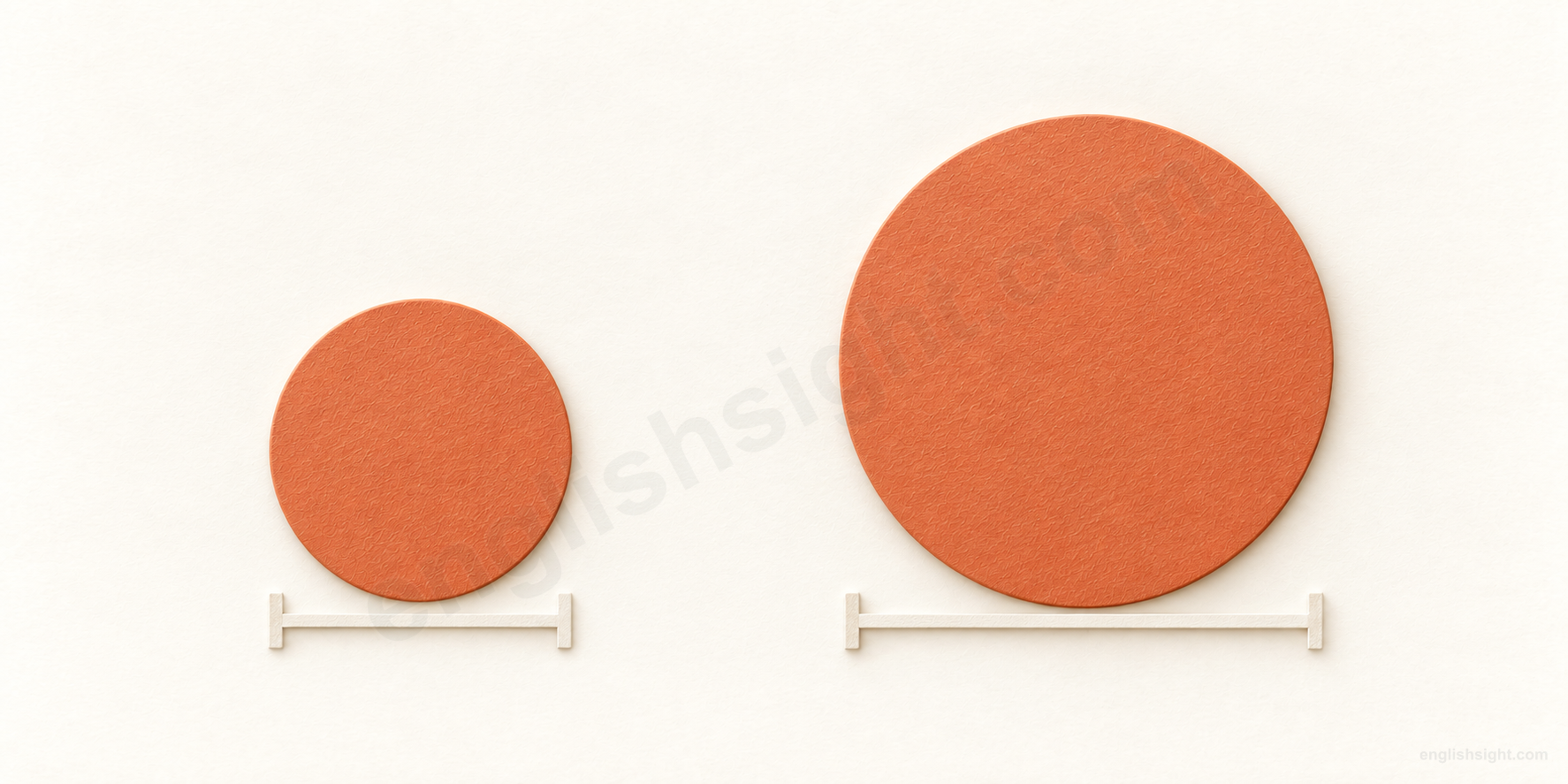
The left disc has a smaller size.
size
The right disc has a larger size.
Compare the widths of the two discs at the same moment.
Same shape, different size; two objects compared at one moment.
Size concerns how large or small something is; the relevant extent may be space, an amount, or a number.
The sketch compares two round objects at one moment. It represents physical extent, not every use of size. Size categories, assessment, and idioms are explained separately.
Size is usually a noun: it tells us how large or small something is. A word such as small, a comparison, or a stated measurement supplies the actual value. Size alone does not mean that something is big or growing.
The same idea helps us discuss the number in a group, the amount of data in a file, or a clothing category. Established expressions such as size someone up need their own explanations. The visual model is a teaching aid, not a claim about a picture shared by every English speaker.
01
Describe and compare extent
Start with a physical object, then identify the dimension or comparison that matters. Size itself can be small, large, or unchanged.
01
the size of + noun; a small / large size; different sizes
the size of something
how much space something occupies
Situation / starting point
You need to move a cabinet through a doorway.
Meaning / result
You compare the cabinet’s dimensions with the opening.
Size names a property; it does not by itself mean big.
Before moving furniture, check the size of both the object and the space available. Its size may be small or large, or just right for the room. The context decides which dimensions matter.
Length, width, and height are individual dimensions; size can summarize them. Weight tells you how heavy something is, and shape tells you its outline. Objects can share a shape yet differ in size, as in the sketch.
In the size of the cabinet, of introduces the thing being described. When comparing several options, use a countable form: The cabinets come in three sizes.
In a sentence
Check the size of the cabinet before you order it.
Watch the difference Ask How big is it? for a general question. What size is it? is especially useful when a product has standard measurements.
02
be the same size as + noun; a thing the size of + noun; a thing this / that size; be similar in size to + noun
the same size as / the size of
compare physical extent directly
Situation / starting point
Two prints need matching frames.
Meaning / result
You establish that their dimensions match.
As introduces the comparison after the same size.
The same size as compares two things: This print is the same size as that one. In a context where the comparison is obvious, They are the same size is enough. Similar in size to means approximately the same size: The pebble is similar in size to a grape. Use to after similar, and as after the same size.
A patch the size of a coin means a patch approximately as large as a coin. The noun phrase the size of a coin can follow patch directly; it describes the patch rather than identifying its owner.
This size and that size can also describe a thing: A room that size needs two heaters. Here that points to a previously shown or mentioned extent.
In a sentence
This print is the same size as the one above the sofa.
Watch the difference Use the same size as, not the same size than. Matching size does not guarantee matching shape.
03
twice / half / three times + the size of + noun
twice / half the size of
give a ratio between two measured extents
Situation / starting point
The old garden covers 40 square metres; the new one covers 80.
Meaning / result
You express a two-to-one area comparison.
A numerical ratio needs an understood measure.
Twice the size of means two times as large on the measure being used; half the size of means one half as large. Three times the size of follows the same pattern.
For a garden, size may mean area; for a file, it may mean the amount of stored data. Doubling every side of a square makes its area four times as large, so do not silently confuse length with area.
If precision matters, name the dimension: twice the width or twice the area. The comparison is a property of the two things and does not necessarily describe a change over time.
In a sentence
Our new garden is twice the size of our old one.
Watch the difference Avoid two times bigger when an exact ratio matters; twice the size of is clearer.
Grow in size and increase in size describe becoming bigger; shrink in size and decrease in size describe becoming smaller. Double in size describes reaching twice the earlier amount or extent.
The company doubled in size might concern staff, sales, or another relevant measure. State the measure when the context does not make it clear.
Size is a noun after in. The change comes from grow, shrink, increase, or double, not from size alone.
In a sentence
The sponge increased in size after we put it in water.
Watch the difference In size names the property that changes; by introduces the amount of change: The population increased in size by 20%. Both an increase in size and a size increase are possible noun phrases.
05
adjective + for its size; a good size; the right size for + noun; vary in size; range in size from ... to ...
for its size
judge something against expectations for its dimensions
Situation / starting point
A small speaker produces a strong sound.
Meaning / result
You judge the sound relative to the speaker’s small body.
For introduces the comparison standard.
The speaker is loud for its size means it is louder than you might expect from something so small. It does not necessarily mean it is louder than every larger speaker.
The room is a good size usually approves of its dimensions as fairly spacious or suitable. The right size for the desk instead stresses suitability for that particular purpose.
In These boxes vary in size, size is the feature along which they differ. In Despite its size, it is light, size is something that might lead you to expect a different weight. Range in size from ... to ... gives the endpoints of a range: The stones range in size from 2 to 5 centimetres across.
In a sentence
This speaker is surprisingly loud for its size.
Watch the difference The right size for a purpose is not automatically a large size. Keep the judgment and its comparison standard clear.
02
Amounts, groups, and the scale of a task
The relevant measure may be a number of people, digital storage, a portion, or the amount of work involved.
06
class / population / sample / serving + size; the size of + group
class size / sample size / serving size
state how much or how many are in a group or portion
Situation / starting point
A school compares classes with 18 and 30 pupils.
Meaning / result
It describes a difference in class size.
The noun before size tells you what is being measured.
Class size usually concerns the number of students in a class, not the area of the classroom. Population size concerns how many people or organisms there are. A business’s size can similarly be described by staff numbers.
Sample size is the number of people or observations included in a particular study. A serving size is the amount intended as one portion; it can be given in grams or another relevant measure.
Ask what is being counted or measured before comparing sizes. A larger sample is not automatically a better study, and a larger serving is not a claim about nutritional quality.
In a sentence
The school reduced class size to give each pupil more attention.
Watch the difference Class size and classroom size answer different questions: number of pupils versus physical dimensions.
07
file size; font size; reduce / increase / change + the size of something
file size / font size
describe data quantity or displayed letter dimensions
Situation / starting point
An email rejects a large attachment.
Meaning / result
You reduce the stored data before sending it.
Different digital size labels refer to different properties.
File size describes how much digital data a file contains, commonly reported in bytes, kilobytes, or megabytes. A photo’s physical print dimensions are a different property.
Font size describes how large the letters are displayed or printed. Increasing font size can make text easier to read without changing its wording.
The verb in reduce the file size names an action on the amount of data. It does not promise to make the image narrower or to keep every other property unchanged.
In a sentence
Please reduce the file size before you attach the photo.
Watch the difference A file size in megabytes is not a measurement of width in centimetres.
08
the (sheer) size of + task / problem / debt; given the size of + noun
the sheer size of the task
emphasize an unusually large amount or extent
Situation / starting point
You discover how much work the repair requires.
Meaning / result
You feel surprised or concerned about its scale.
Context can make size highlight bigness rather than a neutral measurement.
The size of the task can mean the amount of work involved. With sheer, the speaker emphasizes that the amount or extent alone is striking.
The size of a bill or debt refers to the amount of money, not the dimensions of the paper. The same word can therefore move from physical extent to an amount that matters in a situation.
Given the size of the task means taking its scale into account. Given introduces the consideration; it does not turn size into a verb.
In a sentence
We needed more volunteers because of the sheer size of the task.
Watch the difference Size does not always mean difficulty: a small task can still be difficult. Read the context.
03
Choose a size and check suitability
Clothes and other goods use standard size categories. Distinguish the category on the label from whether the item actually fits.
09
what size + do you wear / take?; wear / take + (a) size + number; size + number + noun
What size do you wear?
ask for a standard clothing or shoe measurement
Situation / starting point
You want to buy shoes for someone.
Meaning / result
You ask which numbered category they need.
A size can be a named or numbered product category.
What size do you wear? asks for a clothing or shoe category; What size do you take? is also natural, especially in British shopping contexts. I wear a size 8 and I take size 8 are possible answers.
With a product, you can say size 8 shoes or shoes in size 8. Sizes can also use letters or names, such as XL or medium. You may hear She is a size 12 as a shorthand description of her clothing size.
The label belongs to a sizing system, so the number alone does not establish a universal measurement. When buying across brands or regions, check the relevant size chart.
In a sentence
What size do you wear in these shoes?
Watch the difference Do not replace a clothing size with an age or a height unless the product’s sizing system actually uses that measure.
10
have / come in + size; be a size too small / big; go up / down a size
in my size / a size too small
find an available category that fits
Situation / starting point
The displayed jacket is too tight.
Meaning / result
You ask for a larger size.
In marks the available size category; too marks an unsuitable degree.
Do you have it in my size? asks whether that product is available in the category you need. The shop may sell the style but not stock that size.
It is a size too small means you need approximately the next larger size in that range. Go up a size and go down a size mean choose a larger or smaller category, not move anywhere.
The right size and the wrong size evaluate fit. Size is one part of suitability: the cut or shape can still make a garment uncomfortable even with the expected number on its label.
In a sentence
Do you have this jacket in a larger size?
Watch the difference Say in a larger size, not on a larger size. Use a larger size for the product category; larger alone can simply describe an object.
11
try + something + on for size; try on + something + for size; try it on for size
try something on for size
test whether something fits or suits you
Situation / starting point
You have not decided whether to keep a coat.
Meaning / result
You put it on to check its fit.
For size states the purpose of the trial.
Try the coat on for size means put it on to check whether it fits. You can also say Try this one for size when the trial action is clear.
The expression can be extended to ideas: Let’s try that arrangement on for size means test whether the arrangement suits our needs. Nobody is literally wearing an arrangement.
The separable part is try on: try the coat on or try on the coat, but try it on with a pronoun. For size is a purpose phrase following that action.
In a sentence
Try this coat on for size before you choose a colour.
Watch the difference Trying something for size does not mean you have agreed to buy it or that it will fit.
12
cut + object + to size; be cut to size
cut something to size
make an object match required dimensions
Situation / starting point
A sheet is too wide for the frame.
Meaning / result
You trim it to the required width.
To marks the intended result of cutting.
Cut the board to size means cut it so that it has the dimensions needed for a particular purpose. The exact measurement can be understood from the job or stated separately.
The passive is common when the material is the topic: The panels were cut to size at the workshop. The action changes the material; it does not merely label its existing size.
Compare cut someone down to size, the idiom about reducing someone’s exaggerated self-importance. The extra word down and the personal object lead to a different interpretation.
In a sentence
The shop cut the sheet to size so it would fit our frame.
Watch the difference To size gives a target result; by size in sort by size gives a basis for grouping.
04
Give a size or build a size description
The verb and compound adjectives specify a measurement, an adjustment, or a comparison. Their grammar differs from the ordinary noun.
13
be sized in + unit; size + object + to fit; be sized to fit; sort by size
be sized in / size something to fit
assign a measurement or adjust dimensions
Situation / starting point
A product needs a measurement label or a change of dimensions.
Meaning / result
Its size is specified or adjusted.
The verb size takes an object; passive sized often foregrounds the item.
The verb has forms size, sizes, sized, sizing. In Parts are sized in millimetres, sized refers to how their measurements are specified; in names the unit. It does not necessarily describe a physical change.
In Size the image to fit the screen, size means adjust its dimensions. The image is the object being changed; to fit gives the intended result. The passive is possible: The image is sized to fit the screen.
Sort the pieces by size means arrange them according to their dimensions. Size can itself have this sorting meaning, especially in manufacturing, but sort by size is a clear everyday choice.
In a sentence
The image was sized to fit the screen.
Watch the difference In sized to fit, sized is a verb form, not a plural noun. The -ing form drops the final e: sizing.
build an adjective describing extent or suitability
Situation / starting point
You need a compact description before a noun.
Meaning / result
A compound adjective specifies the relevant size.
The first element supplies a category, a comparison, or a purpose.
A medium-sized bag is neither especially small nor especially large in its range. A full-size model has the normal or complete dimensions rather than being a miniature. A life-size model represents a living thing at its real dimensions.
A coin-sized mark is about as big as a coin. Bite-sized pieces are small enough to eat in one bite; bite-sized lessons extend that idea to short, manageable units. Pocket-sized describes something small enough to carry in a pocket.
The forms -size and -sized both occur, but learn the established form with each combination: full-size and medium-sized are useful defaults. Keep the hyphen in a compound before a noun. A king-size bed names a bed category; its exact dimensions depend on the system.
In a sentence
The guide divides the course into bite-sized lessons.
Watch the difference Do not use size as a general adjective: a small room is natural; a size room is not. Compounds need their other element.
15
a one-size-fits-all + approach / solution / policy
a one-size-fits-all approach
use one design or method for people with different needs
Situation / starting point
A team has people with different schedules.
Meaning / result
A single rigid plan fails to accommodate everyone.
The clothing metaphor is applied to a general method.
A one-size-fits-all approach offers the same solution across different people or situations. It treats the method like a single garment size intended for many bodies.
The expression often appears in criticism: No one-size-fits-all solution will work here. This says different needs require different treatment, not that no solution exists.
Keep the compound together before a noun: a one-size-fits-all policy. It describes the intended breadth of a method, not proof that the method is suitable for every case.
In a sentence
We need flexible study plans rather than a one-size-fits-all approach.
Watch the difference All in this expression describes a proposed general application; it is not evidence of universal success.
05
Assessments and established expressions
These combinations carry meanings beyond physical measurement. Learn the whole expression, its tone, and its limits.
16
size up + noun; size + noun / pronoun + up
size somebody / something up
assess a person or situation
Situation / starting point
A player studies an unfamiliar opponent.
Meaning / result
She forms an opinion before choosing a strategy.
Up belongs to a phrasal verb about assessment, not increase.
Size up can concern a person’s abilities, a difficult situation, or an opportunity. It means look or think in order to form an assessment; physical measurement is not required.
The pattern is separable: size up the opponent or size the opponent up. With a pronoun, use size her up, not size up her. The past form is sized up and the ongoing action can be sizing someone up.
This informal expression can suggest a quick appraisal, but it does not guarantee that the judgment is correct. To size someone up is not the same as to make them bigger.
In a sentence
Mina sized her opponent up before the match began.
Watch the difference In this assessment meaning say size her up. Keep it distinct from choosing a larger clothing size.
17
plural subject + come in all shapes and sizes
come in all shapes and sizes
exist in many different forms
Situation / starting point
You compare several kinds of community group.
Meaning / result
You notice a wide variety of structures and membership.
The phrase can describe variety beyond literal dimensions.
With physical products, the expression can refer to real differences in shape and dimensions. With organizations or plans, it can refer more generally to varied kinds and forms.
Come in here means be available or exist in a range of forms; it is not arrival or entering a room. All is an ordinary broad generalization rather than a mathematical claim about every possible shape.
You can shorten the surrounding description without changing the idiom: all shapes and sizes. Avoid replacing sizes with weights unless you intend a different, literal comparison.
In a sentence
Community groups come in all shapes and sizes.
Watch the difference Use come with a plural subject and comes with a singular one: equipment comes in all shapes and sizes.
18
cut + person + down to size; be cut down to size
cut somebody down to size
make someone recognize that they are less important or capable than they think
Situation / starting point
An overconfident player boasts about an easy victory.
Meaning / result
A defeat challenges his exaggerated confidence.
The idiom concerns perceived importance or ability, not bodily dimensions.
A sharp remark, a defeat, or an awkward result can cut someone down to size. The person’s inflated view of their own importance or ability is challenged.
The passive is common: He was cut down to size. This is informal wording and can sound pleased, hostile, or humiliating; it is not a neutral way to offer someone constructive feedback.
The entire expression has the idiomatic meaning. Cut a board to size is literal work on dimensions; cut someone down to size does not instruct physical harm.
In a sentence
After weeks of boasting, he was cut down to size by a beginner’s victory.
Watch the difference Use this idiom carefully about people: it carries a critical attitude, not simply an objective measurement.
19
that is / that’s + (about) the size of it
That’s about the size of it.
confirm a brief summary of the situation
Situation / starting point
Someone summarizes why the booking failed.
Meaning / result
You confirm that the summary is essentially accurate.
It refers to the situation just discussed.
This informal response accepts an account of the facts: “So we paid, but the room was never reserved?” “That’s about the size of it.” The meaning is roughly That sums up the situation.
About allows for a broad summary rather than every detail. The expression may acknowledge disappointing news, but disappointment is not built into the grammar.
Do not interpret size here as centimetres or a clothing category. This is an established phrase whose conversational function is learned as a whole.
In a sentence
“So we need a new booking?” “That’s about the size of it.”
Watch the difference The phrase confirms an earlier summary; it is not the normal answer to What size do you wear?
Check the measure, the grammar, and the full phrase
Size, shape, and weight answer different questions
Two objects may share a shape but occupy different amounts of space. A larger object need not be heavier. Name the relevant dimension or quantity whenever a general size comparison could mislead.
Noun, verb, and compound
The noun has plural sizes when referring to different measurements or categories. The verb forms are size, sizes, sized, sizing. Compound descriptions include medium-sized and full-size; their form does not make size a free-standing adjective meaning big.
Use respectful descriptions
Clothing size is a practical measurement, not a judgment of someone’s worth or health. Ask about the size needed for the item. Cut someone down to size is a critical idiom and can sound unkind.
Scope of this lesson
This lesson covers everyday extent, common measurements, clothing, adjustment and assessment, plus selected established expressions. Size meaning a glue-like preparation, and size a surface meaning apply that preparation, belong to a separate craft or manufacturing branch. Historical ration and legal senses and specialist metallurgy are not expanded here.
Choose the size meaning
Identify what is being measured and read the whole construction.
1. A school reduces class size from 30 to 20. What changed?
2. The first garden covers 40 square metres and the second covers 80. Which statement gives the area comparison clearly?
3. Mina studies her opponent’s strengths before a match. Which sentence describes this assessment?
4. A jacket is too tight and you want the next larger category. Which request fits?
5. Someone says, “So the train is cancelled and we need another route?” You answer, “That’s about the size of it.” What are you doing?
Sources and teaching notes
The sources below support the uses and grammatical patterns. Explanations and examples are original teaching material. The visual comparison is a teaching model, not a dictionary claim about mental imagery.
The diagram compares physical extent; it does not explain every fixed expression.