From the skin on your hands to surface layers, emotional reactions, and familiar sayings.
A covering between the inside and the outside
A covering between the inside and the outside
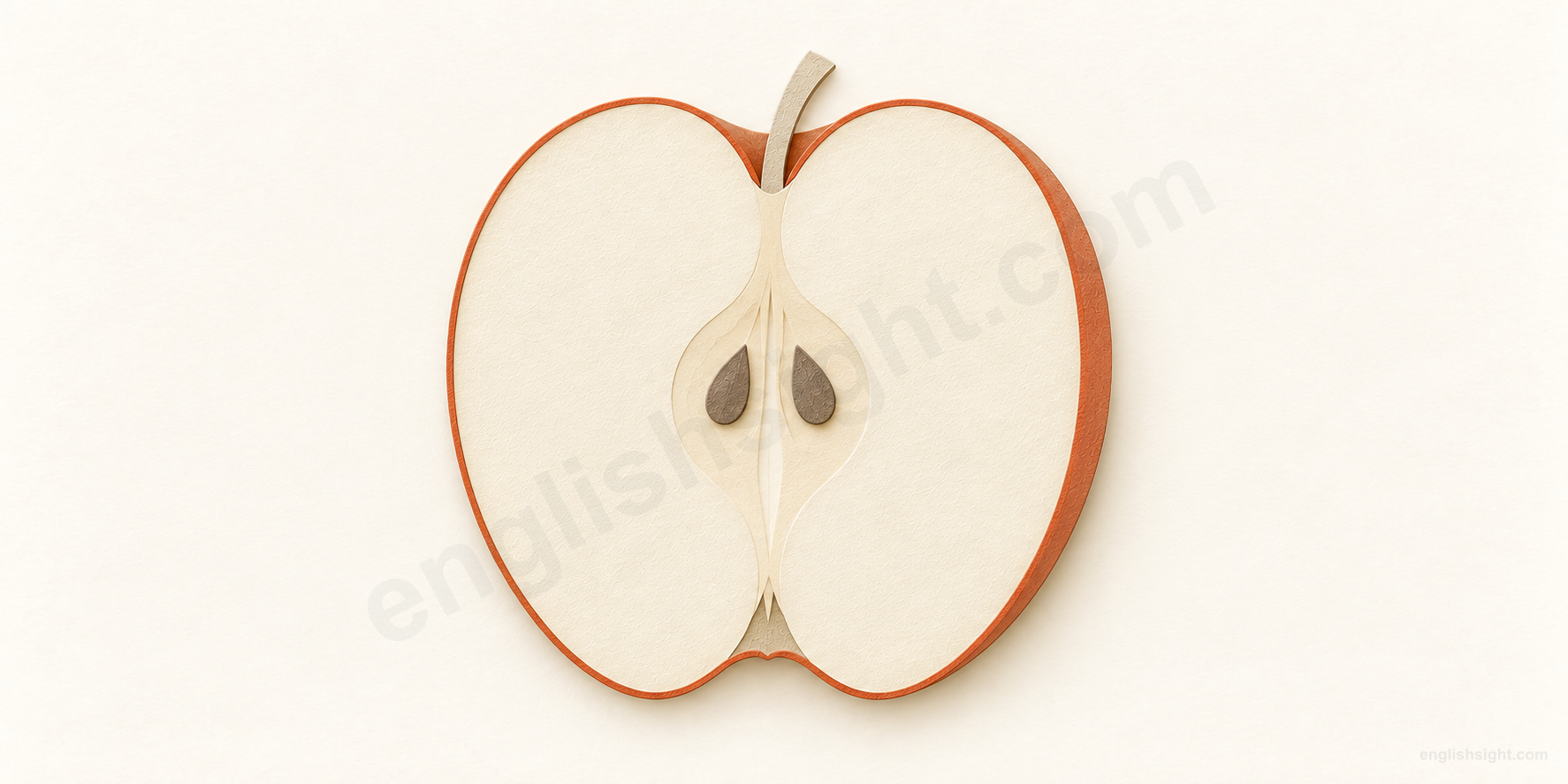
The orange layer lies on the outside of the apple.
skin
The pale flesh lies inside the thin skin.
The cut face reveals the boundary between the skin and the flesh.
The thin orange skin covers the pale flesh beneath it.
Skin is an outer covering: it lies at the boundary between the inside of a body or thing and what is outside it.
The apple section makes the covering relationship visible; it does not define every material or predict fixed idioms. Body skin is living tissue, while other skins may be films, sheets, or visual designs.
Skin /skɪn/ names the covering at the outside of a body. Other uses extend that covering relationship to food, liquids, structures, and software. The context tells you what kind of outside is meant.
Skin can also be a verb, and many expressions have meanings of their own. Start with the outside–inside relationship, then learn what each construction adds rather than trying to translate every phrase word by word.
01
Bodies, food, and other outer layers
Start with a covering at the outside. The object and context tell you whether skin is living tissue, food covering, a surface film, or a changeable design.
01
possessive + skin; adjective + skin; skin + noun; the skin on + body part
your skin; dry skin; skin tone
the natural covering of a person’s or animal’s body
Situation / starting point
You describe how your hands feel after washing.
Meaning in this context
You name the condition of their outer tissue.
Skin names the covering; an adjective or following noun identifies its condition or aspect.
For everyday talk about your body, skin is normally uncountable: My skin feels dry, not My skins feel dry. Say the skin on my hands for a particular area. Skin tone concerns colour; dry, oily, smooth, and sensitive describe other qualities.
Skin can modify another noun: skin care, skin cream, a skin problem. The second noun names the thing being discussed. In fair-skinned or dark-skinned, -skinned means having that kind of skin; it is not an injury verb.
Use on for contact with the surface and under for a position below it. Soaked to the skin means completely wet, with rain or other water reaching through your clothes. It does not mean the water stops at the surface of your coat.
In a sentence
The skin on my hands feels dry after I wash the dishes.
Watch the difference A skin is possible for a type or an individual covering in some contexts, but I have dry skin is the neutral everyday pattern.
02
an animal sheds its skin; an animal skin / animal skins; made of + animal + skin
shed its skin; animal skins
an animal’s covering, including a whole covering removed or shed
Situation / starting point
A snake grows, or animal coverings are used as materials.
Meaning in this context
A complete covering can be referred to as one skin.
Count skins when you mean separate coverings; use skin for the material.
A snake sheds its skin: it loses an old outer covering as part of its growth. The snake is the subject, and its skin is the object of shed; the animal is not performing the verb skin on itself.
An animal skin can also be a covering removed from a dead animal, with or without its hair. Two skins counts whole pieces; made of skin treats it as material. Hide often refers to a large animal’s tough skin; pelt often refers to a fur-bearing animal’s skin. These words overlap but are not interchangeable in every material description.
In a sentence
The museum displays a bag made from goat skin.
Watch the difference Leather is prepared material made from animal skin; skin does not automatically mean finished leather.
03
the skin of + food; food + skin; leave the skin on; remove the skins
potato skin; sausage skin
a food’s outer covering rather than its inside
Situation / starting point
You are preparing potatoes or sausages.
Meaning in this context
You decide whether their outer covering stays on.
The skin belongs to the food; skin is not a general name for every hard shell or rind.
Potato skin, apple skin, and the skin of a grape refer to the outside layer. You can leave the skin on or take the skins off. The plural may count separate coverings or pieces, while the singular can treat the covering as material.
The thin casing around a sausage is also its skin. Chicken skin and fish skin belong to the animal-body meaning even when discussed as food.
Peel overlaps with skin, especially for fruit and vegetables; orange peel is a familiar combination. Rind often suggests a thicker covering, as on a melon or cheese. The usual word for an egg’s hard covering is shell. Choose the established food expression rather than replacing every covering word with skin.
In a sentence
I baked the potatoes with their skins on.
Watch the difference Skin and peel overlap; there is no rule that peel must always be detached before it can be called peel.
04
a skin forms on + liquid; liquid develops a skin
a skin forms on the milk
a thin, relatively solid layer on a liquid
Situation / starting point
Warm milk stands without being stirred.
Meaning in this context
A distinct film appears at its surface.
A skin lies on top of the liquid; it is not the whole liquid becoming solid.
Here a skin is a newly formed layer. The indefinite article introduces that layer: A skin formed on the sauce. The liquid underneath may remain fluid.
This extends the covering relationship beyond living bodies. Form a skin describes what happens at the surface; remove the skin or skim it off describes taking the layer away. The context supplies milk, custard, paint, or another substance.
In a sentence
A thin skin formed on the milk while it cooled.
Watch the difference On is the usual preposition for the layer’s position: a skin on the milk, not a skin into the milk.
05
the outer skin of + structure; a phone skin
the outer skin; a phone skin
an outside layer or close-fitting cover
Situation / starting point
You look at a structure or an electronic device.
Meaning in this context
You identify its outer sheet or an added surface covering.
The covering relationship is similar; the material is no longer biological.
The metal skin of an aircraft is the outside sheeting, not every part of its structure. In this extended meaning, skin focuses on the outer layer rather than the frame or contents.
A phone skin is an added, usually close-fitting surface cover or wrap. It is a physical object. An app skin, in the next use, is an on-screen appearance. A skin and a bulky protective case need not be the same kind of accessory.
In a sentence
She put a patterned skin on her phone.
Watch the difference Do not assume every surface can naturally be called a skin; use this term where an outer layer or wrap is the point.
06
a skin for + app / character / item; change / install a skin; skin + interface
change an app’s skin; a game skin
a changeable visual design for software or a game character or item
Situation / starting point
An app works normally but you want another look.
Meaning in this context
A different design changes what you see on screen.
The skin concerns presentation, not necessarily the program’s underlying functions.
In computing, a skin can change an interface’s colours, fonts, images, or other visual features. It is countable: choose a skin, download two skins. This is an established extension of an outside covering.
In a video game, a skin can be a selectable look for a character or item. The change is cosmetic rather than an increase in the character’s abilities: I chose a silver skin for my character. This digital noun is different from have skin in the game, the idiom for a personal stake.
Developers may also use skin as a transitive verb for changing an interface’s appearance: skin the website; the interface can be skinned. That computing use does not mean removing a physical covering. The particular app determines exactly what its skin changes.
In a sentence
I installed a darker skin for the music app.
Watch the difference A phone skin may be a physical wrap; an app or game skin changes an on-screen appearance. Having skin in the game means having a stake, not choosing a character design.
02
Removing, scraping, or forming a skin
As a verb, skin usually takes an object when someone removes or damages its covering. Skin over describes a surface becoming covered instead.
07
skin + animal / food; be skinned; skinned and + past participle
skin the tomatoes; skin an animal
remove an animal’s or food’s outer covering
Situation / starting point
The tomatoes still have their coverings.
Meaning in this context
The cook takes those coverings off.
The object is the thing losing its skin, not the skin being added.
Skin the tomatoes means remove their skins. Skin is transitive here: someone skins something. The same pattern applies when someone removes a dead animal’s skin. This meaning names an action involving a skin; it is not the noun simply used as a label.
The passive focuses on preparation: The tomatoes were skinned before cooking. Skinned and chopped can describe ingredients in a recipe. Skinning is an action in progress; skin, skins, skinned, skinning are the verb forms, with n doubled before -ed and -ing.
Peel is a useful alternative for many fruits and vegetables, especially when stripping the covering away. Do not add off after skin by analogy with peel off: skin the tomato is already complete.
In a sentence
The tomatoes were skinned before they went into the soup.
Watch the difference Skinned tomatoes have had their skin removed; a thick-skinned person has a different kind of compound description.
08
skin + possessive + knee / elbow / other body part
skin your knee
accidentally scrape skin off a body part
Situation / starting point
A knee rubs hard against the ground in a fall.
Meaning in this context
A small area of its skin is scraped away.
The injured person is the subject; the body part is the object.
I skinned my knee reports a surface injury. It does not mean deliberately removing the knee’s entire covering. The accidental context distinguishes it from skinning a tomato or animal.
Use a possessive for the body part: She skinned her elbow. A skinned knee is a knee with this kind of scrape. Scrape my knee is a useful alternative; cut my knee may describe a different type of wound.
In a sentence
I slipped on the path and skinned my elbow.
Watch the difference The object is my elbow, not myself, when naming the injured body part.
09
paint / a wound + skins over; has skinned over
skin over
become covered by a thin surface layer
Situation / starting point
Wet paint is left exposed in its container.
Meaning in this context
A film develops across its top.
Here the surface gains a layer rather than losing one.
The paint skinned over means that a surface layer formed. Skin is intransitive in this sentence: there is no object after it. Over helps present the layer as covering the surface.
This is the opposite direction from skin the tomatoes: the paint gains a skin, while the tomatoes lose theirs. A wound can also skin over as a new surface forms. The expression describes the surface change; it does not guarantee that everything underneath is dry or fully healed.
In a sentence
The paint in the open tin had skinned over.
Watch the difference Do not interpret skin over as take the skin off. Read the presence or absence of an object and the context.
03
Sensitivity, irritation, and strong reactions
Established expressions use skin to talk about how things affect a person. Read the whole expression: annoyance, attraction, disgust, surprise, and confidence are different reactions.
10
have / develop a thick skin; have a thin skin; be thick-skinned / thin-skinned
have a thick / thin skin
be little affected, or easily hurt, by criticism
Situation / starting point
Someone hears unkind remarks about their work.
Meaning in this context
Their reaction shows how strongly the remarks affect them.
The thickness is a metaphor for sensitivity, not a measurement of tissue.
A thick skin means criticism or insults do not easily upset you. A thin skin means they do. These are conventional emotional descriptions; a person can have physically delicate skin and still have a thick skin in this sense.
Use have a thick skin or develop a thicker skin. The adjectives are thick-skinned and thin-skinned: a thin-skinned manager. They can also have literal meanings for actual coverings, such as thick-skinned fruit, so context matters.
The emotional labels evaluate a person. Calling someone thin-skinned can sound dismissive of their feelings; being thick-skinned does not prove that the criticism is fair or that the person is kind.
In a sentence
Reviewing books online has helped me develop a thicker skin.
Watch the difference Use a in have a thick skin; ordinary I have sensitive skin describes a bodily condition without a.
11
person / thing + gets under + possessive + skin
get under someone’s skin
irritate someone in a persistent or personal way
Situation / starting point
A colleague keeps making the same small joke.
Meaning in this context
You find it increasingly hard to ignore.
Under the skin is figurative: the behaviour reaches you emotionally.
His jokes get under my skin means that they annoy me. The irritating person, habit, or event is the subject of get; the possessive identifies the person affected.
Don’t let it get under your skin advises someone not to become upset. The expression is not a separable particle verb: keep under your skin together. In a positive artistic or romantic context, under someone’s skin can instead suggest a deep impression; see the next use.
In a sentence
The constant tapping is getting under my skin.
Watch the difference Do not assume every use of under someone’s skin is negative; the surrounding words determine the reaction.
12
something gets under + possessive + skin; have (got) + person + under + possessive + skin
get under your skin; have someone under your skin
make a lasting impression or be deeply attracted to someone
Situation / starting point
A song stays in your thoughts, or you keep thinking about a person.
Meaning in this context
The experience or person has a strong emotional hold on you.
A deep effect may be welcome; it is not automatically irritation.
A song that gets under your skin can move or impress you deeply. This established use depends on a context showing fascination or emotional impact. Compare The tapping gets under my skin, where an irritating sound supports the annoyance meaning.
Have someone under your skin, including have got someone under your skin, can mean you are intensely attracted to that person. In I’ve got him under my skin, I am the person feeling the attraction. It does not mean he is attracted to me.
In a sentence
That quiet song really got under my skin; I kept thinking about it all evening.
Watch the difference The expression alone does not specify whether the effect is pleasant, romantic, or annoying. Supply enough context.
cause a strong feeling of fear, horror, or disgust
Situation / starting point
You hear a disturbing account.
Meaning in this context
You feel an intense, almost bodily aversion.
The disturbing thing causes the reaction; the skin is not literally walking.
The image makes my skin crawl says it gives me a deeply unpleasant feeling. The trigger can be a sight, a sound, an idea, or someone’s behaviour; actual physical contact is unnecessary.
The grammar is make + possessive skin + crawl, with the base verb crawl after make. My skin crawled when… describes the reaction directly. This is stronger and more visceral than It annoyed me; flesh can replace skin in the established variant make my flesh crawl.
In a sentence
The story about insects in the cupboard made my skin crawl.
Watch the difference Say made my skin crawl, not made my skin to crawl.
14
person + (nearly) jumps out of + possessive + skin
jump out of your skin
react with a sudden shock or fright
Situation / starting point
A loud crash happens beside you without warning.
Meaning in this context
You jerk or feel intensely startled.
The whole phrase exaggerates a startled reaction.
I nearly jumped out of my skin means I was very startled. It does not describe taking off a covering or actually leaving the body. Nearly and almost are natural with this deliberately exaggerated expression.
The person who is startled is the subject of jump, and the possessive normally matches: she jumped out of her skin. In The crash made me jump out of my skin, the crash is the cause. Compare make my skin crawl, which emphasizes horror or disgust rather than a sudden start.
In a sentence
I nearly jumped out of my skin when the alarm rang beside me.
Watch the difference Do not use it for calmly being surprised by good news unless you intend a strong startled reaction.
15
be / feel comfortable in + possessive + (own) skin
comfortable in your own skin
relaxed and confident about being yourself
Situation / starting point
You feel you have to copy other people to fit in.
Meaning in this context
You become at ease with who you are.
Skin stands for your embodied self; comfortable supplies the feeling of ease.
Being comfortable in your own skin concerns self-acceptance and ease in being yourself. It is not a claim that your skin is physically comfortable or free from itching.
Use be or feel comfortable in my / your / her own skin. Own emphasizes the person’s own identity, though comfortable in your skin is also possible. The possessive changes with the person being described.
In a sentence
I feel more comfortable in my own skin than I did at school.
Watch the difference In is part of this familiar expression. Comfortable on my skin would instead suggest the physical feel of something touching it.
04
Safety, narrow success, and other familiar sayings
These are phrases to learn as complete units. Their conventional meanings cannot be calculated by replacing skin with covering.
16
save + possessive + (own) skin
save your own skin; save someone’s skin
avoid or rescue someone from danger or serious trouble
Situation / starting point
Someone is at risk of punishment or harm.
Meaning in this context
An action gets that person out of trouble.
Skin can stand for a person’s safety or well-being.
Save my skin can mean rescue me from danger or from a serious problem. It is informal and need not involve a skin injury. The possessive identifies who is protected: You saved my skin means you helped me.
Save your own skin stresses self-preservation. It often carries criticism when someone escapes consequences by sacrificing or blaming others. That selfish implication comes from the context and emphasis; saving someone’s skin can instead express gratitude.
In a sentence
Your spare copy of the file saved my skin before the presentation.
Watch the difference My skin and your skin refer to different people’s safety. Keep the possessive aligned with the person rescued.
17
succeed / escape / finish + by the skin of + possessive + teeth
by the skin of your teeth
succeed or escape by a very small margin
Situation / starting point
Only seconds remain before a deadline.
Meaning in this context
You manage to finish just in time.
The phrase emphasizes how close success was to failure.
Finish, pass, win, or escape by the skin of your teeth means only just managing it. This is an informal fixed expression; it does not depend on teeth actually having skin.
Use by before the phrase and a possessive matching the person: She passed by the skin of her teeth. The phrase says little about the cause; luck, effort, or both may explain the narrow result.
In a sentence
We submitted the application by the skin of our teeth, seconds before the deadline.
Watch the difference The result is successful or narrowly avoids failure. We failed by the skin of our teeth is not the usual idiomatic meaning.
18
it is no skin off + possessive + nose / back + if-clause
it’s no skin off my nose
it causes me no loss, harm, or personal inconvenience
Situation / starting point
Someone chooses an option that does not affect you adversely.
Meaning in this context
You say that their choice costs you nothing.
The phrase concerns personal consequences, not everyone’s feelings.
It’s no skin off my nose means it makes no adverse difference to me. It may sound relaxed, indifferent, or dismissive depending on the conversation.
The possessive identifies the unaffected person: It’s no skin off her nose. No skin off my back is another established variant. This differs from no skin in the game, which concerns having no personal stake in an outcome.
In a sentence
It’s no skin off my nose if you take the later train.
Watch the difference This does not promise that the choice is harmless to everybody; it speaks about the named person.
19
be all / nothing but + skin and bone(s)
skin and bones; skin and bone
extremely thin, often suggesting poor health or lack of food
Situation / starting point
An animal has lost a great deal of weight.
Meaning in this context
You describe its extreme thinness vividly.
The phrase imagines almost no flesh between skin and bones.
All skin and bones, nothing but skin and bones, and skin and bone describe someone or something as very thin. The expression exaggerates; it does not mean that muscles and organs are literally absent.
It commonly suggests concern or a negative judgment rather than praise for fitness. When said about someone’s body it can sound intrusive or unkind. Thin or has lost weight is less vivid if that is all you need to say.
In a sentence
The rescued dog was all skin and bones when it arrived.
Watch the difference Do not treat skin and bones as an ordinary compliment meaning healthy and slim.
20
be only skin-deep; under the skin, + clause
skin-deep; under the skin
at the surface, or beneath outward appearances
Situation / starting point
Two products have similar packaging, or two people look different.
Meaning in this context
You distinguish appearances from deeper qualities.
The outer layer provides a metaphor for what is immediately visible.
Skin-deep means superficial, and can describe an attitude, change, or resemblance that does not go very far. The saying Beauty is only skin-deep reminds us that appearance does not determine a person’s character or worth.
Under the skin can mean beneath outward differences: Under the skin, the two rivals have similar worries. This differs from get under my skin, which describes someone or something affecting me emotionally.
Skin-deep can also be literal, meaning no deeper than the skin. In figurative descriptions, context determines what counts as the surface and what counts as a deeper quality; there is no claim that character physically lies under a layer of skin.
In a sentence
The similarity between the two apps is only skin-deep; they work in very different ways.
Watch the difference Under the skin and under my skin are not freely interchangeable fixed phrases.
21
have (some / no) skin in the game
have skin in the game
have a personal stake in how something turns out
Situation / starting point
You invest your own money or have something important at risk.
Meaning in this context
The outcome affects you personally.
Personal consequences, not merely an opinion, create the stake.
Someone with skin in the game has a direct interest in the result and will be affected by it. It is informal and especially familiar in business and discussions of responsibility; the game need not be a sport.
Investing your own money is a clear example, but the stake can be wider than cash. Having no skin in the game means having no such personal stake. Skin is uncountable in this expression: no article a and no plural skins.
In a sentence
The founders invested their savings, so they have skin in the game.
Watch the difference Skin in the game does not mean expertise, fairness, or guaranteed success; it identifies a personal stake.
22
there is more than one way to skin a cat
there’s more than one way to skin a cat
there are different ways to achieve the same aim
Situation / starting point
The first method is unavailable.
Meaning in this context
You suggest trying another route to the same goal.
The complete saying encourages an alternative method.
This informal, often humorous saying is about solving a problem, not about harming an animal. The connection to removing a covering does not predict the saying’s conventional meaning; learn it as a whole.
Use it when one approach fails or another approach may work. There’s more than one way to do it expresses the idea plainly without the graphic animal image.
In a sentence
The printer is broken, but there’s more than one way to skin a cat: we can send the form electronically.
Watch the difference Do not replace cat with an arbitrary animal and expect the same established saying.
23
keep + possessive + eyes skinned + (for + target)
keep your eyes skinned
watch carefully for something
Situation / starting point
You are searching for a sign along the road.
Meaning in this context
You remain alert so that you will notice it.
Skinned is part of a fixed expression about attention.
Keep your eyes skinned for something means remain watchful for it. This is an informal expression, particularly associated with British usage. Keep your eyes peeled and keep your eyes open are useful alternatives.
Keep takes your eyes as its object and skinned as a description of their watchful state in the idiom. It gives no instruction about actual skin removal, and is different from I skinned my knee.
In a sentence
Keep your eyes skinned for the blue sign near the turning.
Watch the difference Match the possessive to the person being told to watch: your eyes, not my eyes, in a direct instruction to someone else.
24
skin + person / object pronoun + alive
skin someone alive
scold or punish someone very severely
Situation / starting point
Someone expects an angry reaction to a serious mistake.
Meaning in this context
They exaggerate how severe the punishment will be.
In the figurative use, this is forceful language about anger or punishment.
My boss will skin me alive is an informal, dramatic way to predict a severe reprimand or punishment. The ordinary figurative reading does not describe actual physical skinning.
Someone is the object, and alive follows it: skin me alive, not skin alive me. The image is violent and the tone can sound threatening, so it is useful to recognize but unsuitable for a polite warning. Scold me or be furious with me is more neutral.
In a sentence
Mum will skin me alive if she sees the broken window.
Watch the difference This lesson teaches the figurative punishment meaning. In an actual account of violence, the words can be literal.
25
something is / could be a banana skin for + person; slip on a banana skin
a banana skin
a potential source of an embarrassing mistake
Situation / starting point
A public figure faces a question with a hidden difficulty.
Meaning in this context
A careless answer could cause an embarrassing setback.
This British figurative use draws on slipping on a discarded covering.
A banana skin can literally be the fruit’s covering. In British informal use, it can instead be a trap or issue likely to cause trouble, especially embarrassment for someone in a public role.
The question could be a banana skin means answering it carelessly could lead to a mistake. Slip on a banana skin may describe making such a mistake figuratively. Context tells you whether there is a real banana on the ground.
In a sentence
The question about expenses could be a banana skin for the candidate.
Watch the difference This figurative meaning is marked British and informal; it is not a neutral international term for every problem.
Keep the covering, grammar, and idiom apart
Choose countability for the meaning
My skin is dry is the usual body description. A skin on the milk names one layer; animal skins can count whole coverings; software skins can count different designs. Do not carry one countability rule into every use.
A body, a surface, or an action?
Skin on a body is a noun. Skin the tomato is a transitive removal verb; skin my knee reports a scrape; skin over describes gaining a layer. Skinning and skinned double n. Passives such as The tomatoes were skinned and progressives such as I’m skinning the tomatoes are normal.
Compounds and fixed phrases
Skin care and skin colour use skin before a noun; dictionaries differ on whether some such combinations are labelled modifiers or adjectives. Skinless means without skin. -Skinned in fair-skinned or thick-skinned describes a kind of covering or sensitivity. The -ed form in a skinned knee instead comes from the injury verb.
Scope and visual limits
The diagram is a teaching example of a covering, not a shared mental picture claimed for every native speaker. This lesson selects modern everyday uses and clearly marked expressions. Specialist biological detail, old slang, and the British slang phrasal verb skin up are not expanded here.
Choose the meaning that fits
Use the whole phrase, its object, and its context.
1. You want to describe the condition of your hands’ outer tissue. Which sentence is the neutral everyday choice?
2. A recipe asks for skinned tomatoes. What should you use?
3. The paint in an open tin has skinned over. What has happened?
4. “The repeated clicking gets under my skin.” What is the speaker saying?
5. “The film got under my skin in the best way; I kept thinking about its kindness.” Which interpretation fits?
6. You passed an exam by the skin of your teeth. What does that tell us?
7. A founder has invested her own savings. Which expression identifies her personal stake?
8. Two apps look similar but function differently. Which phrase describes their similarity?
Sources and teaching notes
Dictionary entries below support the uses and grammatical patterns. The explanations and example sentences are original; the covering diagram is a teaching interpretation.
The diagram shows an outside–inside relationship. It is a teaching aid, not a mental picture shared by every speaker.