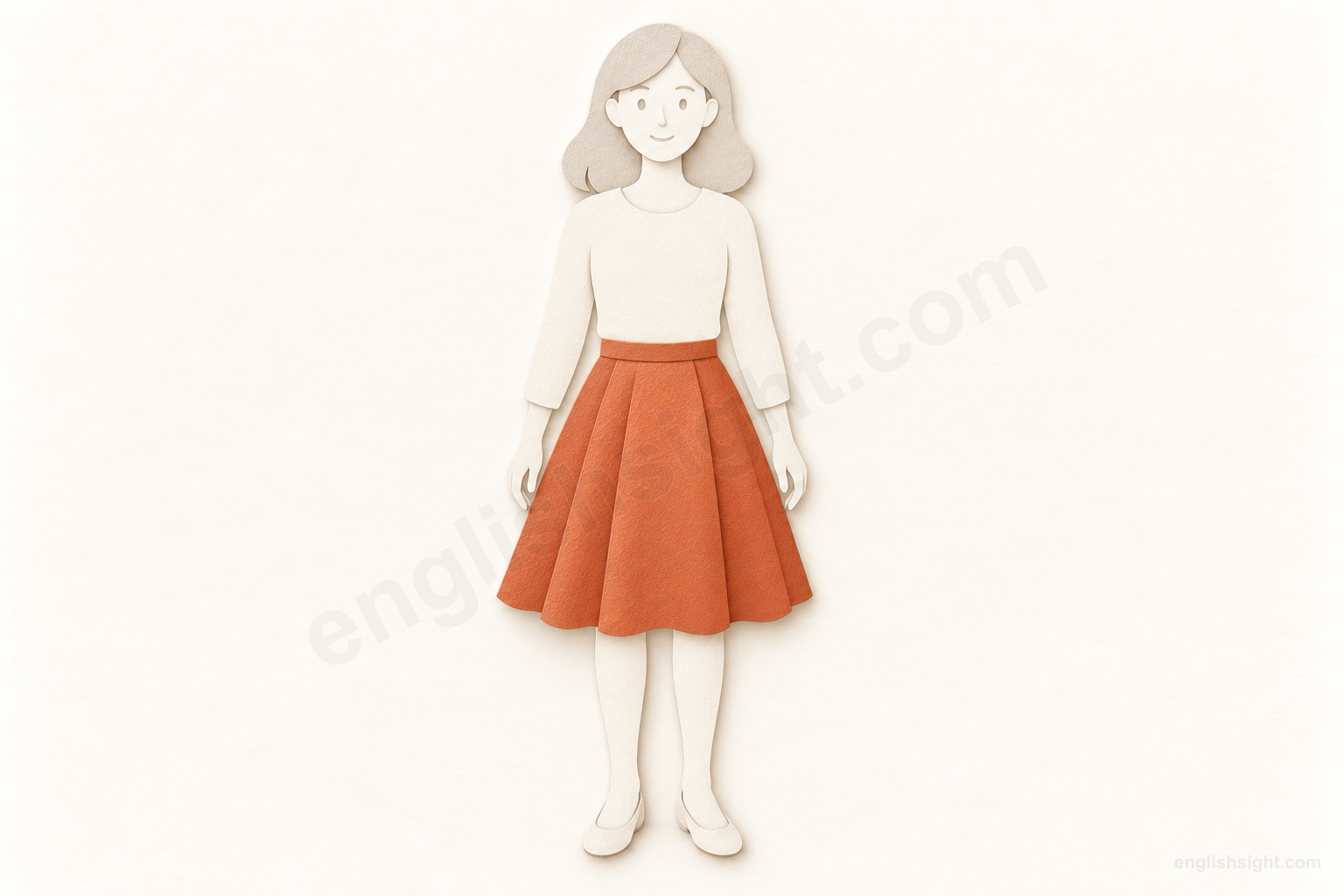
Recognize the clothing noun, then distinguish the verb’s spatial and avoidance uses.
Hanging around the legs
Hanging around the legs
The waistband sits at the wearer's waist.
skirt
Both lower legs emerge beneath the same hem.
One continuous body of fabric hangs around both legs.
The waistband supports fabric around both legs; the hem is its lower edge. This static view illustrates the clothing noun.
A clothing skirt hangs from the waist around the legs, without separate trouser legs. Related covering nouns resemble this lower hanging layer; the verb has an edge-and-avoidance branch.
The labels identify parts of a static relationship, not before-and-after events. The clothing sketch does not predict every use: learn the verb constructions and established compounds in their own contexts.
A skirt can be something you wear, a lower hanging section, or a covering. As a verb, skirt can describe staying along an outside edge or avoiding direct involvement. The sentence tells you which branch applies.
The diagram focuses on the clothing noun: material hangs from the waist around the legs. It is a teaching aid, not a claim that every English speaker imagines the same picture.
01
Clothing and the lower part of a dress
Begin with the everyday countable noun. Describe an item of clothing, or identify a lower section of a larger garment.
01
a skirt; wear / put on / take off a skirt; in a skirt; adjective + skirt
wear a skirt
wear a separate garment hanging from the waist around the legs
Situation / starting point
You choose clothes for work.
Meaning in context
A skirt is part of the outfit.
The skirt hangs around the legs without separate trouser legs.
A skirt is a separate clothing item supported at the waist. It can be short or long; the word alone does not specify a length, fabric, or shape. A dress includes an upper-body section as well as its lower section.
Use a skirt for one item and skirts for more than one or for the category: I wear skirts in summer. Unlike trousers, one skirt is not normally described as a pair of skirts. A person in a skirt is wearing one.
Choose details for the situation: a denim skirt names the fabric; a pleated skirt has folds; a knee-length skirt reaches approximately to the knees. Wear describes having it on, while put on and take off describe changes. These verbs supply the action, not skirt.
In a sentence
Maya put on a knee-length skirt and a light jacket.
Watch the difference Do not use skirt for every garment that reaches below the waist: a whole dress is a dress.
02
the skirt of + dress / coat; the hem of + skirt
the skirt of a dress
the section of a dress or similar garment below the waist
Situation / starting point
You describe a dress with a fitted top.
Meaning in context
Attention turns to its lower, hanging section.
Skirt can name a part of a garment rather than a separate item.
The skirt of a dress is its lower section. The dress may be one garment even when someone discusses its top and skirt separately. This sense can also apply to the hanging lower part of a coat.
The hem is the finished lower edge, not the entire skirt. The phrase the hem of her skirt identifies that edge. You may encounter plural skirts for the lower hanging material of a dress or coat, especially in descriptive writing; it need not mean several separate garments.
In a sentence
The top of the dress is plain, but the skirt has deep folds.
Watch the difference A skirt is not just the hem: the hem is an edge of the fabric.
02
Hanging covers and a food name
A hanging covering can resemble a clothing skirt. Skirt steak is a separate established name to recognize on a menu.
03
a bed skirt; a skirt around / on + furniture
a bed skirt
a hanging cloth covering around furniture
Situation / starting point
The bed frame and stored boxes are visible.
Meaning in context
A cloth panel hangs down around the bed.
A furniture skirt resembles the hanging layer of clothing.
A bed skirt hangs down from the sides of a bed, often hiding the space underneath. Skirt can similarly name cloth hanging from the lower edge of other furniture.
Bed tells you what the covering belongs to. This is a noun compound, not a person wearing clothes and not the top sheet used to cover a sleeper.
In a sentence
The bed skirt hides the boxes under the bed.
Watch the difference Use the furniture context to identify the meaning; the covering does not need a human waist.
04
a protective / rubber skirt; the skirt of + machine / vehicle
a protective skirt
a layer extending down around a machine or vehicle base
Situation / starting point
A machine needs a covering at its lower edge.
Meaning in context
An outer layer surrounds its base.
The extended noun names a surrounding lower covering.
In equipment descriptions, a skirt can be a lower outer layer or attachment that covers or protects a base. A hovercraft, for example, has a flexible skirt around its bottom.
The resemblance is in position and covering function; the part need not be clothing or cloth. Read the equipment description to find out its material and purpose.
In a sentence
The mechanic checked the rubber skirt around the hovercraft.
Watch the difference This is an equipment sense, not a general name for every machine cover.
05
skirt steak; a skirt steak; skirt (British English, beef)
skirt steak
a named cut of beef
Situation / starting point
You read a restaurant menu.
Meaning in context
Skirt steak identifies a food choice.
This established food name is a separate vocabulary branch.
Skirt steak is a thin cut of beef. Learn the complete food name; clothing vocabulary cannot tell you what is on the plate. In British English, skirt alone can also name a cut of beef, as in skirt for a stew. Butchery names can vary by region; do not assume every use identifies exactly the same cut.
In We ordered skirt steak, the phrase names the food. A skirt steak can refer to an individual piece. The first word identifies the kind of steak, not an action performed on it.
In a sentence
We ordered skirt steak with grilled onions.
Watch the difference The diagram does not explain the name of this cut. Do not interpret it as clothing.
03
Moving or lying along an edge
With the verb, distinguish a traveler taking an outside route from a road or landscape feature already lying along a boundary.
06
skirt + place; skirt around / round + place; skirt along + edge
skirt the lake
travel along or around the outside of an area
Situation / starting point
A lake lies beside the walking route.
Meaning in context
The walkers follow its edge instead of entering it.
The moving subject takes a route near the boundary.
When people or vehicles skirt a place, they travel along or around its edge. The object names the place they pass beside, not an object they carry. The route need not make a complete circle.
Both skirt the lake and skirt around the lake are possible. Round is also used, especially in British English. Around makes the outside route explicit; it does not add a new clothing meaning. Skirt along the edge of something is another spatial pattern.
In a sentence
We skirted the lake before climbing towards the village.
Watch the difference Skirting an area does not normally mean crossing its interior, and does not guarantee a full circuit.
07
road / path / trees + skirt + place
a road skirts the town
a feature runs along the edge of a place
Situation / starting point
You examine where a road lies.
Meaning in context
Its course follows the town’s outer boundary.
A road can skirt something without moving.
A road, field, or line of trees can skirt a place by lying along its edge. The subject is a feature of the landscape. The sentence describes its position or extent, not the road traveling anywhere.
Compare We skirted the wood, an event involving travelers, with A path skirts the wood, a description of the path. Use the subject and context to choose between movement and location.
In a sentence
A narrow road skirts the town on its eastern side.
Watch the difference The verb does not require the feature to surround the entire place.
04
Avoiding direct involvement
The edge idea helps organize these uses, but avoiding a question, evading a rule, and narrowly escaping trouble describe different situations.
The speaker talks around it without a direct answer.
The speaker avoids the central matter, as a route avoids an interior.
Skirt the issue, question, or subject means avoid addressing it directly. A speaker may say something related while leaving the main point unanswered. Skirt around or skirt round the issue has the same general use.
The physical edge is a teaching comparison, not a literal place in the conversation. Avoidance can be tactful or evasive, depending on the situation. It does not by itself mean lie, solve the problem, or answer briefly.
In a sentence
Asked about the missing money, he skirted the issue and discussed next year’s plans.
Watch the difference An indirect answer is not necessarily false; the key point is failure to address the matter directly.
09
skirt + rules / regulations / law
skirt the rules
try to avoid the effect of a requirement or restriction
Situation / starting point
A rule would limit a proposed activity.
Meaning in context
Someone looks for a way to avoid its effect.
The object is a restriction rather than a topic of conversation.
With rules, regulations, or the law as its object, skirt can describe evading a restriction rather than discussing it indirectly. Someone may use a loophole or a device intended to avoid a requirement.
This broader avoidance use shares the outside-route comparison with skirt the issue, but the practical goal differs: the person wants to avoid a restriction’s effect. The wording alone does not establish whether the conduct is lawful.
In a sentence
The company split the order into smaller parts to skirt the purchasing rules.
Watch the difference Do not assume skirt the law means definitely obey it, or definitely break it; the context must establish that.
10
skirt + disaster / danger
skirt disaster
come close to trouble while avoiding it
Situation / starting point
A situation becomes dangerously close to failure.
Meaning in context
The worst outcome is narrowly avoided.
Nearness and avoidance combine in this additional figurative use.
In descriptions of danger, skirt disaster can mean narrowly avoid a disastrous outcome. This is not the conversational meaning avoid discussing a disaster: the subject is close to experiencing it.
Compare The captain skirted the question of safety, which concerns an answer, with The voyage skirted disaster, which concerns danger. This is a useful reading extension rather than the first meaning to use when naming clothes.
In a sentence
With its engine failing near the rocks, the boat skirted disaster before help arrived.
Watch the difference Skirted disaster describes a narrow escape in this context; skirted the issue describes avoidance of a topic.
Keep the branches and grammar distinct
One item, not a pair
The clothing noun is countable: a skirt, two skirts. Length and material are extra details, not fixed parts of the meaning. Clothes do not determine who is allowed to wear them.
Forms and construction
The verb forms are skirt, skirts, skirted, skirting. Skirted has an extra final syllable. The object can directly follow the verb, or a preposition can introduce a spatial or figurative complement: skirt it; skirt around it. Do not treat around as a separable particle and write skirt it around for the avoidance meaning.
A useful passive, not a new meaning
The issue was skirted in the report is a passive of the topic-avoidance use. Was skirting can describe ongoing movement or avoidance. The verb does not have a separate everyday causative-complement family to memorize.
Recognize boundaries
For the outer parts of a town, learn on the outskirts of town. You may encounter skirts of a place in older or literary writing, but outskirts is the ordinary learner choice here. Skirt used to refer to a woman is offensive and objectifying; do not use it as a neutral personal description.
Choose the meaning in context
Identify the subject and object, then decide whether the sentence concerns clothing, location, movement, or avoidance.
1. You want one separate garment worn from the waist down. Which request fits?
2. A map shows a path beside a wood. No one is walking in the sentence. What does A path skirts the wood describe?
3. A manager is asked why wages were delayed but only praises the staff. Which description fits?
4. The skirt of this dress is torn. Which part needs repair?
5. The boat skirted disaster near the rocks, but nobody was hurt. What is meant?
Sources and teaching notes
The linked dictionary entries support the senses and constructions. Explanations, examples, comparisons, and the compatibility sketch were created for this lesson; visual links are teaching interpretations.
The diagram is a teaching aid, not a picture shared by every native speaker.