From clouds and stars to flying, high prices, and familiar idioms.
The visible space overhead
The visible space overhead
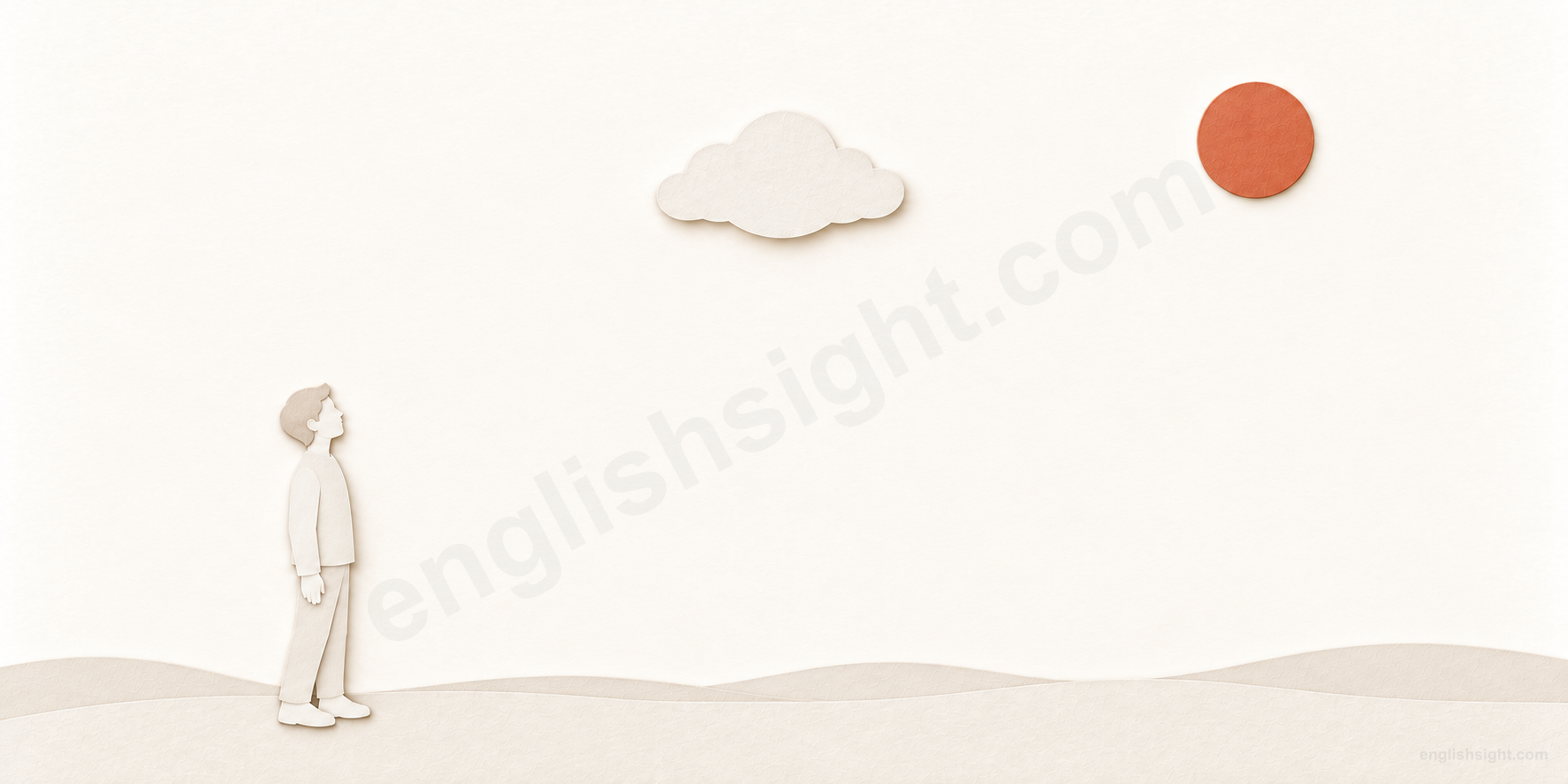
A person stands on the ground beneath a low horizon.
sky
A cloud and the sun appear in the broad expanse above the ground.
The person tilts their head upward toward the open overhead view.
The sky is the broad view above the ground, not just the cloud or the sun.
Sky names the broad expanse we see above the earth when we look up.
This is a viewpoint, not a solid roof or a precise atmospheric layer. A cloud and the sun help locate the expanse; neither one alone is the sky. Fixed idioms need their own explanations.
Look upward from the ground: the broad overhead view is the sky. It can be blue, grey, pink, or dark, and we describe clouds, the sun, and stars as appearing in it.
Start with this visible relationship, then read the complete expression. Sky-high prices, pie in the sky, and the sky’s the limit use familiar comparisons or fixed meanings; they are not new kinds of weather.
01
The view above us
Name the sky, describe its appearance, and choose words for objects, movement, and the ground beneath it.
01
the sky; look at / look up at the sky
the sky
the visible expanse above the earth
Situation / starting point
You are outside and look upward beyond the buildings.
What the expression conveys
You see clouds and open space stretching above you.
Sky names the whole overhead view rather than one cloud or object.
Sky /skaɪ/ is usually a noun. It names the expanse we see above the earth, with clouds, the sun, or stars appearing in it. The usual everyday form is the sky: Look at the sky, or The sky is getting dark.
This is a description from our viewpoint, not a precise scientific boundary. The moon is in the sky in ordinary observation even though it is far beyond the atmosphere. Sky does not mean only the blue part on a sunny day.
Use air for the gas around us: We need fresh air. Use space or outer space when discussing the region beyond the atmosphere: The probe travels through space. Neither is an automatic replacement for the visible sky.
In a sentence
We looked up at the sky and noticed a ring around the moon.
Watch the difference Usually include the: Look at the sky, rather than Look at sky. Do not treat sky as another word for breathable air.
02
a + adjective + sky; adjective + skies; a patch of + sky
a clear sky / clear skies
describe a particular appearance or an extensive view of the sky
Situation / starting point
You want to describe how the sky looks on your trip.
What the expression conveys
You choose a singular description or the familiar plural skies.
Skies often describes extent or weather, not a count of separate overhead objects.
With an adjective, a singular description can use a: We woke to a clear sky. If the view is already identified, the is also possible: The clear sky above the village made the stars easy to see. An adjective does not force a in every sentence.
Skies /skaɪz/ is the plural spelling. Clear skies and blue skies are natural in weather reports and descriptions of broad views. Use singular agreement with sky and plural agreement with skies: The sky is clear; The skies are clear.
Sky also has uncountable uses when you describe an amount or area: A patch of blue sky appeared between the clouds. That is a portion of the view, not a small separate sky.
In a sentence
We crossed the hills under clear skies.
Watch the difference Write skies, not skys. Clear skies does not mean that several planets or several skies have been counted.
03
the sky + clears / darkens; clear / cloudy / overcast + sky or skies
the sky clears / cloudy skies
describe cloud cover and changes in the visible weather
Situation / starting point
Clouds cover the view overhead.
What the expression conveys
The clouds move away and more open sky becomes visible.
A verb describes a change; an adjective describes the sky’s condition.
A cloudy, overcast, or stormy sky describes different appearances associated with weather. A clear or cloudless sky has little or no cloud. Sunny skies describes sunny weather; skies can stand for conditions overhead.
The sky cleared and The skies cleared mean the cloud cover went away or became less. The sky darkened or turned grey describes a change in brightness or colour, which may accompany cloudier weather; darkening can also happen as daylight fades. In these sentences clear and darken are the verbs; sky remains a noun.
Do not make the visual description say more than it does. A clear sky can occur at night or in cold weather. It does not by itself mean a warm day.
In a sentence
The sky cleared after lunch, so we ate outside.
Watch the difference To report improving cloud cover, say The sky is clearing. The sky is cleaning suggests the wrong verb.
04
the night / evening / morning sky; a starry sky; high / low in the sky
the night sky
the sky as it appears at night
Situation / starting point
Daylight fades and you look upward.
What the expression conveys
The moon and stars become visible against the dark background.
Night changes the appearance of the sky, not the identity of the noun.
The night sky is the overhead view at night. A starry sky describes visible stars; the evening sky and the morning sky locate the view in time. These are ordinary noun combinations, not separate idioms.
You can describe the sun as high or low in the sky, or say The evening sky turned pink. These describe apparent position and colour from where we stand, not a scientific claim that the sun is inside the air.
Sky is broader than sunlight or daylight: it is still there when dark. A night sky may be cloudy, so night sky does not itself promise visible stars.
In a sentence
Away from the streetlights, we could see more stars in the night sky.
Watch the difference Use the night sky for the view and at night for the time: We watched the sky at night.
05
something + in the sky; the sky / skies + over / above + place
in the sky / the sky over…
locate a visible object or identify the area overhead
Situation / starting point
You notice something above a town.
What the expression conveys
You explain where it is and which area you are describing.
In locates an object in the overhead view; over or above relates that view to the ground.
Use in the sky for something visible overhead: A plane is in the sky. This is the ordinary pattern for stars, clouds, and aircraft as seen from the ground. Sky supplies the region; in supplies the location relationship.
The sky over the harbour or the skies above the city identifies the ground area below the view. In The plane flew over the harbour, over instead directly relates the plane to the harbour.
For the ordinary visible view, in the sky is the useful default. On the sky does not normally locate a cloud or a bird, and above the sky is not the usual way to say overhead.
In a sentence
We noticed a pale moon in the sky over the harbour.
Watch the difference Say clouds in the sky, rather than clouds on the sky.
06
move across the sky; rise into the sky; fall from / out of the sky
across / into / from the sky
describe a path seen overhead or movement toward or from above
Situation / starting point
You follow the path of a moving object.
What the expression conveys
You describe its direction relative to the overhead view.
The preposition gives the path; sky supplies the visible region.
Across the sky follows a path through the overhead view: A flock crossed the sky. Into the sky presents upward movement into that view: The balloon rose into the sky. Neither combination is a phrasal verb formed from sky.
From the sky presents an overhead source: Hail fell from the sky. Out of the sky can also describe something physically falling from above. Read the event before deciding that the words are figurative.
Compare A balloon hangs in the sky, which locates it, with A balloon rises into the sky, which describes movement. Into belongs to the path, not to a different meaning of the noun.
In a sentence
A bright meteor flashed across the sky above the campsite.
Watch the difference Across the sky does not imply travel into outer space. It describes the visible path from our viewpoint.
07
stand out / appear / be silhouetted + against the sky
against the sky
visible with the sky as a background
Situation / starting point
A dark shape stands out above a ridge.
What the expression conveys
You describe the sky behind its outline.
Against marks a visual background here, not opposition or physical contact.
A tree, bird, or building can stand out against the sky. The sky forms the background that makes the shape easy to see. A bare tree stood black against the pale sky describes this visual contrast.
Compare in the sky, which locates something overhead, with against the sky, which emphasizes how its outline appears. A tower can be seen against the sky although it is fixed to the ground.
In a sentence
The castle towers stood out against the orange sky.
Watch the difference Against the sky does not mean that the object touches a solid surface called the sky.
08
under the open sky; under / beneath + a + adjective + sky
under the open sky
outdoors with no roof overhead
Situation / starting point
You choose a place outside rather than inside a building.
What the expression conveys
The sky is overhead without a roof covering you.
Under relates people or things on the ground to the sky above.
Under the open sky means out in the open, with no roof above. It is a descriptive expression useful for camping, sleeping outdoors, or an outdoor event. Open here is about an unobstructed overhead setting, not a door being opened.
Under a cloudy sky describes the weather above an activity: We walked under a cloudy sky. It does not necessarily mean rain is falling. Beneath can replace under in more literary descriptions.
In a sentence
On the warmest night, we slept under the open sky.
Watch the difference People on the ground are under the sky; that does not place them in outer space.
02
Flying, sport, colours, and high levels
Some combinations keep a physical link to the sky; others use its colour, height, or openness as a comparison. The whole expression determines the meaning.
09
take to the skies; fly / patrol + the skies + over + place
take to the skies
begin flying or go flying
Situation / starting point
An aircraft is on the ground or birds are at rest.
What the expression conveys
They are airborne and flying.
The fixed combination take to gives the start of flight; skies names the flying environment.
Take to the skies is a familiar expressive way to say begin to fly or go flying, often in reports about aircraft or birds. It can describe a first flight or a return to flying. It is more vivid than simply saying take off.
Skies also refers to an area of air used for flight: Aircraft patrol the skies over the coast. The literal connection to the overhead region remains, but a patrol is not necessarily taking off at that moment.
Keep the expression together. A pilot who takes to the skies is going flying, not taking possession of the sky. Skies is the noun in the phrase, not the third-person form of the verb sky.
In a sentence
The restored plane took to the skies again after months of repairs.
Watch the difference Use took to the skies for the established past-tense expression; took the skies changes the construction.
10
sky + ball / shot; skies; skied; skying
sky a ball
hit a ball very high into the air
Situation / starting point
A player makes contact with the ball.
What the expression conveys
The ball travels high upward.
As a sports verb, sky describes the high hit rather than naming the overhead region.
In sport, sky can be a verb with the ball or shot as its object. Someone who skies the ball hits it very high, often higher than intended. The high path connects naturally with the noun, but this is a particular sports use, not a general verb for everything moving upward.
The forms include skies, skied, and skying. Some dictionaries also record skyed. The past skied here is pronounced /skaɪd/; it has the same spelling as the past of ski, which is pronounced /skiːd/. Context distinguishes a high hit from skiing on snow.
A passive is possible: The ball was skied over the goal. In ordinary conversation, hit the ball too high is clearer if the listener does not know the sports verb.
In a sentence
He skied the ball over the goal and into the empty seats.
Watch the difference The sky cleared uses a noun plus another verb. He skied the ball uses sky itself as a verb.
11
sky blue as a colour noun; sky-blue + noun
sky blue / sky-blue
a blue colour compared with a clear daytime sky
Situation / starting point
You choose a colour for paint or clothing.
What the expression conveys
You identify the blue shade by comparison with a clear sky.
The sky supplies a colour comparison; the object need not be outdoors.
Sky blue names a blue colour like a clear daytime sky. Sky-blue is the adjective: a sky-blue shirt. You can say We chose sky blue for the walls, where the colour name functions as a noun.
Distinguish a blue sky, which describes the actual sky, from a sky-blue door, which describes a door’s colour. Reversing the order changes the structure.
Blue-sky thinking is another established expression about ideas. It does not describe the colour of someone’s thoughts or an object painted sky blue.
In a sentence
She picked a sky-blue jacket for the school trip.
Watch the difference A blue sky and a sky-blue jacket are different noun phrases; do not swap their word order.
12
sky-high + noun; be / go / rise + sky-high
sky-high prices / go sky-high
at or to an extremely high level
Situation / starting point
You compare a price or degree of confidence with the usual level.
What the expression conveys
You emphasize how high it is or how far it has risen.
Physical height becomes a comparison for amount or degree.
Sky-high can describe a very high level: sky-high rents, or Her confidence was sky-high. The level can be unwelcome, as with costs, or positive, as with confidence; the expression alone does not mean good or bad.
It also occurs after a verb to describe a rise: Ticket prices went sky-high. Here no price moves physically through the air. The height comparison is useful, but learn the adjective and adverb patterns as combinations.
Sky-high can be literal with movement high into the air. The separate expression blow something sky-high has a destruction meaning; read that complete expression rather than assuming it always means a rise in price.
In a sentence
Hotel prices went sky-high during the festival.
Watch the difference Sky-high confidence means strong confidence, not confidence about the weather.
13
blue-sky + thinking / research / ideas
blue-sky thinking
explore imaginative ideas without starting from immediate practical limits
Situation / starting point
A team is looking for fresh possibilities.
What the expression conveys
Members suggest ideas before testing how practical they are.
This workplace expression concerns the approach to ideas, not the weather.
Blue-sky is used before a noun in combinations such as blue-sky thinking, blue-sky research, and blue-sky ideas. It concerns imaginative possibilities which may not yet be practical. You are not reporting that the meeting happens outside.
As a memory aid, an open sky can suggest room for ideas; that is a teaching comparison rather than a rule for predicting the expression. The established adjective must be learned.
Blue-sky thinking can be welcomed as exploration. Calling a promise pie in the sky is usually dismissive because it seems unlikely to happen. Creative exploration and an unrealistic promise are not the same judgment.
In a sentence
We began with some blue-sky thinking before checking the budget.
Watch the difference Sky-blue thinking would suggest the colour pattern in the wrong order. The established expression is blue-sky thinking.
03
Possibilities, surprises, and strong judgments
Learn these expressions as established combinations. A mental picture may help you remember them, but it cannot supply their full meaning or tone.
14
the sky is the limit; the sky’s the limit
the sky’s the limit
there seems to be no limit to what can be achieved
Situation / starting point
Someone sees an opportunity to develop or succeed.
What the expression conveys
A speaker encourages them to imagine much greater possibilities.
This informal expression presents an open range of achievement, not a measurable height.
The sky’s the limit is an informal encouraging statement about possibilities. Sky’s contracts sky is. A speaker may use it about achievement, earnings, or what someone might do.
The expanse overhead can help you remember the idea of no obvious upper boundary. The phrase is still a conventional exaggeration; it does not remove real financial or physical limits.
Compare The limit is fifty dollars, which states an actual maximum. The sky’s the limit normally does not give you a number or a guarantee of success.
In a sentence
With these new tools, the sky’s the limit for our small design team.
Watch the difference The apostrophe in sky’s represents is here, not ownership. Keep the in the established expression.
15
a plan / promise + be + pie in the sky
pie in the sky
an attractive idea or promise that seems unlikely to become real
Situation / starting point
Someone offers a very appealing future plan.
What the expression conveys
You doubt that the plan can actually happen.
The whole idiom conveys skepticism about an attractive possibility.
Calling something pie in the sky says it sounds appealing but seems unrealistic. It is informal and usually critical. The ordinary interpretation concerns a hope, plan, or promise, not food or the weather.
Something desirable but out of reach is a useful memory aid. It does not follow that sky itself means unrealistic. The skeptical meaning belongs to pie in the sky as a fixed combination.
Contrast blue-sky thinking, which can describe a useful exploratory stage, with pie in the sky, which doubts the likely outcome. Also contrast the sky’s the limit, which usually encourages possibility.
In a sentence
Free transport for everyone sounded like pie in the sky without a funding plan.
Watch the difference The expression normally criticizes feasibility, not whether the idea is pleasant or morally good.
16
praise + someone / something + to the skies; be praised to the skies
praise someone to the skies
express very strong approval of someone or something
Situation / starting point
A speaker is impressed by a person or a result.
What the expression conveys
They describe its qualities with great enthusiasm.
To the skies intensifies praise rather than describing physical movement.
Praise someone or something to the skies means praise them very highly. The person or thing praised is the object of praise, and to the skies describes the strength of that praise.
Height is a helpful association for a very high evaluation, but nobody is lifted physically. A passive is natural: The film was praised to the skies.
Strong praise may be sincere or may sound excessive in context. The idiom alone does not prove that the praise is dishonest.
In a sentence
The reviewers praised the young actor to the skies.
Watch the difference The fixed phrase uses plural skies: praise her to the skies, not praise her into the sky.
17
an event + come / happen + out of a clear blue sky
out of a clear blue sky
suddenly and without being expected
Situation / starting point
Nothing has led you to expect a particular event.
What the expression conveys
It happens and surprises you.
The established expression concerns lack of warning, not actual cloud cover.
Out of a clear blue sky describes a completely unexpected event. It can describe a surprising offer or unwelcome news; the surprise itself does not decide whether it is good or bad.
A clear sky with no visible sign of a storm is a useful memory comparison. In the idiom, however, an email or decision does not physically fall from overhead. Learn the whole expression.
Compare Hail fell out of the sky, which describes a physical source, with The offer came out of a clear blue sky, which emphasizes surprise. Shorter variants such as out of a clear sky are also recorded.
In a sentence
The offer to work abroad came out of a clear blue sky.
Watch the difference A clear blue sky in a weather report is literal. The longer expression has an unexpected-event reading when the context supports it.
18
blow + something + sky-high; be blown sky-high
blow something sky-high
destroy something completely, literally or figuratively
Situation / starting point
Something exists intact, or a claim still seems credible.
What the expression conveys
An explosion destroys it, or evidence destroys confidence in the claim.
The blow construction supplies destruction; sky-high alone does not.
Blow something sky-high is a vivid expression for destroying it completely. It can describe an explosion: The blast blew the old shed sky-high. That is much stronger than saying something merely rose high into the air.
It can also be figurative: The new evidence blew his explanation sky-high. The explanation is shown to be untenable, rather than moving upward or becoming more successful.
Compare Prices went sky-high, which reports a very high level. The verb and object change the interpretation. With a pronoun, keep it after blow: blew it sky-high.
In a sentence
The dated photograph blew their claim sky-high.
Watch the difference Blowing a claim sky-high destroys it; it does not give the claim strong praise.
19
go to + the great + place associated with the subject + in the sky
the great … in the sky
an imagined destination after death or after something stops working
Situation / starting point
A familiar person, animal, or object is no longer present or usable.
What the expression conveys
A speaker imagines a suitable place for it beyond ordinary life.
This humorous or affectionate formula hints at an afterlife or final retirement.
The great … in the sky is a formula in which a suitable place fills the gap. My old laptop has gone to the great computer shop in the sky humorously says it has finally stopped working. It does not report where a real shop is located.
The expression can also refer to death, using a place associated with the person or animal. It draws on a cultural association between the sky and an afterlife, not on the everyday geographical definition of sky.
Treat this mainly as a recognition item. Such humour may be affectionate among people who welcome it, but it can sound insensitive when someone is grieving. Heaven is a separate religious word; ordinary talk about the sky need not be religious.
In a sentence
Our ancient printer has gone to the great office in the sky.
Watch the difference Do not assume this is a neutral way to report a person’s death. Tone and the listener’s feelings matter.
Keep the view, grammar, and idiom distinct
Sky, air, space, and heaven
Sky is the visible overhead expanse. Air is the gas around us; space can name the region beyond the atmosphere; heaven has religious or figurative uses. Seeing the moon in the sky does not put it inside the atmosphere.
Articles and agreement
The sky is the everyday default. A descriptive singular can use a, while a particular identified view can still use the. Skies takes plural agreement and often describes a broad view or weather. A patch of sky uses sky without its own article.
A noun is not secretly a verb
In The sky is clearing, clear is the verb. The separate sports verb sky takes an object and permits a passive. Do not invent a general causative, linking, or particle-verb family from this noun.
A teaching connection has limits
Height, openness, and a visible overhead source can help you remember some expressions. They do not mechanically predict pie in the sky or the great … in the sky, and they do not represent a single image shared by every English speaker.
Coverage boundary
This lesson prioritizes the everyday noun, its main constructions, the sports verb, selected useful compounds, and familiar idioms. Specialist rowing and art-hanging verbs, rare jumping uses, obsolete sky meaning cloud, proper names, and the wider family of compounds are not developed here.
Read the whole expression
Choose the wording or interpretation that fits the situation.
1. You point to an aircraft visible overhead. Which wording is the ordinary location pattern?
2. Which sentence correctly uses the familiar plural skies?
3. The sky is clearing after a cloudy morning. What is happening?
4. A promise sounds attractive, but nobody explains how it could be achieved. Which expression conveys doubt?
5. You want a jacket in a blue shade like a clear daytime sky. Which noun phrase fits?
6. In a match report, a player skied the ball. What does sky mean here?
7. The new evidence blew the explanation sky-high. What happened?
Sources and teaching notes
The sources below support the recorded uses and grammar. The explanations, examples, and visual model were created for this lesson. Connections used as memory aids are teaching interpretations, not dictionary claims about every speaker’s mental image.
The diagram is a teaching aid; English speakers need not share the same mental picture.