Sleep: a resting state, and the expressions around it.
Distinguish being asleep, beginning to sleep, and meanings carried by the whole expression.
A pause in ordinary waking activity
A pause in ordinary waking activity
Ordinary waking activity pauses.
sleep
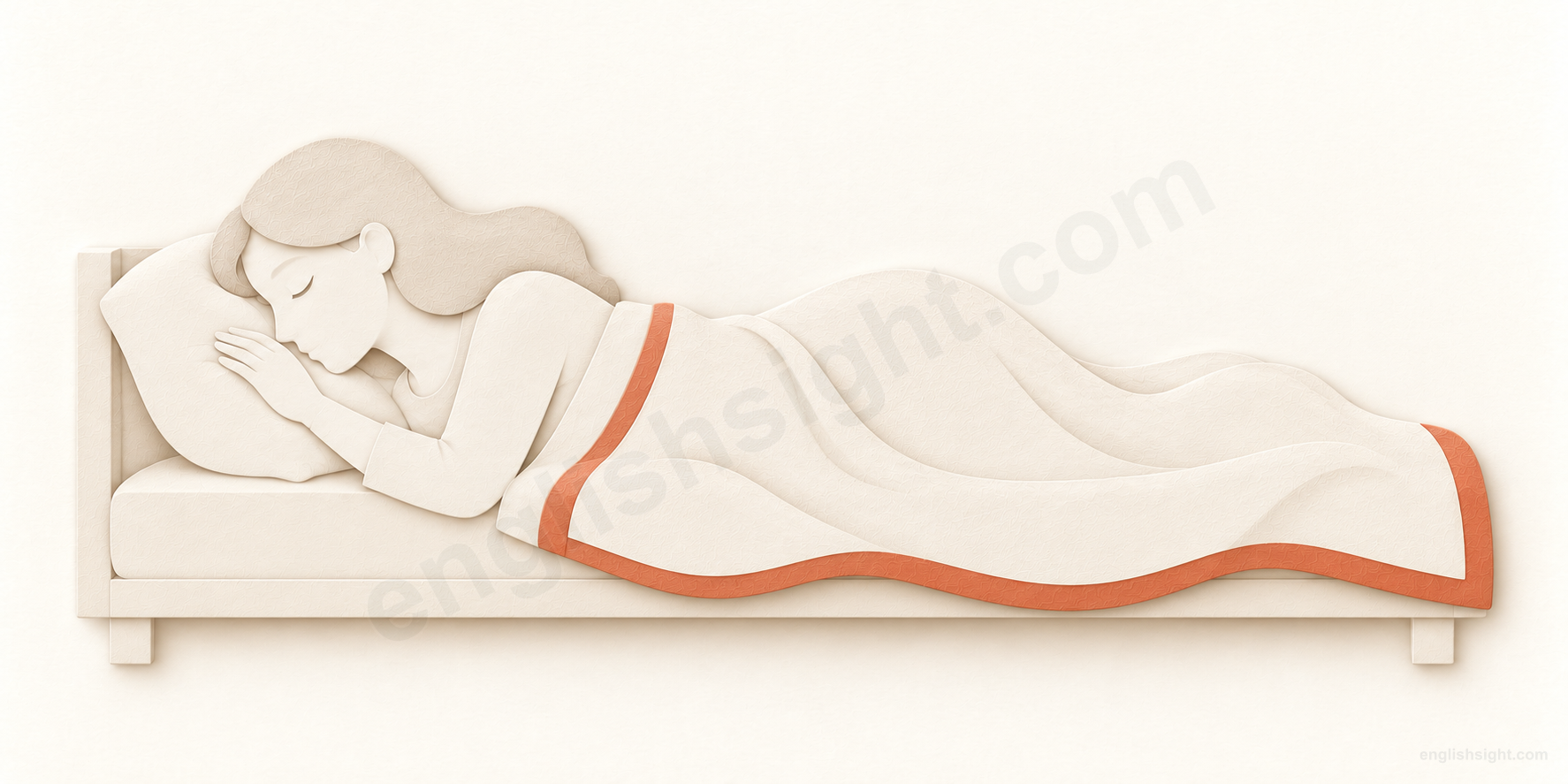
The picture stays with the sleeping state; its beginning and end are not shown.
The person rests on their side, with a closed eye and a relaxed hand on the pillow.
Sleep is a natural resting state; the bed is a familiar setting.
To sleep is to be in a recurring natural state of rest, temporarily disengaged from ordinary waking awareness and activity.
The central meaning is a state, not necessarily the moment of entering it. Go to sleep marks the beginning; wake up marks the end. The model is not a medical definition and does not mean that the brain stops working.
Sleep names a recurring natural rest state and also works as the verb for being in that state. A person can be in bed without sleeping, and sleepy without being asleep.
This lesson connects everyday sleep language to that central state, while keeping accommodation, idioms, and euphemisms distinct. The picture is a teaching aid, not a claim that every English speaker imagines the same scene.
01
Sleeping, falling asleep, and getting enough rest
Separate the state from its beginning, then choose a verb or noun to describe duration and quality.
01
subject + sleep; be + asleep; be + sleeping
sleep / be asleep
be in the natural resting state rather than awake
Situation or intention
Maya has stopped responding to the conversation.
Meaning in this context
She is sleeping on the sofa.
Sleep describes the state; asleep is an adjective describing the person.
Sleep is the general verb for this natural rest. Maya sleeps after lunch describes a habit; Maya is sleeping describes what is happening now. The ordinary sleeper is the subject, with no direct object. Have trouble sleeping and have difficulty sleeping describe a problem with falling or staying asleep; sleeping follows the noun without to.
Maya is asleep describes the same person’s condition. Sleepy means ready or likely to fall asleep; a sleepy person can still be awake. Rest is broader: you can rest quietly without sleeping.
An original example
Please lower your voice; Maya is sleeping.
Watch the difference Say She is asleep or She is sleeping, not She is sleep. Sleep does not mean simply lying down.
02
go / get (back) to sleep; fall asleep
go to sleep / get to sleep / fall asleep
begin sleeping
Situation or intention
You are in bed but still awake.
Meaning in this context
Sleep begins some time later.
The beginning of sleep differs from being in bed or already sleeping.
Go to sleep and fall asleep mark entry into sleep. Get to sleep also means begin sleeping and often occurs when doing so is difficult: I couldn’t get to sleep. Go back to sleep means resume sleep after waking.
Go to bed means get into bed or retire for the night; it does not guarantee immediate sleep. I went to bed at ten but didn’t get to sleep until midnight makes the difference explicit. Fall asleep can also describe an unplanned beginning, as during a film.
An original example
I went to bed early, but I couldn’t get to sleep.
Watch the difference In go to sleep, sleep is a noun after to. Say I fell asleep, not I fell sleep.
03
get / need + some / enough / more sleep; number + hours’ sleep
get some sleep / eight hours’ sleep
talk about the amount of sleep obtained or needed
Situation or intention
A busy week has left you tired.
Meaning in this context
You make time for more sleep.
Sleep is normally uncountable when treated as an amount.
Get some sleep means manage to sleep for a while. Need more sleep, not get much sleep, lack of sleep, and go without sleep describe quantity or its absence. Catch up on sleep means get extra sleep after having too little. Sleep deprivation is a lack of sufficient sleep. A sleep schedule concerns when you plan to sleep; a sleep pattern describes your usual timing and habits.
I slept for eight hours uses the verb plus duration. I got eight hours’ sleep uses a noun with a plural possessive; I got an hour’s sleep has a singular possessive. These describe amounts, not eight separate sleeps.
An original example
I only got four hours’ sleep, so I’ll try to catch up on sleep this weekend.
Watch the difference Use much sleep, not many sleep. Catch up on sleep is a phrase built with catch up, not a phrasal verb formed from sleep.
04
have + a (short / good) sleep; a good night’s sleep
have a sleep / a good night’s sleep
refer to one period of sleeping
Situation or intention
You have a break before the evening shift.
Meaning in this context
You spend part of the break asleep.
A sleep can name one episode, although sleep as a general amount of rest is uncountable.
Have a sleep means sleep for a period; I need a sleep treats it as one rest episode. A good night’s sleep describes a night of satisfactory sleep. Fall into a deep sleep similarly presents a particular spell of sleeping.
A nap is a short sleep, often in the day. Doze and informal snooze also suggest short sleep, often light sleep. They are more specific than the general verb sleep; an ordinary night’s sleep is not normally called a nap.
An original example
I had a short sleep before my evening shift.
Watch the difference A sleep is possible for an episode. This does not make many sleep correct when you mean a large amount of sleep.
05
sleep + adverb; sleep like a log / baby; not sleep a wink
sleep well / sleep like a log / not sleep a wink
describe how well, deeply, or little someone sleeps
Situation or intention
Two nights have been very different.
Meaning in this context
You compare sound sleep with almost no sleep.
These expressions describe quality or emphasize an extreme, rather than a new sleeping action.
Use sleep well or badly to assess sleep, and sleep deeply, soundly, lightly, or fitfully to describe its character. A light sleeper wakes easily; fitful sleep is repeatedly interrupted.
Sleep like a log and sleep like a baby are informal ways to say sleep very well; the baby comparison is a conventional expression, not a scientific claim about babies. I didn’t sleep a wink strongly emphasizes no sleep; I hardly slept a wink means almost none. I didn’t get a wink of sleep and I didn’t have a wink of sleep are equivalent noun patterns.
An original example
I slept like a log on Friday, but I didn’t sleep a wink on Saturday.
Watch the difference Say Did you sleep well? rather than Did you sleep good? in standard English. Not a wink needs a negative or near-negative context.
06
(Goodnight,) sleep tight!
sleep tight
wish someone a good night’s sleep
Situation or intention
You say goodnight to a child or someone close.
Meaning in this context
You express a warm bedtime wish.
Tight belongs to a familiar goodnight formula.
Sleep tight is an informal wish that the listener will sleep well, especially used to children. It is an imperative in form, but normally functions as a friendly farewell at bedtime.
Goodnight, sleep well is a plain alternative. The expression does not instruct someone to tighten a blanket, hold their body rigid, or sleep for an exact length of time.
An original example
Goodnight, Leo. Sleep tight!
Watch the difference Keep tight in this fixed expression; do not change it to tightly to make the bedtime wish.
02
Where and how the night is spent
Place phrases and established combinations describe accommodation, later mornings, overnight visits, interruptions, and recovery.
07
sleep + in / at / on + place; sleep with + condition
sleep in a room / on the sofa
say where or in what position someone sleeps
Situation or intention
The guest room is being painted.
Meaning in this context
You choose another place to sleep.
A following preposition can have an ordinary location meaning.
Sleep in a room, at a friend’s house, on a sofa, or on your back adds a place or position to the sleeping state. Sleep with the light on adds an accompanying condition. These are ordinary phrase patterns; not every sleep plus preposition is an idiom.
The sofa has been slept on and The bed hasn’t been slept in are possible prepositional passives. The sofa or bed is the place used for sleep, not a person made to sleep. Sleeping arrangements means plans for where people will sleep.
An original example
While the room was being painted, we slept on the sofa bed.
Watch the difference A sleeper does not ordinarily take a direct object: not I slept the sofa. Retain on in The sofa was slept on.
08
sleep rough
sleep rough
sleep outdoors without proper accommodation
Situation or intention
Someone has no secure indoor place for the night.
Meaning in this context
They spend the night on the street.
Rough describes the conditions of sleeping, not merely poor sleep quality.
Sleep rough is a British English expression for sleeping outside, often because someone has no home or money. It is used in discussions of homelessness and unsuitable sleeping conditions.
Compare sleep badly, which describes unsatisfactory sleep anywhere. Choosing a campsite for a holiday is normally described as camping or sleeping in a tent, rather than automatically as sleeping rough.
An original example
The charity provides hot meals for people sleeping rough near the station.
Watch the difference Rough is fixed here; sleeping roughly is not the ordinary expression for this situation.
09
accommodation + sleeps + number (of people)
the cabin sleeps four
have sleeping accommodation for a number of people
Situation or intention
You read a holiday rental description.
Meaning in this context
You learn how many people can stay overnight.
The subject is accommodation; the following number measures its capacity.
The cabin sleeps four means there is sleeping space for four people. It does not say four people are currently sleeping there, and the cabin itself is not literally resting.
This is a separate transitive capacity use. The cottage sleeps six is a normal property description; the sense is not normally progressive or passive. Compare Six people are sleeping in the cottage, which describes an actual event.
An original example
The cabin sleeps four, with two beds upstairs and a sofa bed below.
Watch the difference Do not say Four people are slept by the cabin or The cabin is sleeping four for its advertised capacity.
10
sleep in; sleep late
sleep in / sleep late
continue sleeping later into the morning than usual
Situation or intention
There is no early appointment on Sunday.
Meaning in this context
You stay asleep beyond your normal waking time.
In adds the established meaning of a later morning, not a location.
Sleep in and sleep late mean continue sleeping until later in the morning. They can describe a welcome choice or an accidental late start; neither phrase alone guarantees that you missed anything.
Oversleep specifically means sleep longer than intended, often causing lateness. Go to bed late concerns the start of the night, whereas sleep late concerns waking late. In I slept in the tent, in instead introduces an actual location.
An original example
We can sleep in tomorrow because our train leaves at noon.
Watch the difference Do not use I sleep late as an unambiguous way to say that you go to bed late.
11
sleep over (at + place)
sleep over
spend the night at someone else’s home
Situation or intention
A visit will finish too late for a comfortable journey home.
Meaning in this context
The visitor stays until the next morning.
Over marks an overnight stay in this established intransitive combination.
Sleep over means stay overnight away from your own home, especially at a friend’s home. It is often used for children’s visits, but adults can use it too. A sleepover is the related noun for an overnight visit or party.
You can sleep over at someone’s house. There is no direct object to move between sleep and over: at names the location separately. Sleep over is different from sleep in, which concerns waking late.
An original example
Can I sleep over at Nina’s after the party?
Watch the difference Do not say sleep Nina over to mean stay at Nina’s house.
12
sleep through + event / period; sleep through
sleep through the alarm / the night
remain asleep while an event or a period passes
Situation or intention
An alarm rings while you are asleep.
Meaning in this context
You do not wake when it rings.
Through can link continuing sleep to an interruption or to a whole period.
I slept through the alarm means it failed to wake me. I slept through the storm similarly contrasts the event with uninterrupted sleep. Through the night names the period completed without waking.
The baby sleeps through can mean the baby now sleeps all night; the period is understood. Through keeps its following noun or pronoun: sleep through it. It is not a separable pattern like sleep it off.
An original example
I slept through the alarm and missed the early bus.
Watch the difference Say slept through it, not slept it through, for an alarm or storm.
13
sleep off + effect; sleep + effect / it + off
sleep something off
recover from unpleasant effects by sleeping
Situation or intention
A long flight has left you exhausted and out of rhythm.
Meaning in this context
You rest and the effects ease.
Off adds recovery from an effect, rather than waking late or staying elsewhere.
Sleep off jet lag or a hangover presents sleep as a way of recovering from those effects. This explains an everyday expression; it does not promise that sleep cures every cause of discomfort.
The pattern is separable: sleep off the jet lag or sleep the jet lag off. An unstressed object pronoun goes in the middle: sleep it off. The object names what you recover from, not someone you make sleep.
An original example
After the long flight, Ava stayed in her room to sleep off the jet lag.
Watch the difference Use sleep it off, not sleep off it. Sleep off the alarm would not mean fail to hear it; use sleep through the alarm.
14
sleep + time period + away; sleep away + time period
sleep the afternoon away
spend a period of time sleeping
Situation or intention
You have a free afternoon after working all night.
Meaning in this context
Most of the afternoon passes while you sleep.
Away presents time as passing while the person sleeps.
Sleep the day away or sleep away the afternoon describes spending that time asleep. Context may suggest welcome rest or time wasted, but the phrase itself does not guarantee either judgment.
The time expression is the object in this pattern. Compare sleep off the jet lag, where the object is an unwanted effect. Some dictionaries also record sleep away for removing an effect; this lesson uses sleep off as the clearer recovery pattern.
An original example
After the night shift, I slept the afternoon away.
Watch the difference The afternoon is time spent asleep, not something that literally moves away.
03
Decisions, worry, and familiar expressions
These expressions draw on sleep in different ways. Learn their whole meaning rather than treating each small word as a predictable code.
15
sleep on + question / decision / it
sleep on it
wait until the next day before making a decision
Situation or intention
You receive an offer and need time to think.
Meaning in this context
You postpone your answer overnight.
On it refers to considering a matter, not a surface supporting the sleeper.
I’ll sleep on it means I will delay deciding, usually until tomorrow, to give the matter more thought. The phrase is established; the decision is not necessarily made during sleep itself.
Compare sleep on the sofa, where on names a physical surface. With the decision expression, keep the object after on: sleep on it. Can I sleep on it? is a useful way to request time before committing.
An original example
The offer sounds interesting, but can I sleep on it and call you tomorrow?
Watch the difference Say sleep on it, not sleep it on. Sleeping over it is not the usual decision expression.
16
lose (any) sleep over + problem; not lose sleep over + problem
lose sleep over something
worry about something, possibly enough to disturb sleep
Situation or intention
A small mistake is troubling you.
Meaning in this context
Someone reassures you that it can be fixed.
Sleep loss can be literal, while the phrase also conveys worry more broadly.
I’m losing sleep over the deadline can mean worry is actually keeping me awake. Not lose sleep over something is a familiar way to say not worry much about it; the negative expression need not report how many hours anyone slept.
Over introduces the cause of concern. Don’t lose any sleep over it can be reassuring, but I won’t lose sleep over your complaint may sound dismissive. Tone and the importance of the problem matter.
An original example
Don’t lose any sleep over the typo; we can correct it before printing.
Watch the difference Lose sleep does not mean misplace a physical object. Do not confuse it with sleep on it, which postpones a decision.
17
sleep easy / easier (knowing + clause)
sleep easy
feel able to relax because a worry has been removed
Situation or intention
You are waiting to hear that a traveler arrived safely.
Meaning in this context
The message arrives and you feel reassured.
Easy links the ability to rest to freedom from worry.
Sleep easy means relax or stop worrying, often because you know something reassuring. Sleep easier gives a comparison: I’ll sleep easier when the repairs are finished.
The expression can include actual sleep, but its conversational point is reassurance. Rest easy and breathe easy can express a similar release from worry. Easy is the conventional form in this expression.
An original example
I can sleep easy now that I know you arrived safely.
Watch the difference Sleep easy does not mean that a task is easy to perform; that idea uses do it in your sleep.
18
do something + in + possessive + sleep
talk in your sleep
do something while asleep
Situation or intention
You are asleep, but you say a few words.
Meaning in this context
Another person hears them.
In your sleep can literally locate an event within the sleeping state.
Talk, walk, laugh, or cry out in your sleep means do so while sleeping. The possessive follows the person: I talk in my sleep; she talks in her sleep.
This pattern does not by itself claim that the behavior is skilled or easy. Compare I could recite it in my sleep, where an ability claim often introduces an exaggeration about familiarity.
An original example
My brother sometimes talks in his sleep.
Watch the difference In his sleep describes when he talks. It does not say he is deliberately holding a conversation.
19
can / could + do something + in + possessive + sleep
could do it in your sleep
be so familiar with a task that it feels effortless
Situation or intention
You have followed the same procedure hundreds of times.
Meaning in this context
You say it no longer requires much conscious effort.
The imagined lack of waking effort emphasizes familiarity; it is not a literal ability test.
I could do it in my sleep is an informal exaggeration meaning the task is very easy for me because I have done it so often. Can and could commonly frame the ability claim.
The task still needs the ordinary conditions and attention required in real life. This idiom does not recommend actually performing activities while asleep. Unlike talk in your sleep, it usually describes confidence while awake.
An original example
I’ve packed this order so often that I could do it in my sleep.
Watch the difference Do not infer that the speaker really packs orders while asleep.
20
let sleeping dogs lie
let sleeping dogs lie
avoid reviving a troublesome subject
Situation or intention
An old argument has finally become quiet.
Meaning in this context
You choose not to bring it up again.
The quiet sleeper is a metaphor for trouble that could be reawakened.
Let sleeping dogs lie is a saying advising people not to raise a settled or inactive problem, because doing so might create trouble again. It is not restricted to dogs or actual sleeping.
In the saying, sleeping modifies dogs and lie means remain lying or undisturbed. It offers one strategy for a delicate situation; it does not establish that every unresolved problem should be ignored.
An original example
No one has mentioned that old argument for months; perhaps we should let sleeping dogs lie.
Watch the difference Learn the whole saying. It is not an instruction to let dogs tell falsehoods.
04
Meanings that need a clear context
Body parts, caused sleep, sexual expressions, material in your eyes, and device inactivity are distinct uses. Read the surrounding words to avoid misunderstanding.
21
body part + go to sleep
my foot has gone to sleep
a body part has temporarily lost feeling
Situation or intention
You have sat in one position for a long time.
Meaning in this context
Your foot feels numb when you move.
This informal extension concerns sensation in a body part, not a sleeping person.
My foot has gone to sleep uses go to sleep in a figurative sense: the foot has become numb, commonly after being kept in the same position. The subject is a body part rather than a conscious sleeper.
Compare I’ve gone to sleep on the sofa, where a person actually began sleeping. In My leg is asleep, the adjective can express the same figurative numbness; it does not mean the whole person is asleep.
An original example
I sat on my foot for too long, and it’s gone to sleep.
Watch the difference Read the subject: a foot going to sleep describes lost feeling, not a limb taking a nap.
22
put / send + person + to sleep
send / put someone to sleep
make someone begin sleeping, including through boredom
Situation or intention
A child cannot settle at bedtime.
Meaning in this context
A gentle routine helps the child fall asleep.
The causative construction introduces a cause and a sleeper.
Put someone to sleep can mean help or cause someone to fall asleep. Send someone to sleep is also used, including jokingly of a dull talk or film: That lecture nearly sent me to sleep.
The basic intransitive verb sleep does not itself mean make someone sleep: not I slept the baby. The cause comes from put or send. Read the context carefully because put to sleep also has medical and animal-related meanings.
An original example
The slow, repetitive story soon sent the child to sleep.
Watch the difference She sleeps describes her own state; she puts him to sleep describes causing his sleep. They are not interchangeable.
23
put + person + to sleep; person + be put to sleep
put someone to sleep before an operation
make a person unconscious with an anaesthetic
Situation or intention
An operation is about to begin.
Meaning in this context
The patient is made unconscious for it.
Here sleep is an everyday expression for anaesthesia, distinct from natural sleep.
In a medical conversation, put someone to sleep can informally mean give an anaesthetic so that they become unconscious before an operation. It is a meaning of the whole expression, not a claim that an operation simply involves ordinary bedtime sleep.
The passive is common: I was put to sleep before the operation. The patient receives the action expressed by put; the passive does not come from a transitive ordinary sleep verb.
An original example
I was put to sleep before the operation began.
Watch the difference The medical context matters. Put to sleep has another, final meaning when people discuss euthanizing an animal.
24
put + animal + to sleep; have + animal + put to sleep
have an animal put to sleep
have a sick or injured animal euthanized
Situation or intention
A seriously ill pet cannot recover.
Meaning in this context
The owner describes the vet ending the animal’s life.
This is a euphemism for death, not a temporary nap.
Put a sick or injured animal to sleep is a gentler expression for euthanize it: end its life using drugs. People use the phrase to speak less directly about a painful subject.
We had our cat put to sleep uses have + object + past participle: the owner arranged for the action, and the vet performed it. Context distinguishes this from putting a child to sleep or anaesthetizing a patient.
An original example
After the vet explained that our cat could not recover, we had her put to sleep.
Watch the difference Do not interpret this as the cat resting and waking later. Use clear wording if the context could be misunderstood.
25
sleep with + person; people + sleep together
sleep with someone / sleep together
have sex with someone or have a sexual relationship
Situation or intention
A drama discusses two adults’ relationship.
Meaning in this context
The dialogue says they have become sexually involved.
These established euphemisms need not refer to actual sleeping.
Sleep with someone commonly means have sex with that person. They are sleeping together commonly means they have a sexual relationship. The context can concern one occasion or an ongoing relationship; the expression does not by itself establish marital status.
Literal uses are possible where the context clearly concerns sharing sleeping space, but an adult saying I slept with Alex will commonly be understood sexually. If you mean accommodation only, say We shared a room or We stayed at the same house. Sleep with the window open instead adds an ordinary condition, not a partner.
An original example
In the drama, the two characters admit that they have been sleeping together.
Watch the difference Do not use sleep with a person as a careless substitute for stay at their home. Keep the person after with: slept with her, not slept her with.
26
sleep around
sleep around
have sex with many different partners
Situation or intention
A film character makes a judgment about someone’s relationships.
Meaning in this context
The wording carries an attitude as well as information.
Around contributes an established multiple-partner meaning, often with disapproval.
Sleep around is an informal expression for having sex with many different people. It often expresses criticism or disapproval, so it is not a neutral description of someone’s dating life.
It does not mean move between several places to sleep. The verb has no direct object here. Use neutral, explicit wording such as have several sexual partners when an evaluative tone would be inappropriate.
An original example
The film criticizes the way other characters accuse her of sleeping around.
Watch the difference Recognize the potentially judgmental tone; do not use it just to mean visit different friends’ homes.
27
rub / wipe + the sleep + from / out of + possessive + eyes
rub the sleep from your eyes
remove the dried material in the corners of the eyes after sleeping
Situation or intention
You have just woken up.
Meaning in this context
You notice dried material around your eyes.
The noun sleep can informally name a substance associated with sleeping.
In rub the sleep from your eyes, sleep means the dried or sticky material that may collect at the corners of the eyes. It is an informal uncountable noun use, not the act of sleeping.
This sense is separate from the central rest-state model. The eyes and the removal action make the meaning recognizable; the same word in get some sleep names rest instead.
An original example
He rubbed the sleep from his eyes and reached for his glasses.
Watch the difference Do not treat this material as countable sleeps. The meaning depends on the eye-related context.
28
device + be in sleep mode
sleep mode
a reduced-activity state of an electronic device
Situation or intention
A monitor is not being used.
Meaning in this context
Some of its normal operations are switched off.
Sleep becomes a comparison for temporary device inactivity, rather than natural rest.
Sleep mode is a noun compound for a device state in which some parts are switched off while not in use. The word sleep suggests a pause in normal activity; the device is not a living sleeper.
The monitor is in sleep mode describes its current setting. The meaning depends on the complete compound and the device context. This lesson does not specify how any particular product enters that mode or which functions it keeps running.
An original example
The monitor is in sleep mode while I take a break.
Watch the difference Sleep mode is a device setting, not a claim that a machine experiences human sleep.
Read the subject, grammar, and situation
Forms and word classes
The forms are sleep /sliːp/, sleeps, sleeping, slept /slept/, slept. Sleeping can describe an ongoing activity or modify a noun, as in a sleeping child. Asleep is normally used after be or a similar verb: the child is asleep. Sleepy means needing or ready for sleep. Sleep is also a noun: get some sleep.
State, onset, and cause
I am sleeping describes the state; I fell asleep marks its beginning; I went to bed reports retiring to bed. Put or send someone to sleep introduces a cause. Ordinary sleep is intransitive, though places can appear in prepositional passives and accommodation can take a capacity object.
A useful picture has limits
Natural sleep is not simply shutting the eyes, and it does not mean the brain is inactive in every sense. The capacity, numbness, sexual, and eye-residue uses are distinct branches or established expressions. Do not invent a new meaning by applying the bed picture to every combination.
Scope
This is a selection of modern everyday uses, with sensitive euphemisms included for comprehension. Specialist sleep science, botanical sleep, literary death imagery, historical employment-related sleep in, and the full family of compounds such as sleepwalking are not expanded here.
Choose the meaning that fits
Use the situation and the full pattern. Some expressions share the word sleep but do different jobs.
1. You got into bed at ten but stayed awake until midnight. Which describes the beginning of sleep?
2. A rental advertisement says “The cottage sleeps six.” What does it mean?
3. You stayed asleep when the alarm rang. Which expression describes that?
4. You want to refer to recovering from jet lag, using it instead of the noun. Which is standard?
5. An offer needs thought, and you want to reply tomorrow. What can you say?
6. A baker says “I could make this loaf in my sleep.” What is normally meant?
7. Someone says their incurably ill dog was “put to sleep” by the vet. What does that expression mean here?
8. You only mean that you and another adult used the same bedroom overnight. Which wording makes that clear?
Sources and teaching notes
Usage was checked against Oxford and Collins publisher pages. The explanations and examples are original; the visual model is a teaching interpretation, with separate branches where it does not apply.
The picture illustrates the central rest state; it is not a universal mental image.