A hold gives way—or a movement goes almost unnoticed.
Use slip for a lost grip, a quiet movement, a gradual change, and familiar lapses in attention.
Moving beyond a secure hold
Moving beyond a secure hold
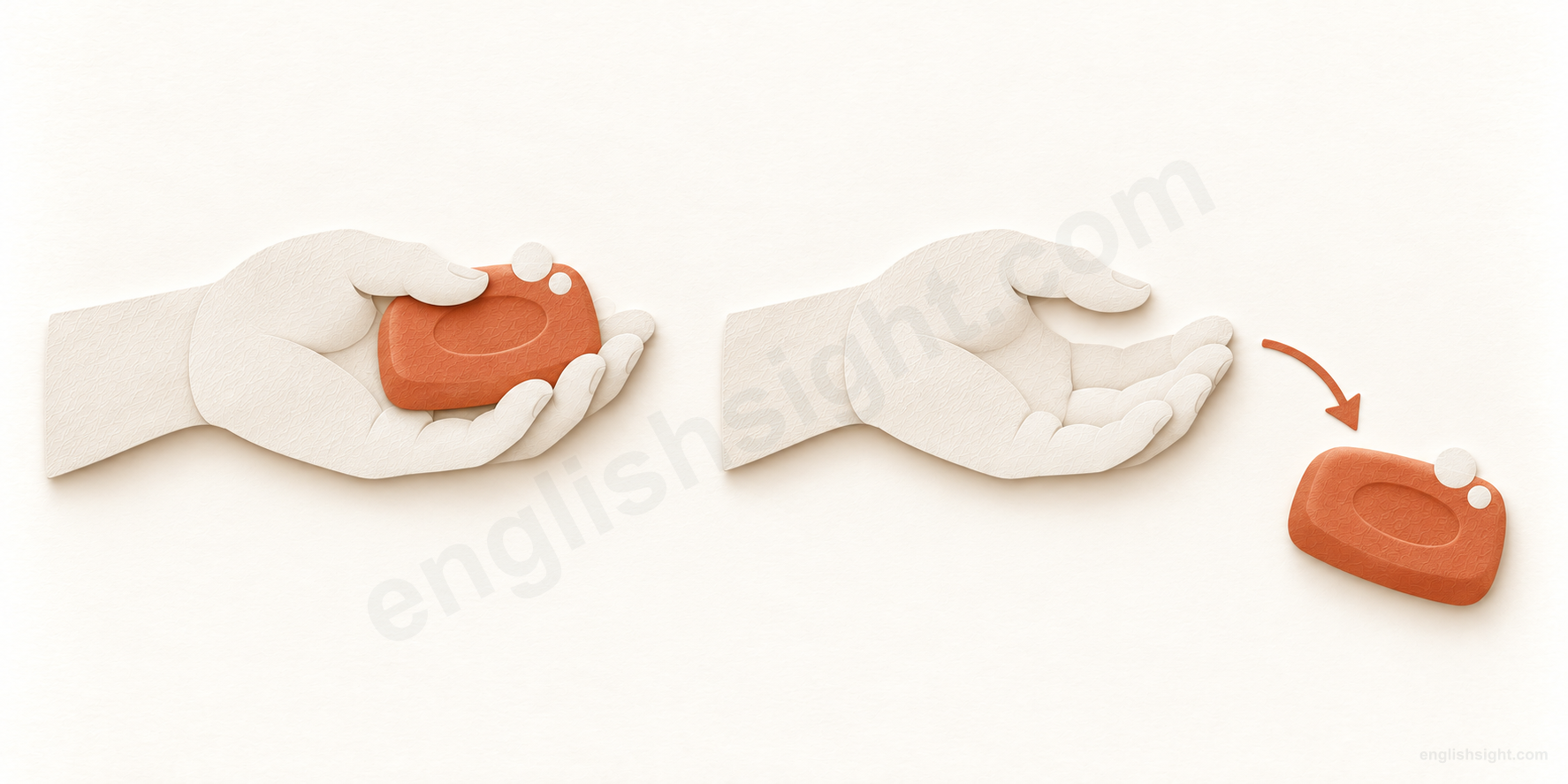
The soap is held in a cupped hand.
slip
The soap is outside the hand’s hold.
The soap slides beyond the fingertips.
The soap slips out of the hand. This shows loss of grip, one use of slip.
Something moves smoothly out of a position or past what holds it, often without firm control or much notice.
The sketch selects the loss-of-grip branch. Quiet placing and gradual changes share useful connections, but fixed expressions and separate noun branches must be learned in context.
Follow the subject first. A foot slips when it loses its hold; a person slips out quietly; someone slips a note into a pocket on purpose. Slip does not always mean an accident, a fall, or moving downward.
A useful connection is movement with little secure hold or little resistance or notice. The hand-and-soap sketch shows one physical starting point. It is a teaching model, not a claim that every speaker shares one mental picture. Paper slips and clothing slips need their own noun meanings.
01
Footing, position, and a loose grip
A foot can lose its hold, an object can move out of place, and an animal can escape a restraint. These uses need different subjects and complements.
01
slip; slip on + surface; slip and + verb
slip on ice
lose your footing when a foot slides
Situation before
Your shoe is supporting you on a frozen path.
What changes
The shoe slides unexpectedly; you almost fall.
The loss of grip matters; a fall is possible but not required.
Imagine walking normally, then finding that your foot moves farther than you intended. Slip names that sudden failure of footing. In I slipped on the ice, on the ice identifies the surface.
I slipped but caught the rail is entirely natural: slipping need not end in a fall. Compare trip over a cable, where an obstacle catches your foot, and slide down a slope, which need not be accidental. A slip can also name the event: One slip on these steps could hurt.
In a sentence
I slipped on the wet tiles but caught the handrail.
Watch the difference On ice is a prepositional phrase; it is not the clothing particle on in slip a coat on.
02
something + slip + down / from / out of + noun
slip out of your hand
slide away from a held or intended position
Situation before
You are holding a wet bar of soap.
What changes
The soap slides beyond your fingers.
The moving object is the subject; the holder is named after from or out of.
The soap slipped out of my hand reports the object’s movement. I dropped the soap instead puts the holder in subject position. Both can describe one accident, but they organize it differently.
A thing can slip without falling out completely: My glasses keep slipping down my nose. The direction phrase tells you where it moves; slip alone does not specify down, out, or a final landing place.
In a sentence
The wet soap slipped out of my hand.
Watch the difference Do not add a direct object to this use: The soap slipped, not I slipped the soap when you mean accidentally dropped it.
03
slip + restraint; slip free; slip out of + restraint
slip free / slip its collar
get loose from something holding you
Situation before
A dog is held by a loose collar.
What changes
It pulls its head out and can run away.
A restraint can be the direct object, or free can describe the result.
The dog slipped its collar means the collar no longer restrained it. The dog is the escaping subject; its collar is the restraint, not an object it quietly hands to someone.
The dog slipped free describes the result without naming the restraint as an object. Compare slipped out of its collar, which makes the route explicit. These escape patterns connect to losing a hold, but the animal may act deliberately.
In a sentence
The dog slipped its collar and ran across the yard.
Watch the difference Slipped its collar does not mean put its collar on.
02
Move, put, or give with little fuss
Slipping can be deliberate. A person moves quietly, places something discreetly, or fits a remark into a conversation.
04
person + slip in / out / away; slip into / out of + place; slip past + person
slip in / out / away
enter or leave quietly and without much attention
Situation before
A meeting is still in progress.
What changes
You leave quietly without interrupting.
A person moves; the direction word identifies the route or departure.
If you slip out of a meeting, you leave discreetly. Slip in describes entering in a similar manner; slip away emphasizes leaving the people or situation behind. You may have planned the movement.
Compare I slipped on the stairs, which normally suggests an accident. In I slipped upstairs to check on the baby, the destination and purpose instead support quiet movement. Into the room names a destination; past the guard names what you pass.
In a sentence
I slipped out of the meeting to take a call.
Watch the difference Slip away does not always mean die; a person leaving a party usually just leaves discreetly.
05
slip + object + into / under / between / onto + noun
slip something into a pocket
put something somewhere smoothly or discreetly
Situation before
A ticket is in your hand.
What changes
You put it inside your coat pocket.
The person acts on an object, and a place phrase supplies its destination.
Slip the ticket into your pocket presents a small, easy placing movement, often done without attracting attention. Compare The ticket slipped out of my pocket: now the ticket moves without a stated person causing it.
The place phrase is important: slip a note under the door, slip a card between the pages, slip a ring onto a finger. This is an ordinary verb with an object and a destination, not a separate idiom for every preposition. Passive wording is possible: A note was slipped under the door.
In a sentence
She slipped the ticket into her coat pocket.
Watch the difference With a pronoun, keep it before the destination: slip it into your pocket, not slip into it your pocket.
06
slip + person + thing; slip + thing + to + person
slip someone a note
give something discreetly
Situation before
You want one classmate to see a message.
What changes
The classmate receives your note without a public announcement.
A recipient and a transferred object are both present.
Slip someone a note focuses on a discreet transfer. The recipient follows the verb and the thing follows the recipient. Slip a note to someone expresses the same transfer with a to phrase.
This can describe an innocent private message or, with a suitable context, a secret payment. The verb alone does not establish that a gift is illegal. Compare slip a note into a bag, which names a place rather than a recipient.
In a sentence
During the lecture, Amir slipped me a note about the room change.
Watch the difference With two pronouns, slipped it to me is a clear choice; do not build a sentence by freely swapping all objects.
07
slip in + remark; slip + remark / it + in; slip + remark + into + conversation
slip in a question
fit a remark into ongoing talk
Situation before
Other people are discussing a plan.
What changes
You add a short question without stopping the flow.
A spoken contribution is treated as something inserted.
Slip in a question is about timing and manner, not a question moving physically. You find an opening in the conversation and add it. A joke, reminder, or word of advice can be slipped in too.
With a noun, both slip in a question and slip a question in are possible. With a pronoun, use slip it in. In slip a question into the conversation, into introduces the larger exchange in which you place the question.
In a sentence
Before the topic changed, I slipped in a question about the cost.
Watch the difference An inserted remark can be deliberate; It just slipped out instead presents unintended speech.
03
Put clothes on and take them off
Read the object and the small word together: the same on can introduce a slippery surface or belong to a clothing expression.
08
slip on + clothing; slip + clothing / it + on
slip a jacket on
put on clothing quickly and easily
Situation before
You are ready to leave but need a light jacket.
What changes
The jacket is on you after a quick movement.
Here on belongs to dressing, not to a slippery surface.
Slip on a jacket and slip a jacket on both mean put it on with little effort or delay. With it, say slip it on. The object must make sense as something worn in this pattern.
Compare She slipped on her shoes before leaving and She slipped on the wet floor. Shoes can be the clothing object; the wet floor is a surface on which footing fails. Context resolves a sentence such as She slipped on a coat.
In a sentence
It was cool outside, so I slipped a jacket on.
Watch the difference Do not use slip on it for putting it on; the pronoun goes between slip and on.
09
slip off + clothing; slip + clothing / pronoun + off
slip your shoes off
remove clothing quickly and easily
Situation before
Your shoes are still on indoors.
What changes
You remove them with little effort.
Off reverses the clothing result of on.
Slip your shoes off and slip off your shoes describe easy removal. With a pronoun, say slip them off. These are transitive clothing uses: a person removes the item named as object.
My shoe slipped off has a different subject and can describe a shoe coming off accidentally. Adding I slipped my shoe off makes the dressing action the natural reading.
In a sentence
At the door, I slipped my shoes off and put on my slippers.
Watch the difference I slipped them off means I removed them; They slipped off means they came off.
10
person + slip into / out of + clothing
slip into / out of a dress
get into or out of clothes easily
Situation before
You are changing before dinner.
What changes
You are wearing a different dress.
Into and out of connect the person to the garment.
Slip into a dress means put it on easily or quickly; slip out of it means take it off. The person is the subject, and the clothing follows the preposition.
The word after into matters: a dress suggests clothing, a room suggests movement, and a bad habit suggests a change of behavior. Into contributes entry; it does not by itself supply a special clothing meaning.
In a sentence
She slipped out of her work dress and into something more comfortable.
Watch the difference Slipped into it is natural with this prepositional pattern; distinguish it from the particle order slipped it on.
04
Changes that happen gradually
Levels, habits, schedules, time, and life can change without a sharp break. The following words identify the kind of change.
11
level / standard + slip; slip from + level + to + level; slip by + amount
standards slip / prices slip
move to a lower level or a worse standard
Situation before
Service has usually been reliable.
What changes
More orders arrive late.
The subject is a level, standard, or ability rather than a sliding object.
Our standards are slipping evaluates a downward change. I must be slipping can be a light or self-critical comment after doing something less well than usual. Neither sentence needs a physical direction phrase.
With numbers, to gives the new level, from the old one, and by the amount of change: The price slipped from ten dollars to nine, or by one dollar. A slip in confidence is the related noun pattern. Check the actual figures rather than assuming slip always describes a tiny change.
In a sentence
The team’s standards have slipped since the weekly checks stopped.
Watch the difference To nine dollars is the resulting price; by nine dollars would be the size of the decrease.
12
slip into + state / habit; slip back into + previous state
slip into a habit
gradually enter a state or pattern of behavior
Situation before
You start checking messages before bed occasionally.
What changes
Doing it every night becomes a habit.
Into names the resulting state; back marks a return.
Slip into a habit presents the change as easy or barely noticed rather than a firm decision. Slip back into an old habit adds the idea that the pattern existed before.
The same grammar occurs with conditions such as debt or sleep: She slipped into sleep while the music played. Sleep itself is not necessarily undesirable; the surrounding noun and context supply the evaluation. This is a change of state, not physical entry into a container.
In a sentence
Without noticing, I slipped back into the habit of checking messages in bed.
Watch the difference Do not assume every slip into is accidental or harmful; read the state and context.
13
slip behind schedule
slip behind schedule
become later than planned
Situation before
The repair was due to finish on Friday.
What changes
Delays mean it will finish the following week.
Behind compares progress with a plan.
A project that slips behind schedule is no longer keeping up with its timetable. Behind schedule supplies the standard of comparison; slip presents a movement away from it.
This concerns timing rather than quality. Work can remain excellent while its completion slips. Add back to show a renewed delay: We have slipped back behind schedule.
In a sentence
The repairs slipped behind schedule when a part failed to arrive.
Watch the difference Behind schedule means late compared with the plan, not physically behind another worker.
14
time / an hour + slip by; time + slip away
time slips by / away
time passes with little notice or becomes unavailable
Situation before
You are absorbed in a game.
What changes
An hour has passed before you notice.
By emphasizes passing; away emphasizes time no longer remaining.
An hour slipped by describes time passing while your attention was elsewhere. Time is slipping away draws attention to the shrinking time left for a task.
Compare We have two hours left, a neutral quantity statement. Slip away can make the approaching limit feel more pressing, but it does not tell you exactly how much time has passed. The subject here is time, not a person leaving quietly.
In a sentence
The afternoon slipped by while we worked on the model.
Watch the difference Slip by does not mean time stops or moves backward.
15
support / hope + slip away; person + slip away (death in context)
support slips away
gradually disappear; sometimes die
Situation before
A proposal has several supporters.
What changes
Over time, fewer people still support it.
What disappears is identified by the subject and context.
When support slips away, it gradually ceases to be available. Unlike a small slip in support, the expression can focus on losing it altogether.
A person can also slip away in a gentle description of death: Her grandfather slipped away in his sleep. This is a euphemism, so context matters. He slipped away from the party ordinarily describes a quiet departure, not a death.
In a sentence
As the delays continued, support for the project slipped away.
Watch the difference Do not infer death from every sentence with a person and slip away.
05
Memory, speech, and mistakes
Familiar expressions treat a lapse as something escaping attention or control. Learn their full grammar rather than translating each word separately.
16
something + slip + my / your / someone’s + mind; it slipped my mind that + clause
slip your mind
be forgotten, often something you meant to do
Situation before
You intended to send a reply.
What changes
You forgot to send it.
The forgotten thing is the subject; the person appears in the possessive.
It slipped my mind is a familiar way to acknowledge forgetting. It can refer to an appointment, a fact, or a task already mentioned. The appointment slipped my mind keeps the appointment in subject position.
Compare I forgot the appointment, where the forgetter is the subject. With a clause, use It slipped my mind that the office would be closed. This expression may soften an apology, but it does not remove responsibility for the omission.
In a sentence
I’m sorry—the deadline completely slipped my mind.
Watch the difference Say It slipped my mind, not I slipped my mind when you mean I forgot.
17
remark / word / it + slip out
it just slipped out
be said without the speaker intending it
Situation before
You meant to keep a detail to yourself.
What changes
You say it before stopping yourself.
The word or remark is the subject of slipped out.
It just slipped out presents a remark as unplanned. It refers back to the words or information that was spoken. The expression is intransitive: it does not take a listener as its direct object.
Compare I slipped out to buy milk, where I am a person moving to another place. Compare I slipped in a reminder, where I deliberately inserted a remark. Out and in alone do not decide intention; the whole construction does.
In a sentence
I didn’t mean to mention the new job; it just slipped out.
Watch the difference The it is the unintended remark, not the person who heard it.
18
let slip + information / that-clause; let it slip that + clause; let + secret + slip
let slip that…
accidentally reveal information
Situation before
You know about a surprise visit.
What changes
You mention it to the person who was not supposed to know.
Let slip puts the person revealing the information in subject position.
I let slip that… introduces the information in a clause. I let it slip that… is also natural. With a noun, you can say let slip a secret or let a secret slip.
This does not normally mean deliberately grant permission for a secret to be told. The established information sense is accidental revelation. Distinguish let a chance slip, which is about a lost opportunity, and It slipped my mind, which concerns forgetting rather than disclosure.
In a sentence
Maya let slip that her brother was planning a surprise visit.
Watch the difference Use the plain form slip after let: let slip, not let slipped. The past of let is still let.
19
make a slip; a slip in + work; a slip of the tongue / pen
make a slip / a slip of the tongue
make a small unintended mistake
Situation before
You mean to say Thursday.
What changes
You accidentally say Tuesday.
A countable noun names the lapse; a following phrase identifies its kind.
A slip can be a small lapse in a calculation, performance, or piece of writing. A slip of the tongue specifies speech; a slip of the pen specifies writing. These phrases need no physical sliding.
In That was a slip of the tongue, the speaker often corrects a word rather than admitting a belief. A small mistake can still have serious consequences. Calling it a slip does not guarantee that nobody is harmed.
In a sentence
I said Tuesday, but I meant Thursday; it was a slip of the tongue.
Watch the difference Keep a in a slip of the tongue; do not replace the whole phrase with a slip tongue.
20
person + slip up; slip up on / over + matter; a slip-up
slip up
make a careless mistake
Situation before
You know the correct delivery address.
What changes
You type the wrong number.
Up is part of a familiar mistake expression, not upward motion.
I slipped up acknowledges an error, often in informal conversation. You can add over or on to identify the matter: I slipped up over the dates. There is no direct object meaning the mistake itself.
The related countable noun is a slip-up: There was a slip-up with the booking. Compare a slip on the steps, a physical event. A mistake can be recoverable or serious; slip up does not set its consequences.
In a sentence
I slipped up when I entered the house number.
Watch the difference Do not say I slipped up the number; say I got the number wrong or I slipped up over the number.
21
a Freudian slip
a Freudian slip
a mistake interpreted as revealing an unspoken thought
Situation before
Someone uses an unexpected word.
What changes
A listener suggests it reveals what the speaker really wants.
The interpretation is part of the label; the mistake alone proves no hidden motive.
A Freudian slip is a slip in speech or another action thought to reveal an unconscious thought or wish. In ordinary conversation, the term is often used jokingly.
Calling a typo a Freudian slip adds an interpretation; calling it a slip of the pen merely identifies a writing mistake. Do not assume all errors reveal secret desires. The lesson teaches the expression, not a method of diagnosing people.
In a sentence
When I called the meeting a holiday, my colleague joked that it was a Freudian slip.
Watch the difference Use the capital F in Freudian; the expression reports an interpretation, not proof of an unconscious wish.
06
Escape, missed chances, and gaps in checks
Who or what gets away matters: a pursued person, an opportunity, an error, or someone a service should help.
22
give + person + the slip
give someone the slip
get away from someone following or watching you
Situation before
Reporters are waiting to follow an actor.
What changes
The actor leaves by another exit and escapes them.
The person after give is the follower being evaded.
Give someone the slip is informal. The person escaping is the subject; the person following is the object after give. The slip is part of the fixed expression, not a piece of paper being handed over.
Compare slip someone a note, where a real object is transferred to a recipient. Giving a pursuer the slip can involve quiet movement, but the whole idiom specifically includes successful evasion.
In a sentence
The actor gave the reporters the slip by using a side exit.
Watch the difference Keep the in the slip; give the slip to someone is not the usual form taught here.
23
chance + slip through + possessive + fingers; let + chance + slip (through your fingers)
let a chance slip through your fingers
fail to keep or use an opportunity
Situation before
You have time to apply for a place.
What changes
You wait too long and the place goes to someone else.
The opportunity escapes your control, like something you failed to hold.
A chance can slip through your fingers even though you never physically held it. Let a chance slip emphasizes failure to prevent the loss. Through your fingers supplies the image of an insecure grasp.
This is different from forgetting: you can remember the chance perfectly and still fail to act. It is also different from letting a secret slip, which releases information rather than loses an opportunity. The fingers can belong to me, you, or another person.
The expression also applies to losing money or failing to catch or keep a person: The money slipped through my fingers suggests that I could not keep hold of it financially. The broader idea is losing something you wanted to obtain or retain, not only missing a future opportunity.
In a sentence
I waited too long and let the chance to join the course slip through my fingers.
Watch the difference The construction is let it slip, not let it to slip.
24
person / error + slip through + checks; slip past + guard
slip through the checks
pass a check that should have stopped or detected something
Situation before
A form contains a wrong account number.
What changes
The checking process fails to catch it.
Through identifies checks passed without the intended control taking effect.
An error that slips through the checks reaches the next stage unnoticed. A person can also slip past a guard or through a security check. The focus is the failure to stop or detect, not a narrow physical hole.
Compare a person who passes a check correctly: slip through often suggests the procedure failed in some way. In physical uses, however, The cat slipped through the gap simply describes easy or unnoticed movement through an opening.
In a sentence
One incorrect account number slipped through the checks.
Watch the difference Through is not freely separable here: the error slipped through them, not slipped them through.
25
person / request / problem + slip through the cracks / net
slip through the cracks / net
be missed by a system that should identify or deal with you
Situation before
Several offices share responsibility for new requests.
What changes
Nobody handles one request because each office overlooks it.
The gap is in coordination or detection, not necessarily in a real object.
Something slips through the cracks when an organization fails to notice or deal with it. Slip through the net uses a catching image: the system fails to find or handle a person or thing it was meant to catch.
The result need not be deliberate escape. A person needing support can be overlooked, while an error can go undetected. Compare slip through the security checks, which focuses more directly on getting past a checking stage.
In a sentence
With three offices sharing the work, my request slipped through the cracks.
Watch the difference Do not infer that the overlooked person deliberately evaded the system.
07
Paper and clothing: separate noun branches
A slip of paper and a slip worn under a dress are countable objects. Neither means an act of falling.
26
a slip of paper; a permission / deposit / sales slip
a slip of paper
a small piece of paper, often carrying information
Situation before
You need to leave a phone number.
What changes
You write it on a small piece of paper.
This countable noun names the piece of paper, not its movement.
A slip of paper can carry a number, instruction, or short message. We write on the slip and can hand the slip to someone. This noun branch should be learned in its own right; the slipping diagram is not its definition.
A purpose can appear before slip: a permission slip asks for approval, a deposit slip records bank details, and a sales slip records a purchase. Not every slip is a receipt. The job or local context identifies the document.
In a sentence
Please write your contact number on a slip of paper.
Watch the difference Paper is normally uncountable for the material: a slip of paper, not a slip of a paper.
27
a slip; wear + a slip + under + dress / skirt
wear a slip
wear a thin undergarment beneath a dress or skirt
Situation before
A light dress needs an extra layer underneath.
What changes
A thin slip is worn beneath it.
A slip here is an item of clothing, not a dressing action.
She wore a slip under the dress uses slip as a countable garment noun. A full-length version resembles a light sleeveless dress; a half-slip resembles an underskirt.
Compare She slipped into the dress, which is a verb describing putting clothes on. The noun and verb can appear in one sentence, but one is not a grammatical substitute for the other.
In a sentence
She wore a cotton slip under the light summer dress.
Watch the difference A slip is worn underneath; slippers are footwear and slip-on describes something easy to put on.
Read the subject, object, and small word
Forms and voice
The forms are slip, slips, slipped, slipping; double p before -ed and -ing. Slipped ends in /t/. Ongoing changes naturally allow the progressive: Standards are slipping. Intransitive The soap slipped has no object to passivize. Transitive A note was slipped under the door has a normal passive.
On can do two jobs
In slip on ice, on introduces the surface. In slip a coat on, it belongs to the dressing pattern; a pronoun comes before it: slip it on. Slip into a coat uses into as a preposition, so slip into it is correct.
Let does not add to
Let the chance slip and let a secret slip use let + object + plain verb. They refer to different outcomes: losing an opportunity and revealing information. Neither takes to before slip.
An easy-to-say name
The idiom slip off the tongue means be easy to say: The new product name doesn’t exactly slip off the tongue. This is about pronunciation, unlike a slip of the tongue, which is a mistake. Roll off the tongue is another established form.
Scope and less central branches
This lesson selects everyday verb patterns, familiar idioms, paper documents, and the clothing noun. Dictionaries also record cricket fielders, boat spaces in North American English, plant cuttings, and ceramic clay mixtures. Those specialized branches are outside the main lesson, as are the old-fashioned a slip of a girl and the proverb there’s many a slip ’twixt cup and lip.
Choose the meaning in context
Notice who moves, what is forgotten, and what follows slip.
1. You slipped on a wet floor but grabbed a rail. Must you have fallen?
2. You want to put your jacket on quickly. Replace your jacket with it.
3. You forgot an appointment and want to acknowledge it. Which sentence fits?
4. You accidentally mentioned a secret. Which sentence describes that?
5. Nobody handled your request because each office thought another office was responsible. What happened?
6. A ticket was in your hand, and you deliberately put it into your pocket. Which sentence fits?
Sources and teaching notes
The linked dictionary entries were consulted for meanings, grammar, idioms, and scope. The explanations and examples are original; the visual model is a teaching interpretation.
The sketch illustrates one connection, not a mental picture shared by every English speaker.