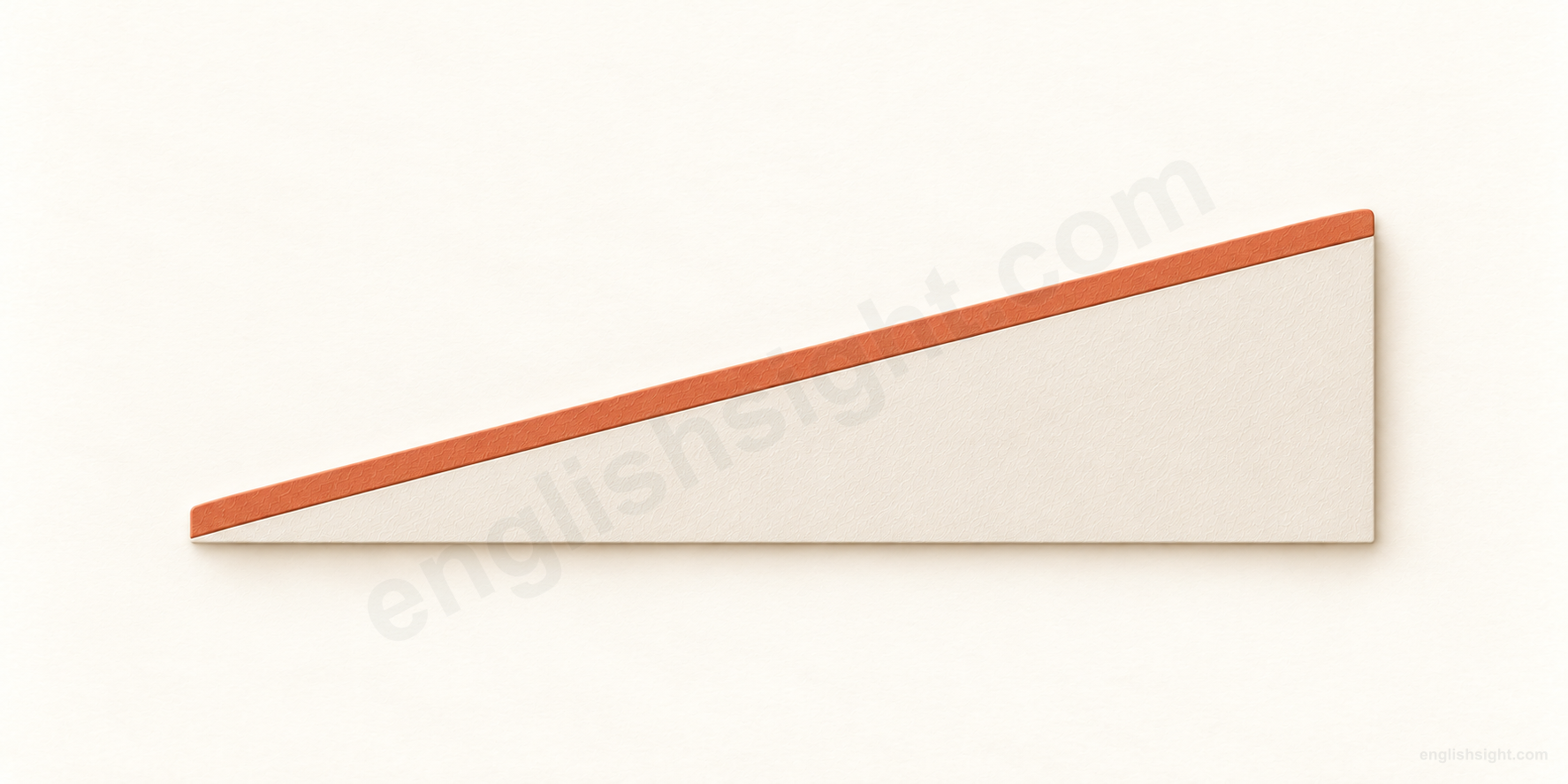
Use slope for slanting ground, an inclined surface, its angle, and a few established expressions.
A surface between different heights
Higher at one end, lower at the other
The lower end is on the left.
slope
The higher end is on the right.
One continuous inclined surface connects the two heights.
One surface connects different heights. Slope describes the incline, not movement.
A surface extends at an incline rather than staying level. Slope can name the surface, describe the incline, or measure its steepness.
This model explains the main physical uses. A slant can also be measured against an upright reference. Slope off is an established informal expression, and slippery slope is a warning metaphor.
A surface can extend from a lower end to a higher end without anything moving. Slope names that inclined surface or its inclination; the verb can describe how it lies.
This lesson uses that physical relation as a teaching model. It also keeps the mathematical use and familiar expressions distinct, rather than treating every use as literal downhill movement.
01
Land, hillsides, and skiing
Name an inclined place, locate part of a hillside, or talk about a ski run. The surrounding words tell us which surface matters.
01
on a slope; move up / down a slope; the top / bottom / foot of a slope
on / up / down a slope
an inclined stretch of ground or another surface
Situation / reference
The path crosses ground with a higher end and a lower end.
Meaning in context
You choose words for location or travel along that ground.
Slope names the inclined surface; on, up, and down supply different relations.
A slope can be natural ground or a constructed surface. On a slope says where something is; walk up a slope and roll down a slope add movement, supplied by the verb and preposition.
The top of the slope is its higher end; the bottom or foot is its lower end. A slope may be gentle or steep. Gentle and steep describe inclination, not how long the route is.
A hill is a raised landform; a slope can be one side of it. A ramp is a constructed inclined surface used to reach another level. Slope describes the incline without specifying that purpose.
In a sentence
We left our bicycles at the foot of the slope and walked up to the gate.
Watch the difference Use an article for an individual surface: on a slope, not on slope.
02
the lower / upper slopes of + hill or mountain; a south-facing slope
the lower / south-facing slopes
areas on the sides of a hill or mountain
Situation / reference
You need to specify which part of a mountain you mean.
Meaning in context
You identify its lower ground or a side facing a particular direction.
Plural slopes can describe a broad hillside region rather than several separate ramps.
The slopes of a mountain are areas along its sides. Lower and upper locate them by height; the phrase northern slopes identifies the northern side, while north-facing slopes specifies the direction the surface faces.
A south-facing slope faces south, not necessarily downhill towards your current position. The expression describes orientation, not movement.
In a sentence
Small farms cover the lower slopes of the mountain.
Watch the difference The slopes are parts of the mountain; they are not necessarily its summit.
03
a ski slope; spend time on the slopes
a ski slope / on the slopes
an inclined area used for skiing
Situation / reference
You are choosing where to ski at a resort.
Meaning in context
You refer to a ski run or to spending time skiing.
In a skiing context, the slopes means the areas where people ski.
A ski slope is a run or inclined area used for skiing. The plural the slopes can stand for those skiing areas collectively: a day on the slopes normally means a day spent skiing there.
Outside this context, slopes can simply be hillsides. Snow, a resort, or skiing in the surrounding conversation establishes the sporting reading.
In a sentence
We spent the morning on the slopes and had lunch at the lodge.
Watch the difference The slopes does not always mean skiing; read the surrounding context.
02
Describing and measuring a slant
Slope can describe how a surface lies, how strongly it inclines, or how a line changes on a graph. These uses need no moving person or object.
04
the slope of + surface; a slope of + number + degrees
the slope of the roof
the amount or degree of inclination
Situation / reference
Two roofs have different angles.
Meaning in context
You describe how much one roof inclines.
Here slope is a property of the surface, not a separate piece of ground.
The slope of the roof means how sharply the roof inclines. You can describe a gentle or steep slope, or specify an angle: a slope of twenty degrees.
Compare a slope behind the house, which names a place, with the slope of the roof, which names an amount of inclination. Dictionaries differ in their countability labels; these established patterns are useful to learn directly.
In a sentence
The designer reduced the slope of the roof.
Watch the difference An angle in degrees and a percentage gradient are different measurements; do not treat the numbers as interchangeable.
05
the slope of a line; have a positive / negative / zero slope
a positive / negative slope
a line’s direction and rate of change on a graph
Situation / reference
You read a straight line from left to right on a graph.
Meaning in context
You describe whether it rises, falls, or stays horizontal.
In mathematics, slope measures vertical change relative to horizontal change.
For a nonvertical straight line, slope is the change in the vertical coordinate divided by the change in the horizontal coordinate. A positive slope rises from left to right; a negative slope falls; a horizontal line has zero slope.
For example, a rise of two units over a horizontal change of one unit gives a slope of two. This number is a ratio, not an angle of two degrees. A vertical line has no defined slope in this usual coordinate system.
This is a precise technical use related to visible inclination. On a data chart, check what the axes measure before interpreting what an upward line means.
In a sentence
The line has a negative slope: it falls as you read from left to right.
Watch the difference Negative slope describes the line’s direction, not whether the result is bad.
06
surface + slope + up / down + to / towards; slope away from; sloping + noun
the ground slopes down / up
a surface lies at an incline
Situation / reference
The garden is higher near the house than near the pond.
Meaning in context
You describe the garden’s shape towards the pond.
The surface is the subject; slopes describes its position, not an action of sliding.
The garden slopes down to the pond says the land becomes lower in that direction. From the pond, the same ground slopes up towards the house. Up and down depend on the direction in which you trace the surface.
Gently, steeply, and slightly describe how much it inclines. Slopes away from the house traces the surface away from that reference point; down makes the decrease in height explicit.
The adjective sloping describes this shape in a sloping roof, sloping shoulders, or a gently sloping path. It does not mean the surface is currently moving. The floor slopes is a straightforward description of its shape; The floor is sloping can also describe an inclined floor.
In a sentence
The garden slopes gently down to a small pond.
Watch the difference The floor slopes describes its angle. The box slides describes movement across a surface.
07
handwriting / letters / walls + slope + to the right / left / backwards
handwriting slopes to the right
something leans rather than following an upright line
Situation / reference
You compare written letters with an upright reference.
Meaning in context
You notice their strokes lean to the right.
Slope can describe a slant away from the vertical as well as an incline from the horizontal.
Her handwriting slopes to the right describes the angle of its letters. They do not travel to the right. The same verb can describe sloping walls that lean instead of standing upright.
The main diagram uses a horizontal reference for a surface. For handwriting or a wall, change the reference to an upright line; keep the idea of a slant. Lean and slant can also describe such an orientation.
In a sentence
The letters in his signature slope to the right.
Watch the difference Slope to the right does not mean turn right or move right.
08
slope + object + towards / away from; be sloped + direction
slope the surface towards a drain
make something incline in a chosen direction
Situation / reference
A builder is shaping a surface.
Meaning in context
The completed surface inclines towards a drain.
With an object, slope can mean cause that object to have an incline.
Slope the surface towards the drain is a practical instruction: shape or position it at an angle so that it inclines in that direction. The object is the surface being shaped.
Compare The surface slopes towards the drain, a description without an object, with Slope the surface towards the drain, an instruction with an object. The passive is possible too: The surface was sloped towards the drain.
This causative use is especially useful in construction instructions. It does not mean every ordinary description of a slope implies someone deliberately made it.
In a sentence
The builder sloped the concrete surface towards the drain.
Watch the difference In The surface slopes, surface is the subject. In Slope the surface, it is the object.
03
Leaving quietly and warning of trouble
Learn these established expressions as whole patterns. A physical incline helps explain the warning metaphor, but it does not predict the informal leaving expression.
09
person + slope off / away; slope off to + place; slope into / out of + place
slope off / away
leave quietly, often to avoid someone or something
Situation / reference
A group is about to start an unwanted task.
Meaning in context
One person leaves without drawing attention.
The familiar informal expression concerns a person leaving, not a surface’s angle.
In British informal English, slope off means go away quietly, often to avoid something. Slope away has a similar leaving use. It may suggest an unobtrusive or furtive departure; it does not specify a fixed walking speed.
This is an intransitive phrasal verb: He sloped off, or He sloped off to the café. There is no object to put between slope and off. Neutral alternatives include leave or go away.
Collins also records quiet arrival or departure with slope into / out of a place. These are informal movement uses: The guests sloped into breakfast late. Learn the context rather than deriving this meaning from the ramp sketch.
In a sentence
When the washing-up began, Ben sloped off to the garden.
Watch the difference Slope off does not require a downhill path. The garden slopes away is instead a description of land.
10
be on / start down a slippery slope; a slippery slope to / towards + outcome
a slippery slope
a course that may become hard to stop and lead to trouble
Situation / reference
Someone proposes a small exception to a rule.
Meaning in context
Another person warns that it may encourage increasingly serious exceptions.
The idiom compares a developing problem to losing control on slippery inclined ground.
Calling something a slippery slope warns of a progression that may be difficult to stop once it begins. The speaker expects further harmful steps, not just one difficult moment.
Use That is a slippery slope, be on a slippery slope, or start down a slippery slope. Towards or to can name the feared outcome: a slippery slope towards dishonesty.
The image of slipping down an incline makes the warning memorable. But describing a proposal this way is a claim about consequences, not evidence that those consequences must happen. A wet hillside can also be literally slippery; context separates the readings.
In a sentence
“Allowing false dates on one form could be a slippery slope towards falsifying whole reports.”
Watch the difference The idiom does not simply mean a steep challenge or a guaranteed disaster.
Keep shape, movement, and expression apart
Forms and word classes
The noun has plural slopes. Verb forms are slope, slopes, sloped, sloped, sloping: drop the final e before -ing. Sloping is also an ordinary adjective. The everyday adjective is a sloping roof, rather than a slope roof.
An incline is not necessarily downward
A slope has higher and lower parts. Up and down identify the direction being considered; slope alone does not mean slide, fall, or go downhill.
Scope of this lesson
This selection covers the modern physical noun and verb, hillside and skiing language, basic graph terminology, the causative construction, and two familiar expressions. Advanced calculus, specialist land-drainage regions, historical military commands, rare adjectival uses, and a recorded offensive ethnic slur are outside the active learning scope.
Choose the relation
Check whether the sentence names ground, describes a shape, measures a line, or uses an established expression.
1. “The garden slopes down to the pond.” What does this describe?
2. You walk from the lower end of a slope to the higher end. Which description fits?
3. Ben quietly leaves to avoid washing dishes. Which expression fits British informal conversation?
4. A nonvertical straight line falls as you read from left to right. What does it have?
5. A speaker calls a small dishonest act “a slippery slope.” What is the warning?
Sources and teaching notes
The sources below support the recorded meanings and constructions. Explanations and examples are original; the ramp is a teaching model, not a claim about the origin of every expression.
The diagram is a teaching aid, not a picture shared by every native speaker.