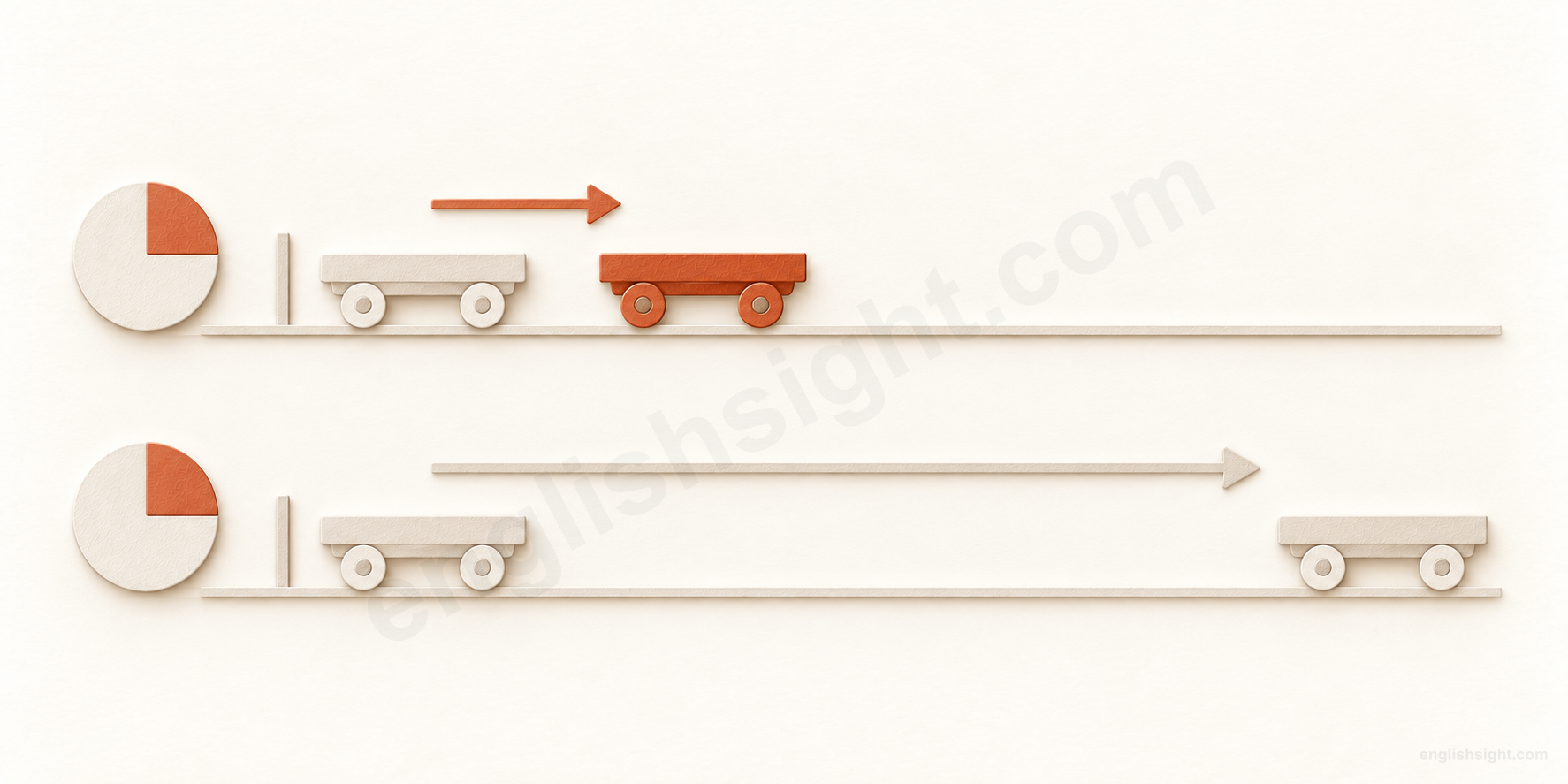
Use slow for a low pace, a delayed response, or a change to a lower rate.
Compare progress with elapsed time
Compare progress with elapsed time
Equal elapsed intervals
slow
The upper cart has the slower pace.
Compare the distances travelled.
In the same time, the upper cart goes less far. This illustrates a low rate, not a change of speed; clock errors and fixed expressions need their own explanations.
At a slow pace, relatively little movement or progress happens in a given time; equivalently, the same task or distance takes longer.
The upper cart travels a shorter distance during the same interval. This comparison illustrates a rate, not a change of speed. The verb slow adds a change; delayed responses, clock errors, and fixed expressions need the distinctions below.
A slow walk, slow progress, and a slow response all invite you to compare what happens with the time it takes. The useful comparison may be another pace, an expected pace, or your own earlier performance.
That connection is a teaching model. A clock that is five minutes slow has a time error, and familiar expressions contribute meanings of their own. English speakers need not picture one identical scene when they hear slow.
01
Speed, progress, and response
Ask what is slow: movement, a process, an answer, or a particular skill. The comparison may be with another person, a usual rate, or what you expected.
01
slow + noun; be / seem + slow; slower than…
a slow walk / a slow train
movement at a low speed
Situation / comparison
You allow plenty of time to walk beside the river.
Meaning in context
You walk without hurrying.
Slow describes a rate, relative to a useful comparison.
A walk can be slow because you choose a gentle pace. A slow driver is someone whose driving is slow; a slow computer takes longer to respond. These descriptions do not automatically mean that anyone arrived late.
A slow train may take longer because it stops at more stations, even if its speed between stops is high. Ask whether slow describes moment-to-moment movement or the overall journey.
In a sentence
We took a slow walk along the river.
Watch the difference Slow is not the same as late: a slow journey can still end before the appointment.
The changing thing may be a skill, recovery, growth, or a task.
Picture progress along a task rather than travel along a road. Slow progress can still be real progress. A slow start describes the early part; it does not say the whole project stays slow.
Slow and steady adds that the pace is consistent. Steady supplies this extra idea: something slow can also be irregular. Compare a slow recovery with a quick recovery, not necessarily with a late recovery.
In a sentence
Progress on the roof was slow, but we finished before winter.
Watch the difference Do not infer failure or laziness from slow progress alone.
03
be slow to + verb; be slow in + -ing; be slow + -ing; slow to anger
slow to reply / slow in replying
an action happens after a delay
Situation / comparison
You send a message on Monday.
Meaning in context
The answer arrives several days later.
To reply identifies the delayed action, not a destination.
Slow to reply concerns how long it takes before someone replies. A person can be slow to reply and then write the reply quickly. Slow in replying and slow replying are also possible descriptions of that delay.
Slow to anger describes someone who does not become angry readily. Learn it as a familiar expression about emotional readiness. In slow to get angry, to begins an infinitive. Neither expression describes slow speech.
In a sentence
I was slow to reply because I was away from my desk.
Watch the difference Slow to act can suggest reluctance in context, but a delay does not prove unwillingness.
04
be slow at + noun / -ing; be slow to understand / learn
slow at typing / slow to understand
needing more time for a task or understanding
Situation / comparison
You are learning to use a new keyboard.
Meaning in context
Typing each line still takes you time.
A specific task is different from a judgment about a whole person.
Slow at typing compares performance on an activity. Slow to understand concerns the time needed to grasp something. Say what the difficulty is when that information matters.
Calling someone slow without naming the activity can suggest low intelligence and can sound insulting. I’m a bit slow today can be self-deprecating. A more precise description is I need more time to understand these instructions.
In a sentence
I’m still slow at typing on this keyboard.
Watch the difference A slow typist is not necessarily a slow learner; the object of comparison matters.
02
Quiet places, stories, and clocks
Slow can describe how much happens, how engaging something feels, or whether a clock displays the correct time. These uses need their own context.
05
business / sales + be slow; a slow day / week
Business is slow.
few sales, customers, or transactions
Situation / comparison
The shop is open for the whole afternoon.
Meaning in context
Only a few customers buy anything.
Low activity is about how much happens, not how fast staff move.
A slow day in a shop may involve very little work. Compare slow service: that means customers have to wait for service. A quiet shop can have fast service when someone finally comes in.
With sales, slow can describe a low level of selling. The subject and context tell you what activity is scarce; you do not need to imagine goods moving slowly.
In a sentence
Business was slow on Tuesday, so we closed early.
Watch the difference Slow business and slow service describe different problems.
06
a film / book / passage / place + be slow
The film is slow.
a story or place lacks pace or excitement
Situation / comparison
A film spends a long time on uneventful scenes.
Meaning in context
You feel that too little is happening.
Slow can evaluate the pace of an experience.
For a film or book, slow often gives a critical judgment about its pacing. It is not necessarily a statement that the actors speak slowly or that the video is playing at a reduced speed.
A slow passage can help build tension, so the word need not condemn the whole work. You can also describe a place as slow: This town is too slow for me means it lacks the activity or excitement you want. These are evaluations in context, not objective measures of the number of seconds.
In a sentence
The opening chapter is slow, but the story soon becomes gripping.
Watch the difference A slow film is not automatically a film shown in slow motion.
07
a clock / watch + be + amount + slow; run slow
My watch is five minutes slow.
a clock shows an earlier time than the correct time
Situation / comparison
The correct time is 10:00.
Meaning in context
Your watch shows 9:55.
The number measures how far the displayed time is behind.
Five minutes slow describes the current error. The watch may simply have been set incorrectly; this sentence does not establish that it is losing more time every hour.
A watch that runs slow tends to fall behind as time passes. Compare five minutes fast, which shows a later time than the correct time. Use slow after be for the time error.
In a sentence
The station clock is five minutes slow; it says 9:55, but it’s 10:00.
Watch the difference A slow clock shows an earlier time; it is not a clock that shows a later time.
03
Adjectives, adverbs, and compounds
Choose slow for a description and usually slowly for the manner of an action. Familiar informal expressions and compounds also use slow as an adverb.
Slowly is the usual adverb; slower and more slowly can both modify an action.
A slow walk uses an adjective before a noun. Walk slowly uses an adverb with a verb. You can ask someone to walk slower or more slowly, and slowest or most slowly can compare several people’s actions.
Go slow and Drive slow occur informally and on signs. Slowly is the broad neutral choice, particularly before a verb: The noise slowly faded. Do not replace every slowly with slow; the alternatives do not have identical distributions.
In a sentence
Could you walk a little slower? I’m carrying a heavy bag.
Watch the difference He is slow describes him; He moves slowly describes his movement. After a linking verb such as seem, use an adjective: He seems slow.
09
slow- + -ing form + noun
slow-moving / slow-drying
the following part names what happens at a low rate
Situation / comparison
You choose paint for a project.
Meaning in context
This paint needs a long time to dry.
The compound specifies the process that is slow.
In slow-drying paint, drying identifies the process. In slow-moving traffic, moving does the same job. You can understand these as paint that dries slowly and traffic that moves slowly.
The hyphen joins the parts before a noun. Do not treat every word beginning with slow as freely predictable: named products, technical terms, and fixed expressions can have extra conventions.
In a sentence
We used slow-drying paint so we had time to blend the colours.
Watch the difference Slow-moving traffic contains moving, not movement: the compound describes traffic that moves slowly.
04
Becoming slower or making something slower
The verb slow describes a change of rate. It works with or without an object; down and up are particles in familiar combinations.
10
subject + slow / slowed / be slowing; slow to + a crawl / a halt
The traffic slowed.
movement or activity changes to a lower rate
Situation / comparison
Cars are moving freely.
Meaning in context
They begin moving less quickly near a junction.
The subject undergoes the change; there is no object.
The traffic is slow describes a condition. The traffic slowed describes a change. The traffic is slowing presents that change in progress; a fall in speed can happen even if the traffic is still fairly fast.
The same verb can describe a rate of growth or production. Slow to a crawl gives the resulting very low pace; slow to a halt says the movement eventually stops. To introduces a result here, not an infinitive.
In a sentence
The traffic slowed to a crawl near the bridge.
Watch the difference Slowing alone does not mean stopping; to a halt adds that endpoint.
11
slow + object; object + be slowed + by + cause
slow the process / be slowed by…
cause someone or something to proceed less quickly
Situation / comparison
A team is processing applications.
Meaning in context
Missing documents reduce its rate of progress.
The subject causes the change; the object is affected.
Slow the process has a direct object. In The process was slowed by missing documents, the affected process becomes the passive subject. No person needs to intend the delay.
Compare slow your breathing, which can be deliberate. Use slowed for both past tense and past participle, and slowing for the -ing form. These are ordinary verb forms, not a new meaning of the adjective.
In a sentence
Missing documents slowed the approval process.
Watch the difference Slow is not followed by an adjective to mean make someone become that adjective: say make her tired, not slow her tired.
12
slow down; slow down + noun; slow + noun / pronoun + down; slow up
slow down / slow it down
reduce a rate, with or without an object
Situation / comparison
A recording is playing too quickly for you.
Meaning in context
You adjust it to hear each word.
Down marks reduction of pace, not movement to a lower place.
The speaker slowed down has no object. She slowed down the recording and She slowed the recording down both have an object. With a personal pronoun, put it in the middle: She slowed it down.
Slow up can also mean become slower or make something slower: The extra checks slowed us up. Up does not reverse the meaning here. Slow and slow down often describe the same change; the context identifies its cause and extent.
In a sentence
Could you slow it down so I can hear the last word?
Watch the difference Say slow it down, not slow down it. Neither down nor up means that the activity must stop.
13
person + slow down; something + slow + person + down
You need to slow down.
reduce the intensity of work or everyday activity
Situation / comparison
You are rushing from one commitment to another.
Meaning in context
You choose a less demanding routine.
The reduced pace can concern a lifestyle rather than travel.
Without a transport context, You need to slow down may advise someone to do less or stop rushing. The intended change concerns demands and activity, not necessarily walking speed.
Something can slow a person down involuntarily too: a heavy workload or tiredness may reduce what they manage. The words alone do not say whether that reduction is welcome.
In a sentence
I’m trying to slow down and keep my weekends free.
Watch the difference Slow down is advice about pace here; it does not mean give up every activity.
05
Familiar expressions and their limits
Learn the whole expression when it adds a specific meaning. A low rate can suggest caution, delayed understanding, gradual development, or less rapid progress.
14
go slow on + noun; take it slow
go slow on something
hold back instead of pursuing something vigorously
Situation / comparison
A proposal needs more evidence.
Meaning in context
The group avoids pushing it forward quickly.
Go slow on names the matter on which activity is restrained.
Go slow on a proposal can describe reduced enthusiasm or a decision to proceed cautiously. On introduces the subject of that restraint; it is not a surface along which somebody travels.
Go slowly can simply describe movement. Take it slow is also a familiar conversational way to recommend an unhurried approach; it uses slow after the action expression. These examples illustrate the pace idea, not a promise of agreement or success.
In a sentence
The committee is going slow on the expansion until it sees the costs.
Watch the difference Going slow on a plan does not necessarily mean rejecting it.
15
be slow on the uptake
slow on the uptake
take time to grasp what someone means
Situation / comparison
Someone explains a joke.
Meaning in context
You understand it only after another explanation.
Uptake refers to understanding in this informal expression.
The expression concerns mental understanding, not physical movement. It can apply to one moment: I was slow on the uptake means I did not catch the point promptly.
It is informal and can be unkind when used to label someone else. For a neutral request, say Could you explain that again? The whole phrase supplies the idiomatic meaning; uptake is not a place you move onto.
In a sentence
I was slow on the uptake and didn’t realise she was joking.
Watch the difference Keep on the uptake together; slow in the uptake is not the usual fixed expression.
16
be slow off the mark; slow off the mark in + -ing
slow off the mark
not react or begin promptly when a situation calls for action
Situation / comparison
A new opportunity becomes available.
Meaning in context
Other teams act before yours does.
The delay is in getting started or responding.
The mark suggests a starting point, as in a race. In ordinary work or news, the phrase often concerns how promptly someone reacts rather than how fast they work after starting.
Contrast quick off the mark. A person can be slow off the mark but very efficient once involved. This distinction helps separate delayed initiation from low speed throughout a task.
In a sentence
We were slow off the mark in advertising the course, and the first class was small.
Watch the difference There need not be a literal race or marked line.
17
do + a slow burn; did / was doing a slow burn
do a slow burn
become angry gradually
Situation / comparison
Someone dismisses your work unfairly.
Meaning in context
Your anger grows as you think about the comment.
Burn is a metaphor for anger building over time.
Do a slow burn is an informal North American expression. Learn it as a whole: there is no actual fire, and do is part of the established wording.
Slow to anger describes not getting angry readily. Doing a slow burn describes anger actually developing. The shared word slow does not make the two expressions interchangeable.
In a sentence
I did a slow burn after he took credit for my work.
Watch the difference This is an anger expression, not an instruction to burn something at a low temperature.
18
a slow burn; a slow-burn + noun
a slow burn / a slow-burn story
something develops gradually rather than making an immediate impact
Situation / comparison
A story introduces its characters without rushing.
Meaning in context
Its emotional effect grows over several chapters.
The developing effect need not be anger.
A slow burn can describe a gradual development. A slow-burn romance builds the relationship or emotional effect over time. It can be praise when the writer wants sustained development.
Compare do a slow burn, which specifically concerns anger. The noun phrase and the do-expression have related imagery but different uses. Use a hyphen when slow-burn works as a modifier before a noun.
In a sentence
The novel is a slow burn, but its final chapters are powerful.
Watch the difference Do not assume every mention of a slow burn describes someone becoming angry.
19
in slow motion; a slow-motion + replay / sequence
in slow motion
action is shown at a reduced playback speed
Situation / comparison
A camera records a jump.
Meaning in context
A replay stretches the action so you can inspect it.
The displayed action is slower than the original event.
In slow motion describes how recorded action is presented. A slow-motion replay is a replay using that method. It does not mean the athlete really moved at that unusually low speed.
People also compare an experience to slow motion when it feels unusually drawn out. In a technical description, keep the distinction between the actual movement and its playback.
In a sentence
We watched the jump again in slow motion.
Watch the difference Use in slow motion, not in slowly motion: motion is a noun modified by slow.
20
the slow lane; be / remain in the slow lane
in the slow lane
in slower traffic, or progressing less quickly than others
Situation / comparison
Other companies adopt a useful new system.
Meaning in context
Your company’s development falls behind theirs.
The road image can describe relative progress.
The literal slow lane is a lane associated with slower traffic. In the slow lane can also describe a company, country, or person making less rapid progress than others.
The metaphor adds a comparison with others; it does not identify the cause. In a literal road context, the expression does not specify left or right independently of the local road system.
In a sentence
Without better equipment, our small workshop will remain in the slow lane.
Watch the difference The figurative phrase is not a statement about the workshop’s physical location.
21
slowly but surely + clause; verb + slowly but surely
slowly but surely
gradual change is nevertheless definitely taking place
Situation / comparison
A difficult task shows only small gains each week.
Meaning in context
You can see that those gains are accumulating.
Surely contributes confidence in the progress, not speed.
Use slowly but surely to acknowledge the low pace while asserting that a change really is happening. The words can encourage someone who thinks small improvements do not count.
The phrase can also describe an unwanted development. Surely does not make it good, and the expression need not guarantee a final outcome. It describes confidence in the ongoing change.
In a sentence
Slowly but surely, I’m learning to read music.
Watch the difference Keep slowly for the manner of learning here; do not infer steady progress from slow alone.
Keep pace, delay, and meaning apart
Forms and roles
The adjective has slower and slowest. The verb has slow, slows, slowed, and slowing. Slowly is the usual adverb, with more slowly and most slowly; informal slower and slowest can also modify verbs. A slow worker, a worker who works slowly, and work that is slowing have different grammatical structures.
Slow is not always a criticism
A slow walk can be relaxing, slow progress can be welcome, and someone slow to anger may be patient. The context supplies the evaluation. Avoid treating a description of one task as a judgment about someone’s intelligence.
Scope of this lesson
This lesson covers everyday adjective, adverb, and verb uses with selected expressions. Photography terms such as slow film or a slow lens, specialist sporting senses, low-temperature oven terminology, and industrial go-slow actions are not developed here. Named appliances and product movements need their own explanations; the picture cannot derive every compound.
Choose the meaning that fits
Look at the subject, the grammar, and the situation.
1. It is 4:00, but your watch shows 3:56. Which description fits?
2. A recording is too fast. Ask someone to reduce its playback speed.
3. There are very few customers, but the staff serve each person promptly. Which description fits the sales activity?
4. A car was moving quickly and now begins moving less quickly. Which sentence explicitly describes the change?
5. Mia waited three days before answering but typed her reply in one minute. Which description focuses on the delay before replying?
6. A colleague claims your work as his own, and your anger gradually grows. Which expression describes that growing anger?
Sources and teaching notes
The publisher pages below were read for meanings, grammar, and expressions. Lesson explanations and examples are original. The rate comparison is a teaching interpretation, not a claim about a universal mental image.
The diagram illustrates the comparison between progress and time. It does not predict every expression.