From physical size to amounts, degrees, and familiar expressions.
Limited extent against a relevant comparison
Limited extent against a relevant comparison
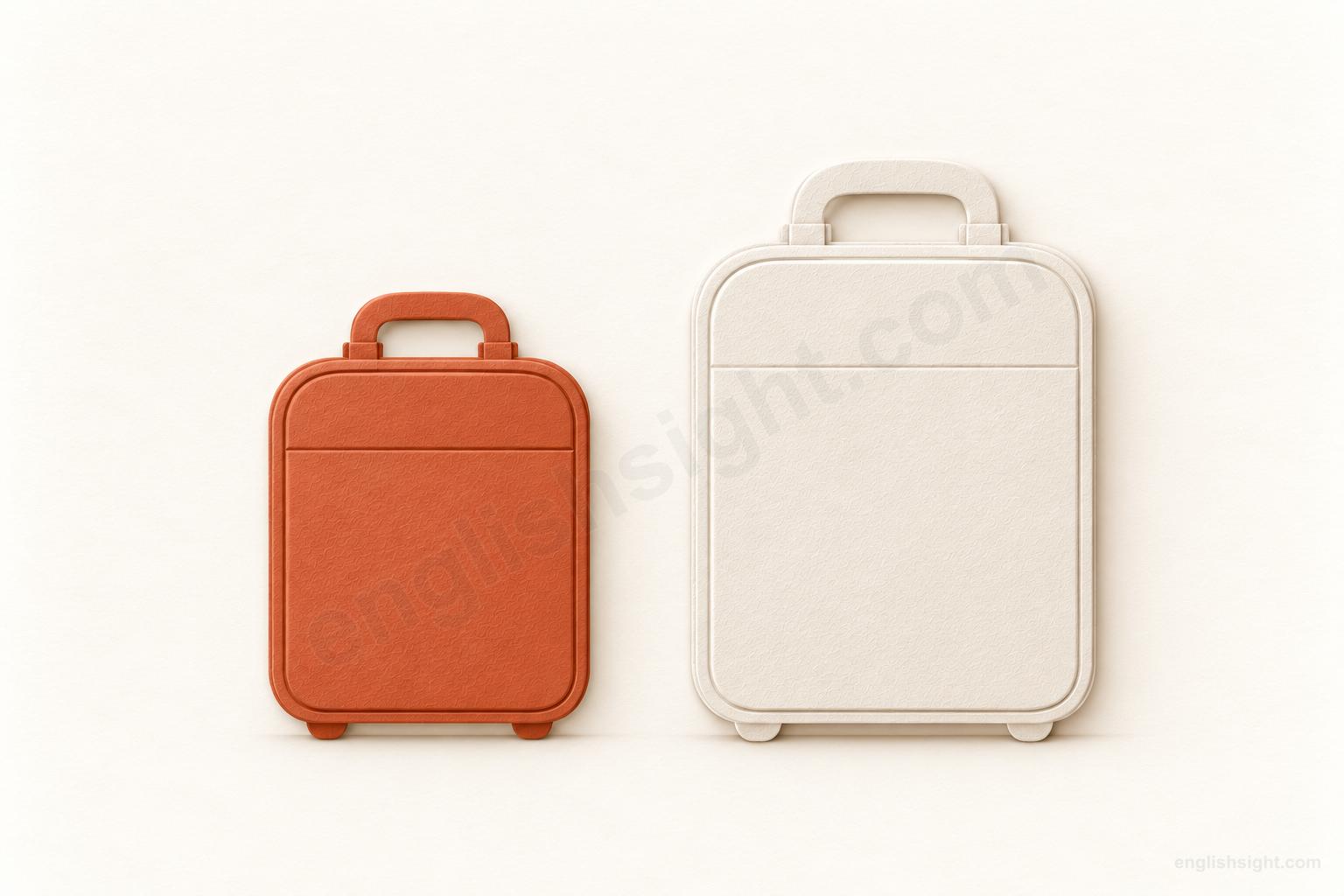
Two cases of the same kind stand side by side.
small
The orange case is small beside the ivory case.
Compare their physical size.
The orange case is small beside the larger ivory case; neither changes size.
Small describes relatively limited size, amount, degree, or extent against a relevant comparison or standard.
The cases illustrate physical size as one teaching model. The comparison is simultaneous, not a before-and-after shrinking event. Age uses, lowercase letters, social metaphors, and fixed expressions need their own explanations.
Small usually places something low on a relevant scale: size, quantity, degree, or extent. The comparison may be another object, a typical member of its kind, or the requirements of a task.
Ask “small in what respect, and compared with what?” Then read the noun and the whole construction. A small child, a small chance, and a small fortune do not deliver the same message.
01
Size depends on a comparison
Identify the object, the relevant comparison, and whether the size actually prevents a use. Small describes size; it does not itself describe shrinking.
01
small + noun; be / look + small
a small room
occupying relatively little space
Situation / comparison
You compare rooms for an overnight stay.
Meaning in context
You describe one room’s limited dimensions.
The relevant kind of object sets the size standard.
A room can be small without being unusable. In The room is small, small describes the subject; in a small room, it describes the following noun.
A small elephant is still much bigger than a large mouse: compare members of the relevant kind. Small does not mean the smallest possible size. Tiny makes a stronger size judgment.
In a sentence
The room is small, but it has everything we need.
Watch the difference Small does not automatically mean poor, cheap, or unsuitable.
02
smaller than; the smallest + noun; as small as; smaller and smaller
smaller than / the smallest
compare sizes or identify a minimum
Situation / comparison
You have several cases to choose from.
Meaning in context
You compare two, then identify the least bulky one.
Smaller compares; smallest selects a minimum within a set.
Use smaller than for a comparison and the smallest for the minimum in a stated or understood group. Much smaller strengthens the difference; a little smaller softens it. Avoid more smaller.
As small as compares equal size; not as small as means larger in that comparison. Smaller and smaller describes a continuing decrease, as in The boat looked smaller and smaller as it moved away. Unlike plain small, that construction adds change.
In a sentence
This case is much smaller than mine, but that one is the smallest of the three.
Watch the difference Smaller is relative: two large cases can differ in size without either being small.
03
too small for + noun; too small (for someone) to + verb; small enough to + verb; small for + category
too small for / small enough to
relate size to a person, category, or purpose
Situation / comparison
You try to put a laptop in a bag.
Meaning in context
You find the bag cannot accommodate it.
For names the reference; too and enough judge suitability.
Too small for my laptop says the size falls short of what the laptop requires. Too small to hold it states the consequence with an infinitive. Small enough to fit in a drawer instead treats limited size as useful.
Small for its age or small for a hotel compares with expectations for that age or category; it need not mean unusable. The room is on the small side is an informal, softened judgment that it is rather small, often a little too small.
In a sentence
The bag is too small for my laptop, but small enough to fit in the drawer.
Watch the difference Say small enough to fit, not enough small to fit. Small for its age does not mean too young.
04
a small + product; a small one; a small; size S
a small / a small one
choose a product size
Situation / comparison
A server asks which drink size you want.
Meaning in context
You select the small size in that range.
Small can label a size even when the noun is omitted.
In a shop or café, small belongs to a set such as small, medium, and large. I’ll have a small is natural when the product is clear. A small one keeps one as a substitute for a singular countable noun.
A size label depends on the seller: a small drink in one shop may hold more than a small elsewhere. S is a common clothing-size abbreviation, not a universal measurement.
In a sentence
“Which coffee would you like?” “A small, please.”
Watch the difference Do not assume every brand’s small has the same dimensions.
02
Numbers, amounts, and degrees
The noun tells you what is limited: a group’s membership, an amount of material, the likelihood of an event, or an operation’s scale.
05
a small number of + plural noun; a small group of + plural noun
a small number of
describe a limited count
Situation / comparison
Only six people attend a workshop.
Meaning in context
You describe the size of the group.
Small modifies number or group; the members remain countable.
A small number of visitors counts people; a small group of visitors views them together. In a small number of visitors, number is singular and visitors is plural.
The group is small does not say its members are physically small. For a direct quantity expression, a few visitors is natural. To compare counts, use fewer visitors or a smaller number of visitors.
In a sentence
A small number of visitors stayed for the final talk.
Watch the difference Avoid small visitors when you mean few visitors: that describes their size.
06
a small amount of + uncountable noun; a small sum of money
a small amount of
describe a limited quantity of material or money
Situation / comparison
A recipe needs only a little oil.
Meaning in context
You describe the quantity without counting individual items.
An amount measures something treated as uncountable.
Use a small amount of oil, water, money, or time. Amount is the countable measuring noun; the following material need not be countable. For coins or minutes as separate items, a small number of is the clearer count pattern.
A little money directly expresses a positive quantity. Little money often stresses scarcity. Small money is not the ordinary substitute for either; a small sum of money is natural.
In a sentence
Add a small amount of oil and stir again.
Watch the difference Small is an adjective, not a general quantity determiner: say a little water, not small water.
07
a small chance of + noun / -ing; a small change / problem / favour
a small chance / a small problem
judge likelihood, extent, or importance
Situation / comparison
A delay is possible but unlikely.
Meaning in context
You describe a low probability, not a short event.
The noun selects the dimension being judged.
A small chance concerns likelihood; a small increase concerns the size of a change; a small problem usually concerns seriousness. None requires a physically small object.
A small favour presents a request as modest and can soften it: Could you do me a small favour and check this address? The listener may still find it demanding. Small hope and small cause for optimism occur in more formal wording; little hope and little reason for optimism are plainer choices.
In a sentence
There is a small chance of rain, so I’ll take a light jacket.
Watch the difference A small chance is not no chance; a small problem can still matter to someone.
08
a small business; on a small scale; in a small way; start small
a small business / on a small scale
describe limited resources or activity
Situation / comparison
A family produces jam in a single kitchen.
Meaning in context
You describe the modest scale of the operation.
Business scale concerns the operation, not just its building.
A small business operates with limited staff, trade, or resources compared with larger firms. Small investors and small farmers describe people operating at a limited financial or production scale, not short people.
On a small scale and in a small way describe limited activity. Start small means begin with a modest operation: We’ll start small and expand if it works. Small-scale production uses a hyphen before the noun.
In a sentence
We sell jam on a small scale from our family kitchen.
Watch the difference Small does not imply unsuccessful, and legal definitions of a small business vary.
03
Age, voice, and social feelings
Some uses concern young children or quiet speech; others are evaluations of dignity or attitude. Do not treat them as measurements of a body.
09
small children; when + person + was / were small
when I was small
refer to childhood or young children
Situation / comparison
An adult remembers early childhood.
Meaning in context
The story is located when the speaker was young.
In childhood contexts, small can refer to age.
Small children commonly means young children. When I was small recalls childhood rather than simply a time when your measurements were different.
The context matters: a small adult describes body size, not youth. Small for her age explicitly compares size with others of the same age; it does not say she is younger than them.
In a sentence
When I was small, my aunt read to me every evening.
Watch the difference Do not use a small adult to mean a young adult.
10
say / ask / answer + in a small voice
in a small voice
speak quietly and often timidly
Situation / comparison
A child is nervous about answering.
Meaning in context
The answer comes out quietly.
Small describes the strength of the voice, not its physical size.
In a small voice often suggests fear, shame, or lack of confidence as well as low volume. The surrounding scene supplies the emotion; small alone does not diagnose how someone feels.
For a neutral instruction about volume, Speak quietly is usually clearer. A quiet voice need not sound timid, while a small voice often presents vulnerability.
In a sentence
“Could you stay?” she asked in a small voice.
Watch the difference Do not replace small voice with short voice: short concerns length, not this vocal quality.
11
feel / look small; make + person + feel / look small
feel small / make someone look small
feel or cause humiliation
Situation / comparison
Someone corrects you harshly in public.
Meaning in context
You feel embarrassed and diminished.
The diminished size is a social metaphor.
Feel small concerns your emotional response; look small concerns how you seem to other people. Make someone feel or look small describes causing that loss of dignity.
Make takes a person followed by the bare infinitive feel or look, without to: It made me feel small. Small is the adjective complement of feel or look inside that construction. This is not a phrasal verb formed with small.
In a sentence
His joke made me feel small in front of the team.
Watch the difference This does not mean your body shrank.
12
small-minded + noun; be small-minded
small-minded
criticize a narrow or petty attitude
Situation / comparison
A person refuses to consider other people’s views.
Meaning in context
You criticize the attitude as narrow.
This compound evaluates someone’s outlook.
Small-minded is disapproving. It can criticize unwillingness to consider other views or an excessive concern with petty matters.
The compound does not measure intelligence or head size. Calling someone small-minded is a criticism; it is not a neutral description of being quiet or shy.
In a sentence
Refusing to hear anyone else’s ideas was small-minded.
Watch the difference Keep the hyphen in small-minded; do not treat it as a body-size description.
04
Letters, actions, and a body-part noun
Small is mainly an adjective, but it also occurs after certain verbs as an adverb and in one useful body-part expression. Letter case is a separate convention.
13
a small + letter name; small letters; with a small + letter
a small letter
use lowercase rather than a capital
Situation / comparison
You spell a name or type an address.
Meaning in context
You specify letter case.
Letter case is distinct from the size of the printed mark.
A small a means lowercase a, contrasted with capital A. A lowercase letter can be printed very large; a capital can be printed very small.
With a small letter can also distinguish a general idea from an official label: a conservative with a small c has conservative views without necessarily belonging to the Conservative Party. That convention depends on the particular label and context.
In a sentence
Write the password with a small b, not a capital B.
Watch the difference A small letter can mean lowercase, not merely a tiny font.
14
cut / chop + object + (up) small
cut it small
produce small pieces by cutting
Situation / comparison
You prepare vegetables for soup.
Meaning in context
The vegetables end up in small pieces.
The result concerns the pieces, not the amount of cutting.
Cut the carrots small means cut them into small pieces. Oxford and Collins list this use as adverbial. The verb contributes the cutting; small describes the resulting piece size.
Cut them into small pieces is an explicit alternative. Small is not a general replacement for carefully or gently: Cut carefully describes the manner of working, which is a different instruction.
In a sentence
Chop the carrots small so they cook quickly.
Watch the difference Cut it a little can mean do a little cutting; it does not clearly request small pieces.
15
write + small; write in small handwriting
write small
make small written marks
Situation / comparison
A form gives you very little space.
Meaning in context
You reduce the size of your handwriting.
Here small follows the verb and describes writing size.
Write small asks for small handwriting. This differs from write in small letters when that means lowercase: handwriting size and letter case are separate choices.
The spelling stays small in this established adverbial use. Do not add -ly to make an instruction such as Write small. Write in small handwriting is an explicit alternative.
In a sentence
Please write small so your full address fits on one line.
Watch the difference This instruction does not mean write fewer words or use only lowercase letters.
16
the small of + possessive + back
the small of your back
name the inward curve of the lower back
Situation / comparison
You describe where a cushion sits.
Meaning in context
You locate it at the lower back’s inward curve.
Small is a noun within this established body-part expression.
The small of my back identifies a particular lower-back area. Change the possessive with the person: her back, your back, or the back in a general description.
This is not the ordinary adjective pattern a small back, which describes an entire back’s size. Learn the whole noun phrase rather than generalizing small of to every narrow body part.
In a sentence
The cushion rests against the small of my back.
Watch the difference Keep the: in the small of my back, not in small of my back.
05
Learn the whole expression
These compounds and idioms have established uses. The comparison model helps with some connections, but the full phrase supplies the message.
17
make small talk; small talk with + person; small talk about + topic
make small talk
have light social conversation
Situation / comparison
Two guests meet before dinner.
Meaning in context
They chat about ordinary, low-stakes topics.
The topic carries little weight, but the social connection can matter.
Small talk is conversation used to be sociable rather than to discuss a major issue. Make small talk is a familiar combination; the talk need not be short or quiet.
Small talk is uncountable in this use: some small talk, not a small talk. A short talk, by contrast, can be a brief presentation.
In a sentence
We made small talk about the weather while dinner was cooking.
Watch the difference Small talk does not mean speaking at low volume.
18
some / any small change; small change compared with + amount
small change
refer to low-value coins or a comparatively minor amount
Situation / comparison
A machine accepts only coins.
Meaning in context
You look for low-value coins in your pocket.
Change is a money noun here, not an alteration.
Small change normally means low-denomination coins. Figuratively, a cost can be small change compared with a much larger amount: To that company, a thousand dollars is small change.
Compare We made a small change to the design: there change is a countable alteration. The article and surrounding words help distinguish the uses.
In a sentence
Do you have any small change for the ticket machine?
Watch the difference A small change usually means one minor alteration; small change is uncountable money.
19
the small print; read / check the small print
read the small print
check easily missed details in an agreement
Situation / comparison
You consider a subscription with an attractive headline price.
Meaning in context
You check its conditions and exclusions.
Small type can contain consequential information.
The small print refers to detailed conditions that are easy to overlook. It is especially British English; the fine print is the usual North American equivalent.
The expression is also useful for online terms where there is no printed paper. Do not infer that the conditions are unimportant just because the lettering or presentation is unobtrusive.
In a sentence
The small print says the discount lasts only one month.
Watch the difference Small print does not mean a minor condition; it may change the whole offer.
20
cost a small fortune; spend a small fortune on + noun
cost a small fortune
emphasize that something is very expensive
Situation / comparison
You buy a replacement part at a surprising price.
Meaning in context
You complain about the large cost.
The whole informal phrase still means a lot of money.
A small fortune is a substantial sum, often presented as surprisingly large. In cost a small fortune, fortune keeps the idea of considerable wealth; small does not turn the cost into a trivial amount.
Other verbs are possible: spend a small fortune on repairs or earn a small fortune. The expression is an informal evaluation, not a precise financial amount.
In a sentence
Replacing the damaged screen cost a small fortune.
Watch the difference Do not interpret a small fortune as a cheap price.
21
on the small screen; a small-screen role
the small screen
refer to television in contrast with cinema
Situation / comparison
A film actor begins work on a television series.
Meaning in context
You describe a move into television.
The established contrast is between television and cinema.
The small screen means television when contrasted with the big screen of cinema. It remains usable even if a particular television set is physically large.
Use on the small screen for appearing on television. In a small-screen role, a hyphen joins the compound before the noun. An ordinary small screen can simply be a physically small display.
In a sentence
After years in films, she returned to the small screen in a detective series.
Watch the difference The small screen does not specifically mean a phone display in this expression.
22
It’s a small world!
It’s a small world!
react to an unexpected social connection
Situation / comparison
A stranger turns out to know your former teacher.
Meaning in context
You express surprise at the shared connection.
The world feels socially close; its physical size is unchanged.
It’s a small world! is a conversational reaction to an unlikely meeting or connection. It can stand alone after the surprising information.
The expression does not claim that the coincidence was actually impossible or that everyone knows everyone. The exclamation responds to this particular discovery.
In a sentence
“Your aunt taught me at school.” “It’s a small world!”
Watch the difference Use it for a surprising connection, not simply as a factual description of Earth.
23
in / into / until the small hours; the early hours
the small hours
refer to the early hours after midnight
Situation / comparison
A conversation continues after midnight.
Meaning in context
You say it lasted late into the night.
This is a time expression learned as a unit.
The small hours names the period after midnight and before morning is far advanced. Into the small hours emphasizes continuing until that late time.
The early hours is an alternative. The wee small hours is especially Scottish; the wee hours is especially North American. None means that an hour contains fewer than sixty minutes.
In a sentence
We talked into the small hours after the reunion.
Watch the difference Keep the plural and the article: the small hours, not a small hour.
24
be no small achievement / task; no small + noun; in no small measure
no small achievement
emphasize that something is considerable
Situation / comparison
A team completes a difficult task.
Meaning in context
You give strong praise for the achievement.
No rejects the description small and creates understatement.
No small achievement means a considerable achievement. It is an emphatic understatement, often used with effort, task, or achievement.
The construction contributes the reversal: small alone still means limited. Compare a small achievement, which calls the result modest, with no small achievement, which praises its significance.
In no small measure is a formal expression meaning to a considerable extent: The project succeeded in no small measure because of the volunteers. It credits their contribution as substantial, not minor; it need not mean they were the only cause. In everyday conversation, They helped a lot is often plainer.
In a sentence
Organizing the exhibition alone was no small achievement.
Watch the difference Do not drop no if you mean to emphasize how impressive it was.
25
be grateful / thankful for small mercies
be thankful for small mercies
notice a modest relief in a bad situation
Situation / comparison
Travel is delayed, but you have a comfortable waiting place.
Meaning in context
You acknowledge the limited positive point.
The benefit is small relative to the wider difficulty.
Be grateful or thankful for small mercies focuses on something that makes an unpleasant situation less bad. It need not refer to religious belief.
The phrase can sound resigned or wry. Applied to another person’s serious hardship, it may sound dismissive, so the relationship and tone matter.
In a sentence
The train is late, but at least we have seats; I’m thankful for small mercies.
Watch the difference The expression acknowledges a limited benefit; it does not say the entire situation is good.
26
don’t sweat the small stuff
don’t sweat the small stuff
advise someone not to worry about minor details
Situation / comparison
A friend worries about every minor party arrangement.
Meaning in context
You encourage them to focus on what matters most.
Small stuff is minor matters; sweat means worry in this informal phrase.
Don’t sweat the small stuff is informal, especially North American. It reassures someone that not every detail deserves anxiety.
It does not mean that every detail is irrelevant. Decide whether the matter really is minor before using a reassuring expression that might minimize someone else’s concern.
In a sentence
The napkins don’t match, but don’t sweat the small stuff.
Watch the difference Sweat here is figurative; this is not an instruction about body temperature.
27
(it is) small / little / no wonder (that) + clause
small wonder (that)…
say that a result is unsurprising
Situation / comparison
Someone stayed awake all night and is tired now.
Meaning in context
You present tiredness as an expected result.
Wonder concerns surprise in this established expression.
Small wonder introduces an outcome that is easy to understand from the circumstances. No wonder is the more conversational alternative; little wonder is also possible.
That can introduce the following clause, or be omitted. The phrase comments on a whole situation, rather than describing a small remarkable object.
In a sentence
He had been awake all night; small wonder he could barely concentrate.
Watch the difference Small wonder does not mean a small amount of curiosity.
28
be small potatoes compared with / to + noun
small potatoes
dismiss something as relatively unimportant
Situation / comparison
A minor expense is compared with a large budget.
Meaning in context
You describe it as insignificant by comparison.
This informal expression compares importance or value.
Small potatoes is North American informal English for something of little importance or value. British English uses small beer in a similar way.
These expressions can refer to matters other than food or drink. Calling someone’s concern small potatoes can sound dismissive. A literal order of small potatoes is different: context decides.
In a sentence
The printing cost is small potatoes compared with the venue hire.
Watch the difference Do not infer that small beer means a small glass of beer in this figurative use.
29
a big fish in a small pond
a big fish in a small pond
describe importance within a limited community
Situation / comparison
Someone has great influence in a small local group.
Meaning in context
You qualify the reach of their importance.
The pond represents the limited social setting.
A big fish in a small pond is important within a relatively small community or organization. The expression can contrast local prominence with less influence in a wider setting.
It can be mildly critical or simply describe a choice of environment. Neither fish nor pond is literal when used of someone’s position in a workplace or club.
In a sentence
At the village club he was a big fish in a small pond.
Watch the difference The idiom does not automatically mean that the person is unskilled or dishonest.
Read the scale and the whole expression
Small and little overlap, but do different jobs
Small is often a neutral size description; little can add affection, pity, or dismissal, depending on context. A small house and a little house can both describe size. For an ordinary quantity expression with an uncountable noun, use little or a little: little time, a little water. Small usually needs a measuring noun, as in a small amount of water. Established combinations such as small hope and small cause for optimism are exceptions; they are more formal and cannot be extended freely to small water or small time.
Forms and complements
The comparative is smaller and the superlative is smallest. Use very small, much smaller, and the smallest; avoid more smaller. As an adjective, small can follow be, look, feel, or become, or precede a noun. Make the image smaller is make + object + adjective: the construction supplies causation. Small has no ordinary modern conjugated verb or everyday phrasal-verb family in this lesson.
Small does not always mean unimportant
A small dose can have a major effect, and the small print can contain crucial terms. No small achievement and a small fortune emphasize something substantial. Do not mechanically substitute tiny or unimportant in every phrase.
Choose the intended meaning
Use the noun, the comparison, and the complete expression.
1. The bag cannot hold your laptop. Which sentence describes the problem?
2. You need a little water, not a few individual containers. Which expression fits?
3. Someone complains that repairs cost a small fortune. What do they mean?
4. A password requires lowercase b. Which instruction clearly identifies the letter case?
5. A cruel joke made Maya feel small. What changed?
6. There is a small chance of a delay. Which interpretation fits?
Sources and teaching notes
Dictionary entries support the usages below. The explanations and examples are original teaching material; the comparison sketch is a teaching model.
The comparison illustrates a useful connection, not a picture shared by every native speaker.