Follow smash from broken objects and forceful contact to records, performances, and popular hits.
A powerful impact and its result
Force meets something and changes the situation
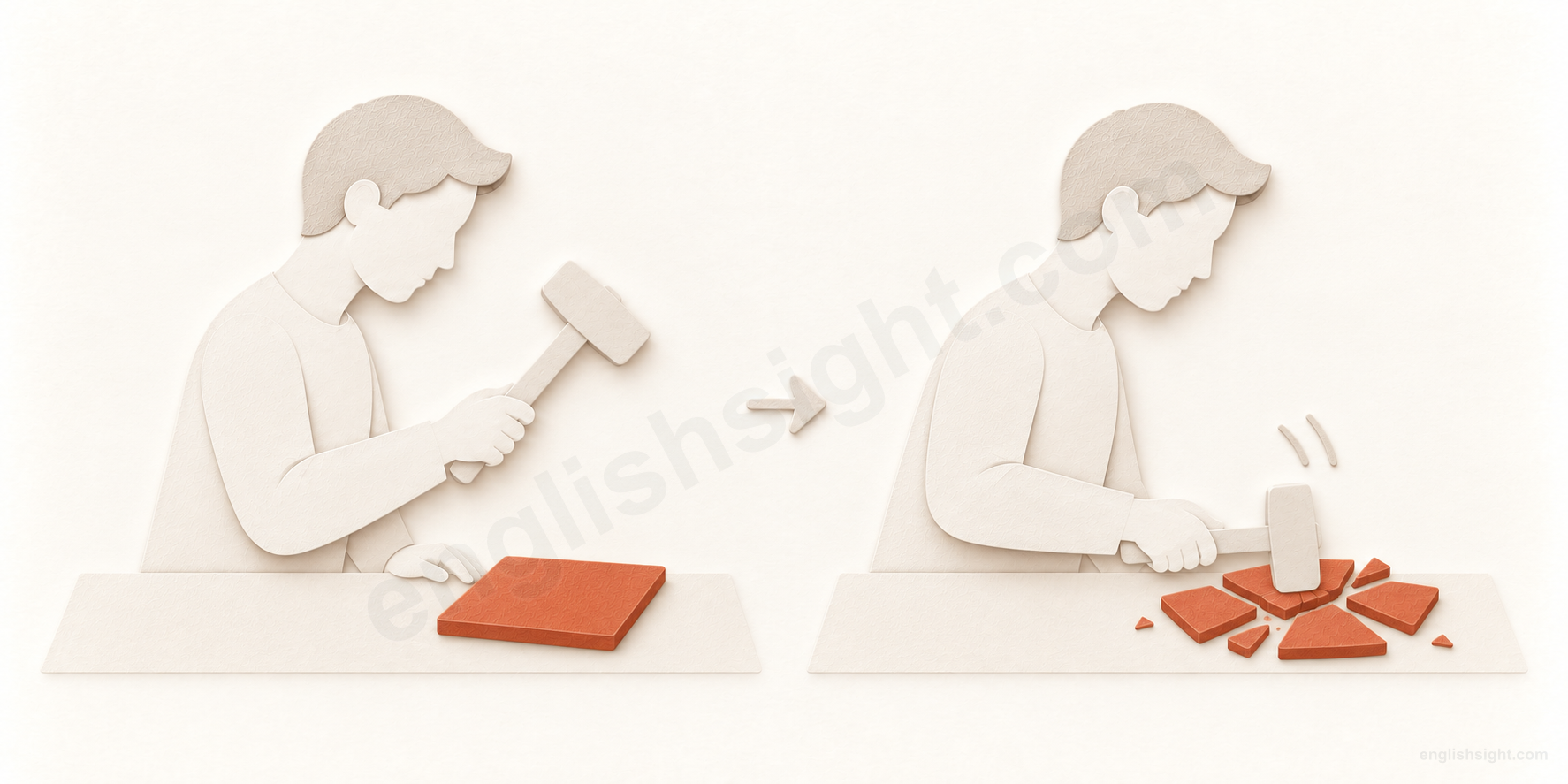
An intact tile lies beneath a raised hammer.
smash
The tile is broken into separated pieces.
A forceful hammer blow strikes the tile.
A forceful blow turns one intact tile into broken pieces.
Smash presents a powerful impact, often with a dramatic result: breaking, crushing, forceful movement, or a figurative decisive effect.
The sketch shows the literal breaking branch. A ball can be smashed without breaking, and success expressions use an established figurative meaning.
Smash often makes an action feel sudden, forceful, and consequential. A window may break, a ball may fly, or a record may be decisively beaten. The object and construction tell you which result is meant.
The physical image is a useful teaching link. Success expressions and fixed compounds still need to be learned in context; they cannot all be predicted by imagining broken pieces.
01
Breaking, crushing, and hitting
Start with a physical action. Ask what receives the force and whether the sentence actually says it breaks.
01
smash + object; subject + smash; be smashed; smash (something) to / into pieces
smash a window / the glass smashed
break something violently, or break in this way
Starting situation
A stone strikes an intact pane.
Action or result
The pane is broken into fragments.
The thing that breaks can be the object or the subject.
Compare The stone smashed the window with The window smashed. The first names a cause; the second reports what happened to the window. Neither structure alone tells us whether a person intended the damage.
The window was smashed is a passive: the window receives the action, and the cause can be left unnamed. A smashed window describes its damaged condition. To pieces or into pieces makes the result explicit: The bowl fell and smashed into pieces.
In a sentence
A falling branch smashed the greenhouse window.
Watch the difference Smash is stronger and more vivid than neutral break. A tiny crack is not normally enough to call a window smashed.
02
smash + object + to smithereens
smash something to smithereens
break something completely into very small pieces
Starting situation
An old ornament is still in one piece.
Action or result
Only small fragments remain.
To smithereens emphasizes the extent of destruction.
Smithereens is a plural noun used in this established result phrase. To does not introduce a destination here; it introduces what the object is reduced to.
The phrase is informal and emphatic. It can exaggerate how thoroughly something broke. Learn the whole chunk rather than treating smithereens as a verb or saying a smithereen in this expression.
In a sentence
The falling shelf smashed the ornament to smithereens.
Watch the difference Use to smithereens, not to a smithereens. The ordinary alternative is to pieces.
03
smash + ingredient + with + tool
smash the garlic
crush an object by applying force
Starting situation
A garlic clove keeps its rounded shape.
Action or result
It has been flattened and split.
Physical smashing can crush rather than scatter hard fragments.
The material matters. Glass may scatter into pieces; a soft ingredient can flatten or split under pressure. The shared connection is force changing the object, not a rule that every smashed thing becomes sharp shards.
In a recipe, Smash the garlic describes a physical preparation step. Mash the potatoes suggests working them into a soft mass; smashing a cooked potato can leave a flattened potato with substantial pieces still together. These are descriptions of different results, not strict rules for every recipe name.
In a sentence
Smash the garlic with the flat side of a knife.
Watch the difference Smash does not by itself mean chop finely or blend until smooth. Follow the result described in the recipe.
04
subject + smash into / against + target; smash + object + against + target
smash into / against something
collide with something with great force
Starting situation
A car loses control on the bend.
Action or result
It hits a wall hard.
The moving subject strikes the object of into or against.
In The car smashed into the wall, car is the subject and wall follows a preposition. Into marks the collision target; it does not mean the car successfully entered the wall. Against highlights contact with a surface, as in waves smashing against rocks.
You can also cause the movement: The wind smashed the loose gate against the post. Here the gate is the object driven against something. Damage may follow, but the collision construction foregrounds the forceful contact.
In a sentence
The car slid on the ice and smashed into a wall.
Watch the difference Compare smash into a wall with smash through a wall: through adds passage beyond the barrier.
05
smash + object (+ direction / contact phrase)
smash the ball into the net
hit or drive something very hard
Starting situation
The ball is within reach.
Action or result
A hard kick sends it into the goal.
A hard hit need not destroy the object being hit.
A player can smash a ball into the net without breaking the ball or the net. The object identifies what is struck; the following phrase can identify where it goes. In this football scene, net means the goal net.
With people, smash can describe a violent blow; it does not imply a sporting action. In He smashed his fist on the table, fist is the moving object and table is the contact surface. Read the participants rather than translating every use as break.
In a sentence
Maya smashed the ball into the net from close range.
Watch the difference Not every sporting use is an overhead smash. The ordinary hard-hit verb can describe a powerful kick or other stroke.
02
Breaking a way in or changing a barrier
Through and into describe a route. Open describes a result. Down, in, and up also occur in established particle constructions.
06
smash through + barrier; smash + possessive + way through / into + place
smash through / smash your way through
get past a barrier by force and damage
Starting situation
A fallen wooden fence blocks the route.
Action or result
A vehicle breaks through and reaches the far side.
The path is made by breaking the obstruction.
Through contributes the route across a barrier; smash contributes the forceful, destructive action. Smash your way through gives the same route a fuller construction: the subject makes a way by smashing.
Into can identify the place reached: They smashed their way into the locked store. Unlike smashed into a wall, this way construction presents forced entry. The whole pattern and the kind of place make the difference.
In a sentence
The truck smashed through the fence and stopped in the field.
Watch the difference Smash through suggests that the barrier gives way. A vehicle may smash into a gate and remain outside.
07
smash + object + open; smash + a hole + in + surface
smash a door open
make something open by hitting and breaking it
Starting situation
A door is shut and cannot be opened normally.
Action or result
Force opens it, with damage.
The object undergoes the result described by open.
In smash the door open, open is an adjective describing the result of the action. It is not the object and is not a particle meaning a direction. The same general result pattern appears in push the door open, but smash adds destructive force.
Smash a hole in the ice is another useful construction: the hole is created by striking the ice. Neither expression means that smash generally takes a to-infinitive or makes another person perform an action.
In a sentence
The rescuers had to smash the jammed door open.
Watch the difference Open describes the resulting state; it does not say the door fell down.
08
smash down + noun; smash + noun / pronoun + down
smash a door down
break a barrier so that it falls down
Starting situation
A door stands across the entrance.
Action or result
After heavy blows, it falls out of the way.
Down emphasizes the barrier falling.
Smash down is a separable particle construction in this use: smash down the door or smash the door down. With a pronoun, say smash it down.
Compare smash the door open, which focuses on an open result, with smash the door down, which says the barrier is brought down. The actions may overlap in a real event, but the descriptions emphasize different results.
In a sentence
They smashed the damaged door down to reach the trapped dog.
Watch the difference Say smash it down, not smash down it. Down does not merely add emphasis here.
09
smash in + noun; smash + noun / pronoun + in
smash a window in
make a hole by striking something hard
Starting situation
A window closes off the inside.
Action or result
Its pane is broken inward, leaving an opening.
In highlights damage into a surface or barrier.
Smash in the window and smash the window in are both possible. A pronoun goes between the verb and particle: smash it in. Contrast smash into the window: into introduces a collision target rather than a movable particle.
The informal phrase smash someone’s face in means hit that person very violently in the face. It can occur as a threat and is aggressive language, not an ordinary way to express disagreement. The body-part phrase is learned as a whole, not as a literal description of making a doorway.
In a sentence
Someone had smashed a side window in during the night.
Watch the difference Smash it in and smash into it have different structures; do not swap in and into automatically.
10
smash up + noun; smash + noun / pronoun + up
smash something up
damage or destroy something by force
Starting situation
The room contains usable furniture.
Action or result
Much of it is broken and unusable.
Up helps present extensive damage, not upward movement.
In smash up the furniture or smash the furniture up, up belongs to a particle construction. With a pronoun, use smash it up. The phrase often describes deliberate destruction, such as vandalism.
With a car, smash it up can instead mean damage it in a collision: He smashed up his car on the way home. The sentence does not by itself say he meant to damage it. Keep the destructive-action and vehicle-accident readings distinct.
In a sentence
Vandals broke into the hall and smashed the furniture up.
Watch the difference Up does not mean the furniture rose. With cars, check whether the context describes a crash or deliberate vandalism.
03
Sport, defeat, and striking success
A forceful stroke, a decisive defeat, and an impressive achievement share an emphasis on strength or impact. Their meanings still depend on the object and context.
11
smash + ball / shuttlecock; hit + a smash; an overhead smash
smash a high ball / an overhead smash
hit a high ball sharply downward in a racket sport
Starting situation
A high return gives the player an attacking chance.
Action or result
A powerful downward shot crosses the net.
This is a particular stroke, not the destruction of a ball.
In tennis and badminton, smash names a forceful overhead stroke. The verb takes the ball or shuttlecock as object; the noun names the shot: an overhead smash. You can hit a smash or practise your smashes.
The connection with physical impact is direct, but the sport supplies the technical details. A strong low shot is not automatically an overhead smash, and a smash is not guaranteed to win the point.
In a sentence
Nina smashed the high return down into the opposite court.
Watch the difference The sports noun is countable: a smash, two smashes. The verb form is also smashes with he, she, or it.
12
smash + a / the / possessive + record
smash a record
improve on a record by an impressive amount
Starting situation
An earlier best result sets the standard.
Action or result
A new result beats it decisively.
The record is surpassed; nothing physical has to break.
A record can be a fastest time, a greatest distance, or another measured best. In a timed race, a lower time can smash the record; in a distance event, a greater distance can do so. The improvement depends on what is measured.
Smash is an emphatic alternative to break a record. It foregrounds how impressive the new result is; it does not supply a fixed numerical threshold.
In a sentence
The relay team smashed the school record by almost three seconds.
Watch the difference Smash a record is about beating a benchmark. It does not mean winning every race or destroying a recording.
13
smash + opponent / opposition
smash the opposition
defeat an opponent decisively
Starting situation
Two teams are competing.
Action or result
One wins by a very large margin.
The impact is figurative: the defeat is overwhelming.
In a match report, smash the opposition can describe a crushing victory. No one needs to be physically injured. The sports context makes this different from a report that someone smashed another person in the face.
It is stronger and more dramatic than neutral beat or defeat. Use it when that forceful tone fits; a narrow win is poorly described as smashing the other side unless the speaker is deliberately exaggerating.
In a sentence
Our team smashed the opposition six–nil.
Watch the difference The object and context distinguish defeating a team from physically striking a person.
destroy an organization’s power or ruin a prospect
Starting situation
A network operates, or a person has hopes for an outcome.
Action or result
The network is broken up, or the hoped-for outcome seems lost.
The destructive result can concern a system or an expectation.
Smash a criminal network presents decisive action that stops it operating. The objects are people’s organization and power, not pieces of material. This is a forceful choice often found in news reporting.
With hopes, the destruction is emotional: The rejection smashed her hopes of joining the team. This does not imply a blow to her body. The impact model is a memory link, not a rule allowing smash before any abstract noun.
In a sentence
The operation smashed a network selling stolen phones.
Watch the difference Smash a plan can suggest ruining it; it does not normally mean completing it well without a clear success context.
15
smash it; smash + task (informal success context)
smash it
do something extremely well
Starting situation
Someone is preparing to perform a task.
Action or result
Their performance is, or is expected to be, excellent.
This informal expression praises success rather than damage.
You smashed it! can congratulate a singer after a performance. You’ll smash it! can encourage a friend before an interview. It refers to the task or occasion understood from context.
Informal English also allows an explicit task object, as in We’re going to smash this presentation. This positive reading is established usage, not a general rule that smash plus any object means succeed. Compare You smashed my phone, where the ordinary reading is damage.
In a sentence
You were so clear in that interview—you smashed it!
Watch the difference Smash it is informal praise or encouragement. In a literal instruction about an object, the same words can mean break it.
04
Sounds, accidents, and hits
As a noun, smash can name a noisy break, a collision, or a popular success. A compound can add a more specific meaning.
16
with + a (loud) smash; hear + a smash; the smash of + breaking material
with a smash
with a sudden noisy break or impact
Starting situation
A ceramic dish falls.
Action or result
A sharp breaking noise is heard.
The noun names the event or the sound it makes.
In with a loud smash, smash is a noun and loud describes the noise. Hear a smash reports the sound without necessarily identifying the object or cause.
A smash of breaking glass makes the source explicit. Compare The dish smashed, where smashed is the verb reporting what happened. The noun and verb can describe different aspects of the same event.
In a sentence
We heard a loud smash from the kitchen.
Watch the difference A crash can also be a loud noise; a smash especially suggests a hard impact or breaking, not every loud sound.
17
a car / head-on smash; be involved in a smash; a smash-up
a car smash / a smash-up
a serious vehicle collision
Starting situation
Vehicles are travelling on a road.
Action or result
A collision has occurred.
Here smash names the accident itself.
A car smash is especially British usage and can occur in informal reports. Crash is a useful neutral alternative. A head-on smash specifies vehicles meeting front to front.
Smash-up is a related countable noun: a motorway smash-up. Compare the noun a smash-up with the two-word verb smash up a car. The noun does not tell us who caused the accident.
In a sentence
The road was closed after a head-on smash.
Watch the difference In a smash names an event. Smashed into a van is a verb plus a collision target.
18
be / become + a smash (hit); a smash-hit + noun; a smash success
a smash / a smash hit
a very popular entertainment success
Starting situation
A new show opens.
Action or result
It attracts strong public enthusiasm.
The figurative impact is popularity and success.
A song, film, or show can be a smash or a smash hit. This is a positive noun use, so The show was a smash does not mean the production fell apart.
Before another noun, smash can also mark a major success: a smash-hit series or a smash success. The full phrase expresses approval. Compare a car smash, where the noun belongs to the accident sense instead.
In a sentence
The small theatre’s new comedy became a surprise smash hit.
Watch the difference Success is supplied by this established sense, not by the literal breaking diagram. Do not use a smash to mean any small everyday achievement.
19
a smash-and-grab + raid / robbery
a smash-and-grab raid
a theft involving a broken shop window and quickly taken goods
Starting situation
Goods are displayed behind a shop window.
Action or result
The window is broken and reachable goods are stolen.
The compound combines breaking access with taking goods.
Smash-and-grab is a British adjective used before a noun such as raid. It identifies a particular type of theft, not simply any crime in which something breaks.
Smash supplies the broken-window action and grab supplies the rapid taking, but the whole compound has an established use in crime reporting. It is not a separable phrasal verb like smash up.
In a sentence
The jeweller replaced the window after a smash-and-grab raid.
Watch the difference Keep the compound together before its noun. A car smash is a collision and does not imply theft.
Read the object, the pattern, and the tone
Break, crack, shatter, and smash
Break is a broad word for damage or loss of function. Crack can leave something mostly together with a split. Shatter emphasizes fragments; smash emphasizes a forceful action or impact and can also describe crushing or a hard hit. These are useful tendencies, not a promise that the words never overlap.
Forms and grammar
The forms are smash, smashes, smashed, smashed, smashing. Smash is /smæʃ/; smashes ends /ɪz/ and smashed ends /t/. Progressive action and passive damage reports are natural: They are smashing the old tiles; the windows were smashed. The result pattern smash the door open is not a general causative pattern with a person plus a bare verb or to-infinitive.
Particles and prepositions
In smash it up / down / in, a pronoun comes before the particle. In smash into it / against it / through it, the preposition keeps its following object. Open is a result adjective. Not every word after smash is part of a phrasal verb.
Related adjectives have their own meanings
In slang, He was smashed can mean he was very drunk; it does not necessarily report an injury. British informal, old-fashioned smashing can mean very good or pleasant: We had a smashing evening. These established adjectives differ from the passive He was smashed into the wall and the action They were smashing tiles.
Scope of this lesson
This is a selection of useful modern senses and constructions, not a frequency ranking or a list of every regional expression. Financial-collapse senses, a cocktail called a smash, slang for coins, specialist bookbinding, the informal drink-quickly sense, and adult sexual slang are not developed here. The retained SVG is a compatibility sketch; the final AI paper-cut illustration is produced and reviewed in a separate stage.
Choose the meaning that fits
Use the participants and the whole construction, not only the idea of breaking.
1. A van hit a gate hard but remained outside. Which description avoids claiming that it passed the barrier?
2. You are describing deliberate destruction of a cabinet. Replace the cabinet with it. Which order is standard?
3. A friend finishes an excellent audition. Which comment praises the performance?
4. A tennis player smashed the ball. Must the ball have broken?
5. A reviewer calls a new comedy a smash hit. What does that mean?
Sources and teaching notes
Usage was checked against the publisher pages below. Explanations and examples are original; the core image is a teaching connection, not a claim about every speaker’s mental imagery.
The diagram explains the breaking branch. It does not predict every use of smash.