Use smile for the action, the expression, and familiar ways of responding to people.
From a level mouth to a visible smile
A visible expression, with room for context
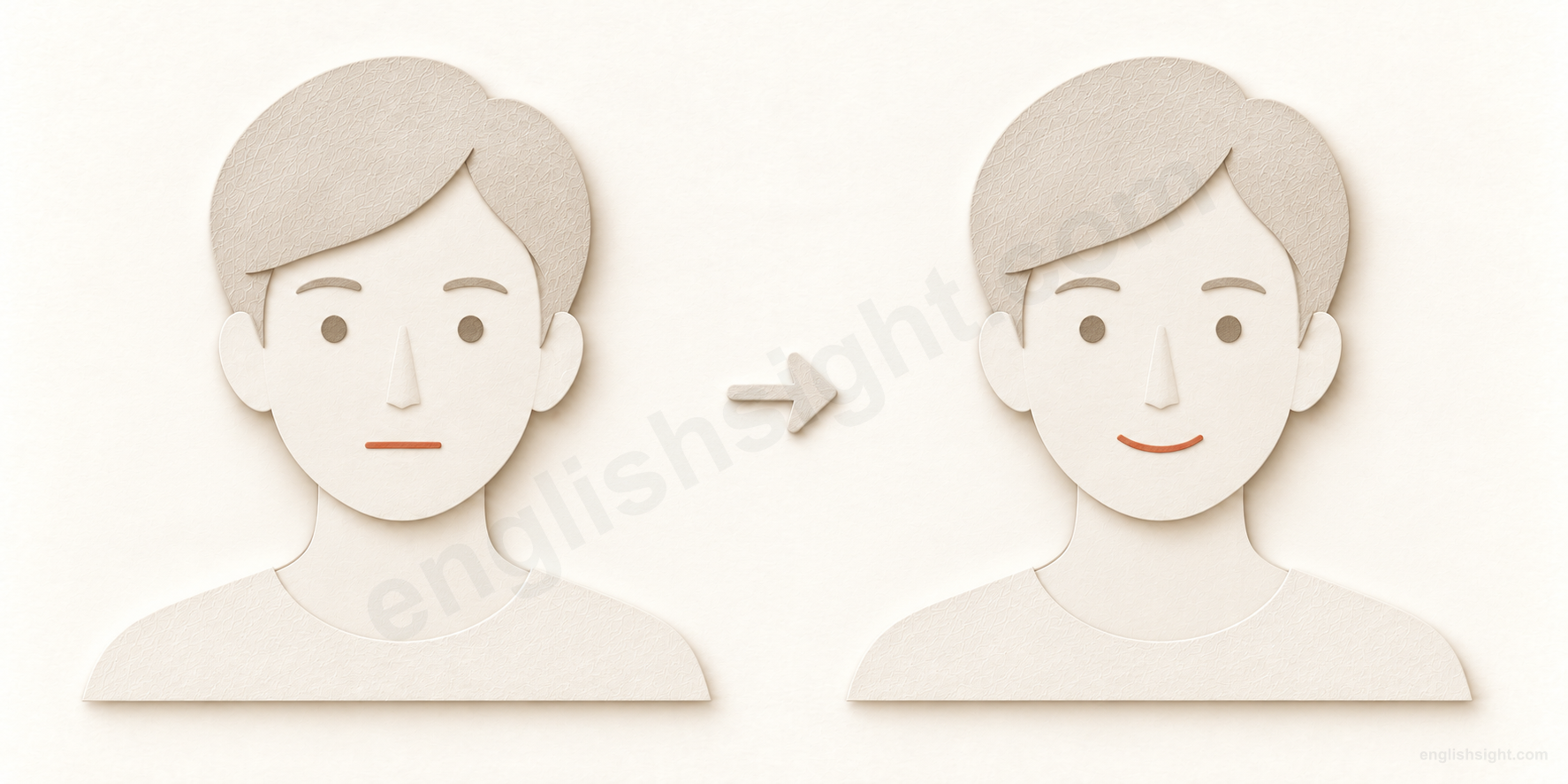
The person has a level, closed mouth.
smile
The same person now shows a closed-mouth smile.
The corners of the mouth turn upward.
The same face changes expression; the smile alone does not tell us what the person feels.
A smile is a facial expression with the corners of the mouth turned upward; to smile is to show that expression.
The comparison shows the same person before and during a smile. It illustrates a visible change, without claiming to reveal the person’s inner feeling or to explain every idiom.
Start with the face: the mouth’s corners curve upward. That visible expression can accompany pleasure, welcome, embarrassment, or other attitudes. The situation tells you how to interpret it.
The verb names smiling; the countable noun lets us speak about a smile, describe it, give one, or watch it fade. Figurative expressions need their own context.
01
The action and what it can show
Start with the visible expression. The person, situation, and added words help you interpret it.
01
smile; be + smiling; Smile!
smile / be smiling
make or have a smiling facial expression
Situation / starting point
A child opens a message from a friend.
Expression / result
The corners of her mouth lift.
The verb describes a facial expression; it does not require a sound.
Smile can stand alone: Mina smiled. The progressive, Mina is smiling, describes the expression happening now. Smile! can be an instruction when someone takes a photograph.
A smile often accompanies pleasure or friendliness, but context may reveal embarrassment or scorn. It does not by itself establish what a person feels. Teeth need not be visible.
Smile for the camera asks for a smiling pose for a photograph. For identifies the purpose or intended audience, rather than a recipient introduced by at.
In a sentence
Mina is smiling as she reads the message.
Watch the difference Do not add an object for the person receiving it: say smile at me, not smile me.
02
smile + adverb; a/an + adjective + smile; smile with relief / in satisfaction
smile warmly / a nervous smile
describe the manner or emotional coloring of a smile
Situation / starting point
A new colleague looks uncertain.
Expression / result
You greet her with a welcoming expression.
An adverb describes smiling; an adjective describes a smile.
Smile warmly describes a welcoming manner. Smile broadly describes a large smile, while smile faintly describes a slight one. Compare a warm smile and a broad smile: the adjective modifies the noun.
A nervous or forced smile may hide discomfort. A wry smile can acknowledge an awkward or disappointing situation with amusement; it need not be cheerful. These modifiers supply information that smile alone leaves open.
With relief and in satisfaction name the feeling accompanying the smile: She smiled with relief when her keys turned up. The prepositions connect a feeling to the action; they do not form new phrasal verbs.
In a sentence
I smiled warmly and offered the new colleague a seat.
Watch the difference Use smiled warmly for the action and a warm smile for the noun; do not treat every smile as happiness.
03
make + person + smile
make someone smile
cause someone to show a smile
Situation / starting point
You send a funny picture.
Expression / result
Your friend smiles at it.
Make supplies the causative meaning; smile names the response.
In The picture made me smile, the picture is the cause, me is the person affected, and smile names the response. The active pattern uses the base form without to.
Compare The picture made me happy: happy describes a feeling, whereas smile describes an outward response. Someone can smile without feeling happy.
In a sentence
Your drawing made me smile after a difficult morning.
Watch the difference Say made me smile, not made me to smile. In a passive construction, to returns: I was made to smile for the photo.
02
Directing and returning a smile
Use prepositions and response words to show who notices whom, or what brings out the expression.
04
smile at + person
smile at someone
direct a smiling expression toward a person
Situation / starting point
You meet your neighbor outside.
Expression / result
You acknowledge her with a smile.
At identifies the person toward whom the smile is directed.
The smiling person is the subject; the person after at receives the look. She smiled at us is an ordinary way to describe a friendly greeting.
At does not itself make the expression kind. He smiled coldly at me describes the same direction with a different manner. A smile can therefore be friendly or unfriendly depending on the context.
In a sentence
The neighbor smiled at us as we passed her gate.
Watch the difference Keep the preposition before a pronoun: smiled at her, not smiled her at. This is not a separable particle verb.
05
smile at + thing / the thought of + -ing; smile to oneself
smile at a memory / smile to yourself
react with amusement, sometimes privately
Situation / starting point
You remember getting on the wrong bus together.
Expression / result
You smile without addressing anyone.
At can introduce the cause of amusement; to yourself marks a private response.
Smile at a joke or at the thought of something gives the thing that prompts the smile. The object need not be physically present. Smiling at someone’s mistake can sound unkind if you are enjoying their difficulty.
She smiled to herself describes a private smile rather than one directed at another person. It does not mean she was looking at herself in a mirror. These phrases may combine: He smiled to himself at the memory.
In a sentence
I smiled to myself at the memory of our first trip.
Watch the difference Smile to yourself and smile at yourself differ: the second can mean being amused by your own behavior.
06
smile back (at + person); return + someone’s smile
smile back / return a smile
respond to a smile with another smile
Situation / starting point
A passenger smiles at you.
Expression / result
You respond by smiling.
Back means in response here, rather than backward movement.
Smile back normally answers someone’s smile. You can name the other person with at: I smiled back at her. The noun construction I returned her smile expresses a similar exchange.
Neither expression means that a physical smile travels between people. In She returned his smile, his smile identifies the expression she responds to; she produces her own.
In a sentence
The passenger smiled at me, and I smiled back.
Watch the difference Do not put a person directly after back: smile back at him, not smile back him.
03
Talking about a smile as a thing
As a countable noun, smile combines with a, adjectives, and verbs that describe its appearance or change.
07
a smile; with a smile; have a smile on one’s face; wear a smile
a smile / with a smile
name an instance or appearance of the expression
Situation / starting point
A receptionist greets a visitor.
Expression / result
Her greeting is accompanied by a smile.
The noun names the expression; with connects it to another action.
Smile is countable: a smile, two smiles, her smile. With a smile tells how someone speaks or acts; it does not turn smile into a verb.
Have a smile on your face and wear a smile describe someone’s visible expression. Wear is figurative here. Compare She smiled, where smiled is the main verb, with She spoke with a smile, where spoke is the main verb.
In a sentence
The receptionist welcomed us with a smile.
Watch the difference A singular countable smile normally needs a determiner: with a smile, not with smile.
08
give + person + a smile; give a smile; flash + person + a smile
give someone a smile / flash someone a smile
direct a smile toward someone, briefly in the flash pattern
Situation / starting point
You notice a friend across the room.
Expression / result
You briefly acknowledge her with a smile.
Give packages the expression as a gesture; flash adds sudden brevity.
Give someone a smile describes a gesture, not handing over an object. You can also say give a smile without naming the recipient.
Flash someone a smile emphasizes a quick, sudden smile. The double-object order is flash + person + a smile. A broader or friendlier quality needs its own description; flash alone tells you about the brief display.
In a sentence
Before stepping onto the stage, I flashed my sister a smile.
Watch the difference In these patterns smile is a noun: give her a smile, not give her smile.
09
force a smile; manage a smile; crack a smile
force / manage / crack a smile
describe effort in producing a smile, or whether one appears at all
Situation / starting point
An interview goes badly, but you try to stay polite.
Expression / result
You produce a smile with effort.
Force and manage add effort; crack a smile means show a smile.
Force a smile suggests making the expression when it does not come naturally. Manage a smile means succeeding in smiling despite difficulty, such as pain, worry, or exhaustion.
Crack a smile is informal and often occurs in negatives: He didn’t crack a smile means he showed no smile at all. Crack a smile does not itself imply reluctance or difficulty, and it does not mean that his face broke.
In the opposite direction, hide a smile means keep others from noticing it, while suppress a smile means hold back the expression. I tried to suppress a smile during the serious announcement describes resisting a smile, rather than forcing one.
In a sentence
I forced a smile when the interviewer mentioned my mistake.
Watch the difference A forced smile need not express pleasure; do not infer a happy mood just from the gesture.
10
break into a smile; a smile spreads across / fades from / vanishes from a face
break into a smile / a smile fades
describe a smile appearing, growing, or disappearing
Situation / starting point
Your friend recognizes your voice.
Expression / result
A smile appears on her face.
The surrounding verb supplies the change; smile is the expression that changes.
She broke into a smile presents the start of smiling, often suddenly. A smile spread across her face presents it becoming noticeable across the face.
Her smile faded describes it gradually becoming less visible; her smile vanished describes its disappearance. In these sentences the smile can be the subject. These are descriptive collocations, not separate meanings of smile.
In a sentence
She broke into a smile when she recognized my voice.
Watch the difference Say broke into a smile, not broke a smile, when you mean began smiling.
11
put a smile on + person’s face; bring a smile to + person’s face; raise a smile
put a smile on someone’s face / raise a smile
cause a smiling response
Situation / starting point
You tell a small joke at the end of a long meeting.
Expression / result
Someone shows a smile.
Put and bring frame the smile as a result; raise means elicit in this combination.
Put a smile on someone’s face and bring a smile to someone’s face describe causing that expression, often by pleasing or amusing the person. The usual prepositions differ: put ... on, bring ... to.
Raise a smile means make someone smile, often through gentle humor. The phrase does not describe lifting a mouth upward with your hands.
In a sentence
My terrible pun at least raised a smile from the team.
Watch the difference Learn the prepositions with the expressions; a smile on my face is the location, not the person who caused it.
04
Established expressions and figurative uses
Learn the whole expression: it can describe obvious delight, a change of mood, or favorable circumstances.
12
be all smiles; smile / grin / beam from ear to ear
be all smiles / smile from ear to ear
look very happy or show a very broad smile
Situation / starting point
Your application is accepted after weeks of worry.
Expression / result
Your delighted expression is obvious.
Both expressions emphasize a visible display of pleasure.
She was all smiles describes her whole manner as visibly happy, sometimes after worry or disappointment. Keep the plural smiles in this established expression.
Smile from ear to ear emphasizes a very broad smile because someone is pleased. It is an exaggeration, not a statement about the mouth literally reaching both ears. Grin or beam can also occur in this pattern.
In a sentence
After opening the acceptance letter, Jo was all smiles.
Watch the difference Use was all smiles, not was all smile. These expressions describe appearance, not a medical measurement.
13
something wipes the smile off + person’s face; Wipe that smile off your face!
wipe the smile off someone’s face
make someone stop smiling or lose a pleased expression
Situation / starting point
A player is smug about winning.
Expression / result
A penalty removes his pleased expression.
The expression treats loss of enjoyment as removal of a smile.
An event that wipes the smile off someone’s face spoils their enjoyment or confident advantage. The speaker may sound pleased to see that change. It is informal and can sound hostile.
Wipe that smile off your face! is a sharp order to stop smiling, usually because the speaker finds it inappropriate. Neither use normally involves touching the face; compare the cause as subject with the person addressed in the command.
In a sentence
The referee’s penalty wiped the smile off the captain’s face.
Watch the difference The command sounds confrontational. Stop smiling is more direct and less idiomatic, but tone still matters.
14
luck / fortune smiles on / upon + person; smile on / upon + proposal
luck smiles on someone / smile on a plan
describe favorable luck or approval
Situation / starting point
Things could easily have gone wrong.
Expression / result
Circumstances turn out favorably.
The welcoming expression becomes a metaphor for favorable treatment.
Luck smiled on us means we were fortunate. Luck or fortune is presented as if it could treat someone kindly. Smile on or smile upon in this sense is formal or literary.
With a human or institutional subject, smile on a proposal can mean favor or approve it; this is also a formal use. That figurative use differs from smile at a person, which describes a facial gesture. Keep the person or thing after on/upon: luck smiled on her.
In a sentence
Luck smiled on us: the last train was delayed long enough for us to catch it.
Watch the difference This metaphor does not mean luck has a face, and smile on is not separable: not smiled us on.
15
smile + one’s thanks / a welcome / approval; “speech,” + person + smiled
smile your thanks / “Yes,” she smiled
convey a message through or alongside a smile
Situation / starting point
Someone holds the door for you.
Expression / result
You acknowledge the kindness without speaking.
A limited transitive pattern names what the smile communicates.
She smiled her thanks means her smile conveyed thanks. Her thanks is the message, not a person or object she is smiling at. Smiled a welcome or smiled approval works similarly.
In narrative writing, “Of course,” she smiled reports words said with a smile. For a plain everyday description, “Of course,” she said with a smile makes the speaking and the expression explicit. These patterns do not make smile a general verb for saying any kind of message.
In a sentence
I smiled my thanks as the driver waited for me.
Watch the difference Do not transfer this pattern to the recipient: I smiled my thanks to the driver differs from the incorrect I smiled the driver.
Read the face and the full construction
Smile, laugh, grin, and smirk
Smile focuses on a facial expression. Laugh describes the reaction commonly involving laughing sounds and bodily movement; a smile alone need not include these. A grin is generally a broad smile, often showing teeth. Smirk adds a smug or self-satisfied attitude and usually sounds disapproving. These words can overlap, but they are not neutral replacements in every scene.
Forms and grammar
Say /smaɪl/. The forms are smile, smiles, smiled, smiling: drop the final e before -ing. Ordinary smile has no direct object; use at for its target. Message objects such as her thanks and the descriptive construction smiled a shy smile are limited transitive patterns, especially in narrative writing. A person is not ordinarily “smiled” in the passive. With make, the passive belongs to make: They made us smile → We were made to smile.
The expression is evidence, not a guarantee
A smile may be spontaneous, polite, nervous, forced, or mocking. A still face does not automatically imply anger either. This visual teaching model describes the word, not a universal rule for reading people’s emotions.
Choose the expression that fits
Look at the grammar, the social situation, and what causes the smile.
1. You acknowledge a new neighbor with a friendly facial expression. Which sentence is standard?
2. A funny memory makes you smile privately. Which expression fits?
3. She forces a smile during an uncomfortable conversation. What can you conclude?
4. A friend’s drawing causes you to smile. Which active construction is correct?
5. You catch the last train because it happens to be delayed. Which sentence figuratively describes your good fortune?
Sources and teaching notes
Dictionary definitions, constructions, and idioms were checked in the publisher pages below. The explanations and examples are original. The diagram is a teaching comparison, not evidence about a person’s feelings.
The diagram is a teaching aid, not a picture shared by every native speaker.