Connect smoke as material with producing it, using it, and familiar figurative expressions.
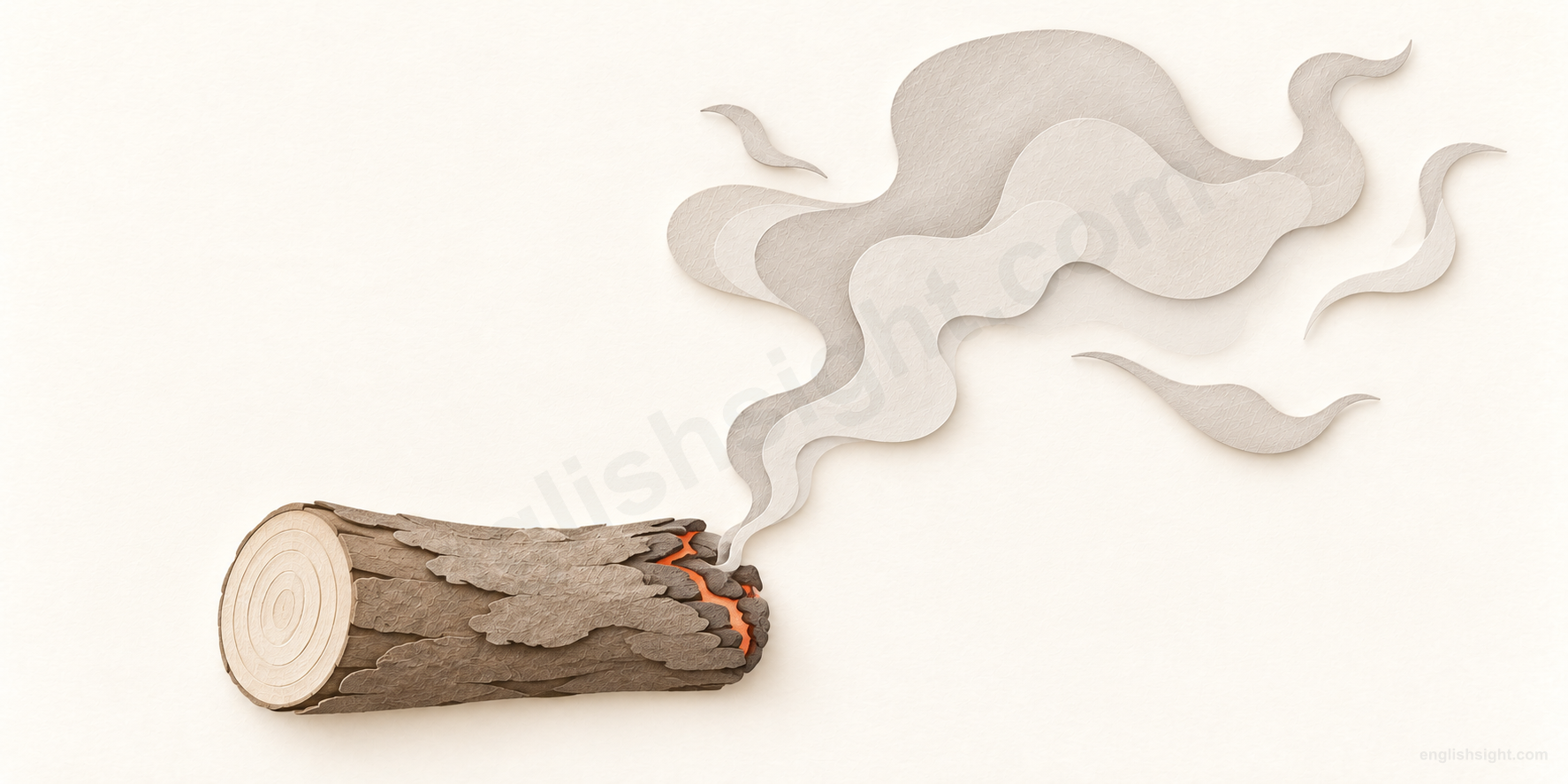
A source releases a spreading plume
A source releases a spreading plume
A log is smouldering at one end.
smoke
The plume widens into the surrounding air, with separate wisps at its edges.
Smoke rises from the glowing end and curls outward.
Smoke spreads into the air from smouldering wood, even without a visible flame.
Burning or smouldering material releases smoke that spreads through the surrounding air.
The picture explains physical smoke and its source. Tobacco use, food treatment, and fixed expressions need their own constructions and contexts.
Smoke most often names the mixture that comes from burning or smouldering material. As a verb it can describe a source giving off smoke, a person smoking, or food being treated with smoke.
The central picture is a teaching aid: material leaves a source and spreads through the air. It helps connect some uses, but it does not predict every idiom or describe a shared mental picture for all English speakers.
01
Smoke in the air
Name the material, describe its source, and recognize familiar household and public-place expressions.
01
smoke; smoke from + source; a cloud / puff of smoke
smoke / a cloud of smoke
the airborne mixture produced by burning or smouldering material
Situation / source
Wood is smouldering nearby.
Result / interpretation
A visible cloud drifts above it.
Smoke names material in the air, not the flame or the remaining ash.
Use smoke as an uncountable noun for this material: some smoke, thick smoke, or smoke from a fire. A cloud, puff, or column of smoke gives the material a countable shape or amount.
You can see smoke, smell smoke, or notice that a room is full of smoke. From identifies the source; with in thick with smoke identifies what fills the air.
The sketch shows a source releasing a spreading plume. Smoke can appear while material smoulders without a visible flame. Ash is what remains after burning; steam normally concerns water heated into vapour, so not every white cloud is smoke.
In a sentence
A thin column of smoke rose above the garden wall.
Watch the difference Say a cloud of smoke, not a smoke, when naming a cloud of the material.
02
something smokes / is smoking; smoking + source noun
The pan is smoking.
produce or give off smoke
Situation / source
A pan has become very hot.
Result / interpretation
Smoke comes from the pan.
The subject is the source that releases smoke.
In this intransitive use, nothing follows smoke as a direct object. A pan, engine, chimney, or burnt object can smoke. The pan is smoking describes an event happening now.
The smoking remains of a shed means remains still giving off smoke. A smoking chimney releases smoke; a person smoking a cigarette is using the cigarette. The subject and any object separate these readings.
In a sentence
The empty pan started smoking on the cooker.
Watch the difference Smoke does not itself say that you can see flames. Smoking here is a verb form, not necessarily tobacco use.
03
a smoke alarm / detector; the smoke alarm goes off
smoke alarm / smoke detector
a device that detects smoke and gives a warning
Situation / source
Smoke reaches the device.
Result / interpretation
The alarm sounds.
Smoke modifies the device name and identifies what it detects.
A smoke alarm warns of smoke in the air; smoke detector is also a familiar name. Smoke is a noun used before another noun, not an action performed by the alarm.
Compare The smoke alarm is sounding with The alarm is smoking. In the second sentence, smoke is actually coming from the device.
In a sentence
The smoke alarm went off while I was making toast.
Watch the difference An alarm going off means it starts sounding; it does not mean it switches off.
04
second-hand / secondhand smoke; exposure to second-hand smoke
second-hand smoke
smoke from other people’s smoking that someone breathes in
Situation / source
Someone else is smoking nearby.
Result / interpretation
Smoke reaches a person who is not smoking.
Second-hand identifies another person as the source of the exposure.
This compound does not mean smoke that has been bought used. It names smoke breathed in because other people are smoking around you.
Use it as an uncountable noun phrase: exposure to second-hand smoke. The spelling secondhand smoke is also used, especially in American English.
In a sentence
She moved away to avoid breathing second-hand smoke.
Watch the difference Someone can breathe second-hand smoke without being a smoker.
02
Smoking: actions, habits, and signs
With a person as subject, smoke usually concerns using tobacco. Read the tense, object, and surrounding words.
05
smoke + cigarette / cigar / pipe / substance; smoke without an object
smoke a cigarette / pipe
draw in and release smoke while using tobacco or another substance
Situation / source
A person has a lit cigarette.
Result / interpretation
The person draws smoke into the mouth and lets it out.
A person performs the action; the object names what is smoked or used.
Smoke a cigarette, smoke a cigar, and smoke a pipe are established combinations. With a pipe, the object names the instrument being used, not something that is itself eaten or consumed whole.
Smoke tobacco names the substance. Without an object, I’m smoking can describe the action now. Do you mind if I smoke? asks whether the listener objects; it is a question about permission in context.
In a sentence
“Do you mind if I smoke?” “Yes, please don’t smoke here.”
Watch the difference In Do you mind if…?, yes means there is an objection. Do not confuse smoke with drink when describing how a substance is taken.
06
smoke as a habit; stop / quit / give up + smoking
Do you smoke? / stop smoking
have, stop, or give up a smoking habit
Situation / source
Someone asks about a regular habit.
Result / interpretation
The reply concerns tobacco use in general.
Simple present often concerns a habit; smoking can name the activity.
Do you smoke? normally asks about a habit, rather than what you are doing at this second. I don’t smoke answers that habit question; I’m not smoking describes the current situation.
Use stop smoking, quit smoking, or give up smoking to describe ending the activity. In stop to smoke, to smoke instead gives the purpose of stopping another activity: someone interrupts a walk, for example, in order to smoke.
In a sentence
Mara stopped smoking last spring.
Watch the difference Stopped smoking and stopped to smoke have different meanings. The first ends smoking; the second begins a break for it.
07
have a smoke; go (outside) for a smoke; smokes = cigarettes (informal)
have a smoke / go for a smoke
spend a short time smoking
Situation / source
A person takes a break.
Result / interpretation
They use the break to smoke.
A smoke counts an occasion, not the airborne material.
In informal conversation, have a smoke or go outside for a smoke refers to an act or period of smoking. Here a smoke is countable, usually singular.
Informal smokes can also mean cigarettes: He bought a packet of smokes. This differs from thick smoke, where the material remains uncountable. Use cigarettes for a clearer neutral expression.
In a sentence
He went outside for a smoke after lunch.
Watch the difference The article is possible for an occasion or cigarette, but not ordinarily for the material itself.
08
smoke like a chimney; smoke heavily; be a heavy smoker
smoke like a chimney
smoke a great deal
Situation / source
Someone describes how much a person smokes.
Result / interpretation
The description emphasizes a very heavy habit.
The chimney is an exaggerated comparison, not a literal identity.
This informal comparison emphasizes quantity. It does not mean that a person’s body works like a household chimney.
Smoke heavily and be a heavy smoker are more neutral descriptions. Smoker is a person noun; smoking names the activity.
In a sentence
He used to smoke like a chimney, but he has given up.
Watch the difference This is a critical or exaggerated description, not a precise number of cigarettes.
09
No smoking; a smoke-free + place; a non-smoking room
No smoking / smoke-free
prohibit smoking or describe a place without cigarette smoke
Situation / source
A visitor reads a sign or room description.
Result / interpretation
They learn whether smoking is allowed.
The whole label expresses a rule or a condition of the place.
No smoking is a conventional prohibition on signs. Smoking names the activity being prohibited, not a particular person.
A smoke-free office is free from cigarette smoke or does not allow smoking. Smoke-free does not mean cigarettes cost nothing. Non-smoking is also familiar in descriptions such as a non-smoking room.
In a sentence
The hotel offers smoke-free rooms.
Watch the difference No smoke describes an absence of material; No smoking tells people not to perform an activity.
03
Using smoke to treat food
A cook can expose food to smoke. The food receives the treatment; it does not perform the smoking action.
10
smoke + food; food is smoked; smoked + food noun
smoke fish / smoked salmon
treat food with smoke for flavour or preservation
Situation / source
Food is placed where wood smoke can reach it.
Result / interpretation
Exposure gives the food a smoked flavour or helps preserve it.
The cook applies smoke; the food receives the treatment.
Smoke fish or smoke meat is transitive: the food is the object. The same relation appears in the passive, The fish is smoked over wood.
Smoked salmon and smoked cheese describe food treated in this way. Smoked does not simply mean burnt. It also does not tell you by itself whether a particular food has been fully cooked; it names the smoke treatment.
In a sentence
The shop sells cheese smoked over oak wood.
Watch the difference The salmon is smoked describes treatment; The pan is smoking says the pan is giving off smoke.
04
Bringing things out, losing them, and hiding the truth
Some expressions extend the effects of smoke; others are fixed sayings. Learn the whole expression and its tone.
11
smoke + object + out; smoke out + noun; smoke them out (of + place)
smoke somebody / something out
force a hidden person or animal out by using smoke
Situation / source
An animal is inside a hiding place.
Result / interpretation
Smoke forces it to leave that place.
Out supplies emergence from a hiding place; smoke supplies the means.
This separable phrasal verb describes using smoke to drive a living thing from shelter. It is a meaning to recognize, not a recommendation for handling animals.
With a noun, smoke out the animals or smoke the animals out is possible. With an object pronoun, use smoke them out. A passive is possible too: They were smoked out of hiding.
In a sentence
In the story, they used smoke to smoke the rats out of the cellar.
Watch the difference Say smoke them out, not smoke out them. This is a phrasal verb; go up in smoke is a different kind of expression.
12
smoke out + hidden person / secret; smoke + object + out
smoke out a secret / hidden person
take action to uncover something concealed
Situation / source
Someone is hiding information.
Result / interpretation
Investigation makes the information or person known.
The concealed thing is exposed, without actual smoke.
Questions or investigation can smoke out a secret or smoke out someone trying to stay hidden. The expression extends forcing something out of concealment; it is stronger and more deliberate than simply noticing it.
The object can be a person or concealed information. The separable grammar remains: smoke the truth out, smoke out the truth, or smoke it out.
In a sentence
Careful questions helped the reporter smoke out the real reason for the delay.
Watch the difference Do not use this automatically for every discovery. It suggests active efforts to uncover what is hidden.
13
physical object + go / went up in smoke
go up in smoke: fire
be destroyed by burning
Situation / source
A building or object is intact.
Result / interpretation
A fire destroys it.
The whole expression presents destruction, not just smoke drifting upward.
With a physical object as subject, go up in smoke can mean destruction by fire. Went up in smoke is a vivid description of loss.
Compare Smoke went up from the roof: here smoke is the subject, and the sentence describes its movement. The shed went up in smoke describes what happened to the shed.
In a sentence
The wooden shed went up in smoke overnight.
Watch the difference A smoking shed is not necessarily completely destroyed. Go up in smoke conveys a much stronger result.
14
plans / hopes / money + go up in smoke
go up in smoke: plans
fail completely or be lost without the hoped-for result
Situation / source
People expect a plan to succeed.
Result / interpretation
An event destroys their hopes for it.
The subject is an expectation or investment, and no real fire is required.
Plans, hopes, dreams, or money can go up in smoke. The familiar image of something disappearing through burning helps memory, but the phrase has an established figurative meaning.
It is more dramatic than saying a meeting was delayed. Use it when the outcome is lost or the plan collapses, rather than for every small inconvenience.
In a sentence
Our plans for a picnic went up in smoke when the storm arrived.
Watch the difference Read the subject and context. Hopes going up in smoke does not normally report a literal fire.
15
There’s no smoke without fire; Where there’s smoke, there’s fire
no smoke without fire
say that rumours or suspicious signs suggest some underlying truth
Situation / source
People hear a damaging rumour.
Result / interpretation
A speaker assumes the rumour has some basis.
The saying expresses the speaker’s inference, not proof.
There’s no smoke without fire is the usual British form; Where there’s smoke, there’s fire is familiar in North American English. Both commonly concern suspicion or rumours.
As a teaching comparison, smoke is a sign and fire is its suspected cause. The proverb does not establish that an accusation is true; someone may repeat a completely false rumour.
In a sentence
“I don’t know whether the rumour is true,” he said, “but there’s no smoke without fire.”
Watch the difference This can sound unfair or accusatory. It reports an attitude toward a rumour, not a rule of evidence.
16
be (all / just) smoke and mirrors
smoke and mirrors
a misleading display that hides the real situation
Situation / source
A presentation contains impressive but distracting details.
Result / interpretation
The audience has trouble seeing what is really happening.
The whole idiom names concealment through misleading appearance.
A speaker may dismiss a proposal as smoke and mirrors when its showy details obscure the facts. The phrase is critical; it suggests deception or diversion rather than ordinary complexity.
The image of smoke obscuring a view helps connect the phrase to the material sense. Mirrors and the whole fixed expression contribute the idea of a deceptive display.
In a sentence
The impressive charts were smoke and mirrors; they hid the missing costs.
Watch the difference This is not a neutral synonym for a complicated explanation. It challenges the explanation’s honesty or substance.
17
blow / be blowing smoke
blow smoke
mislead someone with empty or deceptive talk
Situation / source
Someone makes impressive claims.
Result / interpretation
The listener doubts that the claims have substance.
In this informal idiom, smoke stands for talk that obscures the truth.
Especially in American informal speech, Are you just blowing smoke? questions whether someone’s claims are misleading or empty. It may challenge exaggeration rather than describe physical smoke.
The longer expression blow smoke up someone’s ass is vulgar and often concerns insincere praise. Recognize its register; use mislead or give false praise for neutral wording.
In a sentence
Is the salesman offering real evidence, or is he just blowing smoke?
Watch the difference Blow smoke into the air can be literal. The idiomatic interpretation depends on the conversation; the longer vulgar form is unsuitable in many settings.
18
Put that in your pipe and smoke it.
Put that in your pipe and smoke it.
tell someone to accept an unwelcome fact
Situation / source
A person challenges a claim or decision.
Result / interpretation
The reply insists that they accept the stated fact.
The entire saying is a defiant response, not an instruction to smoke.
This informal expression tells the listener that the speaker regards the preceding statement as a fact they must accept. That points back to what was just said.
It can sound triumphant, confrontational, or deliberately humorous. A neutral alternative is You may not like it, but that is the situation.
In a sentence
“I won the final vote. Put that in your pipe and smoke it!”
Watch the difference Do not use this as a polite way of offering advice. Its force belongs to the whole saying.
19
a decision made in a smoke-filled room
a smoke-filled room
a private meeting where a small group makes decisions
Situation / source
A decision could be discussed openly.
Result / interpretation
A small group settles it behind closed doors.
In political criticism, the room represents a closed decision-making process.
A decision made in a smoke-filled room can mean one made privately by a small influential group, with disapproval that others were excluded. Actual cigarette smoke is not necessary for this figurative use.
The same adjective can be literal: They left the smoke-filled room simply describes a room full of smoke. The political context supplies the critical interpretation.
In a sentence
The candidate was chosen in a smoke-filled room, critics complained.
Watch the difference Do not infer secret political dealings whenever a room actually contains smoke.
Choose the noun, action, or whole expression
Count the occasion, not the material
Smoke in the air is normally uncountable. A smoke is an informal smoking occasion or cigarette; smokes can mean cigarettes. A cloud of smoke counts the cloud.
The subject and object matter
A pan smokes by giving off smoke; a person smokes a cigarette by using it; a cook smokes cheese by treating it. The food is smoked is passive, while The pan is smoking is progressive.
Forms and grammar
Forms are smoke, smokes, smoked, smoking; drop the final e before -ing. In ordinary pronunciation, smoked ends in /t/. Smoke does not form a general linking pattern such as smoke happy. Out is separable in smoke someone out; in go up in smoke, in smoke is a prepositional phrase in a fixed expression.
Limits of the picture and coverage
Smoke can hide a view or disappear into the air, which helps explain some metaphors. Whole idioms still have established meanings. This lesson covers common modern uses and selected expressions for recognition, not every specialist, regional, or historical use. Slang smoke someone meaning defeat them, the Big Smoke for a large city, and technical smoke treatments are not expanded here.
Read the whole situation
Choose the expression that matches the subject, action, and context.
1. You see a visible plume above a fire. Which description names the material naturally?
2. A menu says smoked cheese. What does smoked describe?
3. Someone gave up their smoking habit. Which sentence expresses that?
4. A reporter takes action to expose hidden people. Replace the noun with them.
5. A sudden cancellation ruins all your holiday plans. Which interpretation fits Our plans went up in smoke?
6. Someone repeats There’s no smoke without fire about a rumour. What are they doing?
Sources and teaching notes
The dictionary pages below were read to check senses, grammar, and expressions. The explanations, examples, and visual model are original teaching material.
The diagram illustrates a useful connection; individual speakers need not share the same mental picture.