Describe an even surface, a steady movement, or an easier process—and learn what smoothing changes.
Evenness without roughness or interruptions
Evenness without roughness or interruptions
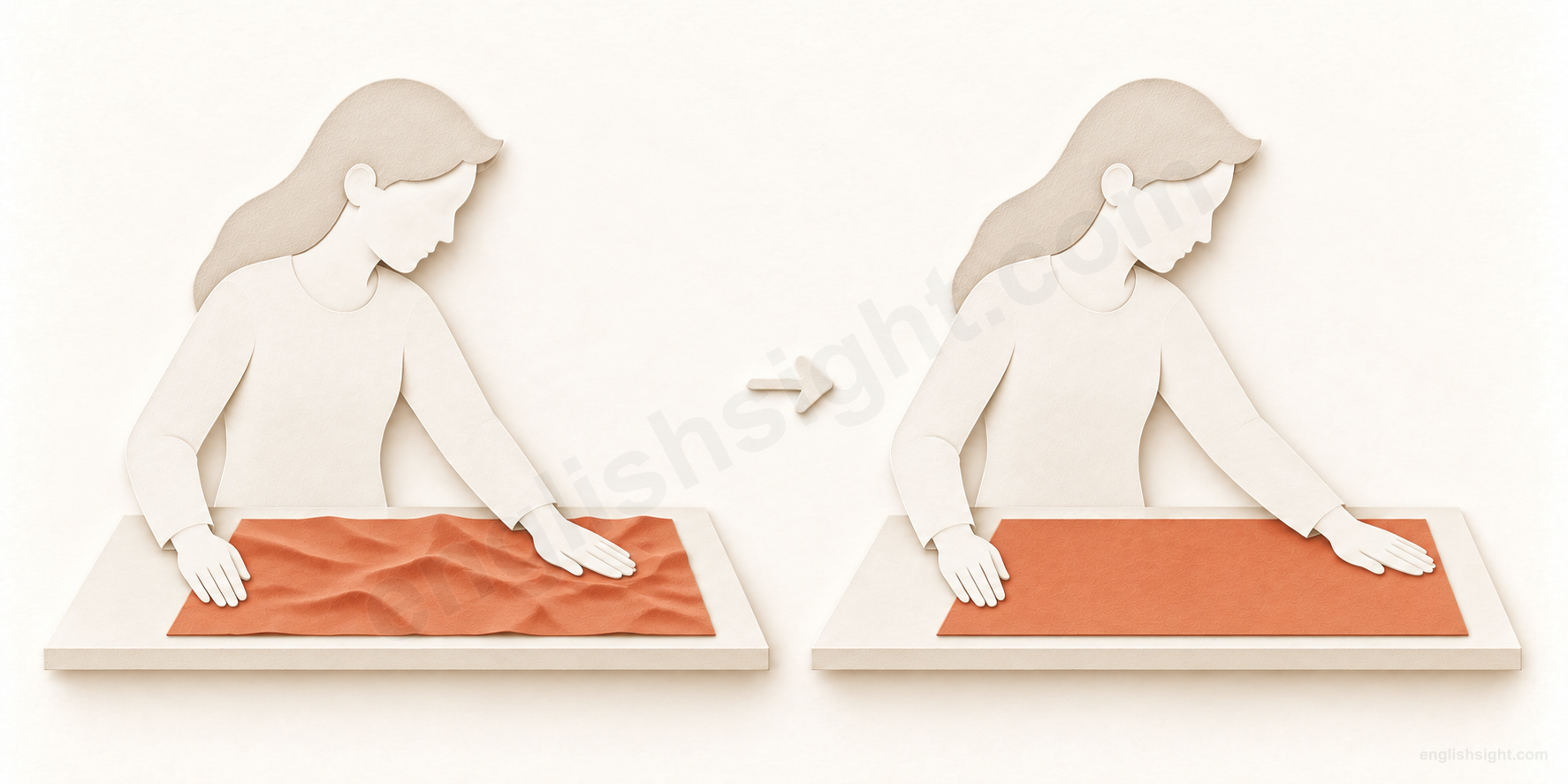
The sheet has raised wrinkles.
smooth
The same sheet lies flatter and more even.
She presses and smooths the sheet with her hands.
Smoothing reduces unevenness; smooth describes the resulting surface.
Smooth describes an even surface or a continuous, trouble-free movement or process; to smooth something is often to reduce unevenness or make progress easier.
The sketch uses a creased sheet becoming flat to connect a quality with an action. An already smooth object does not have to undergo smoothing. Taste, social manner, and idioms need the specific explanations below.
A smooth stone has no rough patches; a smooth movement has no jerks; a smooth handover has no troublesome interruptions. The relevant kind of unevenness changes with the thing you describe.
As a verb, smooth often means making something more even or easier to manage. This connection is a useful teaching model, not a rule that predicts every idiom or a claim that all English speakers share one mental picture.
01
What feels, tastes, or sounds smooth
Start with a quality: the relevant surface, texture, taste, or sound has no disturbing roughness. The noun tells you what kind of roughness matters.
01
smooth + noun; be / feel / look + smooth; be worn smooth
a smooth surface
even to look at or touch, without rough patches
Situation / starting point
You compare two pieces of wood by touch.
Quality / result
One has an even finish with no rough patches.
Smooth describes the surface, not the material’s softness or overall shape.
Use smooth before a noun or after be, feel, look, or become. A smooth stone can be hard and round: smooth is about its surface, not whether the whole object is flat or soft.
Skin, paper, wood, roads, and still water can all be smooth. The water is as smooth as glass describes a calm, unbroken-looking surface; as smooth as silk is another familiar comparison. With skin, smooth can also emphasize the absence of hair or stubble: His cheeks felt smooth after shaving.
Worn smooth describes a result of repeated rubbing or use: The old step has been worn smooth. That can be damage rather than an improvement, as with a tire whose tread has worn away.
In a sentence
The stone feels smooth, but it is too hard to squeeze.
Watch the difference Smooth and soft are different. Slippery means difficult to grip or stand on; a smooth surface is not necessarily slippery.
02
a smooth + mixture noun; mix / blend until smooth
a smooth mixture
a mixture with an even texture and no lumps
Situation / starting point
There are small flour lumps in the batter.
Quality / result
After mixing, the batter has an even texture.
Here smooth concerns what is inside the mixture, not just its top surface.
Use smooth for sauces, soups, pastes, creams, and mixtures without unwanted lumps or pieces. It does not mean watery: a thick paste can be smooth.
In Blend until smooth, until introduces the desired end state; the understood meaning is until the mixture is smooth. Blend it smooth also uses smooth as a result description. Smooth peanut butter contrasts with the crunchy kind.
In a sentence
Blend the soup until it is smooth, then warm it gently.
Watch the difference A smooth mixture can still be thick. Use thin or runny if you mean that it flows very easily.
03
smooth + drink; a smooth taste / flavor
smooth coffee
pleasant to drink, without a harsh or bitter edge
Situation / starting point
You compare the taste of two coffees.
Quality / result
One tastes gentle rather than harsh.
Taste is a sensory extension of the absence of roughness.
Smooth coffee, wine, or whisky has a pleasing, mellow quality. This is an evaluation of the taste or drinking experience, rather than a statement about the drink’s surface.
It need not be sweet or weak. A drink can taste rich and smooth while still having a strong flavor. This meaning is distinct from a smooth soup’s lack of lumps.
In a sentence
This coffee is strong, but the taste is surprisingly smooth.
Watch the difference Do not infer sugar content, alcohol strength, or thickness from smooth alone.
04
a smooth voice / sound; smooth music
a smooth voice
pleasant and flowing to hear, without a rough edge
Situation / starting point
You listen to a singer’s voice.
Quality / result
The sound flows gently without a harsh edge.
The roughness being judged is audible rather than physical.
A smooth voice or smooth music is easy on the ear and has a flowing quality. This extends the surface idea to sound; it does not mean the sound is silent.
A smooth voice describes how someone sounds. A smooth talker describes a persuasive manner and can suggest insincerity. Someone can have a smooth voice without trying to persuade anyone.
In a sentence
Her smooth voice suited the quiet song.
Watch the difference Smooth does not specify volume or pitch: a voice can be smooth and low, or smooth and fairly loud.
02
Movement, progress, and personal manner
Smooth can describe a continuous movement, a comfortable journey, or a process without trouble. With a person’s manner, effortless charm can also raise doubts about sincerity.
05
a smooth movement / motion; a smooth curve
one smooth movement
a continuous, controlled movement without jerks
Situation / starting point
You need to lift a tray without spilling anything.
Quality / result
The lift happens continuously, without sudden jolts.
Smooth concerns continuity and control, not a required speed.
A smooth movement or motion has no abrupt stops, starts, or changes of direction. A slow movement and a fast movement can both be smooth.
A smooth curve changes direction gradually rather than forming sharp corners. The connection is continuity, not the claim that all smooth movement follows a curved path.
A smooth dancer can also mean a skillful, polished dancer. Here smooth evaluates the performance, not the texture of the dancer’s skin.
In a sentence
She lifted the tray in one smooth movement.
Watch the difference Smooth is not the same as straight, fast, or slow. It tells you how evenly the movement proceeds.
06
a smooth ride / flight / landing / crossing
a smooth ride
a comfortable journey without unpleasant shaking or bumps
Situation / starting point
You are judging how a vehicle feels to travel in.
Quality / result
Passengers experience little shaking or jolting.
The quality belongs to the ride, landing, or crossing.
A smooth ride or flight is comfortable because the movement is even. A smooth landing puts the focus on touching down without a jolt. The road itself need not be perfect if the vehicle absorbs its bumps.
By contrast, a trouble-free journey could mean there were no delays or lost bags. Smooth can describe the overall experience too, so use the surrounding detail to see whether physical movement or practical arrangements matter.
In a sentence
The sea was calm, so we had a smooth crossing.
Watch the difference A smooth flight does not by itself say that it left on time or arrived quickly.
07
a smooth start / transition / handover; the smooth running of + noun
a smooth transition
a process or change that proceeds without problems
Situation / starting point
A team is preparing to use a new booking system.
Quality / result
The change happens without major interruptions.
Practical difficulties are treated like bumps that disrupt progress.
Use smooth for a start, transition, transfer, handover, or operation that goes well. The smooth running of an event means its organization works without troublesome interruptions.
This is a figurative connection to even movement. A smooth transition may still require much preparation; smooth describes the experienced process, not the amount of effort behind it.
In a sentence
Clear instructions helped us make a smooth transition to the new system.
Watch the difference Say The transition was smooth or The change went smoothly. In standard neutral prose, avoid The change went smooth.
08
go / run / work / move + smoothly; be / feel + smooth
go / run smoothly
happen or work without problems; move without jerks
Situation / starting point
You want to describe how something happens.
Quality / result
An adverb describes the action or process.
Smoothly modifies the verb; smooth can describe a thing or resulting state.
The engine runs smoothly may concern even mechanical operation. The meeting went smoothly concerns the absence of practical or social trouble. The adverb keeps the relevant adjective meaning while modifying an action.
Compare The ride was smooth with The car moved smoothly. After feel in The fabric feels smooth, smooth describes the fabric, so an adjective is correct. In She smoothed the paper flat, smoothed is the verb and flat states the result.
In a sentence
We tested the equipment so that the presentation would run smoothly.
Watch the difference Use smoother and smoothest to compare things, but more smoothly and most smoothly to compare how actions happen.
09
be smooth; a smooth talker / operator; a smooth-talking + person
a smooth talker / operator
someone with an assured, polished, persuasive manner
Situation / starting point
A salesperson speaks with effortless confidence.
Quality / result
You notice the charm but question the promises.
Ease in social behavior can sound impressive or suspicious.
Calling someone smooth often suggests that their charm is too practiced or not fully sincere. Smooth-talking particularly highlights confident, persuasive speech; a smooth talker is not simply someone with a pleasant voice.
A smooth operator is someone who handles people or situations skillfully, often using charm to get what they want. Tone and context affect whether this sounds admiring or critical. These descriptions can apply to any gender.
In a sentence
He is a smooth talker, but I want to see the contract before I agree.
Watch the difference Smooth is not always praise when applied to a person. For an unambiguous compliment about kindness, choose a word such as considerate.
03
Making a surface or situation smoother
The verb usually takes an object. Some additions describe a physical direction or result; established particle combinations also describe dealing with practical or social difficulties.
10
smooth + object; smooth + object + adjective; be smoothed with + tool
smooth the surface
make a surface even by rubbing, pressing, or a similar action
Situation / starting point
A clay pot has rough areas on its outside.
Quality / result
Someone works on those areas to make them even.
The verb names an action that produces the adjective’s quality.
Smooth usually takes the thing being made even as its object: smooth the clay, smooth the paper, smooth the surface. A hand or a tool can do the work; the exact method comes from the context.
A result adjective can follow the object: smooth the paper flat. The passive is useful when the object is the topic: The surface was smoothed with a wet sponge. The adjective alone does not imply that someone has deliberately worked on it.
In a sentence
She smoothed the clay with a damp sponge.
Watch the difference Keep the meanings apart: The clay is smooth names a quality; She is smoothing the clay names an action in progress.
11
smooth + object + down / back; smooth down + noun; smooth it down
smooth down / smooth back
press something into a flatter or tidier position
Situation / starting point
Your hair is sticking up before a photograph.
Quality / result
You press it down or sweep it back into place.
Down and back contribute the direction or desired arrangement.
Smooth down your hair and smooth your hair down both describe flattening or tidying it with your hand or a tool. With a pronoun, say smooth it down. Smooth your hair back specifies a backward arrangement.
The same physical pattern works with a skirt, a shirt, or fabric. These literal direction words do not add a wholly separate mysterious meaning: smooth supplies the action, and down or back gives its orientation.
In a sentence
Before the photo, she smoothed her hair back with both hands.
Watch the difference Use smooth it down, not smooth down it. Smooth back does not mean return something to its owner.
12
smooth + substance + on / onto / into / over + surface
smooth cream over the skin
spread a soft substance in an even layer
Situation / starting point
A small amount of cream sits on your arm.
Quality / result
You spread it gently across the skin.
The object is the substance being spread; the following phrase names its destination.
Smooth cream onto your skin, smooth lotion into your hands, and smooth icing over a cake describe spreading rather than merely making an existing surface less rough. The particular preposition shows placement, working in, or coverage.
Over in smooth icing over the cake introduces a surface and has its ordinary spatial role. That is different from the established expression smooth over an argument, which deals with a social difficulty.
In a sentence
Smooth a thin layer of icing over the cooled cake.
Watch the difference Say Smooth the cream onto your skin, not Smooth your skin the cream. The cream is the direct object in this spreading construction.
13
smooth out + noun; smooth + noun / pronoun + out
smooth out the creases
remove folds or wrinkles by making something flat
Situation / starting point
A folded sheet of paper has raised creases.
Quality / result
You press the paper to reduce the creases.
The object can be the wrinkled thing or the wrinkles being removed.
Smooth out the paper focuses on the thing you flatten. Smooth out the creases focuses on the unevenness you remove. Out suggests eliminating the irregularities rather than moving the paper outside. Smooth away wrinkles likewise presents the wrinkles as being removed.
Both smooth out the creases and smooth the creases out are possible. Use smooth them out with a pronoun. Depending on the material, smoothing may reduce wrinkles without removing every trace of them.
In a sentence
He laid the map on the table and smoothed out the creases.
Watch the difference Use smooth it out, not smooth out it. The physical object and the unwanted crease are different possible objects of the verb.
14
smooth out / away + problems / difficulties; smooth things out; smooth them away
smooth out / away difficulties
work through difficulties so that they no longer obstruct progress
Situation / starting point
Two teams have conflicting delivery arrangements.
Quality / result
They agree on a workable schedule.
A practical or interpersonal obstacle is treated as an unevenness to remove.
Smooth out problems or differences usually means resolving them, often through discussion or adjustment. Smooth things out is a useful general expression when the difficulty is already understood.
Smooth away difficulties is an established alternative that also presents them as disappearing. Both can be passive: The remaining problems were smoothed out. Out or away belongs to the full expression, not a physical location.
Compare smooth over: that emphasizes reducing tension or making a difficulty less serious. The meanings overlap in real contexts; neither expression is a guarantee that a solution will last.
In a sentence
We met on Friday to smooth out the remaining problems with the schedule.
Watch the difference With pronouns, use smooth them out or smooth them away. Do not treat smooth out as a promise to hide problems.
15
smooth over + difficulty; smooth + difficulty / pronoun + over; smooth things over with + person
smooth over a disagreement
reduce tension or make a difficulty less serious
Situation / starting point
A careless remark has upset a colleague.
Quality / result
An apology makes the conversation less tense.
The focus is on easing a social difficulty, not necessarily removing its cause.
Smooth over an argument, misunderstanding, or awkward situation often involves talking tactfully to the people affected. Smooth things over leaves the exact difficulty unnamed.
Both smooth over the disagreement and smooth the disagreement over are possible; use smooth it over with a pronoun. In some contexts smoothing over can suggest minimizing or glossing over trouble. It does not always imply deception, and it does not guarantee a full solution.
In smooth cream over a surface, cream is a physical substance and over introduces the destination. In smooth over a disagreement, the whole particle expression has a conventional social meaning.
In a sentence
I called to apologize and smooth things over with my colleague.
Watch the difference Do not claim that smooth over always solves a problem, or that it always hides one. Context determines how much is actually repaired.
04
Learn the whole expression
Paths, feathers, sailing, and roughness provide familiar metaphors, but their conventional meanings and sentence patterns need to be learned as expressions.
16
smooth the way for + person / event; smooth the path to / towards + goal
smooth the way / path
make it easier for a later development to happen
Situation / starting point
New staff find the registration process difficult.
Quality / result
Better guidance reduces obstacles for future arrivals.
The path is a metaphor for progress, not necessarily a real road.
Smooth the way for someone or something means preparing helpful conditions or removing obstacles. Smooth the path to or towards an agreement points to the desired development.
The plain verb can also take a process as object: Clear guidance smooths the application process. The idiom adds the path or way metaphor; for introduces the person or development helped, and to/towards points to a goal.
In a sentence
The new guide should smooth the way for international students.
Watch the difference Easier progress is not certain success. This expression does not say all difficulties have disappeared.
A tactful explanation helps that person feel calmer.
The feathers stand for an upset person’s feelings, not literal bird care.
This figurative expression compares an offended person to a bird with disturbed feathers. Smooth their ruffled feathers means soothing their annoyance, often through reassurance, apology, or tact.
The possessive identifies whose feelings need calming. Smooth ruffled feathers can leave the person unnamed when the context makes it clear. You may also encounter smooth someone down meaning calm them, but calm someone down is a straightforward everyday choice.
In a sentence
After the tense meeting, she stayed behind to smooth a few ruffled feathers.
Watch the difference This is a figurative idiom, not an instruction about clothing or hair. It can sound light or slightly dismissive of the person’s annoyance.
18
be smooth sailing; be smooth sailing from here / now on; not all smooth sailing
smooth sailing
an easy period of progress without serious problems
Situation / starting point
A difficult setup stage is finally complete.
Quality / result
You expect the remaining work to be easier.
Sailing on calm water is a conventional metaphor for trouble-free progress.
It is smooth sailing means things are proceeding easily. It should be smooth sailing from here predicts easier progress after the current stage. It wasn’t all smooth sailing means there were difficulties along the way.
Smooth sailing and clear sailing are especially associated with North American English; plain sailing is the familiar British counterpart. The expressions can describe a project, relationship, or other process without any actual boat.
In a sentence
Once the permits arrive, it should be smooth sailing from there.
Watch the difference Learn sailing as part of the idiom. Smooth sailing is not a claim that the work requires no effort at all.
19
take the rough with the smooth
take the rough with the smooth
accept the difficult parts as well as the pleasant parts
Situation / starting point
You enjoy the freedom of a new job but dislike its uncertain hours.
Quality / result
You accept that the same job has both benefits and drawbacks.
The rough and the smooth name contrasting sides of an experience.
This established expression, particularly associated with British English, advises accepting bad experiences alongside good ones. Here the smooth is used like a noun for the pleasant or easy aspects.
Take contributes acceptance; with presents the two sides together. The idiom does not mean actively make a situation smoother. It can sound unsympathetic if used to dismiss someone’s real difficulty.
In a sentence
I love working outdoors, but on rainy days I have to take the rough with the smooth.
Watch the difference Keep the conventional articles: the rough with the smooth. Do not use a smooth as an ordinary countable noun for a good experience.
Choose the right kind of smoothness
Smooth, flat, soft, and slippery
Smooth concerns surface texture or even flow. Flat concerns shape or levelness, soft concerns yielding to touch, and slippery concerns low grip. A hard round stone can be smooth; a flat board can still be rough.
Adjective, verb, and adverb
A smooth surface and The surface feels smooth use the adjective. She smooths the surface uses the verb. The machine runs smoothly uses the adverb. Comparatives are smoother / smoothest and more smoothly / most smoothly.
Forms and objects
Say smooth / smooths / smoothed / smoothing. The verb keeps the final voiced sound /ð/: /smuːð/, with smoothed pronounced /smuːðd/. Actions can be progressive or passive: She is smoothing the paper; The paper was smoothed flat. An object plus a result adjective is possible, but smooth someone to do something is not the normal way to ask someone to help or allow an action.
Particles and prepositions do different work
Down or back can give a literal direction; out can describe removing creases or resolving problems. Smooth over a dispute is an established expression. In smooth cream over your skin, over instead introduces the surface receiving the cream. Use the object and context to recognize the construction.
No promise of perfection or honesty
Smooth can describe a pleasant surface, a well-run event, or an assured manner. It does not mean every risk has vanished. Calling a person smooth can be critical, and smoothing over tension may leave a deeper problem unresolved.
Related noun
Smoothness names the quality: the smoothness of the stone or the smoothness of the ride. The smooth in take the rough with the smooth belongs to a fixed expression; it is not a general countable noun for an enjoyable event.
Choose the meaning and construction
Identify what is smooth, or what the action is intended to change.
1. A polished stone is hard but has no rough patches. Which description fits?
2. The meeting had no delays or technical problems. Complete: “The meeting went ___.”
3. Which sentence describes spreading a substance rather than calming a social difficulty?
4. You pressed a folded map flat. Replace “the map” with “it”.
5. Someone says, “We apologized and smoothed things over.” What can you safely conclude?
6. “She is a smooth talker, but check her promises.” What does smooth talker highlight?
Sources and teaching notes
The dictionary pages below support the meanings, patterns, and usage notes. The explanations and examples are original. The visual connection is a teaching model, not a dictionary claim about how every speaker thinks.
The sketch links an even surface with the action of removing unevenness. Other uses extend or conventionally adapt that idea.