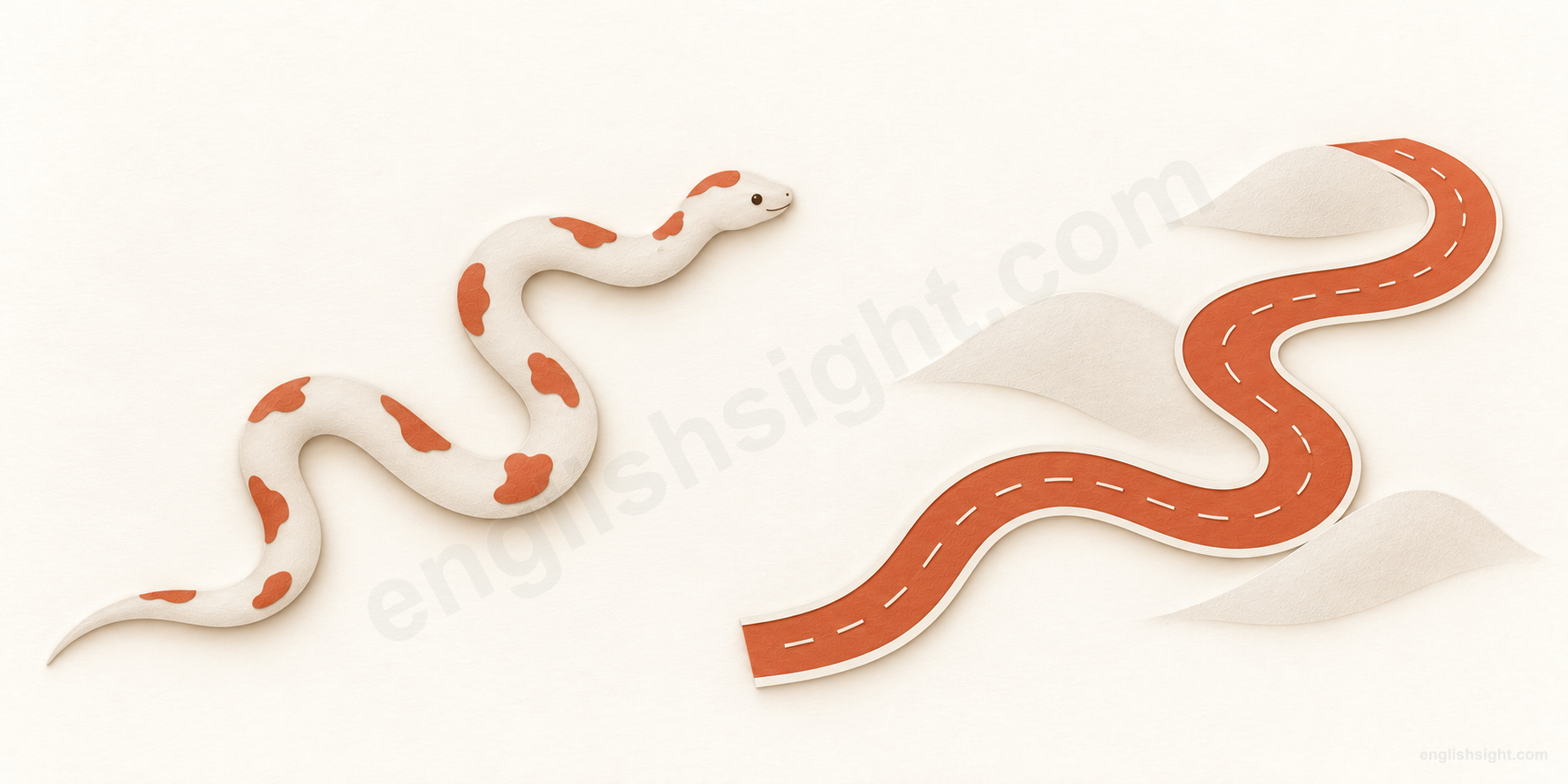
Meet the animal, follow the curves, and learn the expressions separately.
From body to winding course
From a bending body to a winding course
A snake’s long, legless body bends from side to side.
snake
The road snakes among the hills while staying in place.
Compare its repeated bends with the road’s curves.
The body and the road share a winding shape; the road itself stays in place.
A snake is a long-bodied, legless reptile; as a verb, snake commonly describes movement or extension along winding curves.
The shared feature is a long, bending shape or course. A road need not move, and calling a person a snake belongs to a separate evaluative metaphor. The animal need not always adopt the pose shown.
Snake first names an animal. Its long, flexible body also offers a useful way to picture winding lines and routes: a road can snake through hills, and people can snake their way through a crowd.
That connection helps with shape and movement. It does not explain every fixed expression: a snake in the grass and snake oil carry established social meanings. The diagram is a teaching aid, not a claim that all English speakers share one mental picture.
01
The animal and words around it
Start with the countable animal noun. Descriptions of its body and behavior belong to the surrounding words.
01
a / the / this + snake; plural snakes
a snake / snakes
a long-bodied reptile without legs
Situation / starting point
You notice an animal beside a stone.
Meaning in context
You identify it as a snake.
Snake names the animal; it does not mean any long, thin object.
Use a snake for one animal and snakes for more than one: We saw two snakes. Snake is a countable noun, so an ordinary singular reference needs a determiner, as in a snake or that snake.
The characteristic long body helps connect the noun to later shape and movement uses. A worm is not a snake just because it is long and has no legs. Serpent is another word for a snake, often used in literary or traditional contexts.
In a sentence
A small snake rested beside the stone.
Watch the difference Say I saw a snake, not I saw snake, when you mean one animal.
02
a coiled / venomous snake; snake + noun; be bitten by a snake
a coiled snake / snake venom / a snake bite
describe the animal, its substance, or an injury
Situation / starting point
You want to describe more than the animal’s name.
Meaning in context
You choose the surrounding word that supplies the detail.
Coiled describes body position; venom and bite identify different things.
A coiled snake has its body arranged in loops. A snake can slither, hiss, or bite: these verbs describe movement, sound, or an action, rather than new meanings of snake.
In snake venom and a snake bite, snake comes before another noun to identify its source or cause. Venom is a substance; a bite is an injury or biting event. The noun remains singular in these combinations even when snakes in general are meant.
Venomous snake and poisonous snake both occur in ordinary descriptions. Do not infer from the word snake alone that every species has venom.
In a sentence
The guide pointed to a coiled snake beside a sign about snake venom.
Watch the difference Snake venom is not another name for a snake bite; compare the substance with the injury.
02
Winding shapes, routes, and movement
The long, bending body provides a useful connection to winding lines. Check whether something moves, simply extends, or is guided by someone.
03
a snake of + plural noun
a snake of people
a long line resembling a snake
Situation / starting point
People form a long, bending line.
Meaning in context
You describe the line through its resemblance to the animal.
This is an image of shape, not an accusation about the people.
A snake of people pictures a long line with bends. This figurative countable noun is vivid descriptive language; a line of people is a plainer alternative.
The of-phrase identifies what makes up the long shape. It does not mean that a snake owns the people. Keep this shape metaphor separate from calling one person a snake, which is an insult.
In a sentence
A snake of people stretched from the entrance around the corner.
Watch the difference A snake of people describes their arrangement; those people are snakes would judge their character.
04
road / river / path + snake + through / around / across + place
a road snakes through the hills
extend in a winding course
Situation / starting point
A road has a series of bends.
Meaning in context
You describe its course across the landscape.
The road stays in place; snake describes how it extends.
The subject may be a road, river, path, or cable. Snake highlights repeated curves, not a straight route. A present-tense sentence can describe a permanent layout.
Through names the area crossed; around names something the route bends around; across names the space it crosses. These are ordinary route descriptions, not separate fixed phrasal verbs. Collins labels its descriptive verb use literary, so wind or curve may be plainer choices.
In a sentence
The narrow road snakes through the hills.
Watch the difference A road can snake without moving. The verb does not always describe an ongoing journey.
05
snake + route phrase; snake + my / your / its / our / their way + route phrase
snake your way through a crowd
move along a winding route
Situation / starting point
You need to get past people standing close together.
Meaning in context
You follow a route that bends between them.
The mover is the subject; the route winds around obstacles.
Snake through the crowd and snake your way through the crowd both describe a winding course. In the way construction, match the possessive to the subject: I snaked my way; she snaked her way; the procession snaked its way.
The expression emphasizes how the route bends. It does not by itself say that the person is dishonest, that permission is missing, or that the movement is fast. Through supplies the surrounding space.
In a sentence
We snaked our way through the crowd to the exit.
Watch the difference In these route examples, snake emphasizes bends; sneak emphasizes going quietly or secretly. The meanings can overlap in other contexts.
06
snake + object + through / behind / around + place
snake a cable through a gap
guide a flexible object along a winding route
Situation / starting point
A cable needs to pass through a narrow space.
Meaning in context
You feed it along the required route.
Here the person causes the cable to move; the cable is the direct object.
Compare A cable snakes behind the shelves with We snaked a cable behind the shelves. The first describes its position or course; the second describes people guiding it.
The direct object comes after snake, followed by the route phrase: snake it through the gap. A passive is possible when the cable is the focus: The cable was snaked through the gap. This is ordinary transitive grammar, not a new particle verb.
In a sentence
We snaked the cable through a gap behind the shelves.
Watch the difference In snake it through the gap, it is the cable. Through introduces the route and stays with the gap.
03
A flexible tool
In a plumbing context, snake can name a tool rather than an animal. American English also uses it as a verb for clearing a drain.
07
a drain / plumber’s snake; snake + drain / pipe
a drain snake / snake a drain
a flexible drain-clearing tool; clear a drain with that tool
Situation / starting point
A drain is blocked.
Meaning in context
A plumber uses a long flexible tool to clear it.
The tool’s flexible length motivates its name; the verb names using it.
A drain snake or plumber’s snake is a flexible tool for removing blockages from pipes. In a plumbing conversation, a snake may refer to that tool without repeating drain or plumber’s.
In American English, snake the drain means clear it with a snake. The drain is the direct object, not the thing taking a winding route. A passive such as The drain was snaked yesterday is possible. This practical sense is separate from the general movement verb.
In a sentence
The plumber used a drain snake to clear the blockage.
Watch the difference Snake the drain refers to tool use; it does not mean that the drain is curving.
04
People, products, places, and a game
These established expressions need their own meanings and tone. The animal picture alone cannot predict them.
08
be / call someone + a snake (in the grass)
a snake / a snake in the grass
a person accused of hidden disloyalty or deceit
Situation / starting point
Someone seems friendly but acts against you.
Meaning in context
You describe that person as untrustworthy.
The whole expression makes a negative judgment about someone.
Calling someone a snake is strongly disapproving. A snake in the grass particularly suggests someone whose apparent friendliness hides betrayal or a threat. It is an accusation, so context and tone matter.
In the idiom, in the grass is fixed wording; there need not be any real grass. A literal snake in the grass is also possible in a nature story. The situation decides whether the sentence concerns an animal or a person.
In a sentence
I trusted him with my plans, but he sold them to a rival—what a snake!
Watch the difference Being quiet or shy does not make someone a snake. The figurative use concerns an objectionable character or behavior.
09
be / sell + snake oil; a snake oil salesman
snake oil / a snake oil salesman
something sold with claims of usefulness that it does not deserve
Situation / starting point
A seller promises impressive benefits.
Meaning in context
A critic judges the product ineffective or useless.
This is a dismissive judgment about what is sold and how it is promoted.
Snake oil is an informal, uncountable expression, especially associated with North American English. It can describe a supposed remedy or another product offered with misleading promises of value.
A snake oil salesman is a seller of such products. Learn the combination as an established expression; it need not involve an animal or actual oil. Calling a product snake oil expresses the speaker’s criticism rather than providing evidence by itself.
In a sentence
The reviewer dismissed the miracle cleaner as snake oil.
Watch the difference In this figurative use, say That is snake oil, not That is a snake oil.
10
a snake pit; a snake pit of + noun phrase
a snake pit
a literal pit containing snakes, or a very unpleasant or dangerous place
Situation / starting point
You enter an environment that seems hostile.
Meaning in context
You describe the place as threatening or deeply unpleasant.
The figurative use evaluates the environment, rather than its shape.
A literal snake pit is a hole where snakes are kept. The figurative countable noun describes an extremely unpleasant or dangerous place, often because of the people or conditions there.
The phrase can occur with of to explain what makes the place unpleasant: a snake pit of office politics. This metaphor is stronger than simply saying that a place is busy or untidy.
In a sentence
She described the department as a snake pit of office politics.
Watch the difference An ordinary difficult day does not automatically make a workplace a snake pit; this is a strong negative description.
11
play snakes and ladders; a game of snakes and ladders
snakes and ladders
the British name of a children’s board game
Situation / starting point
Players move pieces across a board.
Meaning in context
Ladders move pieces forward and snakes send them back.
This is a game name with a fixed plural form.
In British English, snakes and ladders names a board game in which the pictures determine jumps forward or backward. The snakes are pictured routes on the board, rather than live animals.
Use play snakes and ladders or a game of snakes and ladders. Chutes and Ladders is a familiar American game name; do not assume every American board has snakes on it.
In a sentence
We played snakes and ladders after lunch.
Watch the difference Keep snakes plural in the game name. It is not called snake and ladder.
Keep shape, grammar, and social meaning distinct
Forms and pronunciation
Snake is /sneɪk/. The noun plural is snakes; verb forms are snake, snakes, snaked, snaked, snaking. Drop the final e before -ing. Snaked ends in /t/. The progressive is natural for movement: A line of visitors was snaking around the building.
Snake, sneak, and winding routes
In the route uses taught here, snake draws attention to a bending course. Sneak emphasizes quiet or secret action. Merriam-Webster also records quiet or secret movement under snake, so the two verbs are not strict opposites. Context matters: a road that snakes is not secretly doing anything. Wind and curve can describe a route without the explicit animal comparison.
Objects and passives
An intransitive road snakes through a valley; there is no direct object to make passive. A person can snake a cable through a gap, and American plumbing usage allows snake a drain. These transitive uses can have passives. Do not invent a general causative pattern such as snake someone to do something.
Scope and register
The movement verb is vivid descriptive language; Collins marks its core movement entry literary. Ordinary route prepositions are not a large fixed phrasal-verb family. Specialist log-hauling uses, the historical European currency arrangement, dice slang snake eyes, and further animal names are outside this lesson.
Choose the meaning that fits
Check the subject, the route, and whether the expression is fixed.
1. The road snakes across the hillside. What does this describe?
2. Complete the sentence about our route: We snaked ___ way through the crowd.
3. A plumber says, “I need a snake to clear this drain.” What is needed?
4. In a story about betrayal, someone is called a snake in the grass. What is the criticism?
5. Which sentence uses the figurative product expression naturally?
Sources and teaching notes
The linked publisher entries support the meanings, grammar, expressions, and register notes. The explanations and examples are original; the body-to-route connection is a teaching model.
This diagram connects the animal’s body with a winding course; fixed expressions need their own explanations.