Describe the bodily reflex, count its events, and recognize one useful idiom.
A sudden bodily event
A reflex sends breath outward
Just before the sneeze
sneeze
The reflex is happening
A sudden outward burst of breath
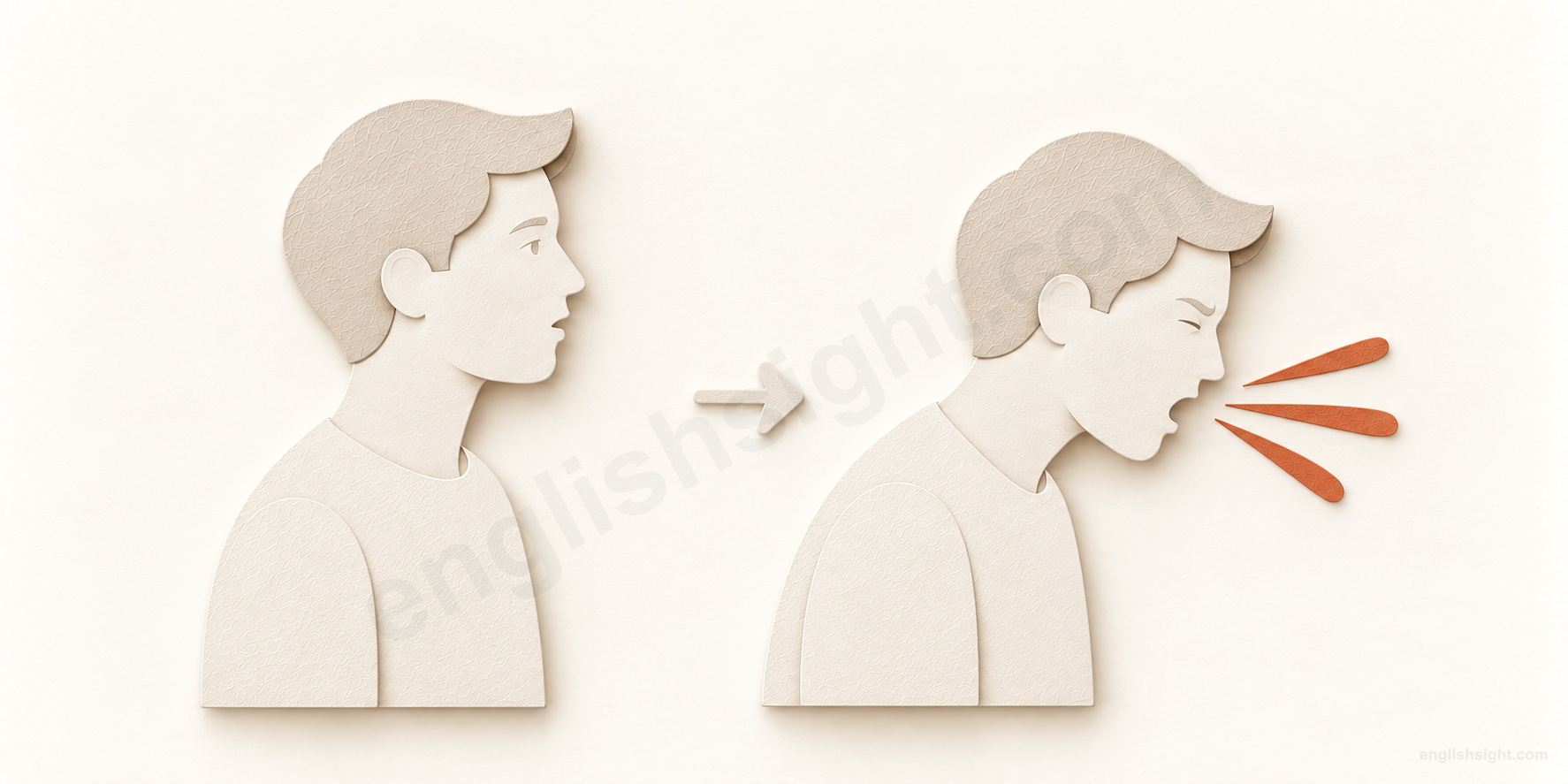
The two views show one person before and during a sneeze; orange marks represent the sudden burst of breath.
To sneeze is to release a sudden, noisy burst of air through the nose and mouth as a bodily reflex.
The picture models the literal event. It does not identify a medical cause or explain the figurative expression about value.
Sneeze names a sudden bodily reaction, and a sneeze names one occurrence or its sound. Patterns around the word add a cause, repetition, or direction.
The informal expressions not to be sneezed at and nothing to sneeze at mean something deserves attention. This established meaning needs its own explanation.
01
The bodily event and its cause
Describe who sneezes, then add a separate construction if you want to name the trigger.
01
someone + sneeze; sneeze + adverb
sneeze
have a sudden, involuntary burst of air from the nose and mouth
Situation before
A person feels the urge to sneeze.
Event or meaning
Air bursts out with a sudden sound.
The person experiences a bodily reflex; no object is required.
The subject is the person or animal whose body reacts. I sneezed describes the event itself. An adverb adds how it sounded: I sneezed loudly. A sneeze is different from a cough or a deliberate action such as blowing your nose.
The ordinary verb is intransitive: say I sneezed, not I sneezed my nose. The noun nose can occur after a preposition in an explanation, but it is not a direct object of this verb.
In a sentence
I sneezed just as the room went quiet.
Watch the difference Sneeze does not mean breathe out in general; the sudden reflex is essential.
02
something + make + someone + sneeze; cause + someone + to sneeze
make someone sneeze
cause another person’s body to produce a sneeze
Situation before
Dust reaches a person’s nose.
Event or meaning
The person sneezes in response.
The trigger is the subject of make; the affected person is its object and the one who sneezes.
Dust makes me sneeze identifies a cause. Make supplies the causative relationship; sneeze still names the bodily reaction. This can describe an unwanted reflex without anyone intending it.
After active make + person, use the base verb: makes me sneeze. After cause, include to: causes me to sneeze. These are constructions with make and cause, not additional transitive meanings of sneeze.
In a sentence
The dust in the attic made me sneeze.
Watch the difference Use made me sneeze, not made me to sneeze or sneezed me.
02
Repetition, direction, and individual events
Grammar lets you report a series, say where the burst goes, or count what you heard.
03
keep / cannot stop + sneezing; have been + sneezing
keep sneezing
sneeze repeatedly over a period of time
Situation before
One sneeze is followed by more.
Event or meaning
The speaker describes the repeated activity.
Repeated events can be described together without making each sneeze a long action.
I keep sneezing reports repeated sneezes. I can’t stop sneezing emphasizes that the series continues despite wanting it to end. Keep and stop take the -ing form in these patterns.
I’ve been sneezing all morning connects repeated events with a period continuing up to now. It does not mean one unbroken sneeze lasts all morning. Sneezing can also name the activity: The sneezing interrupted our conversation.
A sneezing fit is a short burst of repeated sneezing. Fit groups the events into a bout; it does not mean physical fitness here. For example: A sneezing fit interrupted my phone call.
In a sentence
I keep sneezing whenever I open that cupboard.
Watch the difference Stop sneezing means cease the activity; stop to sneeze means pause another activity in order to sneeze.
04
sneeze into + something; sneeze on + someone/something; sneeze at + place
sneeze into a tissue
describe where the outward burst goes
Situation before
A person holds a tissue near their face.
Event or meaning
They sneeze into it.
Into supplies a destination; it does not create a new sense of sneeze.
In sneeze into a tissue, into connects the sneeze with what receives the burst. Sneeze on someone instead describes the burst landing on that person. These are ordinary prepositional descriptions, not separable phrasal verbs.
Someone sneezed at the back of the bus uses at to locate the event. Read the whole phrase: at the back names a place, while the fixed expression not to be sneezed at evaluates something’s importance.
In a sentence
Maya turned away and sneezed into a tissue.
Watch the difference Do not move the pronoun as if into were a separable particle: into it, not it into.
05
a / one + sneeze; number + sneezes; give + a + adjective + sneeze
a sneeze / sneezes
name one event or the sound of that event
Situation before
A sudden noise comes from the next room.
Event or meaning
The listener identifies it as a sneeze.
The noun lets us count, hear, or describe individual events.
A sneeze is countable: one sneeze, two sneezes. The noun can refer to the action or its noise. I heard a sneeze does not require seeing the person who made it.
She gave a loud sneeze describes the same kind of event as She sneezed loudly. Give supports the event noun; it does not mean transferring something to another person. Contrast a sneeze with sneezing, the activity considered more generally.
In stifle a sneeze, the event noun is the object of stifle, meaning suppress or prevent the expression. This does not make sneeze itself a transitive verb: He tried to stifle a sneeze is a different structure from He sneezed.
In a sentence
We heard two loud sneezes from the next room.
Watch the difference Use a sneeze for one event; I have sneezing is not a natural substitute for I am sneezing.
03
Social responses and a fixed evaluation
Recognize a conventional reply to a sneeze, then learn the separate informal expression about something’s value.
06
someone sneezes → another person says “Bless you!”
sneeze → “Bless you!”
respond conventionally when someone has just sneezed
Situation before
A person near you sneezes.
Event or meaning
You acknowledge it with a familiar spoken response.
The words are a social convention, not another meaning of the verb sneeze.
Bless you! is a familiar thing to say to someone after a sneeze. In a short exchange, “Bless you!” can be followed by “Thanks.” The person who says Bless you is responding to the person who sneezed.
This response belongs to the situation rather than to the grammatical pattern of sneeze. It is not needed to complete a sentence such as Tom sneezed, and the reflex diagram shows only the bodily event, not the social exchange.
In a sentence
When I sneezed, Noor said, “Bless you!”
Watch the difference Bless you is addressed to the person who sneezed; it is not the name of the action.
07
something + be + not to be sneezed at; something + be + nothing to sneeze at
not to be sneezed at / nothing to sneeze at
valuable or significant enough to deserve serious attention
Situation before
Someone might dismiss a modest saving.
Event or meaning
The speaker points out that the saving matters.
The negative fixed expression rejects treating something as negligible.
A saving of fifty pounds is not to be sneezed at means it is worth taking seriously. Fifty pounds is nothing to sneeze at conveys the same evaluation. Both are informal; neither describes an actual bodily action.
Learn the negative wording and final at together. Here at belongs to the established expression about dismissing something. The literal reflex diagram cannot predict this meaning, and replacing at with into loses the idiom.
In a sentence
The monthly saving is only fifty pounds, but that’s nothing to sneeze at.
Watch the difference Nothing to sneeze at means significant, not worthless. Do not interpret the negative as denying the saving’s value.
Keep the event, the grammar, and the idiom distinct
Forms and sound
Sneeze is pronounced /sniːz/, with a final /z/. Forms are sneeze, sneezes, sneezed, and sneezing; drop the final e before -ing. The noun plural and third-person verb are both written sneezes.
Objects and passive wording
The ordinary bodily verb has no direct object, so it has no ordinary object passive. The fixed not to be sneezed at is different: retain be, sneezed, and at as part of the idiom. Cause is expressed with make someone sneeze or cause someone to sneeze.
Scope of this lesson
These are common modern uses, not a frequency ranking or a medical guide. Derived words such as sneezy and technical descriptions of the reflex are outside the lesson.
Choose the meaning and construction
Decide whether the sentence describes a bodily event, its grammar, or the fixed evaluation.
1. Dust causes a reflex. Which sentence names the cause naturally?
2. You heard the action happen twice. Which noun phrase counts the events?
3. A friend says, “An extra day off is nothing to sneeze at.” What does the friend mean?
4. Someone stops walking for a moment in order to sneeze. Which sentence matches?
Sources and teaching notes
Dictionary entries support the meanings and constructions below. The explanations, examples, and visual model were created for this lesson.
The diagram is a teaching aid, not a claim that all native speakers share one mental picture.