Talk about snowfall, accumulated snow, disrupted plans, and familiar figurative expressions.
From falling flakes to a covering layer
From falling flakes to a covering layer
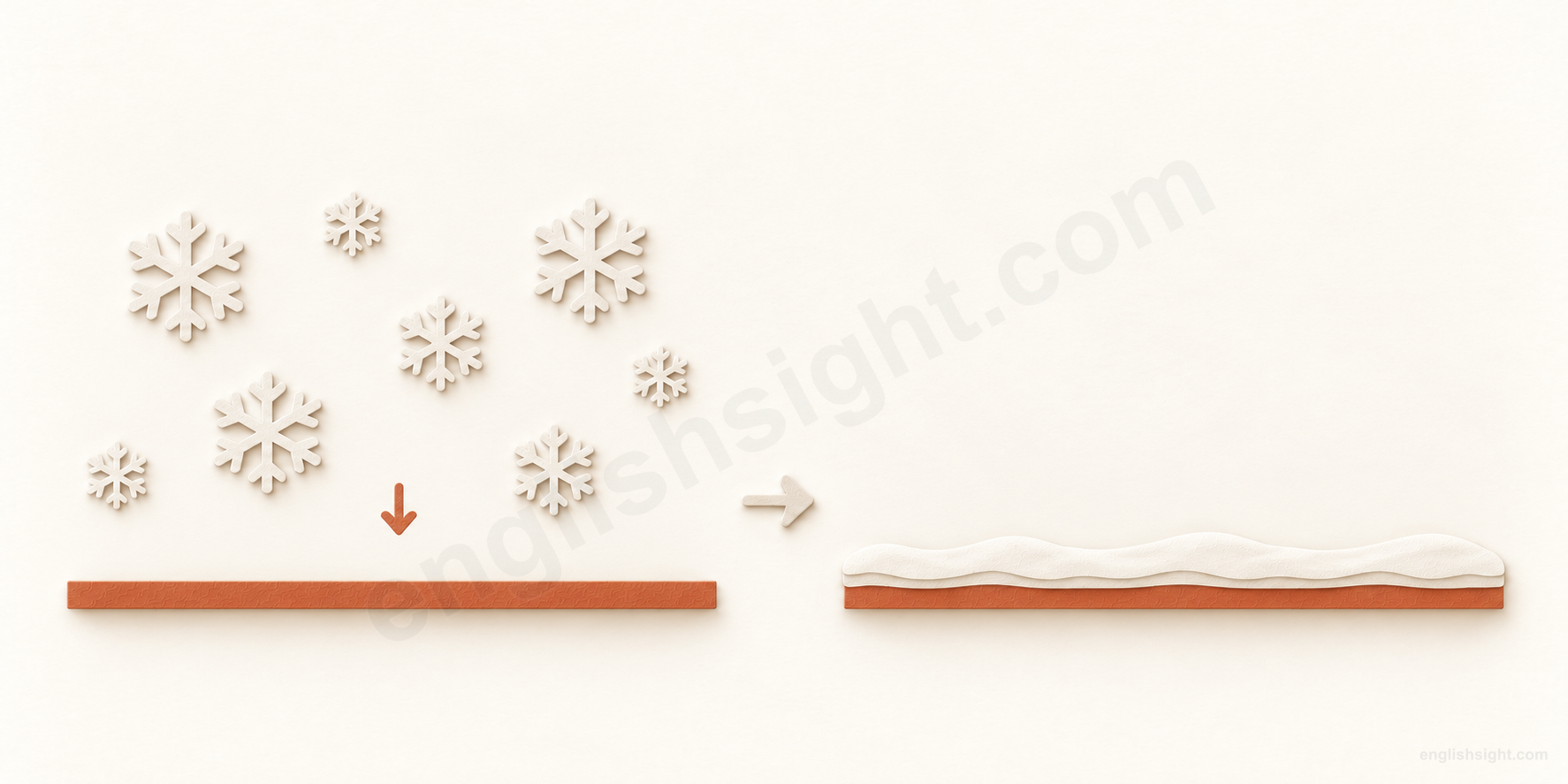
Snowflakes fall above a bare ground strip.
snow
A white layer lies on the same ground after the snowfall stops.
The flakes settle and remain instead of melting immediately.
Falling flakes and the layer they leave are both snow; a layer forms only when the flakes remain.
Snow consists of frozen crystals or flakes falling through the air or lying together on a surface. When falling snow settles, a layer can accumulate.
The sketch connects snowfall and accumulated material. It does not imply that every snowfall settles, and it does not predict all idioms or the persuasion sense.
Snow names the frozen flakes we see falling and the material they leave behind. The verb tells us about the falling; a noun phrase can describe snow that remains long afterward.
Begin with that physical connection, then learn where whole expressions add confinement, overload, persuasion, or a comparison. This is a teaching model, not a claim that all English speakers share one mental picture.
01
Falling snow and lying snow
Start with the material, then distinguish its quantity, condition, seasonal use, and the weather verb.
01
snow falls; snow on + surface; in / through the snow
snow on the ground
frozen flakes falling or lying as a layer
Situation
White flakes fall past the window.
What the expression describes
A white layer covers the garden.
Snow names both the falling material and the material after it lands.
Snow is made of ice crystals, often joined into flakes. The noun can refer to flakes in the air or the layer they form on a surface. A snow-covered garden can remain white after the falling has stopped.
In There is snow on the roof, snow is a mass noun and on the roof tells us its location. In The children are playing in the snow, in places the activity among or within that material. These prepositions do not create separate idioms.
Rain falls as liquid drops; snow falls as frozen crystals or flakes. Ice is the broader word for frozen water, including a solid sheet on a pond. Do not use the three words interchangeably.
In a sentence
There is still snow on the roof, but the sky is clear.
Watch the difference Snow on the ground does not mean it is snowing now.
02
some / much / a little snow; number + unit + of snow
some snow / ten centimetres of snow
measure a mass without counting it as individual objects
Situation
You check how much fell overnight.
What the expression describes
You report a depth rather than a number of flakes.
Count units such as centimetres or flakes; normally leave snow uncountable.
Use some snow, a little snow, a lot of snow, or not much snow. For depth, put a measuring unit before of snow: five inches of snow. For individual pieces, say a snowflake or two flakes of snow.
We had snow last night and We got a lot of snow report the weather a place experienced; have and get do not describe buying or owning it here. The snow can identify a particular layer already mentioned.
Ordinary snow is not counted as a snow or three snows. The special plural the snows has a seasonal or geographical use, explained separately.
In a sentence
We got ten centimetres of snow overnight.
Watch the difference Say a lot of snow, not many snow; say two snowflakes when counting pieces.
03
heavy / light / deep snow; snow settles / melts; covered in / with snow
heavy snow / snow settles and melts
describe intensity, accumulation, and disappearance
Situation
A forecast predicts a lot of falling snow.
What the expression describes
Later, you check whether it stayed or turned to water.
Heavy describes intensity; settle and melt describe what happens to the material.
Heavy snow means a substantial amount or intense snowfall; light snow means a small amount or gentle snowfall. Deep snow describes the depth already lying on the ground. These descriptions answer different questions.
Snow settles when it stays on the ground instead of disappearing immediately. Snow melts when it turns into liquid water. Snow can fall without settling, so falling does not guarantee the layer shown in the sketch.
The path is covered in snow and covered with snow are both natural. Clear snow from the path describes removing it. Cover and clear supply those actions; snow names the material.
In a sentence
Snow fell for an hour, but it did not settle on the warm pavement.
Watch the difference Use heavy snow, but It is snowing heavily: the verb takes an adverb.
04
it + snows / snowed; it + is / was snowing; it has been snowing
It is snowing.
say that snow is falling
Situation
You look outside during a cold afternoon.
What the expression describes
You report the current weather.
Weather it fills the subject position; it does not refer to an object.
Use it with the weather verb: It snows here in January describes a recurring pattern; It is snowing describes falling snow in progress. It snowed yesterday reports a past event.
The forms are snow, snows, snowed, snowed, and snowing. It has been snowing since dawn connects an ongoing period to now. It started snowing and It started to snow both mark the beginning; It stopped snowing marks the end of the snowfall.
This weather use has no direct object. Compare Snow is falling, where snow is a noun and falling is the verb. A statement about snowfall is different from There is snow outside, which may describe an old layer.
In a sentence
It was snowing when we left the station.
Watch the difference Say It is snowing or Snow is falling, not The weather is snowing.
05
the first snows of + season; the snows of + place
the first snows of winter
refer to seasonal or regional snow in a more literary style
Situation
Winter begins in the mountains.
What the expression describes
A description marks its first snowfalls.
The marked plural can refer to snow associated with a time or place.
The first snows of winter refers to the season’s early snowfalls. The snows of the mountains refers to extensive or characteristic snow there. Oxford marks this plural use as literary.
This is a special use of the noun, not permission to count every quantity of snow. For a plain weather report, The first snow of winter arrived today is also natural.
In a sentence
The first snows of winter covered the higher slopes.
Watch the difference Keep this marked plural separate from everyday quantities such as some snow.
02
Closures and blocked journeys
These combinations describe what accumulated snow prevents people from doing. Read the whole expression.
06
a snow day; have + a snow day
a snow day
a day when snow causes school or work to close
Situation
Snow makes journeys difficult.
What the expression describes
The school announces a closure.
The whole compound names a consequence of the weather.
A snow day is a day when a school or business closes because snow prevents normal travel. It does not simply mean any day on which snow falls.
Snow modifies day, and day supplies the countable noun: a snow day, two snow days. Compare a snowy day, which just describes the weather and does not itself announce a closure.
In a sentence
The school announced a snow day, so the children stayed home.
Watch the difference A snowy day need not be a snow day; the closure is part of the compound’s meaning.
07
be / get snowed in; be snowed in at + place
be / get snowed in
be unable to leave because snow blocks the way
Situation
You are staying in a remote cabin.
What the expression describes
Heavy snowfall prevents you from getting out.
In presents confinement; the expression concerns blocked access, not just indoor location.
We are snowed in describes the resulting situation. We got snowed in describes entering it. The snow blocks the routes out; you need not be inside a building, and the building need not be buried.
Oxford also records be snowed up for this confinement meaning. Snowed in is a useful neutral choice when the focus is on people unable to leave. Simply staying in because you dislike the weather does not necessarily mean you are snowed in.
In a sentence
We got snowed in at the cabin and had to stay another night.
Watch the difference Use the past participle after be or get: snowed in, not snowing in for this state.
08
road / pass + be snowed up
a road is snowed up
a route is blocked by accumulated snow
Situation
A road leads across the pass.
What the expression describes
Snow makes that route impassable.
Here up belongs to an established expression for blockage.
Oxford lists be snowed up especially for a road blocked with snow. The road is the affected subject. Compare We are snowed in, which focuses on the people who cannot leave.
A road covered in snow may still be usable; snowed up indicates blockage. Do not invent snow up someone as the normal way to say that someone is busy.
In a sentence
The pass was snowed up, so we took the coastal road.
Watch the difference Snowed up is not the same as snowed under with work.
03
Work, persuasion, comparisons, and screens
Some extensions recall a covering layer or a visible property; others must be learned as established expressions with their own register.
09
be / get snowed under (with + work or demands)
be snowed under with work
have more tasks than you feel able to manage
Situation
Messages and requests keep arriving.
What the expression describes
You cannot deal with them all comfortably.
Accumulated snow supplies a useful comparison for accumulated demands.
In informal conversation, I am snowed under means I have a very heavy load of things to do. With names the load: snowed under with emails, orders, or paperwork. You can omit it when the work is understood.
Be describes the overloaded state; get describes becoming overloaded. The expression is figurative here: there is no real snow. It usually communicates more pressure than simply saying I have some work.
Learn snowed under as a whole expression. Under helps suggest being overwhelmed by a pile, but that image alone cannot establish every possible English combination.
In a sentence
I cannot join you for lunch; I am snowed under with orders.
Watch the difference Say snowed under with work, not snowed in with work for this everyday meaning.
10
snow + someone + (with + impressive talk); be snowed by + someone
snow someone with impressive talk
win someone over with impressive, often misleading words
Situation
A seller makes extravagant claims.
What the expression describes
A listener is impressed and may believe the pitch.
This informal transitive branch concerns persuasion, not weather.
In North American informal English, someone can snow a listener by using impressive claims, flattery, or talk that may be untrue. The listener is the direct object: He snowed me, not He snowed to me.
With can introduce the impressive talk. A passive is possible too: I was snowed by her confident answers. This is a separate established sense; do not treat any ordinary snowfall as an act of deception.
In a sentence
The salesman tried to snow us with claims about impossible fuel savings.
Watch the difference This is informal and regionally marked; persuade or mislead is clearer in neutral international writing.
11
give + someone + a snow job; do a snow job on + someone
give someone a snow job
try to deceive or persuade through exaggerated talk or praise
Situation
You ask for a straightforward explanation.
What the expression describes
The reply offers flattering claims instead of reliable information.
Snow job is a fixed countable noun, not a job clearing snow.
A snow job is an attempt to influence someone with false or exaggerated statements or excessive praise. It is informal and especially North American. The expression can describe an attempt even if the listener remains unconvinced.
Give someone a snow job puts the recipient after give. Do a snow job on someone is another familiar pattern. For actual employment removing snow, say a snow-clearing job and make that meaning explicit.
In a sentence
Do not give me a snow job; show me the actual repair costs.
Watch the difference The noun job does not make this a weather-related occupation.
12
(as) white as snow
as white as snow
compare something’s colour with bright white snow
Situation
You examine a freshly washed sheet.
What the expression describes
You describe its very white appearance.
The comparison selects whiteness rather than coldness or texture.
As white as snow means very white. The first as is often omitted in a short description such as white as snow. The adjective tells you which quality is being compared.
The sheet was as white as snow does not say the sheet was frozen or made of snow. This is an ordinary comparison using a familiar property of snow, rather than a new literal substance.
In a sentence
After washing, the cotton sheet was as white as snow.
Watch the difference Keep as in the comparison: as white as snow, not as white than snow.
13
as pure / clean as the driven snow
as pure as the driven snow
describe complete purity or innocence, sometimes with irony
Situation
Someone is accused of behaving dishonestly.
What the expression describes
They claim to be entirely innocent.
Purity is an established figurative comparison, not a physical weather report.
As pure as the driven snow describes someone or something as completely pure or innocent. As clean as the driven snow is also recorded. The image supplies a comparison, not proof of a person’s character.
The phrase can sound emphatic, playful, or ironic depending on the surrounding sentence and tone. In He claims to be as pure as the driven snow, claims may signal doubt, but the phrase itself does not always mean the opposite.
In a sentence
He says he is as pure as the driven snow, but he will not explain the missing money.
Watch the difference Keep the in the driven snow; do not assume the phrase is always sarcastic.
14
snow on + television screen; the screen is full of snow
snow on a television screen
visual noise appearing as changing pale specks
Situation
An old analogue television loses its signal.
What the expression describes
Moving specks replace a clear picture.
Resemblance to scattered snow gives this separate technical everyday sense.
Snow can name the flickering speckled interference seen on an analogue television when reception is poor or absent. No frozen water is involved.
This use is less relevant to many modern digital displays, which may freeze, show blocks, or display an error instead. Static is a more general word for signal noise. Not every damaged screen is naturally described as snow.
In a sentence
The old television showed nothing but snow until we adjusted the aerial.
Watch the difference This is a recognition sense for signal interference, not an everyday name for all display faults.
Keep the material, grammar, and idioms distinct
Mass noun and weather verb
Ordinary snow is uncountable. Count flakes, depths, or snowfalls instead. Weather snow uses it as subject and has no object; the informal persuasion sense can take an object and a passive.
A picture is a starting point
The layer helps explain covering and overload. Whiteness helps explain comparisons. Neither connection makes an unfamiliar phrase automatically correct; snow job and snow someone need their established meanings and register.
Related words have their own grammar
Snowy is an adjective; snow is the noun or verb. Snow can also modify a noun, as in snow day. Related words such as snowflake, snowball, and snowman are useful vocabulary, but their separate meanings and idioms are not all senses of snow.
Scope
This lesson prioritizes ordinary weather and common learner-dictionary expressions. The literary plural and television sense are marked for recognition. Drug slang, specialist substances such as carbon dioxide snow, proper names, and poetic uses are not developed here.
Choose the meaning from the whole pattern
Use the situation, the grammar, and any particle or comparison to decide.
1. The snowfall stopped yesterday, but the garden is still white. Which statement describes the remaining material?
2. You want to report the depth of snow that fell overnight. Which sentence is natural?
3. A colleague has too many messages to handle. Which expression describes the workload?
4. It is snowing lightly, but school opens as usual. Does that alone make today a snow day?
5. A salesperson praises you excessively and makes implausible claims to win your support. What is the speaker criticizing?
6. Which sentence naturally counts two individual pieces of falling snow?
Sources and teaching notes
The linked dictionaries support the meanings, patterns, and usage labels. The explanations, examples, and compatibility sketch are original teaching material; visual connections are teaching interpretations.
The diagram connects falling flakes with a settled layer. It does not represent a mental picture shared by every native speaker.