Learn how so emphasizes, refers back, and links what follows.
A degree made clear in context
A degree made clear in context
A width to describe
so
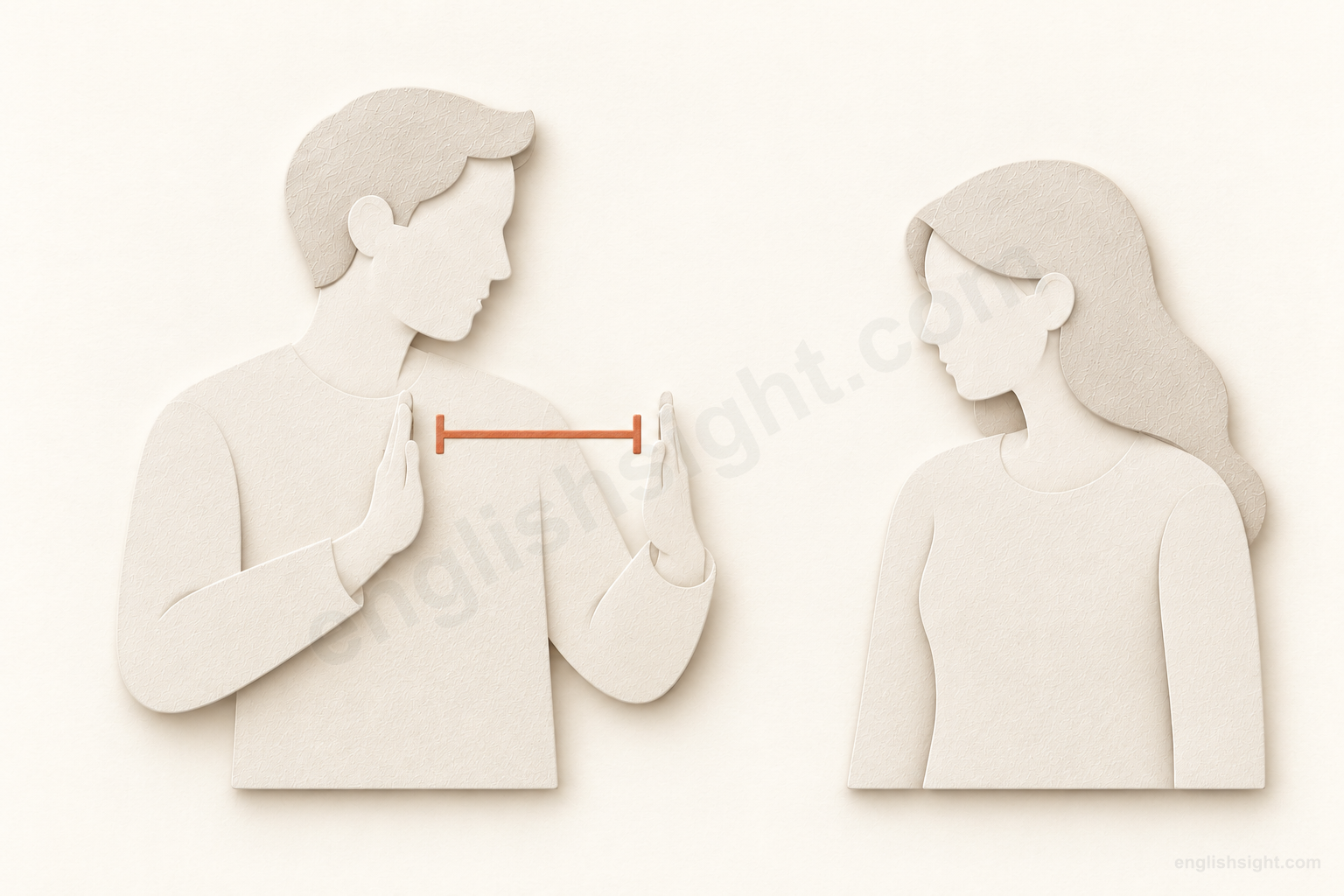
About the width shown between the hands.
The speaker holds both hands apart to show the width.
In about so wide, the gesture supplies the degree; no exact measurement is stated.
So can point to a degree made clear by the situation, rather than giving an exact measurement.
The marked width illustrates about so wide. Other branches reuse a statement or link a consequence; these need their own grammar and are explained below.
So is a small word with several grammatical jobs. It can highlight a degree, pick up an idea already available in context, or connect a situation with a consequence. The words around it decide which job it is doing.
A useful starting point is reference: so often directs attention to a degree, way, or situation that the listener can recover. This is a teaching connection between some uses, not a rule from which every expression can be guessed.
01
Degrees, amounts, and comparisons
So can emphasize a quality or point to a degree supplied by context. The noun pattern, comparison, or result clause tells you how to interpret that degree.
01
so + adjective / adverb; verb + so much
so cold / so quickly
emphasize a degree or refer to a degree already understood
Situation / intention
You notice how cold the room feels.
What is expressed
You stress the strength of the feeling.
So modifies a quality or manner, rather than naming a thing.
In This room is so cold, so draws attention to the degree of coldness, often with feeling or surprise. In Why are you walking so quickly?, the degree is evident from the situation. So does not always mean an objectively extreme amount.
Use so before an adjective or adverb: so narrow, so carefully. A result clause is optional. Thank you so much uses much to intensify thanking; I miss you so is possible too, with a more emotional tone. Ever so grateful is an especially British way of saying very grateful.
In a sentence
This room is so cold!
Watch the difference Very cold is a more neutral description; too cold says the cold exceeds a relevant acceptable limit.
02
so many / few + plural noun; so much / little + uncountable noun
so many / so much / so few / so little
emphasize a large or small quantity
Situation / intention
The number of replies surprises you.
What is expressed
You highlight that unexpectedly large number.
The quantity word determines whether you count items or measure an amount.
Use so many or so few with plural count nouns, and so much or so little with uncountable amounts: so many messages, so few chairs, so much work, so little time. Few and little emphasize a small quantity; so itself does not make the amount large.
So much can stand without a noun when the amount is understood: That costs so much. Thank you so much is an ordinary expression of strong gratitude. With size rather than quantity, little can be an adjective: such little boxes means boxes that are small.
In a dismissive description such as Their excuses were just so much nonsense, (just) so much means nothing but or merely. This is an established use, not simply a claim that there was a large amount of nonsense.
In a sentence
We received so many replies that we had to extend the deadline.
Watch the difference For an ordinary noun description use such a busy day, not so busy day.
03
only so much + uncountable noun; only so many + plural noun
only so much / only so many
say that there is a limit without specifying it
Situation / intention
Your team has limited time available.
What is expressed
You set a boundary on what it can achieve.
Only changes the expression from simple emphasis to a restriction.
There is only so much we can do means our ability to help has a limit. It need not mean we can do a very large amount. Only so many people can fit sets an unspecified limit on numbers.
Compare We have so much time, which emphasizes a large amount, with We have only so much time, which warns that time is finite. Context supplies the practical limit.
In a sentence
We can answer only so many calls in an hour.
Watch the difference Do not interpret only so many as meaning a surprisingly large number in this pattern.
04
about so + size adjective; like so; just so
about so wide / like so
point to a size or show a way of doing something
Situation / intention
You indicate a width with a gesture.
What is expressed
Your listener understands the approximate width.
The situation or demonstration supplies what so points to.
You can hold your hands apart and say The shelf is about so wide. No exact measurement is spoken; the gesture provides the degree. This is the branch illustrated by the lesson’s sketch.
When demonstrating a fold, say Fold it like so. Here the demonstration supplies a manner, rather than a size. Just so can also describe something arranged exactly as required: She wanted the flowers just so.
In formal wording, so can precede a participle to mean in such a way: The shelves were so arranged that every title was visible. The arrangement supplies a manner and the following clause shows its effect; this is separate from so + adjective + that. The more ordinary The shelves were arranged so that every title was visible can describe the intended arrangement or its actual result, depending on context.
In a sentence
The shelf is about so wide.
Watch the difference Without the gesture or another clear reference, so wide may leave the listener asking how wide.
05
so + adjective / adverb + (that) + clause; so + adjective + a/an + noun + that-clause
so…that…
state a degree by giving its consequence
Situation / intention
The alarm has a very low volume.
What is expressed
You explain that this prevented you from hearing it.
So marks the degree; the that-clause supplies its consequence.
The alarm was so quiet that I missed it connects a degree of quietness to a result. That can be omitted when the relationship remains clear: It was so quiet I missed it.
With a singular count noun, use such a quiet alarm that… in ordinary phrasing. The more formal so quiet an alarm that… places so plus the adjective before a/an and the noun. It has the same degree-result relation, with different word order.
In a sentence
The alarm was so quiet that I slept through it.
Watch the difference So that I could sleep expresses a purpose; so quiet that I slept describes a degree and its result.
06
so + adjective + as to + verb; would you be so kind as to + verb?
so kind as to…
connect a degree with an action or make a formal request
Situation / intention
You need someone to close a window.
What is expressed
You phrase the request courteously.
An adjective separates degree so from as to.
Would you be so kind as to close the window? is a formal polite request. So kind as to links the described kindness with the requested action; the complete formula contributes the courteous tone.
In I am not so careless as to leave it unlocked, the action indicates a degree of carelessness that the speaker rejects. Compare so as to leave early: with no adjective between so and as, so as to introduces purpose.
In a sentence
Would you be so kind as to close the window?
Watch the difference This formula can sound ceremonious or, with a sharp tone, irritated; it is not automatically warmer than could you.
07
not so + adjective / adverb + as…; not so much as…
not so…as…
compare degrees negatively
Situation / intention
You compare two routes.
What is expressed
You say this route is less demanding.
The as-part supplies the comparison standard.
Not so steep as the old route means less steep than the old route. Not as steep as is also ordinary and often the easier default. Not so bad can stand alone when the expected standard is understood.
Not so much as before compares amounts. That differs from the expression not so much X as Y, which corrects a description rather than merely comparing quantities.
In a sentence
The new route is not so steep as the old one.
Watch the difference Do not use than to complete this pattern: not so steep as, but less steep than.
08
even more so; (all) the more so because + clause
even more so / all the more so
apply an earlier description to a greater degree
Situation / intention
You have called the town lively.
What is expressed
You say weekends strengthen that description.
So reuses the earlier quality; more changes its degree.
The town is lively, even more so at weekends means it is even livelier at weekends. The word so saves you from repeating lively.
All the more so because… adds a reason for stronger judgment: Her achievement is impressive, all the more so because she had little support. The because-clause explains the increased force of impressive.
In a sentence
The town is lively, even more so at weekends.
Watch the difference Use much more lively or even more so; so is not a general replacement for a comparative ending.
09
statement + so much so that + result clause
so much so that…
reinforce a previous description by adding a result
Situation / intention
You have said that your brother enjoys baking.
What is expressed
You add a consequence showing how strongly he enjoys it.
The earlier description is taken up as a degree with a result.
So much so that… points back to the description just given and then demonstrates its strength. It can follow a clause about a quality, activity, or preference.
Compare He enjoys baking so much that he opened a shop. That places the degree phrase inside one clause. He enjoys baking—so much so that he opened a shop adds a second, reinforcing comment.
In a sentence
My brother loves baking, so much so that he opened a small bakery.
Watch the difference The result clause needs a clear previous description to reinforce.
02
Picking up an earlier idea
These patterns reuse a statement, action, or description. Pay attention to the verb and word order: so do I and so I do perform different jobs.
10
think / hope / suppose / expect + so
I think so / I hope so / I suppose so
respond to a whole statement without repeating it
Situation / intention
Someone asks whether the last bus is still running.
What is expressed
You express a belief about that possibility.
So stands for the proposition, not for the bus itself.
In I think so, so stands for the statement under discussion: here, that the bus is still running. I hope so adds desire; I suppose so can show tentative agreement or reluctant acceptance. The attitude comes from think, hope, or suppose.
Common negatives include I don’t think so, I hope not, and I suppose not. I suppose so is not a promise, and I hope so is not evidence. Learn the negative form with its verb rather than adding not so everywhere.
I’m afraid so acknowledges an unwelcome statement: “Is the shop closed?” “I’m afraid so.” It does not necessarily report fear. I’m afraid not gives the corresponding negative answer: “Can we still go in?” “I’m afraid not.”
In a sentence
“Is the last bus still running?” “I think so.”
Watch the difference Say I hope not for the ordinary negative hope response; not I don’t hope so.
11
say so; be so; is that so?; or so + subject + reporting verb
say so / is that so?
refer to what has been said or to a stated situation
Situation / intention
A colleague reports a change to the schedule.
What is expressed
You check whether that report is true.
So can represent the content of a statement.
If you need help, say so means say that you need help. In Is that so?, the speaker asks whether a previous claim is true; tone can make this sound interested, surprised, or skeptical.
That isn’t so denies a previous account. Or so she says attributes information to her, sometimes with doubt: The parcel has arrived, or so she says. The doubt comes from the reporting frame and context, not from so alone.
So can also reuse a description after be or remain: The room is quiet and will remain so means it will remain quiet. Here so stands for the earlier quality, rather than naming the room or adding another subject.
In a sentence
“The timetable has changed.” “Is that so?”
Watch the difference Do not use so as an ordinary object pronoun: I saw it refers to an object; I think so refers to a statement.
12
question / statement + if so, + clause
if so
make the next step conditional on an earlier statement
Situation / intention
You ask whether a visitor needs a receipt.
What is expressed
You offer to print one if the answer is yes.
So packages the earlier proposition inside a condition.
If so means if that is the case. It avoids repeating the earlier proposition. In this example it means if you need a receipt, not if the receipt already exists.
If not is the usual negative counterpart. Unlike because, if so does not assert that the condition is true; it tells you what follows should it be true.
In a sentence
Do you need a receipt? If so, I can print one now.
Watch the difference If so does not mean therefore; the earlier situation remains a condition.
13
do / does / did so; in doing so
do so / in doing so
refer back to an action
Situation / intention
The form tells you to sign each page.
What is expressed
You confirm that you followed the instruction.
Do carries the action grammar and so refers back to the action.
The instructions asked me to sign every page, and I did so avoids repeating signed every page. This action reference is common in careful writing. Do that and do it may sound more conversational, depending on context.
In doing so means in performing the action just described: He lowered the shelf and, in doing so, made it easier to reach. Do so usually refers to an action someone can carry out; it is not a universal substitute for any verb, especially states such as owning a house.
In a sentence
The instructions asked me to sign every page, and I did so.
Watch the difference I did so refers to an action; so did I says that the same statement applies to me too.
14
so + auxiliary / modal / be + subject
so do I / so can we
add another person or thing to an affirmative statement
Situation / intention
Your friend says she enjoys gardening.
What is expressed
You say that you enjoy it too.
The auxiliary comes before the new subject.
So do I means I do too. Choose the auxiliary that fits: “I’m hungry.” “So am I.” “I can swim.” “So can we.” “I enjoyed it.” “So did I.” Do, be, have, and modals reflect the earlier clause.
For an ordinary negative agreement, use neither/nor plus auxiliary plus subject, or a negative clause with either: “I don’t drive.” “Neither do I.” Not So do I. The new subject can be a thing: Prices rose, and so did demand.
In a sentence
“I enjoy gardening.” “So do I.”
Watch the difference Me too is an informal alternative. So I do has a different word order and normally confirms something about me.
15
so + subject + auxiliary / be / modal
so I do / so it is
acknowledge a fact, often after noticing it
Situation / intention
Someone points out that you have a spare key.
What is expressed
You realize that this is true.
The subject comes before the auxiliary: the same claim is confirmed.
“You have a spare key.” “So I do!” means you are right; I have just realized or remembered that I do. It does not add a second person who also has a key.
“It’s nearly noon.” “So it is.” similarly recognizes the fact. So I will can also accept a suggested action in context: “You could phone them.” “So I will.” Read the whole exchange rather than applying the too rule mechanically.
Quite so! is an established expression of agreement, especially associated with British usage: “We should check the figures first.” “Quite so.” It agrees with the point without adding a new subject.
In a sentence
“You have a spare key.” “So I do!”
Watch the difference So do I would normally add me to a statement about someone else.
03
Results, purposes, and conversation
A clause after so may follow from a situation, state an intended aim, or move the conversation along. These functions are related but are not interchangeable.
connect a situation with a consequence or inference
Situation / intention
The printer has run out of paper.
What is expressed
You explain why you used another printer.
The first clause provides the basis; the second states what follows.
So joins the paper shortage to the decision to print upstairs. It can introduce a physical consequence, a decision, or an inference: The lights are off, so they may be asleep. The inference can be uncertain; so does not prove it.
Because introduces the reason, while result so introduces what follows. In ordinary standard writing, choose The printer was empty, so I went upstairs or Because the printer was empty, I went upstairs. Avoid using because and so as a doubled pair around these same two clauses.
In a sentence
The printer was out of paper, so I printed the tickets upstairs.
Watch the difference Do not reverse the reason and result accidentally: I went upstairs because the printer was empty.
17
action clause + so (that) + subject + verb
so (that) we can…
explain the aim of an action
Situation / intention
You move chairs to create a safe passage.
What is expressed
You explain whom the change is intended to help.
The second clause states an intended outcome, which may not yet have happened.
We moved the chairs so that everyone could get through gives the purpose of moving them. The two clauses can have different subjects. Can, could, will, and would often help express the intended ability or outcome; no single modal is compulsory in every context.
That is often omitted in conversation: Move closer so I can hear you. So that can also introduce an actual result in some contexts. Decide from the meaning: an intention explains what people wanted; a result reports what happened.
In a sentence
We moved the chairs so that everyone could get through.
Watch the difference So that introduces a clause; do not follow it with a bare infinitive such as so that to pass.
18
so as to + verb; so as not to + verb
so as to / so as not to
express an aim using an infinitive
Situation / intention
You leave early to avoid a queue.
What is expressed
You state the purpose in careful wording.
With no adjective between them, so as to forms a purpose expression.
So as to avoid the queue gives the aim of leaving early. The understood subject of avoid is normally the subject of left: we leave and we avoid. To avoid the queue is a shorter everyday alternative.
Use so as not to for a negative purpose: We spoke softly so as not to wake anyone. If you need a different subject, a so that clause is often clearer: I left a light on so that you could find the door.
In a sentence
We left early so as to avoid the queue.
Watch the difference Compare so tired as to fall asleep: the adjective makes that a degree pattern, not this purpose phrase.
19
so + question / comment / next event
So, what happens next?
open, resume, infer, or close a conversational step
Situation / intention
You have finished checking the route.
What is expressed
You invite the group to move to the next decision.
Discourse so organizes the exchange and need not state a strict cause.
So, where shall we meet? can introduce a practical next question. So, how was your trip? picks up a topic. So, that’s all for today closes a conversation. So, I’ve been testing a new idea can begin an explanation.
In a story, And so the journey began connects the next event with what preceded it. In So you’re leaving tomorrow?, the speaker checks an inference. Tone and context decide whether so sounds friendly, purposeful, impatient, or challenging.
In a sentence
So, where shall we meet tomorrow?
Watch the difference Do not translate every sentence-initial so as a strong therefore; sometimes it simply manages the conversation.
20
(just) as + clause, so + clause
just as…, so…
draw a parallel between two situations
Situation / intention
You compare how practice helps two different skills.
What is expressed
You make the parallel explicit.
The whole as…so pattern signals a corresponding relationship.
Just as repetition helps a musician, so it helps a language learner sets the two situations beside each other. This is a fairly formal way to develop an analogy, rather than a casual reply meaning me too.
Inversion is also possible: Just as costs have risen, so have prices. Compare the ordinary result connector: Costs have risen, so we raised our prices emphasizes a consequence instead of presenting two parallel developments.
In a sentence
Just as repetition helps a musician, so it helps a language learner.
Watch the difference Do not assume the second situation is caused by the first; the pattern may simply compare them.
04
Established expressions in everyday use
Learn these combinations as expressions. Their meanings depend on the whole phrase, including words such as far, long, even, and much.
21
list + and so on / and so forth
and so on / and so forth
leave the rest of a recognizable list unstated
Situation / intention
You list a few items needed for a picnic.
What is expressed
You let the listener supply similar items.
So carries forward the pattern established by the examples.
Cups, plates, napkins, and so on gives examples and leaves the remaining similar items unstated. And so forth has the same basic function and can sound a little more formal.
The reader must be able to infer the category. In precise instructions or a safety checklist, an open-ended list may be less useful than specifying everything required.
In a sentence
Bring cups, plates, napkins, and so on.
Watch the difference The phrase continues a category; it does not mean every imaginable object.
22
number / amount / duration + or so
ten minutes or so
give an approximate amount
Situation / intention
You estimate how long a repair will take.
What is expressed
You avoid claiming an exact time.
Or so follows the quantity that it makes approximate.
Ten minutes or so means roughly ten minutes. It can follow a measure, count, or duration: a dozen or so guests, a kilometre or so away.
Place it after the amount: an hour or so. About an hour expresses a similar estimate with about before it. Neither tells you an exact error margin.
In a sentence
The repair should take ten minutes or so.
Watch the difference Do not read or as offering a second exact number; or so marks an estimate.
23
so far; so far, so good; only so far
so far / so far, so good
report progress up to the present or a limit
Situation / intention
You are halfway through a trial.
What is expressed
You report the results available at this point.
Far supplies the idea of a point reached in time or extent.
We have found no errors so far reports the period up to now. The present perfect often fits an unfinished period, but so far also works with a present state: So far, everything looks fine.
So far, so good means progress has been satisfactory up to this point, while the task remains unfinished. Only so far can also limit extent: This explanation takes us only so far means it helps to a point, not without limit.
In a sentence
We have found no errors so far.
Watch the difference So far does not guarantee that the remaining work will be equally successful.
24
as / so far as + clause; in so far as + clause
so far as I know / in so far as
limit a claim to a viewpoint or extent
Situation / intention
You know of no change to a meeting.
What is expressed
You qualify your answer by the knowledge available to you.
The full far-as expression sets the range of the claim.
So far as I know, the meeting is still on limits the claim to your knowledge. As far as I know is an ordinary alternative. So far as cost is concerned limits the topic instead: you are discussing cost, not every aspect.
In so far as means to the extent that and is formal: The plan works in so far as it reduces waste. This is not the time expression so far meaning up to now.
In a sentence
So far as I know, the meeting is still on.
Watch the difference The qualification allows for missing information; it is not a claim of certainty.
25
so long as + finite clause
so long as…
state a condition for permission or continuation
Situation / intention
You agree to lend a bicycle with a condition.
What is expressed
You state the condition the borrower must meet.
The full long-as phrase introduces the condition.
You can borrow it so long as you bring it back tonight means on condition that you return it tonight. As long as is another ordinary form of this conditional expression.
The phrase can also connect continuing circumstances: So long as the road remains closed, buses will use the bridge. Do not confuse these uses with a literal comparison of length or time, such as not so long as yesterday.
In a sentence
You can borrow my bicycle so long as you bring it back tonight.
Watch the difference Keep the subject and verb after as; so long as bringing it back is not the same clause pattern.
26
so long!
So long!
say goodbye informally
Situation / intention
You finish a visit with friends.
What is expressed
You give an informal farewell.
This is a fixed farewell, not a measurement of time.
So long! is an informal way to say goodbye. It may feel more characteristic of some speakers or styles than others; bye is a straightforward alternative.
Compare We waited so long, where long describes duration and so intensifies it. The same two words do different jobs because the farewell is an established expression.
In a sentence
So long! See you next weekend.
Watch the difference The farewell does not promise that the separation will be long.
27
statement; even so, + clause
even so
acknowledge a fact but continue against the expectation it creates
Situation / intention
The hotel is expensive.
What is expressed
You still recommend it.
Even turns the reference to that fact into a concessive link.
Even so means despite that. The first statement gives a possible reason against the recommendation; the second says that the recommendation still stands.
Compare The hotel is expensive, so we won’t stay there, where so introduces the expected consequence. In It is expensive; even so, we recommend it, the relationship is concessive. Even though instead introduces a clause: Even though it is expensive, we recommend it.
In a sentence
The hotel is expensive. Even so, I would recommend it.
Watch the difference Do not substitute even so for so without changing the relationship between the statements.
28
not so much + X + as + Y
not so much X as Y
say that a second description fits better
Situation / intention
A room is being called an office.
What is expressed
You suggest that storage room is a better description.
The contrast shifts the description from X toward Y.
It is not so much an office as a storage room means storage room is the more accurate description. This does not have to deny every office function; it changes the emphasis.
Parallel phrases make the contrast clear: not so much tired as bored; not so much a question of speed as of accuracy. This differs from not so much money as before, which compares amounts.
In a sentence
It is not so much an office as a storage room.
Watch the difference Keep X and Y comparable; this is a correction of emphasis, not necessarily a numerical comparison.
29
without so much as + noun / -ing; not so much as + verb
without so much as… / not so much as…
emphasize that even a minimal expected action did not happen
Situation / intention
Someone leaves without acknowledging you.
What is expressed
You emphasize the lack of even a small courtesy.
The whole expression establishes a minimum that was not met.
Without so much as a wave means without even a wave. Without so much as saying goodbye gives an action in the -ing form after without.
He did not so much as look up similarly means he did not even look up. Compare not so much X as Y, where a better description replaces a weaker one. Here the focus is the absence of a minimum action.
In a sentence
She left without so much as a wave.
Watch the difference After without, use saying, not say, when the complement is an action.
30
so much for + noun phrase
so much for…
dismiss a failed idea or finish discussing a topic
Situation / intention
A supposedly reliable bag tears on its first use.
What is expressed
You comment ironically on the claim of strength.
The full expression can close a topic or reject an expectation.
So much for its strong handles! signals that the claim has proved disappointing. It can express irony or frustration, not gratitude or a large amount.
A second use is a topic transition: So much for the travel costs; now let’s discuss accommodation. Here you finish one part of the discussion. Context and tone distinguish neutral closure from disappointment.
In a sentence
The handle broke on the first trip. So much for our sturdy new bag!
Watch the difference Thank you so much for your help is a different structure: so much intensifies thanks, and for introduces the reason.
31
so what?; so?; so what if + clause
So what? / So? / So what if…?
challenge the importance of a fact
Situation / intention
Someone criticizes your unusual choice of colour.
What is expressed
You say that the criticism does not matter to you.
The expression questions the significance of the fact, rather than its truth.
So what? often means why should that matter? It can sound dismissive or rude. So? alone can have the same challenging force, although in other contexts it may simply request the next point.
So what if my coat is bright? accepts the possibility or fact and challenges its relevance. So I’m late—there’s still time similarly concedes a fact while minimizing its importance. Tone is crucial.
In a sentence
“Your coat is very bright.” “So what? I like it.”
Watch the difference For a neutral request for consequences, ask What does that mean for us?; So what? may sound confrontational.
32
if + clause, so be it
so be it
accept a situation, often reluctantly
Situation / intention
A decision may delay a project.
What is expressed
You accept the delay as a consequence.
The fixed wording accepts that the situation will stand.
If that means waiting another week, so be it expresses acceptance, perhaps with resignation or determination. It does not necessarily mean the speaker likes the outcome.
The be in this fixed expression is not an ordinary present-tense statement such as it is. Keep the established word order. The expression is more formal or emphatic than That’s fine.
In a sentence
If that means waiting another week, so be it.
Watch the difference Do not replace it with so is it when expressing acceptance.
33
if + favourable possibility, so much the better
so much the better
welcome an extra benefit
Situation / intention
A room is already suitable.
What is expressed
You welcome the additional possibility of a window seat.
The fixed comparative expression marks an added advantage.
If we can get a window seat, so much the better means that would be an additional benefit. All the better is another established form.
Contrast This seat is so much better, which directly compares the quality of seats. In so much the better, keep the: the phrase evaluates an extra favourable circumstance.
In a sentence
The room is fine; if it has a sea view, so much the better.
Watch the difference Do not omit the from this fixed expression, although ordinary so much better has a different grammar.
34
every so often + clause; clause + every so often
every so often
say that something happens occasionally
Situation / intention
A loose wheel makes a noise intermittently.
What is expressed
You describe the occasional recurrence.
The whole phrase gives a loose frequency, not a precise schedule.
Every so often means from time to time. It tells the listener that something recurs, but does not set a fixed interval.
Compare every ten minutes, which specifies a schedule. Every so often the wheel squeaks leaves the timing approximate and can describe irregular recurrence.
In a sentence
Every so often, the wheel makes a clicking sound.
Watch the difference This does not mean very frequently just because so often on its own can emphasize frequency.
35
figurative / unusual wording + so to speak
so to speak
signal an unusual or figurative choice of words
Situation / intention
You describe one person as the team’s engine.
What is expressed
You mark engine as a figurative description.
The phrase comments on wording rather than giving a purpose.
She is the engine of the team, so to speak marks engine as a deliberate figurative description. It invites the listener to understand the expression in a special or approximate way.
This is not so as to speak, which would have purpose grammar. It is also different from roughly speaking, which usually announces an approximate statement or estimate.
In a sentence
She is the engine of the team, so to speak.
Watch the difference Do not add this automatically to every ordinary comparison; use it when you want to draw attention to the wording.
36
I told you (so)
I told you so
remind someone that an ignored warning was correct
Situation / intention
You warned that a cheap umbrella would break.
What is expressed
It breaks, and you remind the owner of your warning.
So points back to the prediction, while the whole expression carries a social attitude.
I told you so commonly follows an unwelcome result that the speaker predicted. It often sounds self-satisfied, reproachful, or unhelpful to the person affected.
The speaker need not repeat the warning because context supplies it. A softer response such as That’s frustrating; let’s see what we can do avoids claiming credit for being right.
In a sentence
“The umbrella broke already.” “I told you so.”
Watch the difference This is usually not a comforting response; consider the relationship and tone.
37
so not + phrase; statement + so there!; I am so!
so not / so there!
add informal emphasis or defiance
Situation / intention
Someone suggests an activity you strongly dislike.
What is expressed
You emphatically reject it.
Informal emphasis and fixed defiant wording go beyond neutral degree.
I am so not going to that party uses so before not for emphatic rejection. This expressive informal pattern is different from neutral so plus an adjective such as so tired.
So there! expresses a defiant refusal to change position: It’s my turn, so there! It often sounds childish or deliberately playful. The argumentative I am so! also insists that a denial is wrong; recognize the tone rather than treating it as neutral agreement.
Informal so can also strengthen a positive verb phrase: I so want to see that film means I very much want to see it. This expressive use should not be turned into a rule that so can freely intensify every verb.
In a sentence
I am so not going to that party.
Watch the difference These forms can sound theatrical, childish, or confrontational and usually do not suit formal writing.
38
it (just) so happens that + clause
it just so happens that…
introduce a relevant coincidence
Situation / intention
Someone needs a spare ticket.
What is expressed
You happen to have one available.
The whole phrase presents a fact as a coincidence.
It just so happens that I have a spare ticket introduces a coincidentally useful fact. Just is common but not essential: It so happens that… has the same basic frame.
The phrase can also be used pointedly when correcting an assumption: It just so happens that I know the owner. Its conversational effect depends on tone, but its grammar still requires the following clause to state the fact.
In a sentence
It just so happens that I have a spare ticket.
Watch the difference This is not a result connector meaning therefore I have a ticket.
Read the construction before choosing a meaning
So and such have different noun patterns
Use so + adjective/adverb (so useful, so quickly) and such + noun phrase (such a useful tool). So many books and so much work are quantity patterns. The formal so useful a tool is possible, with its special word order.
Reference is not a universal replacement rule
I think so reuses a proposition, do so reuses an action, and so do I adds another subject. Their negative forms and word order differ. Knowing the meaning of so alone does not tell you which verbs permit each pattern.
Purpose does not guarantee a result
We left early so that we could get seats states our aim. It does not establish that we got seats. We left early, so we got seats presents the second event as a consequence. Context can distinguish purpose and result even where so that appears in both.
Scope and pronunciation
This lesson covers modern adverbial, connective, and conversational so, plus a selection of established expressions. Pronunciations are /səʊ/ in a common British model and /soʊ/ in a common American model. Sew and sow can sound the same but are different words. So has no verb inflections or particle-verb family here. The musical note so/sol, abbreviations, historical forms, and separate words such as so-so, so-called, so-and-so, and say-so are outside this lesson.
Choose what the whole pattern means
Use the surrounding words and the situation to choose an interpretation.
1. “I can swim.” You can swim too. Choose the ordinary reply.
2. You left early with the aim of getting a seat, but do not yet know whether you succeeded. Which sentence states that aim?
3. There is a limit to the help you can give. Which wording fits?
4. “Do you hope the flight is cancelled?” You hope it is not cancelled. Choose the ordinary short reply.
5. The walk is long, but you still want to go. Which connector expresses that contrast?
6. Choose the ordinary noun phrase for a particularly useful tool.
Sources and teaching notes
Definitions and usage were checked against the sources below. Explanations, example sentences, and the diagram were written for this lesson; the visual connection is a teaching interpretation.
This diagram helps explain a connection; it is not a picture shared by every native speaker.