A washing substance—and the action of applying it.
Use soap for the material, count bars or varieties, and recognize the separate drama and idiom branches.
Soap, water, and washing
Soap, water, and washing
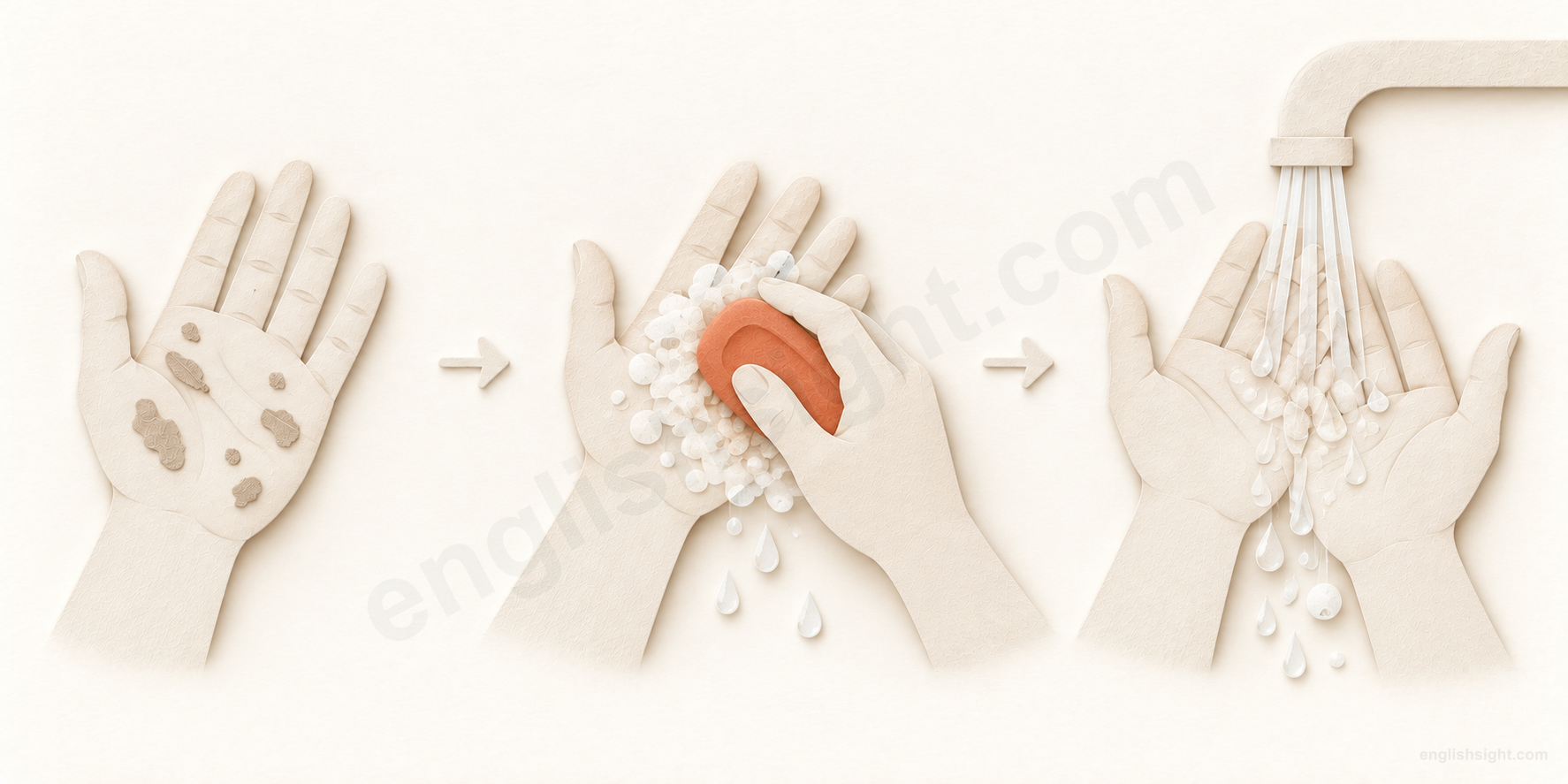
Dirt is visible on an open palm.
soap
Hands without visible dirt are being rinsed under a tap.
A hand rubs an orange bar of soap onto the palm, producing lather.
Soap helps washing remove dirt. Soaping is the application step; rinsing follows.
Soap is used with water to help remove dirt; to soap something is to apply the substance to it.
Application is one part of washing. The clean final hand represents the result after rubbing and rinsing, not a result guaranteed by the verb soap alone. The television and idiom branches are explained separately.
Start with a familiar relation: soap is a substance used with water to help remove dirt during washing. As a verb, soap means put or rub that substance onto someone or something.
The ordinary substance noun, its countable product uses, and the television noun need different grammar. Fixed expressions such as soft soap cannot be predicted simply from a bar in a bathroom.
01
The substance, its amount, and its forms
Ask for soap, count bars or bottles, and describe the product you need. Grammar distinguishes a substance from a unit or a variety.
01
some / more / enough soap; wash + object + with soap (and water)
some soap; soap and water
a substance used with water for washing
Starting situation
Your hands are dirty after gardening.
Meaning in context
You ask for a washing substance to use with water.
Soap names what you wash with; it does not name the water or the whole action.
In an ordinary request, soap behaves as a substance noun: some soap, more soap, or not much soap. It can be solid or liquid. The word does not itself specify a bar.
With in wash your hands with soap introduces the material used. Soap and water names the two things together. Compare wash your hands: wash names the action, while soap here names a material.
The diagram connects this material with washing dirt away. It is a teaching sequence, not a rule that every use of soap describes successful cleaning.
In a sentence
Is there any soap by the sink? My hands are covered in soil.
Watch the difference For an unspecified amount, ask for some soap rather than automatically using a soap.
02
a bar / cake / piece of soap; number + bars of soap; a bottle of liquid soap
a bar of soap
count a solid portion of the substance
Starting situation
You are buying two solid pieces for the bathroom.
Meaning in context
You name the units as bars.
The count belongs to bar, bottle, or another container, not to an unspecified amount of soap.
A bar of soap is one solid piece; two bars of soap counts two pieces. A cake of soap is another established expression for a solid piece. Cake here is a unit shape, not something to eat.
For liquid soap, name a container when you need to count it: a bottle of soap or two bottles of liquid soap. A piece of soap can refer to part of a bar.
Countable soap is possible in product contexts, but bars of soap is clearer when your point is how many solid pieces you want.
In a sentence
Please put two bars of soap in the guest bathroom.
Watch the difference Say two bars of soap, with plural bars and singular soap; do not add -s to soap just because there are two bars.
03
adjective / describing noun + soap; different / several + soaps
liquid soap; different soaps
describe a form, quality, brand, or variety
Starting situation
A shop has several washing products.
Meaning in context
You distinguish the kinds rather than measuring one amount.
Soaps can mean varieties or products; it need not mean separate bars.
Liquid soap describes a flowing form; bar soap describes a solid form. Hand soap names its intended use. Mild soap and perfumed soap describe qualities.
In American English, dish soap names a product for washing dishes. Despite soap in the name, the product may be a detergent rather than soap in the chemical sense. The modifier dish tells you its intended use; it does not mean the product is suitable for every kind of washing.
Soap is normally uncountable when discussing an amount, but soaps is natural for different varieties or products. Compare We need more soap with This shop sells several handmade soaps.
A soap in a product review can similarly mean one kind or product. Context matters: a soap in a television conversation normally means a drama series instead.
In a sentence
The stall sells handmade soaps in several scents.
Watch the difference Do not learn an absolute rule that soap never has a plural. Separate amount, product variety, and television senses.
04
soap powder; soap flakes
soap powder; soap flakes
name forms used for washing clothes
Starting situation
You are reading the names of laundry supplies.
Meaning in context
You identify powder or thin pieces used in washing.
Powder and flakes specify the form; soap links the product to washing.
Soap powder is a British English term for a laundry powder made with soap and other ingredients. Soap flakes are small, thin pieces used especially for washing clothes by hand.
These are noun combinations, not different meanings created by a verb particle. In soap flakes, plural flakes names the pieces. Soap stays singular as the modifier.
A laundry detergent is not automatically identical to soap in the chemical sense. Learn the actual product name and directions rather than treating every cleaner as interchangeable.
In a sentence
The label says to dissolve the soap flakes before washing the scarf.
Watch the difference Do not use soaps flakes. The first noun normally remains soap in this combination.
02
Applying soap and describing washing
The verb names putting soap on someone or something. Bubbles and rinsing are related parts of washing, but applying soap alone does not mean the job is finished.
The object receives the soap; the verb names application, not the entire washing process.
In soap your hands, you are the person acting and your hands are what the soap goes onto. Soap can also take a person, another body part, or an object as its direct object.
Soap yourself uses a reflexive pronoun because the person applying the soap and the person receiving it are the same. Compare She soaped the child with She soaped herself.
The regular forms are soap, soaps, soaped, and soaping. An ongoing action is possible: He is soaping his hands. A passive is possible too: The surface was soaped before it was rinsed.
Unlike wash, soap does not itself say that dirt has been removed. Soap your hands, then rinse them gives two distinct actions.
In a sentence
Maya soaped her hands, rubbed them together, and rinsed them.
Watch the difference Soap is a verb here and needs no with before its direct object: soap your hands; alternatively, wash your hands with soap.
Up belongs to the washing expression; it does not mean movement upward.
In a washing context, soap up means lather or cover with soap. You can soap up your hands or soap your hands up. With a pronoun object, use soap them up.
The expression describes covering something or yourself with soap or lather. It does not guarantee a particular amount of foam or that rinsing is already complete.
Soap someone up also has a figurative flattering use in some dictionaries. The bathroom context here selects the literal use; the later soft soap entry explains the persuasion branch.
In a sentence
Soap your hands up, then rinse them under the tap.
Watch the difference With a pronoun, say soap them up, not soap up them. Keep soap up distinct from soak up, which can mean absorb.
07
soap + bubble / dish / dispenser
soap bubbles; a soap dish
describe bubbles and objects connected with soap
Starting situation
You need words for what you see by the washbasin.
Meaning in context
You name the bubbles and the holder for a bar.
The second noun identifies the thing; soap explains its connection with washing.
Soap bubbles are bubbles formed from soapy liquid. A soap dish is a small holder for a bar of soap. A soap dispenser holds and releases soap, often liquid soap.
These noun combinations show different relationships: a bubble is made from the soapy liquid; a dish or dispenser is for holding or supplying soap. They do not all mean objects made of soap.
Count the second noun: one soap bubble, several soap bubbles; one soap dish, two soap dishes. These transparent combinations do not create extra dictionary senses of soap.
In a sentence
Put the bar in the soap dish beside the sink.
Watch the difference A soap dish holds soap; it is not normally a dish made from soap.
03
Television and fixed expressions
A soap can be a continuing drama. Soft soap and no soap have established figurative meanings that the washing picture cannot predict.
08
a soap / soap opera; watch a soap; act in a soap; soap star
a soap; a soap opera
a continuing television or radio drama
Starting situation
You are talking about a series with recurring characters.
Meaning in context
Soap refers to the drama rather than a washing substance.
This countable informal noun shortens soap opera; it is a separate established branch.
A soap follows the lives and relationships of a recurring group of characters across many episodes. It is informal for a soap opera. It is not the name for every kind of television series.
You can watch a soap, act in a soap, or talk about your favourite soaps. In soap star, soap describes the kind of programme in which the actor is known.
The name soap opera comes from sponsorship by soap manufacturers. This history helps explain the label, but it does not let you derive the drama meaning from the cleaning action in a new sentence.
In a sentence
Leah has played the same character in a radio soap for five years.
Watch the difference A soap in this context is one series, not one episode or one bar. The plural is soaps.
09
a real-life soap opera; turn into / become a soap opera
turn into a soap opera
compare real events to an emotional continuing drama
Starting situation
Friends keep reporting new arguments and complicated relationships.
Meaning in context
Someone describes the unfolding situation as a soap opera.
The comparison draws on the drama genre, not on washing.
A real-life situation can be called a soap opera when it seems full of complicated personal conflicts and emotional developments. The comparison can sound humorous or critical.
In turn into a soap opera, turn into supplies the change; soap opera names what the situation is compared with. No actual filming or television broadcast is implied.
In a sentence
Their shared-house dispute has turned into a soap opera, with a new argument every week.
Watch the difference This is an evaluative comparison, so it may sound dismissive of the people involved.
10
soft soap; soft-soap + person; soft-soap + person + into + -ing
soft soap; soft-soap someone
flattering talk used to influence someone
Starting situation
Someone praises you enthusiastically before asking a favour.
Meaning in context
You suspect the praise is meant to win you over.
The whole expression conveys persuasive flattery; ordinary soap does not mean praise in every context.
Soft soap as a figurative noun means flattering talk. Soft-soap as a verb means try to influence someone with such talk, often with a suggestion that it is insincere.
A person is the direct object: soft-soap the manager or soft-soap him. Soft-soap someone into doing something adds the intended or achieved result of the persuasion.
Collins also records soap someone (up) for flattery. For a beginner, learning soft-soap as a complete expression makes the intended meaning easier to recognize. This lesson includes the branch for recognition rather than claiming it is as useful as the basic washing noun.
In a sentence
He tried to soft-soap me into lending him my bike by praising how generous I was.
Watch the difference Praise alone is not necessarily soft soap. The expression suggests an attempt to influence someone; it does not guarantee success.
11
try + action, but no soap; No soap as a response
no soap
no success, or a refusal to accept or allow something
Starting situation
An attempt fails, or a request is rejected.
Meaning in context
A speaker uses a fixed slang response.
This fixed expression can concern failure or refusal, with no washing meaning.
In North American slang, but no soap can report that an effort was unsuccessful: I tried the spare key, but no soap. You did not get the result you wanted.
As a response to an offer or request, No soap can mean that it is unacceptable or will not be allowed: He asked to borrow the car, but the answer was no soap.
Learn it mainly for recognition. No luck, It didn’t work, or No are straightforward alternatives in ordinary conversation. The literal There is no soap instead says that the washing substance is absent.
In a sentence
I asked whether they would lower the price, but no soap.
Watch the difference Do not use no soap as a neutral general replacement for every negative sentence. Context selects a literal shortage, failed effort, or slang refusal.
Keep the substance, action, and fixed meanings apart
Count a unit or distinguish a kind
Some soap refers to an amount; two bars of soap counts pieces; several soaps may refer to varieties. A soap on TV is a separate countable meaning.
Soaping is a step
Soap your hands means apply soap to them. Wash your hands describes washing more generally. Rinse removes soap or other material with water; these verbs are not interchangeable.
Forms and scope
Forms are soap, soaps, soaped, and soaping. The literal verb allows direct objects, reflexives, progressive forms, and passives. It has no special common adjective-complement or to-infinitive family to memorize here. Technical fatty-acid salts, slang bribery uses, and separate words such as soapbox are outside the main lesson.
Choose by meaning and grammar
Decide whether you need an amount, a unit, an action, or an established expression.
1. You want two solid pieces for the bathroom. Which request is clearest?
2. You need an unspecified extra amount for washing your hands. Which request fits?
3. Someone says, “Soap your hands, then rinse them.” What does the first step ask you to do?
4. “He has acted in three soaps.” What is being counted in this acting context?
5. In an informal North American story, “I tried the spare key, but no soap” most naturally reports what?
Sources and teaching notes
The main meanings and patterns were checked in publisher dictionary entries. The soap up synonym entry was available in publisher-indexed text only; its full page could not be fetched. Explanations, examples, and the diagram are original teaching material.
This washing sequence is a teaching aid, not a picture shared by every English speaker.