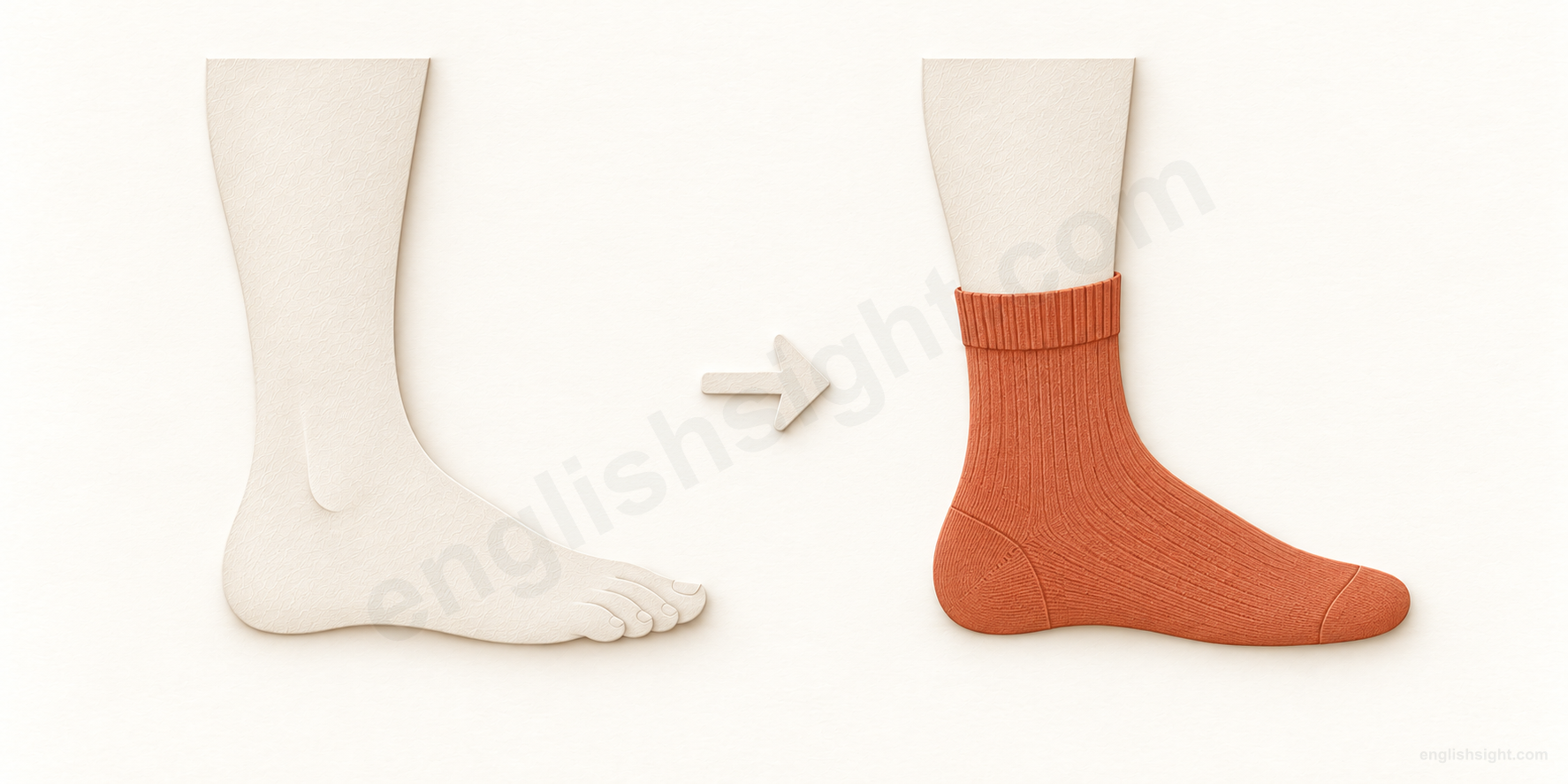
Start with the garment, then recognize the impact verb and fixed expressions.
Fabric around the foot
Fabric around the foot
A bare foot and ankle.
sock
The sock covers the foot and ankle.
A soft sock fits around the foot.
Soft fabric surrounds the foot, with a cuff above the ankle.
A sock is a soft garment worn around a foot and usually the ankle or lower leg.
This model explains the ordinary clothing noun. The impact verb and fixed expressions need their own explanations; the picture is a teaching aid, not a shared mental image claimed for every English speaker.
A sock fits around your foot and usually covers the ankle or part of the lower leg. This concrete clothing meaning is the starting point for everyday dressing, shopping, and laundry.
English also uses sock for a hard hit and in established expressions about effort, surprise, savings, and weather. Learn these branches with their constructions; a single clothing picture cannot predict them all.
01
Dress, count, and describe
Use the countable garment noun in everyday situations, then see how the compound sock puppet develops.
01
a sock; socks; a pair of socks; two pairs of socks
a sock / a pair of socks
a fabric garment that covers a foot and usually the ankle or lower leg
Situation / starting point
You have one bare foot.
Meaning / result
A soft garment covers the foot.
A sock fits around a foot; two socks can form a pair.
Sock is countable: one sock, two socks. One pair of socks normally contains two individual socks. Unlike trousers, sock can name one item in the singular.
Count pairs separately from individual garments: I bought two pairs of socks means four socks. In One pair is missing, pair is the singular head noun; in My socks are wet, socks is plural.
The diagram anchors this clothing meaning. A sock is flexible clothing, whereas a shoe has a more structured shape for the foot. People can wear socks without shoes.
In a sentence
One sock is missing, so this pair is incomplete.
Watch the difference Use a pair of socks, not a pair of sock. For ordinary spelling, use socks rather than sox.
02
put + socks + on; take + socks + off; wear / have socks on
put on / take off your socks
dress your feet or remove the clothing
Situation / starting point
Your socks are beside your feet.
Meaning / result
You have your socks on.
The action comes from put on or take off; sock names the garment.
Put your socks on and put on your socks describe dressing. Wear socks describes the resulting state: I wear socks at home. Have socks on also describes a state.
Take your socks off reverses dressing. With a pronoun, put it between the verb and particle: Put them on; take them off. Pull on your socks emphasizes drawing them over your feet.
Literal Pull your socks up means adjust them higher on your legs. The same words can be an idiom about improving your work; the situation decides which meaning applies.
In a sentence
Put your socks on before you put your shoes on.
Watch the difference Socks is a noun here. Put on and take off supply the action; these are not phrasal verbs formed from sock.
03
material / length / describing word + socks; sock + noun
cotton socks / ankle socks / odd socks
describe material, height, or whether socks match
Situation / starting point
You choose socks from a drawer.
Meaning / result
You identify their material, length, or matching status.
Words before socks specify the kind or appearance.
Cotton socks describes material; thick socks describes thickness. Ankle socks are short, while knee-high socks reach to around the knee. These are descriptions of garments, not new meanings of sock.
In British English, odd socks can be two socks that do not match: I found a blue sock and a yellow one, so I wore odd socks. Mismatched socks makes the contrast explicit.
A sock drawer is a drawer for socks. In this noun compound, sock normally stays singular; compare a drawer full of socks, where socks is an ordinary plural noun.
In a sentence
I packed thick cotton socks for the trip.
Watch the difference Odd socks need not mean socks with a strange design; in the matching context, they do not belong to the same pair.
04
a sock puppet; sock puppets; a sock puppet of + controller
a sock puppet
a puppet made from a sock, or a person or online identity controlled by someone else
Situation / starting point
Someone moves a sock over a hand, or secretly controls another voice.
Meaning / result
An apparent speaker acts under someone else’s control.
The compound moves from a hand-controlled puppet to a controlled or invented voice.
In We made a sock puppet for the play, a sock becomes a hand puppet. This is a transparent compound: sock tells you what the puppet is made from.
Calling a public figure a sock puppet suggests that someone else controls that person’s actions: The article portrays the official as a sock puppet of the company. That is an accusation, not a neutral job description.
Online, a sock puppet is a false identity used to present its creator’s views as if they came from another person. The shared idea is a voice controlled from behind the scenes. The whole compound carries this meaning; sock alone is not a general word for an online account.
In a sentence
The seller used a sock puppet to praise his own products online.
Watch the difference An anonymous account is not automatically a sock puppet; the expression implies a deceptive identity or hidden control.
02
A blow and a financial burden
Keep the informal hitting meaning separate from the garment; a cost can be described as a figurative blow.
05
sock + person + in the + body part; give + person + a sock
sock somebody / give somebody a sock
hit someone hard, especially with a fist
Situation / starting point
Two people are arguing.
Meaning / result
One person delivers a hard blow.
This informal verb and noun describe impact, not clothing.
In sock someone in the jaw, someone is the person hit, and in the jaw identifies the body part. Sock is informal; hit or punch is a more neutral choice in a factual account.
The countable noun a sock can also mean a hard blow: He gave the attacker a sock on the nose. Clothing and impact are separate modern branches; do not invent a rule that hitting involves a garment.
The verb is regular: sock, socks, socked, socking. A passive is possible: He was socked in the jaw. Here socked describes being hit, not becoming dressed.
In a sentence
During the fight, one man socked the other in the jaw.
Watch the difference Distinguish a sock on the foot from a sock on the jaw: the latter can mean a blow.
06
sock + person + with + charge; be socked with + cost
sock somebody with a charge
impose an unwelcome financial cost on someone
Situation / starting point
A customer expects a small bill.
Meaning / result
The customer faces an unexpectedly heavy charge.
A financial burden is presented as a figurative blow.
Sock customers with higher charges treats an unpleasant cost as an impact. The person or group bears the cost; with introduces the charge. The wording expresses disapproval or surprise.
The passive is useful when the affected person is the topic: We were socked with an extra fee. No physical hitting is involved, and the charge need not be literally a fine.
Compare They charged us a fee, a neutral report. They socked us with a fee makes the same event sound more unwelcome or forceful.
In a sentence
We were socked with an extra cleaning fee after checkout.
Watch the difference This is informal and evaluative. Use charged or required to pay when you need a neutral tone.
03
Saving and weather expressions
These established combinations have meanings that need to be learned with the whole expression.
The whole phrasal verb means save; it does not specify a storage container.
Sock away is informal and especially North American. A sum of money is its usual object: She socks away a little each week. For names of savings goals, add for: for a bike, for college, for emergencies.
The object can go before or after away: sock away the money or sock the money away. With an object pronoun, use sock it away, not sock away it.
I have some money socked away describes savings already accumulated. The money may be in a bank; it does not have to be hidden in a sock. Save is the straightforward alternative.
In a sentence
I sock a little money away each month for repairs.
Watch the difference Do not use sock away for spending money. Away is part of an established saving expression.
08
airport + be socked in; be socked in by + bad weather
be socked in
be closed or unable to operate because of bad weather
Situation / starting point
An airport is ready for flights.
Meaning / result
Fog prevents normal flight operations.
In this regional weather expression, socked in describes being blocked by conditions.
In North American informal usage, an airport that is socked in is closed by adverse weather. The subject is the affected airport, and by fog can identify the cause.
The familiar be socked in form reports the resulting condition. It is not the clothing noun plus a location phrase, and it is not the punch verb’s ordinary body-part pattern.
Compare The airport is foggy, which reports weather without necessarily saying operations have stopped. Socked in emphasizes the operational obstruction.
In a sentence
The airport was socked in by fog, so our flight could not leave.
Watch the difference This is a regional informal weather use. For a general audience, closed because of fog is clearer.
04
Strong reactions, effort, and tone
Read the whole phrase and the situation. Socks may be entirely figurative, and several expressions are strongly informal.
09
something + knock / blow + somebody’s socks off
knock / blow somebody’s socks off
surprise or impress someone greatly
Situation / starting point
You encounter something you did not expect.
Meaning / result
Its effect on you is very strong.
The clothing image exaggerates the strength of a reaction.
The view knocked my socks off means it made a powerful impression. Blow someone’s socks off is an established alternative. Both are informal; neither requires anyone to lose clothing.
The subject is whatever causes the reaction. The possessive identifies the person affected: her performance knocked our socks off. Keep socks plural in the familiar expression.
This often conveys enthusiasm, but the core idea is a very strong surprise or impression. Compare take your socks off, which normally means remove the garments.
In a sentence
The singer’s final note knocked my socks off.
Watch the difference Do not replace the possessive phrase with knock me socks off in standard English: use knocked my socks off.
10
person + pull + their socks up; need to pull your socks up
pull your socks up
make more effort to improve your work or behavior
Situation / starting point
Your recent work has been careless.
Meaning / result
Someone calls for better effort and performance.
The idiom demands improvement; it is not an instruction about clothing.
This British informal expression can sound like a telling-off. If a teacher says You need to pull your socks up, the message is that your effort or results must improve.
The possessive follows the person who needs to improve: I must pull my socks up; they need to pull their socks up. A demand does not mean the improvement has already happened.
With actual socks slipping down, Pull your socks up can be literal. With missed deadlines or poor schoolwork, the same sequence is an established idiom. The surrounding situation supplies the difference.
In a sentence
After missing two deadlines, I knew I had to pull my socks up.
Watch the difference This can sound critical or patronizing. You need to improve your work is more explicit, though still direct.
11
work + possessive + socks off; work your socks off to + verb
work your socks off
work extremely hard
Situation / starting point
There is a demanding task to finish.
Meaning / result
People put a great deal of effort into it.
The idiom emphasizes effort, without promising success.
Work your socks off is an informal way to stress how hard someone works. The possessive changes with the worker: She worked her socks off; we worked our socks off.
A following to-infinitive can name the goal: They worked their socks off to finish on time. For can identify a beneficiary or reward: She works her socks off for her family.
Contrast pull your socks up, which calls for improvement. Work your socks off describes intense effort and can be praise for effort already made. It does not necessarily mean the person removed any clothing.
In a sentence
We worked our socks off to get the hall ready before noon.
Watch the difference Hard work is the meaning; finishing successfully is not guaranteed by the idiom itself.
12
Put a sock in it!
put a sock in it
tell someone rudely to stop talking or making noise
Situation / starting point
Someone keeps talking while you are trying to listen.
Meaning / result
You tell that person to be quiet.
The fixed command expresses irritation; it is not a literal action.
Put a sock in it is a British, old-fashioned informal command. It can be rude, so recognize it in dialogue without treating it as an ordinary polite request.
The it belongs to the fixed expression. You do not need to identify a physical container, and there is no real sock to insert.
For a more considerate request, say Could you be quiet for a moment, please? Context can make the idiom joking between friends, but the wording still carries a blunt tone.
In a sentence
“Put a sock in it!” he snapped when the comments continued.
Watch the difference Do not use this as a neutral way to ask a customer, teacher, or unfamiliar person for silence.
13
sock it to + person; sock it to them
sock it to somebody
act or speak forcefully, sometimes treating someone harshly
Situation / starting point
Someone is about to perform, argue, or confront an opponent.
Meaning / result
They are urged to make a strong impact.
The fixed idiom carries force; context decides whether it is encouraging or hostile.
Go and sock it to them! can encourage a performer or speaker to make a powerful impression. In that use, it is informal or humorous, not necessarily an instruction to hit anyone.
It can also describe harsh treatment or attack: The interviewer really socked it to the minister with those questions. This example refers to forceful questioning, not a physical blow.
Keep the expression sock it to + person together. The fixed it does not normally name a sock or another object. Compare sock someone, which can literally mean punch that person.
In a sentence
Before the debate, her friend said, “Go out there and sock it to them!”
Watch the difference This colorful idiom is unsuitable for neutral formal instructions; use speak forcefully or challenge them when precision matters.
Keep the branches and grammar clear
Sock, stocking, and shoe
A sock is usually shorter than a stocking; knee-high socks are still socks. A shoe is the outer footwear. Do not use sock as a general word for every covering worn on a foot or leg.
Forms and pronunciation
The clothing noun has plural socks. The impact verb has socks, socked, and socking; socked has one syllable and ends in /t/. Typical dictionary pronunciations are British /sɒk/ and American /sɑːk/. Sox occurs in some names, including baseball team names; socks is the ordinary plural spelling.
Whose verb is it?
In put on your socks, sock is the noun and put on supplies the dressing action. In sock money away, sock away is a phrasal verb. Pull your socks up and work your socks off are idiomatic expressions built around other verbs, not particle forms of the verb sock.
Scope and the picture
This lesson covers present-day clothing, the informal blow noun and hitting verb, financial impact, familiar expressions, and sock puppet. Historical theatrical uses, technical insole and furniture senses, windsock shorthand, rare adverb or show-business uses, and the verb meaning provide with socks are not expanded. They cannot be derived reliably from this diagram.
Choose by situation and construction
Read the whole expression, then choose the meaning or form that fits.
1. A shop sells two pairs of socks. How many individual socks is that normally?
2. You want to say that you save some money. Which pronoun placement fits sock away?
3. A manager says, “You need to pull your socks up,” after repeated mistakes. What is the message?
4. “We were socked with an extra fee.” What happened?
5. “The view blew my socks off.” Which interpretation fits?
6. You need a polite request for silence during a meeting. Which wording fits?
7. The airport is socked in by fog. What does this regional expression report?
Sources and teaching notes
The linked publisher pages support the uses and register notes. Explanations, examples, and the visual teaching model are original to this lesson.
The picture anchors the clothing meaning; it does not predict every expression or represent every speaker’s mental image.