Connect materials, gentle sensations, human responses, and familiar combinations.
A surface that gives way
Little resistance under pressure
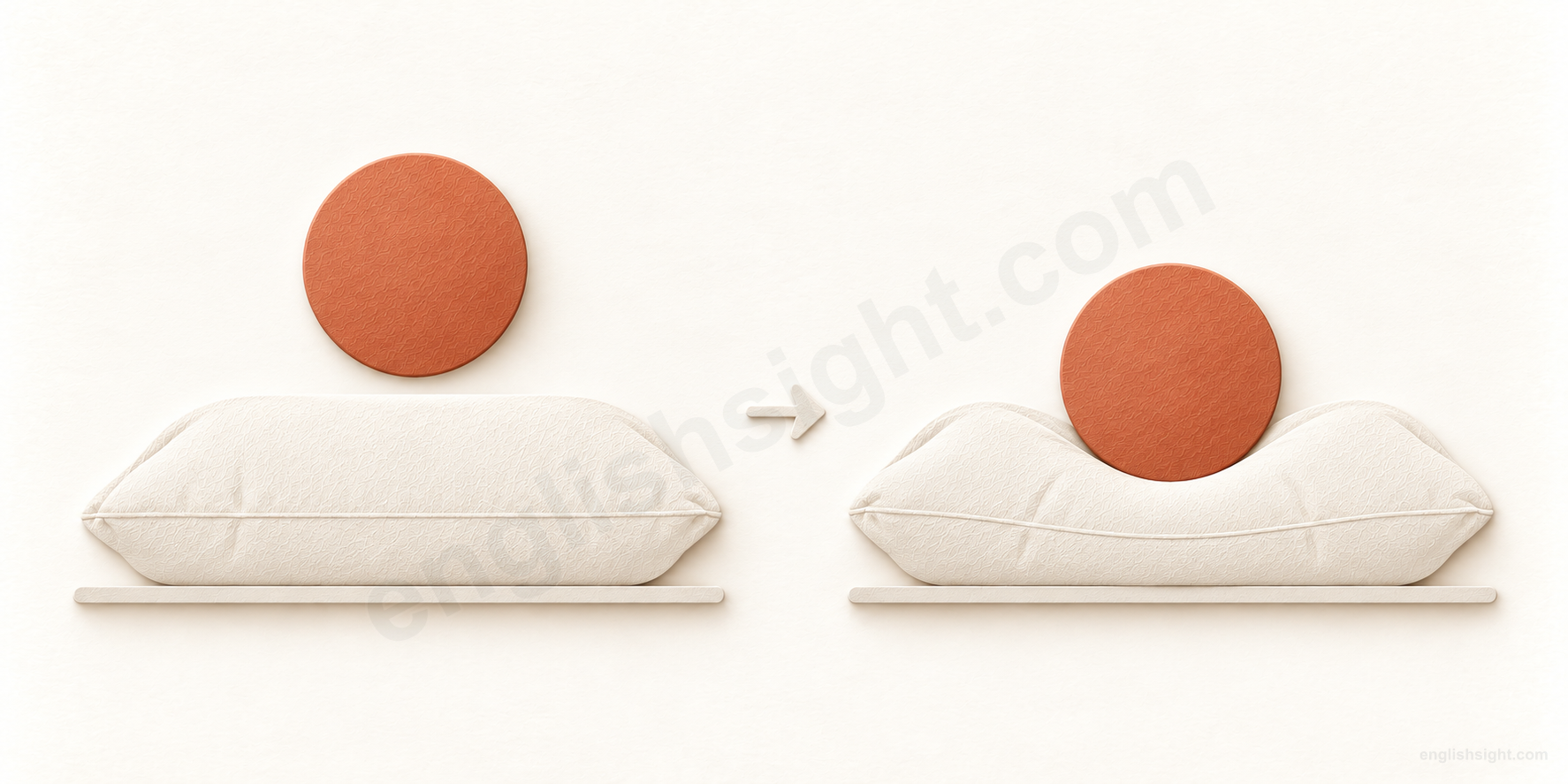
The weight is above the cushion.
soft
The cushion gives way beneath it.
The weight presses down.
Pressure reveals the cushion's softness: its surface gives way under the weight.
A soft material gives way easily when pressure is applied. Many other uses describe less harshness or force; established combinations also need to be learned in context.
The diagram shows a property revealed by pressure, not an object becoming soft. Surface feel, sound, kindness, and category terms are explained separately below.
Press a cushion and its surface gives way. Soft often contrasts with hardness, harshness, or force, but the relevant contrast changes with the thing being described.
This lesson uses that relation as a teaching model. It does not claim that every speaker pictures a cushion, or that every fixed expression can be predicted from one physical meaning.
01
Materials, touch, and change
Start with what resists pressure and what gives way. Then distinguish a yielding object from a pleasant surface, and a condition from a change.
01
soft + noun; be / feel + soft; softer than; the softest
a soft cushion / soft ground
give way rather than resist pressure
Situation / starting point
A weight is about to rest on a cushion.
Meaning in this context
The cushion dips under the weight.
Soft describes the material’s response to pressure.
A soft cushion compresses under you; soft ground lets your feet sink in. This is the physical relation shown in the diagram. Soft metals can be marked or shaped relatively easily, even though they do not feel like cushions. Soft food is easy to bite or chew; this describes its texture, not whether its flavour is mild.
Use soft before a noun or after a linking verb: a soft seat; The seat feels soft. Softer and softest compare degree: This seat is softer than the wooden one. Relative softness depends on what you are comparing.
In a sentence
The ground was so soft that my shoes sank into it.
Watch the difference Soft is not the same as liquid, fragile, or elastic. A soft material need not flow, break, or spring back.
02
soft + skin / hair / cloth / fabric; feel soft
soft skin / a soft cloth
feel gentle and pleasant against the skin
Situation / starting point
You choose a cloth to wipe your glasses.
Meaning in this context
The cloth feels gentle rather than coarse.
Surface feel and resistance to pressure are related but different.
Soft skin, hair, fabric, and a soft cloth describe how contact feels. A cloth may be thin and soft without being a thick cushion. A soft toy combines a gentle outer surface with stuffing that yields when squeezed.
Smooth focuses on an even surface. A polished stone can be smooth yet hard; a fluffy scarf can be soft without having a flat surface. Say The scarf feels soft to describe the scarf, and She touches it softly to describe her action.
In a sentence
This scarf is soft against my neck.
Watch the difference Do not replace every instance of smooth with soft: the words answer different questions about a surface.
03
get / go / become / stay soft; make / keep + object + soft
get soft / go soft / make something soft
become, remain, or cause something to be less firm
Situation / starting point
The butter is too firm to spread.
Meaning in this context
After being left at room temperature, it spreads easily.
The verb supplies change, cause, or continuation; soft names the condition.
The butter is soft describes a state. The butter has gone soft describes a change. Get soft and become soft also mark a change; stay soft and keep something soft concern continuation. Food may become soft through cooking, ripening, or warming, depending on the food.
In make the dough soft, make supplies the cause, the dough is the object, and soft describes the resulting object. Compare Leave the butter out to soften: soften is the related verb. Soft alone is not the ordinary modern verb for this action.
In a sentence
Leave the butter on the counter until it gets soft.
Watch the difference Soft does not always mean fresh or good: a biscuit that has gone soft may have lost its intended crispness.
02
Gentle impressions and small force
With sounds, light, outlines, and contact, ask which kind of intensity is reduced. These uses do not mean the object can be squeezed.
04
a soft voice; soft music; speak softly; a soft-spoken person
a soft voice / soft music
be quiet and gentle in sound
Situation / starting point
People are talking while a baby sleeps.
Meaning in this context
One person lowers their voice.
Sound can have little force without being physically compressible.
A soft voice or soft music is quiet and gentle. Soft describes the sound; softly describes speaking: He spoke softly. The compound soft-spoken describes someone with a quiet, gentle voice, as in a soft-spoken guide.
A low voice can refer to low volume or low pitch. Soft mainly directs attention to a gentle sound, so it does not guarantee a deep voice. Soft-spoken does not by itself mean shy or unwilling to disagree.
In a sentence
She answered in a soft voice so she would not wake the baby.
Watch the difference For a neutral instruction about manner, use Speak softly rather than treating soft as the regular adverb.
05
soft light / lighting; a soft + colour
soft light / soft colours
have a gentle rather than glaring visual effect
Situation / starting point
A room is lit by a harsh overhead lamp.
Meaning in this context
A shaded lamp gives the room a gentler glow.
Here soft concerns visual intensity, not touch.
Soft light and soft colours suggest a less harsh visual effect. A soft blue is a gentle shade; soft lighting can make a room feel restful. The colour expression can include an article because a blue here means a shade of blue.
Dim tells us that there is little light. Soft tells us about its gentle quality, so the two descriptions can overlap without being identical. Likewise, a colour is not called soft because the painted surface can be pressed in.
In a sentence
We chose a soft yellow for the bedroom walls.
Watch the difference Use soft for a visual quality and softly for the manner of lighting: a softly lit room.
06
soft lines / edges; in soft focus; a soft-focus portrait
soft lines / in soft focus
have gentle or less sharply defined edges
Situation / starting point
A portrait shows every edge very sharply.
Meaning in this context
A soft-focus version gives the portrait gentler edges.
A boundary can look less hard without changing the material.
Soft lines may be gently curved; soft edges may be less distinct. In photography, in soft focus describes an image whose edges are deliberately less sharp, often for an attractive effect. It is not a comment about the photograph’s paper.
Compare The face is in sharp focus, where detail is clearly defined. An accidentally blurred picture and a deliberately soft-focus portrait can look similar, but soft focus names a photographic effect rather than explaining every cause of blur.
In a sentence
The photographer showed the flowers in soft focus.
Watch the difference In soft focus is about the image, not whether the flowers feel soft to touch.
07
a soft touch on + body part; a soft breeze
a soft touch / a soft breeze
involve little force or impact
Situation / starting point
You want to attract someone’s attention gently.
Meaning in this context
You touch their shoulder lightly.
Soft may describe the force of contact rather than the object touched.
A soft touch on someone’s shoulder is gentle contact. A soft breeze similarly has little force. Here the contrast is gentle versus forceful, whereas the cushion illustrates low resistance to pressure. These are related teaching comparisons, not the same physical event.
The noun matters: a person who is a soft touch has a separate idiomatic meaning, taught below. Compare The brush is soft, describing its texture, with She brushed the dust away softly, describing her manner.
In a sentence
A soft breeze moved the curtain.
Watch the difference Keep soft touch meaning gentle contact separate from be a soft touch meaning easy to persuade.
03
Feelings, firmness, and easy choices
A soft response may be kind, insufficiently strict, affectionate, or easily influenced. The construction and situation tell you which judgment is intended.
08
have a soft heart; a soft-hearted person
a soft heart
be sympathetic and easily moved by others’ suffering
Situation / starting point
You hear that a neighbour needs help.
Meaning in this context
You feel sympathy and offer support.
Emotional responsiveness is not a physical property of a heart.
A soft heart means a sympathetic disposition. The connection with yielding is a useful metaphor: another person’s trouble affects you. A soft-hearted person may be generous without being unable to make a firm decision.
A compliment about a soft heart differs from a complaint that someone is too soft on rule-breaking. Read the attitude of the speaker rather than treating soft as always praise or always criticism.
In a sentence
My aunt has a soft heart and cannot ignore an animal in need.
Watch the difference Do not interpret a soft heart as a medical description in ordinary conversation.
09
be / go soft on + person / behaviour; be soft with + person
be soft on / with someone
treat someone less strictly than expected
Situation / starting point
A pupil repeatedly arrives late.
Meaning in this context
The teacher imposes no penalty, and a colleague objects.
Soft here judges how firmly someone enforces expectations.
Be soft on someone or something can criticize insufficient strictness: soft on crime concerns a policy response, not affection for crime. Soft with someone can describe how you handle that person. Too soft makes the negative evaluation explicit.
In The coach is soft on late arrivals, on introduces the people or behaviour receiving lenient treatment. It is an adjective followed by a prepositional phrase, not a separable phrasal verb. Compare strict with the players or tough on lateness.
In a sentence
The coach is too soft on players who miss practice.
Watch the difference Soft on a person can also express affection; use the surrounding situation to distinguish the meanings.
10
be soft on + person
be soft on someone
feel affection or romantic attraction
Situation / starting point
Friends notice that Leo pays special attention to Maya.
Meaning in this context
They suspect he is fond of her.
The same on-pattern can describe affection instead of leniency.
In informal use, being soft on someone can mean being fond of or attracted to them. Leo is soft on Maya may be a personal observation about affection; it need not mean he is responsible for disciplining her.
This sense and the leniency sense can overlap when affection affects judgment. For a clear neutral statement of romantic interest, say He is attracted to her. Do not assume that every soft on sentence concerns romance.
In a sentence
Everyone knows Leo is soft on Maya.
Watch the difference On names the person the feelings concern; it does not describe touching or putting something on them.
11
have / have always had + a soft spot for + person / thing
have a soft spot for…
feel a particular fondness for someone or something
Situation / starting point
An old song brings back happy memories.
Meaning in this context
You still feel especially fond of it.
The whole expression names affection, not an actual weak patch.
Have a soft spot for someone or something expresses a special liking. It can concern a friend, a place, animals, food, or a kind of music. Romance is possible with a person but is not required.
Learn the frame have a soft spot for: have carries tense, a belongs before soft spot, and for introduces the person or thing liked. Compare a weak spot in an argument, which is a flaw rather than affection.
In a sentence
I have always had a soft spot for old adventure films.
Watch the difference Use for in this idiom; do not substitute on from be soft on someone.
12
be a soft touch; be no soft touch
be a soft touch
be easily persuaded to help, give, or lend
Situation / starting point
A friend repeatedly asks you for money.
Meaning in this context
They expect you to agree readily.
Here soft touch describes a person’s susceptibility to requests.
Calling someone a soft touch is informal and suggests they are easy to persuade, especially to give or lend money. It can be affectionate, but it can also imply that other people take advantage of them.
A soft touch is a countable description: She is a soft touch; They think we are soft touches. No soft touch means not easy to persuade. This idiom is different from giving someone a soft, gentle touch on the arm.
In a sentence
They think I am a soft touch, but I will not lend them any more money.
Watch the difference Use the article in be a soft touch; do not confuse it with have a soft spot for a particular person.
13
go / get / grow soft; be too soft for + demanding activity
go soft / get soft
lose toughness or readiness to face hardship
Situation / starting point
You used to enjoy long walks in the rain.
Meaning in this context
Now you avoid any discomfort and joke about it.
This is an informal judgment about toughness, not kindness alone.
Someone who says I have gone soft may mean they have become less tough, physically or emotionally. Get soft from inactivity can concern reduced fitness. The context decides whether this is self-mockery, criticism, or a warm response to growing tenderness.
The verb go or get supplies the change; soft supplies the resulting quality. You can say I am going soft about a developing change. That is not an inflected verb called soft, and there is no particle to move around.
In a sentence
I used to camp in any weather, but I think I am getting soft.
Watch the difference Calling someone soft can sound insulting; it does not neutrally describe every person who chooses comfort.
14
take / choose the soft option; a soft life / job
the soft option / a soft life
involve less effort or difficulty, often with disapproval
Situation / starting point
You can solve a problem directly or avoid the demanding part.
Meaning in this context
Someone criticizes the easier choice.
Soft can evaluate how little a choice demands of someone.
The soft option is the less demanding choice, often presented critically. A soft life or soft job similarly suggests comfort or little effort. The phrase describes the speaker’s assessment, not a measured level of difficulty.
Take the soft option means choose it; option supplies the idea of a choice. Compare an easy task, which can simply report low difficulty without implying that you avoided responsibility. Do not use soft as a general replacement for easy in every sentence.
In a sentence
Fixing the problem took work; ignoring it would have been the soft option.
Watch the difference An easy password is not normally called a soft password just because it is easy to remember.
15
be / become a soft target for + attacker / attack
a soft target
be comparatively easy to attack or exploit
Situation / starting point
A small organisation has little protection.
Meaning in this context
Someone sees it as easy to attack.
Soft evaluates vulnerability, not the target’s surface.
A soft target is a person or thing that is easy to attack. The attack may be physical or figurative, such as fraud or hostile criticism. The phrase does not tell us whether an attack has actually happened.
Target supplies the intended object of an attack; soft describes its vulnerability. Compare a soft touch, who is easy to persuade: the two can overlap in a scam, but they do not name the same relation.
In a sentence
The unprotected website became a soft target for hackers.
Watch the difference A soft target is not necessarily a kind person or a person with a soft voice.
04
Learn the whole combination
Some familiar expressions name established categories. Learn their meaning with the noun or preposition; the cushion picture cannot define them all.
16
soft water; the water is soft
soft water
contain little of the mineral content that makes water hard
Situation / starting point
You wash with water that lathers easily.
Meaning in this context
You need relatively little soap.
Soft is an established description of water composition.
Soft water has low levels of the minerals associated with hardness, especially calcium and magnesium. Soap generally lathers more readily in it. This is a separate category sense: water is not classified by whether your fingers can press into it.
Water is normally uncountable here: soft water; The water is soft. Compare a soft drink, a different expression about alcohol. Neither temperature nor whether the water is still or sparkling defines its hardness.
In a sentence
We use less soap here because the water is soft.
Watch the difference Soft water does not mean warm water; hard water is still liquid.
17
a soft drink; soft drinks
a soft drink
a cold non-alcoholic drink
Situation / starting point
A guest wants a cold drink without alcohol.
Meaning in this context
You offer lemonade.
The combination names a drink category.
A soft drink is a cold drink without alcohol, such as lemonade. In many everyday menus it refers especially to drinks such as cola and other sweet drinks. Fizzy texture is common but is not what soft itself means here.
The compound is countable: a soft drink, two soft drinks. This is not the texture sense used in soft cheese, and it is not the mineral-content sense used in soft water. Learn each noun combination as a unit.
In a sentence
Would you like a soft drink, such as lemonade?
Watch the difference Soft does not mean low in sugar, and the expression does not classify a drink by temperature alone.
18
a soft-boiled egg; like + eggs + soft-boiled
a soft-boiled egg
an egg boiled so that its yolk remains soft or runny
Situation / starting point
An egg is cooked briefly in its shell.
Meaning in this context
The yolk has not become firm throughout.
The compound specifies both cooking method and result.
Soft-boiled describes an egg whose yolk remains soft or liquid after boiling. Boiled supplies the method; soft specifies the result. A hard-boiled egg has a firm yolk. This does not mean the eggshell becomes soft.
Use the hyphenated compound before a noun: a soft-boiled egg. You can also say I like my eggs soft-boiled. A soft egg without the full compound is less explicit about how it was cooked.
In a sentence
I ordered a soft-boiled egg with toast.
Watch the difference Do not infer a universal cooking time from the word; size and cooking conditions vary.
19
a soft c / g; c / g is soft
soft c / soft g
the conventional names for particular c and g sounds
Situation / starting point
You compare the letters in city and cat.
Meaning in this context
You identify different sounds for the same letter.
Here soft labels a pronunciation category, not volume.
In elementary English pronunciation, soft c names /s/, as in city, and soft g names /dʒ/, as in gem. Compare hard c /k/ in cat and hard g /ɡ/ in go. The labels concern the sound represented by the letter.
A soft c can be spoken loudly, and a hard c quietly. These are conventional teaching labels rather than a single scientific meaning of soft for every language. Learn the actual sound and example word together.
In a sentence
The c in city is soft, but the c in cat is hard.
Watch the difference A following e or i is a clue, not a rule without exceptions: compare get and give, which have hard g.
20
soft skills; develop / demonstrate soft skills
soft skills
personal abilities used to communicate and work with people
Situation / starting point
A job requires both technical knowledge and teamwork.
Meaning in this context
An applicant describes listening and cooperation.
Soft classifies the kind of skill, not its difficulty.
Soft skills include personal and interpersonal abilities such as listening, communicating, and working with others. In a job discussion, the phrase helps distinguish these from specific technical abilities.
The usual expression is plural: develop your soft skills. A person can have strong soft skills, so soft does not mean weak, unimportant, or easy to learn. The cushion model offers no reliable definition of this workplace term.
In a sentence
The role needs technical knowledge and strong soft skills.
Watch the difference Do not translate the phrase as easy skills; communication can require considerable practice.
21
use the soft sell; a soft-sell approach
the soft sell
persuade customers without an aggressive sales approach
Situation / starting point
A customer is considering a product.
Meaning in this context
The seller gives information without pushing for an immediate decision.
Soft describes the pressure of the selling method.
The soft sell is a sales approach based on persuasion with less overt pressure. Compare the hard sell, an aggressive attempt to make someone buy. Both expressions name methods rather than kinds of merchandise.
Use it as a noun phrase: use the soft sell. Before another noun, soft-sell can modify approach: a soft-sell approach. The expression does not guarantee that an offer is honest or suitable; it describes how it is presented.
In a sentence
The assistant used the soft sell and let us compare the models in our own time.
Watch the difference A low price is not the defining feature of the soft sell.
22
make / achieve / hope for + a soft landing
a soft landing
land gently; in economics, slow down without a recession
Situation / starting point
A spacecraft approaches the surface, or an economy is slowing.
Meaning in this context
The landing avoids damage, or the slowdown avoids a recession.
The phrase has a physical meaning and an established economic extension.
A spacecraft makes a soft landing when it reaches a surface without destructive impact. The surface need not be a cushion. The adjective concerns the manner and result of landing.
In economic discussion, a soft landing is a slowdown that avoids a recession. For example, Economists hope for a soft landing after rapid growth. Landing is a metaphor for the economy’s adjustment; this does not mean that all prices stop changing or that no one faces difficulties.
In a sentence
The spacecraft made a soft landing and sent back its first pictures.
Watch the difference Use the context to distinguish an actual arrival from an economic slowdown.
23
soft power; use / build / exercise soft power
soft power
influence other countries through attraction or persuasion rather than military force
Situation / starting point
A country builds cultural connections abroad.
Meaning in this context
Those connections help shape preferences and cooperation.
Soft names a way of exerting influence, not a lack of influence.
Soft power concerns influence through such means as culture and economic relationships rather than military power. It is a term used in international relations. The contrast concerns the means of influence, not whether the influence is effective.
Power is uncountable in this expression: a country’s soft power; develop soft power. A film festival can illustrate cultural influence, but the phrase does not mean that every cultural event was designed as a government strategy.
In a sentence
The country hopes its films and universities will strengthen its soft power.
Watch the difference Do not read soft power as permission to substitute soft for weak in every use of power.
24
a soft launch of + product / service; soft-launch + object
a soft launch
introduce a product or service gradually, often to a limited audience
Situation / starting point
A service is nearly ready for broad release.
Meaning in this context
It first becomes available to a limited group.
Soft describes the scale or staging of an introduction.
A soft launch introduces a product or service in stages, often to a restricted audience. It can let a team observe early use before a wider release. It is an actual introduction, not merely a private plan to launch later.
Use the countable noun a soft launch, or the compound verb soft-launch a product. Compare The company soft-launched the app last week. The verb belongs to the compound; it does not make soft a general verb meaning release.
In a sentence
We began with a soft launch for existing customers.
Watch the difference A soft launch does not necessarily mean a free launch or an unfinished product.
Choose the relevant contrast
Adjective, adverb, and related verb
Use soft before a noun or after be, feel, look, or become; use softer and softest for comparison. The ordinary manner adverb is softly: She spoke softly. Dictionaries also record adverbial soft in restricted or stylistic use, but it is not the neutral choice everywhere. Soften is the ordinary related verb. Adjective soft itself has no transitive/passive or phrasal-verb paradigm.
Not one universal opposite
A soft mattress contrasts with a hard or firm one; soft fabric with rough fabric; soft light with harsh light; a soft policy with a strict or tough one. Choose the contrast for the intended sense rather than automatically replacing soft with weak.
People and tone
A soft heart can be praise, while too soft with someone can be criticism. Soft in the head is an informal, potentially insulting way to call someone foolish or irrational. Recognise it in context; use more specific, respectful wording in your own descriptions.
Recognition beyond this lesson
Soft prices, a soft market, and soft currencies occur in financial reporting, with weak demand, falling values, or limited convertibility depending on the term. Soft drugs is a conventional, contested category label, not a claim that a substance is harmless or universally legal. Specialist scientific senses and separate words such as software are outside this lesson.
Read the noun and the situation
Choose the expression that conveys the intended relation.
1. The butter was firm but is now easy to spread. Which sentence explicitly reports the change?
2. You want to describe how a guide speaks, using the ordinary manner adverb. Which fits?
3. You are especially fond of old trains. Which familiar expression says this?
4. A menu offers soft drinks. What does soft tell you here?
5. A manager is criticised for ignoring repeated rule-breaking. What does too soft on the staff mean here?
6. An employer asks for strong soft skills. Which interpretation fits?
Sources and teaching notes
Dictionary meanings and constructions were checked against the linked publisher pages. Explanations and examples are original; the visual model is a teaching interpretation, not a claim about the origin of every sense.
The diagram illustrates a relation; it does not represent an identical picture in every speaker’s mind.