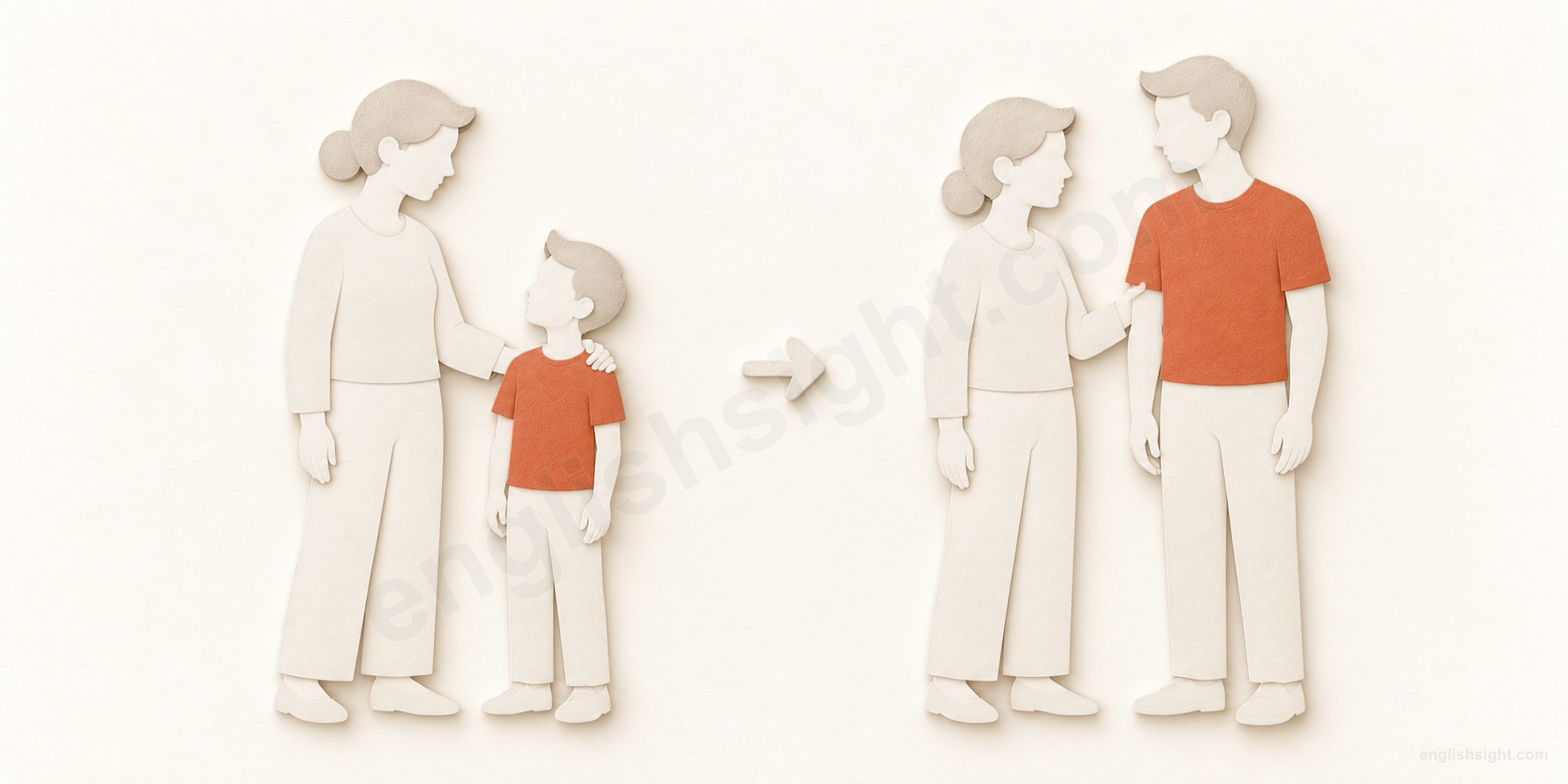
A family relationship that lasts as someone grows.
Use son to relate a male child to a parent, then recognize extensions of that relationship.
The son grows; the relationship remains
The son grows; the relationship remains
A mother stands beside her young son, with her hand on his shoulder.
son
The same mother stands beside her adult son, with her hand on his upper arm.
Time passes, and the same son grows into an adult.
He grows into an adult; he remains her son.
A son is a person’s male child; the parent–son relationship continues when he becomes an adult.
The two stages show age changing while the same family link remains. They do not explain adoption history, legal status or every idiom; those distinctions are described below.
Son tells you how someone is related to a parent. It can describe a baby, a teenager or an adult. Start with the relationship rather than a picture of a small boy.
Other expressions borrow family closeness or origin, or have established meanings of their own. The diagram is a teaching aid, not a claim about an image shared by every English speaker.
01
Family relationships and useful forms
Start with the parent–son relationship, then specify age, family position and the kind of connection.
01
my / your / his / her / our / their + son; have + a son
my son / have a son
a male child in relation to a parent
Situation / relationship
Maya introduces a member of her family.
What the expression tells you
The listener knows that Leo is her child.
Son names a family relationship, not just a boy’s age.
A boy can be somebody’s son; a grown man can too. Boy usually tells us about age, while son identifies a relationship. Child can mean a young person or somebody’s offspring; son specifies the male child.
A mother or a father can say my son. Adopted children are sons too: the word does not by itself specify a biological relationship. Have a son describes family membership, not ownership.
In a sentence
This is my son, Leo.
Watch the difference In an ordinary singular noun phrase use a determiner: my son or a son, rather than I have son.
02
adjective + son; give birth to + a son
a baby son / an adult son / an only son
specify age or position within a family
Situation / relationship
A speaker needs to identify which son she means.
What the expression tells you
An age or family-order description makes the reference clearer.
Being a son continues through adulthood.
Baby son, teenage son, adult son and grown-up son add age information. Have a son can describe an existing family relationship; in a birth announcement, had a son can report the arrival of a baby. Give birth to a son explicitly describes birth.
Eldest son and oldest son identify the oldest of the sons, not necessarily the oldest of all the children. Youngest son identifies the youngest male child. An only son has no brothers but may have sisters; an only child has no siblings.
In a sentence
Her only son is forty, and she also has two daughters.
Watch the difference Only son does not mean only child. Son is not restricted to a small boy.
03
be + somebody’s son; the son of + person; a son of + possessive pronoun
the son of… / a son of mine
identify a parent or present one of someone’s sons
Situation / relationship
You explain how Daniel is related to Anna.
What the expression tells you
Anna is identified as his parent.
Of points back to the parent; it does not describe something the son owns.
Daniel is Anna’s son and Daniel is the son of Anna express the same relationship. The son of a teacher describes his family background; it does not tell us Daniel’s own job.
A son of mine uses a possessive pronoun after of, as in a friend of mine. It commonly presents one of my sons, without making an exact claim about how many I have. Say a son of mine, not a son of me.
In a sentence
A son of mine works at the hospital.
Watch the difference Son of a doctor does not mean a doctor’s assistant, and it does not make the son a doctor.
04
son → sons; son’s + noun; sons’ + noun
sons / son’s / sons’
distinguish number from possession
Situation / relationship
You write about one son or several sons and their belongings.
What the expression tells you
The plural ending and apostrophe identify the intended relationship.
Sons counts people; an apostrophe marks a possessive phrase.
One son becomes two sons. My son’s room belongs to or is used by one son; my sons’ room can be shared by several sons. Compare My son’s asleep: here ’s is short for is, not a possessive.
Son is pronounced /sʌn/, just like sun in standard British and American pronunciation. Context and spelling distinguish the family word from the star. The final sound in sons is /z/.
In a sentence
I painted my sons’ room while the two boys were at school.
Watch the difference Use sons without an apostrophe when you simply mean more than one son.
distinguish adoption, a partner’s child, and marriage into a family
Situation / relationship
Several different family connections need accurate names.
What the expression tells you
The chosen word tells us which connection is relevant.
The added word or compound changes what relationship is specified.
An adopted son is a son through adoption. A stepson is a male child your spouse or partner has from an earlier relationship with someone else. These descriptions concern different relationships; a family may simply say son when no distinction is needed.
A son-in-law is the husband of your child, whether your child is a daughter or a son. The plural is sons-in-law. He is not your grandson: grandson means your child’s son.
On a business sign, a name such as Patel & Sons suggests a family business involving sons. The business name is not an apostrophe form, and it need not describe the company’s current ownership.
In a sentence
Our son-in-law and our daughter are coming for lunch.
Watch the difference A son-in-law is related through marriage; a stepson is your partner’s son from an earlier relationship.
02
Closeness, address and belonging
A family word can express affection or a connection to a place. Context tells you whether the relationship is literal.
06
be + like a son + to + person; treat + person + as a son
be like a son to someone
have the emotional closeness of a parent and son
Situation / relationship
An older person describes someone they care for deeply.
What the expression tells you
A family comparison expresses affection without asserting parenthood.
Like marks resemblance; to names the person who feels that relationship.
He is like a son to me describes closeness comparable to a parent–son bond. The person need not be a biological, adopted or legal son.
Compare He is my son, which asserts a family relationship. Treat him as a son describes how someone behaves toward him; it does not itself establish legal adoption.
In a sentence
Omar is like a son to us.
Watch the difference Keep to in like a son to me; the comparison alone does not prove a legal relationship.
07
sentence + comma + son; my son as direct address
“Come in, son.” / “my son”
address a boy or younger man familiarly
Situation / relationship
An older speaker talks directly to a younger male.
What the expression tells you
Son works as an address rather than a report about a family tree.
An address can borrow a family relationship without asserting it.
A parent may address their own child as son. An older person may also use it familiarly to a younger boy or man who is not related. Tone and the relationship matter: it can sound warm or patronizing, so a name is often the safer neutral choice.
Write a comma with direct address: Come in, son. Compare My son came in, where son is part of the subject. In a religious setting, a priest may address a male as my son; this is a formal spiritual role, not a claim of biological fatherhood.
In a sentence
“Take your time, son,” the older man said.
Watch the difference Do not assume that someone addressed as son must be the speaker’s child.
08
a native son of + place; a son of + place / background
a native son / a son of…
a man associated with his place or formative background
Situation / relationship
A newspaper introduces a musician’s connection to a town.
What the expression tells you
The man is presented as belonging to or coming from that place.
A place takes the figurative role of a parent or origin.
A town’s famous son is a man who comes from that town. A native son emphasizes local origin. This use belongs especially to journalism or literary description, rather than every casual introduction.
The place or background replaces the literal parent in the relationship. The expression does not mean the town gave birth physically, nor does famous son necessarily mean the man is young.
In a sentence
The exhibition celebrates a famous son of the town.
Watch the difference For neutral everyday information, He comes from this town is often simpler.
09
place’s + favourite / favorite son; a favourite / favorite son
a favourite son / a favorite son
a locally celebrated person, or a locally backed US presidential candidate
Situation / relationship
A headline emphasizes local pride or political support.
What the expression tells you
The expression marks a particular connection with a home area.
This set expression has public meanings beyond a parent’s preference.
A place’s favourite son can be a successful public figure admired where they were born. In American spelling, write favorite son. In US election reporting, it can mean a presidential candidate initially supported by their own state.
Context matters: her favourite son in a family discussion may literally mean the son she prefers. The public expression does not always mean that a parent favors one child. The political use is useful for recognition, not a general synonym for any popular politician.
In a sentence
The paper called the returning athlete the city’s favourite son.
Watch the difference Check whether the context is family preference, local pride or a US election.
03
Generations, resemblance and return
These established sayings and allusions add meanings that son alone does not supply.
10
pass / hand down + something + from father to son
from father to son
pass something through successive family generations
Situation / relationship
A family craft is taught to the next generation.
What the expression tells you
The skill continues beyond its previous holder.
From…to… gives the direction of transmission; son supplies the family link.
From father to son describes transmission down a family line. A story, trade or skill can be handed down or passed down this way. In a particular sentence it may refer to a real father and his son; more broadly it can summarize continuity across generations.
The phrase names a male family line. It does not mean that only men can inherit or learn. From one generation to the next is a broader alternative when no male line is intended.
In a sentence
The carving technique was passed from father to son.
Watch the difference There is no article in the fixed phrase from father to son.
11
Like father, like son.
Like father, like son.
comment that a son resembles his father in character or behavior
Situation / relationship
A father and his son show the same habit.
What the expression tells you
A familiar saying draws attention to the similarity.
The saying compares two people rather than defining every son.
This proverb can comment on a shared habit, attitude or behavior. The remark may be affectionate, amused or critical, depending on what the two people are doing.
The meaning belongs to the whole saying. It does not assert that every father and son are alike, or explain whether the similarity comes from learning or biology.
In a sentence
They both keep lists for everything—like father, like son.
Watch the difference Like means similar here; it is not the verb meaning enjoy.
12
the / a + prodigal son; the prodigal son + return
the prodigal son
a person who returns after leaving and behaving wastefully or unwisely
Situation / relationship
Someone leaves home, wastes their resources, then comes back sorry.
What the expression tells you
The return can be described through a familiar story of forgiveness.
The story supplies the departure, regret and return; son alone does not.
The expression refers to a biblical story in which a son wastes his inheritance and is welcomed back by his father. In wider use, it can describe a person returning after a period of foolish behavior or estrangement.
It may be used humorously about a return, even without every detail of the story. Prodigal means wasteful, not talented: do not confuse a prodigal son with a child prodigy, who has exceptional ability.
In a sentence
After wasting his savings abroad, he returned home as the prodigal son.
Watch the difference This is an allusion, not a literal description of every son who travels away.
04
Religious titles and informal expressions
Recognize specific cultural references and registers before choosing an expression for yourself.
13
the Son; the Son of God
the Son
Jesus Christ in Christian teaching about the Trinity
Situation / relationship
A text names the Father, the Son and the Holy Spirit.
What the expression tells you
Son has a specific religious reference.
Capitalization and religious context distinguish a title from an ordinary family noun.
In Christian language, the Son refers to Jesus Christ as one of the three persons of the Trinity. This is a religious title; it is not the ordinary expression for a person’s male child.
The Son of God is another familiar Christian title for Jesus. In a different context, the son of a farmer remains an ordinary family description. A capital S is meaningful in the religious title, but capital letters also appear at the start of sentences.
In a sentence
The painting shows symbols of the Father, the Son and the Holy Spirit.
Watch the difference A priest saying my son is an address; the Son is a title with a different reference.
14
Well, son of a gun!; a son of a gun; you old son of a gun
son of a gun
an informal expression of surprise, annoyance or familiar admiration
Situation / relationship
A speaker reacts strongly or uses an old-fashioned friendly address.
What the expression tells you
The full expression carries the attitude rather than literal kinship.
Learn the whole phrase; a gun is not being described as a parent.
Especially in North American informal speech, Well, son of a gun! can express surprise or annoyance. Calling a troublesome person or thing a son of a gun can convey irritation: This son of a gun won’t start could refer to a machine.
An older-fashioned friendly use occurs in You old son of a gun! addressed to a man the speaker likes. These are context-dependent uses of one expression, not a neutral family label.
In a sentence
Well, son of a gun! I didn’t expect to win.
Watch the difference Do not interpret son of literally, and do not use this as a general term of address for strangers.
15
call + person + a son of a bitch; SOB
son of a bitch / SOB
a strong offensive insult for a disliked person
Situation / relationship
A film character uses an angry insult.
What the expression tells you
The listener recognizes hostile language rather than a family statement.
The insult is fixed; it does not give factual information about someone’s mother.
Son of a bitch is taboo, offensive slang for someone the speaker regards as very unpleasant. SOB is a written abbreviation, particularly associated with North American English.
This entry is for understanding dialogue. It is not a friendly equivalent of son and should not be used as a polite way to describe a person. A neutral report such as He insulted the driver avoids repeating the insult.
In a sentence
In the film, the furious passenger calls the driver a son of a bitch.
Watch the difference Recognizing this expression does not make it suitable for ordinary polite conversation.
Keep relationship, age and register separate
Son is a countable noun
Use a son, my son, the son or sons as the sentence requires. This noun has no verb tense, passive, causative or particle-verb family to learn. The surrounding verb supplies an action: raise a son, visit a son or have a son.
A relationship word is not an age label
An adult may still be someone’s son. A man may be a father and a son at the same time, in relation to different people. Son, brother and grandson identify different family links.
A family connection does not specify biology
Son includes adopted sons. Add biological or adopted only when that distinction matters. Family members may also choose son instead of a more specific compound in everyday conversation.
Scope and the illustration
This lesson covers modern family usage, useful constructions, major extensions and selected fixed expressions. Ancient lineage uses, specialist theology and historical terminology are not expanded. The diagram shows a continuing parent–son relationship as the son grows; the fixed expressions need their own explanations.
Choose the relationship
Read the whole expression and its situation.
1. Nina’s male child is now forty-five. Which sentence can still be true?
2. A mother has one son and two daughters. Which description is accurate?
3. Your child marries Alex, a man. What is Alex in relation to you?
4. Two sons share a bedroom. Which phrase identifies it as their room?
5. An older shopkeeper says “Can I help you, son?” to a young customer. What can you infer?
6. A father and his son both arrive early and carefully check every detail. What does “Like father, like son” comment on?
Sources and teaching notes
Dictionary entries were consulted for meanings, constructions and register. Explanations, examples and the teaching diagram were created for this lesson. The visual model is a teaching interpretation.
The diagram illustrates one relationship; it is not a universal mental picture.